THEY TOLD HER TO LEAVE THE DYING DRAGON IN THE SNOW—SHE DRAGGED HIM DOWN THE MOUNTAIN AND DISCOVERED WHO HE REALLY WAS
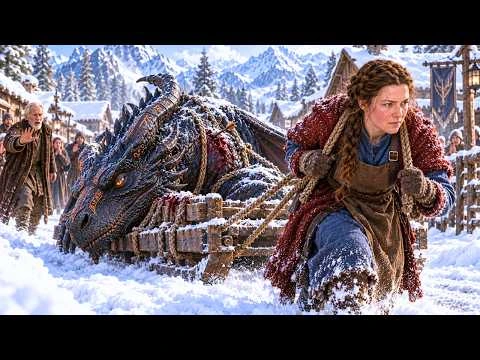
THEY TOLD HER TO LEAVE THE DYING DRAGON IN THE SNOW—SHE DRAGGED HIM DOWN THE MOUNTAIN AND DISCOVERED WHO HE REALLY WAS 🐉❄️
Part 1
The dragon was bleeding to death across the only road out of Delia Holloway’s village when the elders told her to leave him there.
Snow was already collecting across his black wings.
Blood had turned the white ground dark beneath one shoulder.
And the storm coming over the mountain would close the road within an hour.
Elder Fenwick stood thirty paces away, refusing to come any closer.
“Leave it.”
Delia looked at him.
“Leave it?”
“The decree is clear. No unauthorized contact with dragons.”
Behind him, two other elders nodded.
Neither looked comfortable.
Neither moved toward the dying creature.
Delia tightened her gloves.
“I run this road every night.”
“Then take the eastern pass.”
“It’ll be buried before I reach it.”
“That is unfortunate.”
Delia stared at him.
“So is bleeding to death in the snow.”
Fenwick lowered his voice.
“This is imperial business.”
Delia turned back toward the dragon.
He was enormous.
Far larger than anything her father’s old firewood sled had ever carried.
His breathing was shallow.
One wing lay twisted across the road.
And buried near the shoulder joint was a crossbow bolt.
Not a hunting arrow.
A military one.
Delia did not yet know that the creature dying in front of her was Emperor Kestrel himself.
Hours earlier, Kestrel had been flying alone along the border.
He had deliberately left his escort behind because tensions with a rival house had been worsening for months.
A visible military flight might have provoked the confrontation he was trying to avoid.
Instead, marksmen waited along a ridge his maps incorrectly marked as friendly territory.
The bolt struck exactly where dragon armor was weakest.
At the shoulder joint.
Kestrel escaped the ambush.
Barely.
He flew until blood loss turned the world beneath him into blurred white and black shapes.
When he saw village lights below, he used his last strength to choose what looked like flat ground.
He crashed across Delia’s road.
Now the emperor lay unconscious while three generations of village law instructed everyone to pretend they had not seen him.
Fenwick tried again.
“The prohibition exists for a reason.”
“What reason?”
“There was an incident.”
“Three generations ago.”
“Yes.”
“What happened?”
Fenwick hesitated.
Delia noticed.
“You don’t actually know.”
“We know enough.”
“No. We know the story people kept telling afterward.”
She pointed toward the dragon.
“I know what is happening now.”
Fenwick’s expression hardened.
“And what exactly do you intend to do?”
Delia looked toward her father’s house.
Then back toward the road.
“I’m getting the sled.”
“You cannot be serious.”
“I am not stepping around a dying creature because an old decree finds his dying inconvenient.”
Fenwick followed her halfway up the path.
“Your father would have told you to think before doing something reckless.”
Delia almost laughed.
“My father pulled a neighbor’s ox out of a flooded crossing during a storm worse than this one.”
“That was different.”
“No.”
She kept walking.
“He simply did the thinking while already moving.”
Her father had run the mountain delivery route for thirty years.
Firewood.
Grain.
Medicine.
Tools.
Anything the valley needed.
Two years earlier, his hands finally became too stiff to manage the ropes.
He died that same winter.
Delia inherited the sled and the route.
She also inherited his rule:
A load in trouble gets helped before anyone argues about whose responsibility it is.
Forty minutes later, Delia returned with rope, blankets and her father’s reinforced sled.
The elders watched from a distance.
Nobody helped.
Getting the dragon onto the sled took nearly an hour.
Delia used ropes.
Leverage.
Wooden blocks.
Every practical trick she had learned after two years of hauling impossible loads alone.
Halfway through, the dragon stirred.
One golden eye opened.
“You should not…”
His voice was barely audible.
Delia froze.
“…be doing this.”
She looked at him.
The intelligence in that eye told her immediately this was no wild creature.
“My escort will find me.”
“You’ll freeze before they do.”
“You risk your standing for a stranger’s crisis.”
Delia pulled another rope tight.
“You’re not a stranger’s crisis.”
She secured the knot.
“You’re a body bleeding on my road.”
Kestrel’s eye remained on her.
“And I have exactly one sled, one usable route, and no better plan.”
A faint sound came from the dragon.
Almost a laugh.
Then his eye closed.
Delia wrapped blankets around the wound.
Checked the lashings twice.
Then began the descent.
The first switchback nearly defeated her.
The sled was built for grain sacks.
Not dragons.
Every downhill grade tried to pull it away from her.
Every patch of black ice threatened to turn the entire load sideways.
Delia worked the brake rope until her palms burned beneath her gloves.
“Stay together,” she muttered toward Kestrel.
“I don’t know what that means for a dragon, but do it anyway.”
At the second switchback, the rear runner caught a buried root.
The entire sled lurched.
For one horrifying second, Kestrel’s weight began sliding toward the unguarded drop.
Delia threw herself against the high side.
Her shoulder screamed.
The sled shifted another inch.
Below her was darkness.
She pushed harder.
“Not tonight.”
The runner caught.
The sled slammed back onto the road.
Delia stood shaking.
Then looked at the unconscious emperor.
“That was far too close.”
She grabbed the ropes.
“And we are never doing it again.”
Farther down, people had already heard what she was doing.
At one waypoint, old Merin shouted:
“Delia Holloway! Have you completely lost your senses?”
“Possibly.”
“You’re hauling a dragon emperor through a snowstorm on your father’s firewood sled!”
Delia did not stop.
“My father would call this Tuesday.”
The objections followed her down the mountain.
Only one man did not lecture her.
Oscar, an old trapper who had known Delia’s father for twenty years, stepped silently from his cabin.
He handed her dry kindling.
Then a skin of something warm.
No speech.
No warning.
Just help.
“Thank you, Oscar.”
He nodded once.
That small kindness steadied her more than all the shouting had shaken her.
By the time Delia reached the valley, full darkness had fallen.
Snow drove sideways.
Kestrel’s breathing had become dangerously shallow.
The valley town had no ancient dragon decree.
People ran toward the sled.
A healer arrived.
Then assistants.
A proper stretcher appeared.
The town’s head healer stared at Delia.
“You brought him down the mountain on that?”
Delia looked at her father’s battered sled.
“Yes.”
“Alone?”
“Yes.”
“In this storm?”
“Yes.”
The healer shook her head.
“You mountain people have a strange relationship with survival.”
Then she turned toward Kestrel.
“Inside. Now.”
Delia remained near the fire while healers worked.
Hours passed.
Her shoulders began hurting now that she had stopped moving.
Her hands trembled.
Someone offered her a bed.
She refused.
“I’ll sleep when I know the hauling worked.”
Past midnight, a voice came from across the room.
“You stayed.”
Delia looked up.
Kestrel was awake.
Weak.
Bandaged.
But alive.
“You sound surprised.”
“I have been protected by soldiers.”
His golden eyes held hers.
“Physicians. Guards. People sworn to keep me alive.”
He paused.
“I do not think anyone has ever protected me simply because leaving me to die offended their sense of what was acceptable.”
Delia gave him a tired look.
“I wouldn’t overthink it.”
“I am emperor. Overthinking is most of the profession.”
That finally made her smile.
The healer entered.
“He’ll live.”
Delia released a breath she had been holding since the mountain road.
Then Kestrel asked:
“What exactly did your elders say when you found me?”
Delia told him.
About the decree.
About Fenwick.
About the warnings.
About the rule against helping him.
Kestrel listened without interruption.
When she finished, his expression had changed completely.
“That law nearly killed me.”
“It nearly did.”
“And you would break it again?”
Delia answered without hesitation.
“Tomorrow.”
Kestrel stared at her.
“Under the same circumstances?”
“Every time.”
For the first time that night, the emperor smiled.
“Good.”
Delia frowned.
“Good?”
Because Kestrel had already decided that when he returned to his throne, one of the oldest laws in her village was going to fall—
and Delia Holloway was about to discover that the dragon she saved intended to come back for her.
👉 Find Part 2 in the comments—or leave ANY WORD and I’ll send it to you privately.
Part 2
and Delia Holloway was about to discover that the dragon she saved intended to come back for her.
Kestrel’s escort reached the valley before dawn. Soldiers filled the street, horrified to discover their wounded emperor alive in a healer’s house because one village woman had ignored an imperial prohibition.
Delia expected that to be the end of it.
It wasn’t.
Weeks later, after his wound had healed enough for him to fly again, Kestrel summoned council scholars and ordered them to find the original decree.
The law dated back three generations.
Its origin was real: a disastrous encounter between frightened villagers and an injured dragon had ended in several deaths.
But over decades, a narrow safety rule had become absolute.
No contact.
No exceptions.
Not even to save a dying creature.
Kestrel read the wording twice.
Then said:
“A law that required Delia Holloway to watch me die for fear of punishment is badly written.”
The council objected.
Tradition.
Precedent.
Safety.
Kestrel listened.
Then revised it anyway.
Unauthorized interference with dragons remained restricted—but emergency aid intended to preserve life was expressly protected.
No future villager would be forced to choose between obedience and leaving someone to die.
When spring began touching the mountain, Kestrel returned personally.
His arrival sent Delia’s entire village into panic.
Fenwick came outside wearing his ceremonial coat.
The same man who had told Delia to leave the dragon now bowed before him.
Kestrel handed him the revised decree.
Then addressed everyone.
“The rule you defended nearly cost me my life.”
Nobody moved.
“But I did not come here to shame you.”
He turned toward Delia.
“I came to explain why the woman who broke your rule was right to do so.”
Fenwick lowered his eyes.
Kestrel continued:
“Delia did not know who I was when she helped me.”
Delia raised an eyebrow.
“You told me ‘majesty’ halfway through.”
A few villagers laughed nervously.
Kestrel smiled.
“By then you had already decided to help.”
“That’s true.”
“And that is the distinction.”
His expression became serious.
“I have spent my life surrounded by people obligated to preserve me.”
He looked at Delia.
“She had no obligation.”
Silence.
“She did the arithmetic of a difficult choice and decided a life mattered more than convenient obedience.”
Fenwick looked toward Delia.
Something changed in the old man’s face.
Not embarrassment.
Recognition.
After the gathering, Kestrel remained.
Delia expected him to return to the capital.
Instead, he asked to walk the road.
“The road?”
“The one you dragged me down.”
“You want to see it voluntarily?”
“Yes.”
Delia stared at him.
“You emperors have very strange hobbies.”
They walked until they reached the first switchback.
Kestrel looked over the unguarded edge.
“You brought a full-grown dragon around this?”
“Very slowly.”
“On a firewood sled.”
“It was the only sled I had.”
He looked at her.
Then laughed.
It was the first time Delia heard him laugh without pain beneath it.
Near sunset, they reached the place where the runner had caught the buried root.
Kestrel stopped.
“This is where we almost went over?”
“Yes.”
“And you still continued?”
Delia shrugged.
“Going back uphill seemed worse.”
He studied her.
“You reduce extraordinary decisions to very ordinary language.”
“It keeps people from becoming insufferable about them.”
“Do you consider me insufferable?”
“Occasionally.”
Kestrel smiled.
Then his expression softened.
“Delia.”
Something in his voice made her stop.
“I came back for more than the decree.”
She stared at him.
Kestrel looked down the road where she had once dragged his dying body through the snow.
“I think I began falling in love with you somewhere between the second switchback and the moment you told me not to overthink being saved.”
Delia forgot every clever answer she had ever possessed.
And Kestrel, seeing her silence, added quietly:
“I have faced crossbows with less fear than I feel waiting for your answer.”
👉 LIKE and COMMENT “SLED” if you want Part 3. Once I receive enough comments, I’ll post Part 3.
Part 3
“I have faced crossbows with less fear than I feel waiting for your answer.”
Delia stared at the emperor.
Wind moved through the pines.
Melting snow dripped from the branches.
Somewhere farther down the mountain, water ran beneath thinning ice.
For several seconds she could think of absolutely nothing useful to say.
That irritated her.
Delia Holloway could calculate the braking pressure of a loaded sled on black ice.
She could repair a cracked runner in darkness.
She could tell by the sky whether a storm would close the eastern pass.
But apparently one dragon emperor admitting he had fallen in love with her could reduce her mind to empty space.
Finally she said:
“That seems medically unwise.”
Kestrel blinked.
“What?”
“You nearly died the first time you met me.”
A smile started at the corner of his mouth.
“And your conclusion is that falling in love with me is a continuation of poor judgment?”
“I am simply noting a pattern.”
Kestrel laughed.
Then Delia did too.
The tension broke.
But when the laughter faded, the seriousness remained.
Delia looked at him.
“You barely know me.”
“I know you pulled an injured creature twice your house’s size onto a sled while everyone you trusted told you not to.”
“That is one evening.”
“I know you refused to leave the healer’s house until you knew I would live.”
“One long evening.”
“I know you speak about your father as though you are still arguing with him every day.”
Delia’s face softened.
Kestrel continued.
“I know you dislike ceremony, flattery, badly written laws and anyone who wastes time when there is practical work to be done.”
“That is disturbingly accurate.”
“I know you are kind without being sentimental about your kindness.”
He stepped closer.
“And I know that, after a lifetime surrounded by people whose concern for me is tied to my office, I have never forgotten the woman who saw neither emperor nor political consequence.”
His eyes held hers.
“You saw something bleeding on your road.”
Delia looked away toward the valley.
“That still doesn’t mean you should marry the first person who refuses to let you freeze.”
“I did not say marriage.”
“You are an emperor. Your face did.”
Kestrel’s expression betrayed him.
Delia sighed.
“Oh, gods.”
“I was intending a slower progression.”
“Were you?”
“Yes.”
“You revised three generations of imperial law and personally rode into my village.”
“That was government.”
“You asked to walk the exact road where I dragged you half dead.”
“Historical interest.”
“You’re terrible at pretending.”
“I have people who usually do that for me.”
She laughed again.
Then became quiet.
“I don’t know how to be part of your world.”
Kestrel’s answer came immediately.
“I am not asking you to become good at court.”
“You say that now.”
“I mean it now.”
“Palaces change people.”
“So do mountain roads.”
That made her look at him.
Kestrel touched the scar near his shoulder where the bolt had entered.
“I know.”
They did not become engaged that afternoon.
Delia would later be grateful for that.
Instead, Kestrel returned to the capital.
Then returned to the village.
Again.
And again.
Sometimes in human form.
Sometimes as a dragon circling above the mountain before landing well outside the sheep fields after one disastrous visit caused every animal within a mile to panic.
Delia continued running deliveries.
Kestrel continued ruling an empire.
Their worlds did not merge cleanly.
They collided.
The first time Delia visited the imperial palace, a servant tried to take off her muddy boots.
Delia stepped backward.
“What are you doing?”
“Preparing you for court, my lady.”
“They’re my boots.”
“Yes.”
“Then why are you touching them?”
The servant looked terrified.
Kestrel, watching from the doorway, said:
“Leave the boots.”
The servant fled.
Delia turned toward him.
“I made her uncomfortable.”
“You made most of my court uncomfortable before lunch.”
“Good.”
Kestrel smiled.
“That is becoming one of my favorite things about you.”
Delia learned court slowly.
Not submission.
Navigation.
She refused jeweled gowns that prevented her from walking naturally.
She learned which ministers actually understood mountain roads and which only understood maps.
She asked questions people considered embarrassingly practical.
“How long does grain sit at the northern checkpoint?”
No one knew.
“Then why are you debating grain tariffs without knowing how much spoils before reaching market?”
Silence.
Kestrel leaned back in his chair.
One minister muttered:
“This is not usually how these meetings are conducted.”
Delia answered:
“Perhaps that is why nobody knew.”
Kestrel hid a smile behind his hand.
The more time she spent near government, the more she understood the problem represented by the old dragon decree.
It had not been written by fools.
That almost made it more dangerous.
It had begun as a response to real tragedy.
People were hurt.
Officials wanted to prevent repetition.
So they wrote a rule.
Then the people who inherited the rule inherited the fear but not the circumstances.
Eventually obedience became easier than judgment.
Fenwick came to understand that too.
At first, he avoided Delia.
Not because he remained angry.
Because he was ashamed.
Months after the rescue, he found her repairing harness straps outside her house.
“May I sit?”
“It is a public bench.”
“That isn’t what I asked.”
Delia looked at him.
Then moved her tools aside.
Fenwick sat.
For a long time he said nothing.
Finally:
“I was wrong.”
Delia continued threading leather.
“I know.”
He almost smiled.
“I had prepared a much longer apology.”
“You may still give it.”
Fenwick looked down the road.
“I defended the decree because it gave us certainty.”
Delia’s hands slowed.
“My entire life, whenever someone asked what to do about dragons, the answer already existed.”
He swallowed.
“No contact. No involvement. No responsibility.”
Delia said nothing.
“The night Kestrel fell, I saw that the answer was wrong.”
Fenwick’s voice dropped.
“But admitting that meant the decision became ours.”
He looked toward her.
“If we left him and he died, we could no longer blame a rule.”
Delia finally stopped working.
“That frightened you.”
“Yes.”
The admission was bare.
Honest.
“I think sometimes people defend rules not because the rules are right, but because rules allow them to avoid owning what happens afterward.”
Delia considered that.
Then nodded.
“That sounds true.”
Fenwick exhaled.
“I am sorry.”
This time Delia answered differently.
“I know.”
By winter, the revised law had already been tested.
A young courier encountered an injured juvenile dragon near a forestry station.
Instead of fleeing, the courier summoned help.
The dragon survived.
Nobody was punished.
When Kestrel told Delia, she smiled.
“One decent line of law.”
“One?”
“You have an entire empire. Don’t become proud.”
“Again, people usually handle my pride for me.”
“Poorly.”
Their wedding came the following spring.
Not at the palace.
Kestrel offered.
Delia refused.
“Too many stairs.”
“That is your objection to the imperial palace?”
“It is among them.”
Instead, they married at the valley’s edge.
The exact place where Delia’s brutal descent had finally ended.
The village came.
The valley healers came.
Oscar the trapper appeared in the same coat he had worn the night of the storm and handed Delia a bundle of dry kindling as a wedding gift.
She laughed so hard she nearly cried.
“You have an extremely consistent sense of humor, Oscar.”
He nodded.
Still hardly speaking.
The imperial court arrived too.
Some nobles looked horrified by the mud.
Delia considered this an unexpected bonus.
And in the village square stood the sled.
Her father’s sled.
Kestrel had secretly ordered imperial craftsmen to repair and reinforce it.
But Delia had insisted they leave the old scratches.
Especially the damaged rear runner.
“That nearly killed us,” Kestrel said.
“Exactly.”
“Why preserve it?”
“So you don’t become romantic about the descent.”
The sled became part of the ceremony.
Not as a royal relic.
As evidence.
A wooden reminder of one night when practical kindness outweighed inherited fear.
Before the vows, Elder Fenwick stepped forward.
He had asked permission to speak.
Delia had reluctantly agreed.
“I counseled this woman toward caution,” he began.
Several villagers smiled.
“She ignored me.”
More smiles.
Fenwick looked toward Delia.
“She was right.”
The old man paused.
“I spent months asking why I defended the decree so strongly.”
He looked around at the villagers.
“I once believed it was wisdom.”
His voice grew quieter.
“It was partly fear.”
No one moved.
“The rule allowed us to avoid hard choices by pretending the choice had already been made.”
Delia felt her throat tighten.
Fenwick continued.
“But Delia stood on a road with a dying stranger in front of her.”
He looked toward Kestrel.
“She did not have the comfort of abstraction.”
Then toward Delia.
“I am glad you chose the harder path instead of the easier one I offered.”
Delia stepped forward.
She hugged him.
Fenwick clearly had not expected that.
Neither had she.
When she moved back, his eyes were wet.
“Don’t make this dramatic,” she murmured.
“You are marrying a dragon emperor beside a legendary sled.”
“Fair point.”
Kestrel heard and laughed.
Their vows were simple.
Kestrel promised that his title would never become an argument used to silence her.
Delia promised that when he became insufferable, she would tell him.
Several ministers looked alarmed.
Kestrel said:
“She has already been practicing.”
Then they married.
There was no miraculous transformation afterward.
Delia did not stop missing the quiet of her village simply because she became empress.
Kestrel did not stop being emperor simply because he had learned that laws could be wrong.
They argued.
Often.
Once over whether a mountain road budget was sufficient.
Another time because Kestrel sent six guards with Delia on a journey she had planned to make with one horse.
“Six?”
“You are empress.”
“I survived before becoming empress.”
“I am aware.”
“Then remove five.”
“Two.”
“One.”
“Two.”
“One and a half.”
“How does one employ half a guard?”
“That is your problem. You are emperor.”
They settled on two.
Marriage, Delia discovered, involved many negotiations of approximately this quality.
But they also changed each other.
Kestrel visited villages he once knew only as marks on maps.
Delia learned how difficult governing became when every solution harmed someone.
He taught her diplomacy.
She taught him that maps lied by omission.
A road marked “open” could still be impossible in winter.
A regulation marked “protective” could still abandon someone in an emergency.
A village marked “loyal” could still be frightened.
Years later, Kestrel brought Delia the original version of the old decree.
The document had been removed from active law and placed in the imperial archive.
She read it slowly.
No unauthorized contact with dragons.
No exceptions.
Delia shook her head.
“So much trouble from so few words.”
“That is often how law works.”
“You admit this?”
“Only in private.”
She returned the parchment.
“Burn it?”
Kestrel shook his head.
“No.”
“Why?”
“Because forgetting a bad law makes it easier to write the same one again.”
Delia considered him.
“That sounded almost wise.”
“I have improved.”
“Slightly.”
The sled remained in the village square.
Children climbed on it despite repeated instructions not to.
Travelers came to see it.
Stories grew around it.
Some claimed Delia fought off twenty assassins while descending.
Others said Kestrel had been unconscious for seven days.
One particularly imaginative version claimed Delia carried him down the mountain on her back.
When she heard that one, she stared at the storyteller.
“Have you seen the size of him?”
The man shrugged.
“It sounds better.”
“It sounds anatomically impossible.”
Over time, the village stopped telling the story as one about reckless defiance.
It became something else.
A story about judgment.
About courage.
About the danger of allowing rules to replace conscience.
Every winter, on the anniversary of the crash, Delia walked the old road.
Sometimes Kestrel joined her in human form.
Sometimes he flew above.
They always stopped at the buried root.
The place where the sled had almost gone over.
One year, Kestrel stood there staring down the slope.
“You know, I remember almost nothing of this.”
“I remember enough for both of us.”
“I remember your voice.”
Delia looked at him.
“What did I say?”
“Mostly complaints.”
“That sounds right.”
“You told me not to make a habit of falling off mountains.”
“Excellent advice.”
He smiled.
“Then I remember waking in the valley and seeing you beside the fire.”
Delia’s expression softened.
“I thought you were ridiculous.”
“I was recovering from a crossbow wound.”
“You started philosophizing.”
“That was the fever.”
“You still do it.”
“That may be permanent damage.”
They stood quietly.
Then Kestrel said:
“You changed my life on this road.”
Delia shook her head.
“No.”
He frowned.
“You were already alive.”
“Barely.”
“You changed it afterward yourself.”
She looked toward the mountain.
“I only refused to leave you there.”
“That was enough.”
Maybe it was.
Delia eventually trained a younger cousin to take over her father’s route.
The young woman complained constantly about the condition of the sled.
“It belongs in a museum.”
“It belongs carrying wood.”
“It carried an emperor.”
“Once.”
“That makes it historically significant.”
“That makes it old.”
Eventually Kestrel intervened.
“It can be both.”
Delia looked betrayed.
“You’re supposed to support me.”
“I am practicing diplomacy.”
“Poorly.”
The cousin won.
The original sled stayed in the square.
A newer one took over deliveries.
Years passed.
Fenwick grew older.
Oscar spoke perhaps twelve additional sentences.
The valley healer became a friend.
The rival house responsible for Kestrel’s ambush was eventually exposed through investigation and political pressure rather than the war their attack had apparently been designed to provoke.
That mattered deeply to Kestrel.
He had nearly died trying to prevent an unnecessary conflict.
He refused to let his survival become an excuse to start one blindly.
Those responsible for the ambush were prosecuted within imperial law.
Border agreements were rewritten.
Maps were corrected.
Escort protocols changed.
And one obscure mountain village appeared permanently in imperial records.
Not because an emperor had fallen there.
Because someone had refused to leave him fallen.
On their tenth wedding anniversary, Delia and Kestrel returned to the valley’s edge.
Snow had begun early.
Not a storm.
Just light flakes.
They stood near the place where she had finally reached safety all those years before.
Kestrel looked toward her.
“If you found me on that road tonight, knowing everything you know now…”
Delia groaned.
“No.”
“I haven’t asked the question.”
“You’re about to become philosophical.”
“Answer anyway.”
She smiled.
“Yes.”
“You would do it again?”
“Of course.”
“Even knowing the trouble?”
“What trouble?”
“The court.”
“The politics.”
“The marriage?”
He looked offended.
“Especially the marriage.”
Delia laughed.
Then took his hand.
“I told you the first night.”
“What?”
“I did the arithmetic.”
She looked toward the mountain.
“Helping cost less than leaving you there.”
Kestrel squeezed her hand.
“And after all these years?”
Delia pretended to calculate.
“Closer than I expected.”
He laughed.
Then she leaned against him.
“But helping still wins.”
Below them, the old mountain road curved toward the valley.
The same switchbacks.
The same cliff.
The same village.
But one thing was permanently different.
No traveler would again be told that saving a life was forbidden simply because an old rule had failed to imagine the circumstances.
And every child in Delia’s village grew up hearing the same lesson her father had lived long before anyone wrote it into imperial law:
When something is in trouble, help first.
Argue about the paperwork afterward.
Because sometimes courage is not grand.
Sometimes it is one exhausted woman fastening ropes around a load everyone else is afraid to touch.
Sometimes it is continuing down an icy road while people shout that you should turn back.
Sometimes it is choosing responsibility when a rule offers you permission to look away.
And sometimes the life you save becomes the person who stands beside you years later, looking back at the mountain where both your futures nearly ended.
Delia had never set out to change an empire.
She had only refused to leave a dying creature in the snow.
But that refusal changed a law.
Changed a village.
Changed an emperor.
And eventually changed the story everyone told about what courage actually looked like.
Not obedience.
Not recklessness.
Not glory.
A choice.
Made on an ordinary road.
In terrible weather.
When nobody could promise that doing the right thing would end well.
And doing it anyway. ❤️❄️🐉
Disclaimer: This story is entirely fictional and created for entertainment purposes only. It does not represent any organization or individual, nor does it encourage inappropriate behavior. The content was generated with AI assistance.








