THEY VANISHED WITHOUT A TRACE IN 2003 — A HUNTER STUMBLED ON SOMETHING BURIED THAT UNCOVERED A 23-YEAR NIGHTMARE NO ONE DARED BELIEVE
Part 1
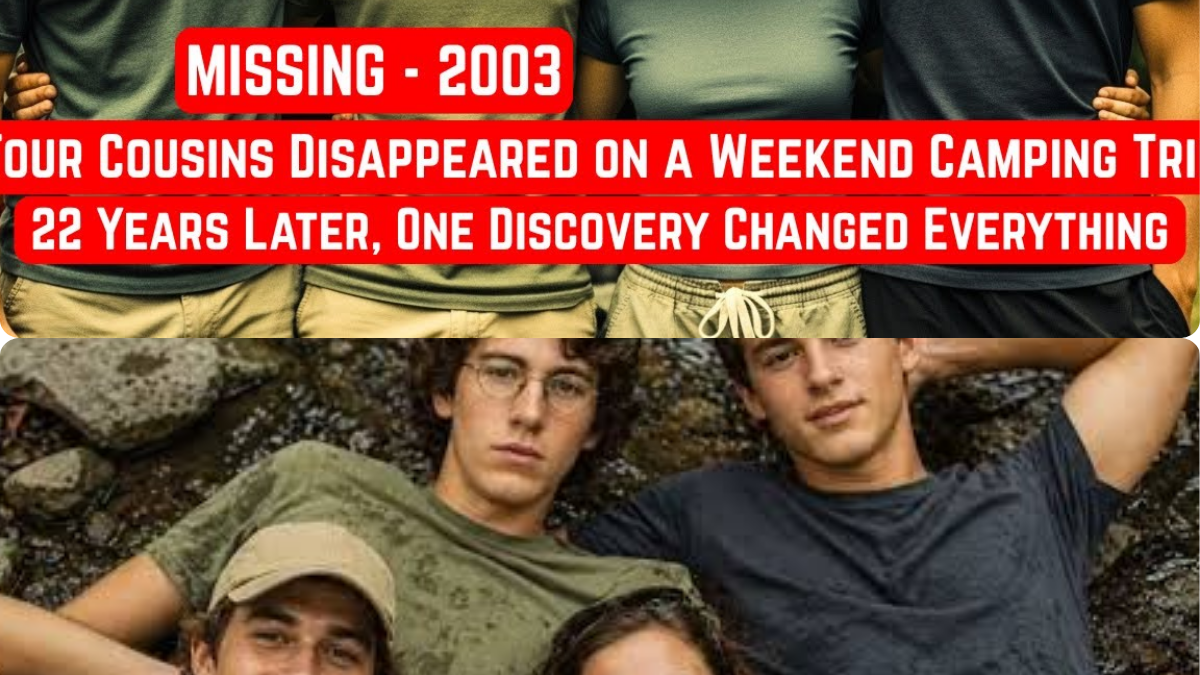
It was the last weekend of July 2003 when four young cousins drove into Red Hollow, Tennessee — and simply ceased to exist.
Josh, 19, was heading to college that fall, his used SUV gleaming in the summer sun.
Beside him sat his quiet, bookish brother Ryan, 17; their cousin Caleb, 18; and Amy, just 15.
They’d grown up roaming these woods together — fishing in the creeks, playing in their grandfather’s old barn, camping in the hollow where he’d hunted decades before.
This trip was meant to be their farewell, one last unbroken weekend before life pulled them apart.
At 5:46 PM on Friday, a gas station clerk on Route 19 watched them leave — laughing, teasing each other about who’d forgotten the matches, their arms loaded with firewood, water, and a disposable camera.
They looked like any group of excited kids.
No one would see them again.
By Sunday evening, worry had bloomed into dread.
By dawn Monday, it had turned cold and sharp.
Their families drove out to the trailhead off County Road 214 to find Josh’s SUV parked exactly where they’d left it — keys still in the ignition, doors locked.
Inside, everything was neatly arranged: sleeping bags, a cooler, a first-aid kit tucked against the side.
But something was horribly wrong.
There were no fingerprints — not on the handles, not on the glass, not on the steering wheel — except Josh’s.
It was as if someone had wiped the vehicle clean, deliberately, carefully, leaving not even a smudge behind.
Searchers followed tire tracks and faint footprints half a mile into the trees to their campsite — and found it frozen in time.
The tent lay unrolled but never staked.
Cans of food sat unopened.
The fire ring held only damp, unburned wood, as if they’d arrived and then… stopped.
On a nearby rock rested an old flip phone, its screen glowing faintly, emitting a low, constant hiss of static.
Beyond that spot, the scent vanished — abruptly, completely — as if the forest itself had swallowed them whole.
Search dogs, helicopters, more than 30 volunteers over 48 hours, drones, cadaver teams — nothing turned up.
Not a scrap of clothing, not a wrapper, not a footprint.
A farmer told deputies he’d heard strange metallic noises that night — dragging, rhythmic, soft tapping carried on the fog — but no one could say where they came from.
A crumpled note was found pressed into the mud: only two words legible — South path.
No fingerprints, no name, no explanation.
The case became known as the Red Hollow Mystery.
Families broke apart under the weight of unknowing.
Years passed.
Parents were laid to rest without answers.
The woods reclaimed the trails.
The story faded into legend — told around campfires, whispered on late-night radio, a warning to children not to wander past the second ridge.
Then, in early September 2025, bow hunter Mark Ellison stepped off-trail deep in the hollow.
He noticed it first — the earth, disturbed, stones arranged in a pattern that didn’t belong.
He called it in.
When investigators carefully brushed away the soil, they uncovered items that should never have been there: a dented metal flask, a rusted 2003 Coleman camping stove, a compass keychain, and a broken watch face frozen at 10:47.
Beneath them lay small, weathered bones — human bones.
The site matched the coordinates scrawled on an old map found in Josh’s SUV 22 years earlier.
But it was what forensic technicians found next that turned a heartbreaking disappearance into something far darker.
Under blacklight, faint streaks along the SUV’s rear door — overlooked in 2003 — were confirmed to be residue consistent with latex gloves.
Someone had been inside that vehicle after it was parked.
Someone had wanted to make sure no trace remained.
And the burial pit? It was shallow, hurried — an attempt to hide, not honor.
As if whoever buried them had been terrified of being caught.
Detective Laura Hensley, young, determined, had reopened the case after a viral podcast brought it back to light.
Now she stood at the edge of the dig site, watching the fog roll in exactly as it had all those years ago, and realized the unthinkable: the cousins hadn’t gotten lost.
They hadn’t stumbled into a ravine.
They hadn’t been taken by a bear.
They had been right here, all along — hidden beneath the feet of every searcher who’d walked these woods.
And someone had known.
Someone had kept the secret.
Then ground-penetrating radar swept the slope.
The readings weren’t just showing remains.
They revealed something larger — something man-made, buried deep beneath the soil.
As excavators cleared away the earth, metal began to show — rusted, corroded, unmistakable.
It was a vehicle.
Buried nose-first into the hillside.
A 1978 Chevrolet maintenance truck, listed missing from Monroe County since 1989.
And inside, wedged amid rotting seats and dried mud, were three fused-together cell phones.
Serial numbers confirmed it: Amy’s flip phone.
Ryan’s Nokia.
Caleb’s prepaid.
All three had vanished with them.
The phones should not have been there.
The truck had disappeared 14 years before the cousins did.
Part 2
The phones should not have been there.
The truck had disappeared 14 years before the cousins did.
The discovery sent shockwaves through the investigation.
How could three phones from 2003 be inside a vehicle buried since 1989? It was impossible — yet the evidence sat right there, sealed beneath layers of earth and time.
Beside them lay the melted remains of a county-issued handheld radio.
The deeper they dug, the more the timeline fractured.
Forensic analysis brought a new horror: carbon monoxide residue in bone marrow samples from Josh and Caleb.
They hadn’t died from exposure or a fall.
They’d been overcome by toxic gas — trapped, breathing it in, their bodies fighting for air until they could fight no more.
Blunt-force fractures suggested a violent impact as well — something heavy striking them, or something collapsing around them.
Melted plastic and scorched soil hinted at fire, deliberate or accidental, near or over where they lay.
Hensley re-examined every old statement.
The farmer’s metallic noises.
The fog that rolled in too thick.
The scent that ended so sharply.
Then Mark Ellison, the hunter, admitted something he’d held back: the day he found the site, before he called police, he’d caught a faint chemical smell — burned plastic and old fuel — lingering in the air, as if it had been released only recently.
Soil testing delivered a gut punch: the ground around the truck showed two distinct periods of disturbance.
The first was decades old — the original burial.
The second was not natural erosion.
It was manual.
Someone had come back.
Dug into the site.
Disturbed the remains.
And covered it up again.
Layer compression dated that second intrusion to roughly 2005 — two full years after the cousins vanished.
Someone knew.
Someone had found them and said nothing.
A torn fragment of fabric was recovered beneath the truck’s driver’s seat — a sleeve from a Monroe County work uniform.
DNA was partial, degraded, but it did not belong to any of the four cousins.
County employment records from 2005 were incomplete, water-damaged, illegible in places — but one name surfaced repeatedly: Roy Dalton.
A seasonal contractor, hired for erosion control work in the exact area.
A drifter.
Quiet.
Kept to himself.
Vanished abruptly that same summer without notice.
A local shop owner remembered him coming in with deep scratches down his arms, saying something about a “bad cave.
” No one had seen him since.
Then technicians managed the impossible: from the heat-damaged memory of Ryan’s Nokia, they recovered a single six-second audio file.
Mostly static.
Faint, ragged breathing.
Then a voice — too distorted to identify clearly — whispering one word.
Some heard help.
Others heard stop.
Hensley stood at the dig site as dusk fell, the trees closing in around her.
If Roy Dalton had found them in 2005, why hadn’t he reported it? Had he stumbled upon them by chance — or had he been there the first time? And what lay deeper still? The radar had shown something larger beneath the truck — a void, rectangular, unnatural — stretching far back into the ridge.
The next morning, as the team prepared to descend, a tech froze over the screen.
Something was moving down there.
Part 3
Something was moving down there.
It was not an animal — not in that sealed, confined space.
It was not a shift of earth — the pattern was too steady, too rhythmic.
But as quickly as it appeared, it vanished, leaving only the still, heavy silence of the hollow.
Hensley ordered the excavation expanded immediately.
What they uncovered next would not only explain the four cousins’ disappearance — it would rewrite the entire history of Red Hollow.
Beneath the buried maintenance truck lay an entrance to something no modern map recorded: a long-decommissioned underground storm drainage tunnel, built by the county in the 1970s, abandoned after repeated collapses.
The truck had been driven partially into the mouth of the tunnel during a storm in 1989, then buried in a hastily attempted cover-up.
Over the years, erosion had shifted the earth, opening a narrow fissure just large enough for a person to squeeze through — hidden by brush and exposed roots, visible only to those standing right at it.
On that fateful July weekend in 2003, the cousins had found it.
The last image from their disposable camera confirmed it — a grainy, blurry shot of the tunnel mouth, rusted support beams framing darkness.
Curious, excited, they’d decided to explore.
They’d brought their camping stove for light and warmth, unaware that deep within the tunnel lay a severed ventilation pipe — once connected to the buried truck’s exhaust system.
What happened next was swift and devastating.
At some point — likely while they were inside — someone started the truck’s engine.
Exhaust poured directly into the confined tunnel.
Carbon monoxide, invisible and odorless, built up within minutes.
By the time they realized the danger, it was already too late.
They’d been overcome before they could escape.
The tunnel entrance collapsed moments later, sealing them in.
Roy Dalton had been working in the area that weekend.
He’d seen the cousins head toward the restricted zone.
He’d known the tunnel was there — and he’d known the truck was buried just inside it.
He’d gone to warn them.
But when he arrived, the air was already thick with gas.
He’d pulled at the debris, tried to dig through — the scratches on his arms were from that frantic effort — but the collapse was too solid.
He’d called out until his voice cracked.
There had been no answer.
Terrified, he’d fled.
For two years, the secret ate at him.
Then, in 2005, he’d returned — not to finish burying them, but to see if anything had shifted.
He’d dug cautiously, found remains, and in his panic and guilt, he’d covered them again, convinced that revealing what he knew would make him a suspect.
He’d left town that summer, broken and running from a nightmare he couldn’t bring himself to share.
He’d died alone a few years later in a distant county hospital, never telling anyone what he’d seen.
The movement on the radar? It was nothing more than settling earth — a trick of the instruments, amplified by exhausted nerves and a place that felt alive with ghosts.
But the truth was real enough.
The cousins hadn’t been lured there.
They hadn’t been murdered in cold blood.
They’d simply been young, curious, and unlucky — walking into a trap laid years before, hidden by neglect and silence.
The discoveries continued until every piece was in place.
Amy and Ryan’s remains were recovered deeper in the tunnel, where they’d tried to find another way out.
Josh and Caleb had been closer to the entrance, their bodies partially exposed during Dalton’s 2005 visit.
The phones had been carried inside the truck cab during a later collapse, protected enough to survive the decades.
The faint word on the recording? It was impossible to know for certain — but Hensley chose to believe it was help.
The families gathered on the ridge one soft spring day.
Four wooden crosses stood in a row, carved with their names.
No speeches were made.
There were no arrests to bring closure, no dramatic courtroom confession to satisfy the need for justice.
There was only the quiet, terrible truth: the woods hadn’t swallowed them.
People had — through carelessness, silence, and fear.
Sheriff Emeritus Carl Donnelly stood at the edge of the clearing, his face lined with grief and relief.
“We’ll find the truth,” he’d said years before, “but not the whole of it.
” He’d been right.
No one would ever know exactly what passed between those four cousins in their final moments.
No one would know the exact second they realized they were trapped.
But they knew enough.
They knew they hadn’t been forgotten.
They knew they hadn’t simply vanished.
Detective Hensley placed a hand on Amy’s mother’s shoulder as the wind stirred the leaves above.
“They were here,” she said softly.
“They were real.
They mattered.
”
The case was closed.
The records were filed.
But Red Hollow would never be quite the same again.
The trail was cleared, the memorial marked, the dangerous sections of the tunnel sealed for good — not to hide, but to protect.
And sometimes, on quiet evenings, hikers say they hear something soft and faint drifting through the trees — not static, not tapping, but laughter, carried on the breeze, as if four cousins are finally, truly on their way home.
“This story is entirely fictional and created for entertainment purposes only.
It does not represent any organization or individual, nor does it encourage inappropriate behavior.
The content was generated with AI assistance.
”








