They Vanished Without a Trace in a National Park — 2 Years Later They Were Found in a Cave, Whispering About Eyes in the Dark… What Actually Happened Will Haunt You Forever
They Vanished Without a Trace in a National Park — 2 Years Later They Were Found in a Cave, Whispering About Eyes in the Dark… What Actually Happened Will Haunt You Forever
Part 1
They were supposed to return by August 18, 2016 — but Daniel and Claire Brenner simply vanished into the wild, leaving behind nothing but an empty silver Subaru and a silence so deep it felt like the mountains themselves had swallowed them whole.
Daniel, 31, a quiet software engineer, and Claire, 32, a bright freelance graphic designer, were seasoned hikers — the kind who studied maps until their fingertips smudged the paper, who packed emergency gear like second nature, who treated the wilderness with reverence and respect.
From Boulder, Colorado, they’d planned every mile: four days, 35 miles, Death Canyon Trail, Grand Teton National Park.
They checked in at the Moose Visitor Center on August 15; the ranger noted they carried a two-way radio, high-end gear, and bright, eager smiles.
A trail camera caught them striding forward at 9:30 a.
m.
Other hikers passed them five miles in, moving steadily beneath a cloudless sky.
No storms.
No warnings.
No signs of trouble.
Then — nothing.
When Claire’s sister in Jackson, Wyoming, received no call, no text, no sign of them on August 19, she drove to the trailhead.
Their car sat exactly where they’d left it.
The park launched a massive search: 12 rangers, 50 volunteers, helicopters, tracking dogs, more than 100 square miles combed in painstaking detail.
They checked every campsite, every landmark, every possible turn.
They found no tent, no food wrappers, no scrap of clothing, no footprint that did not belong to deer or bear.
The dogs caught faint scents that faded into nothingness.
The helicopter scanned ridges and valleys from dawn until dusk and saw only rock, pine, and shadow.
It was as if the couple had stepped off the trail and ceased to exist.
Weeks bled into months.
Autumn painted the Tetons gold; winter buried them under snow.
The search scaled back, then stopped.
The case file moved to the “cold” shelf.
Friends and family clung to hope, but reality whispered what no one wanted to say: in these mountains, people disappear and are never found.
Claire’s sister kept their car in her garage, unable to bear selling it.
Two years passed.
Then, in late July 2018, a solo backpacker named Trevor Dawson was hiking far off-trail, northwest of Death Canyon, when he caught it — not the sharp, acrid tang of wildfire, but the soft, familiar scent of a small, contained campfire.
He followed it up a slope of loose rock, curious, then concerned.
What he found changed everything.
Partway up the face, hidden behind a tangle of juniper, was a cave.
And from inside, he heard voices — low, rhythmic, terrified.
“Hello?” Dawson called out.
“I’m a hiker.
Are you hurt?”
The response was not a plea for help.
It was a high, animal shriek, then silence.
He called again, stepping closer.
A voice drifted from the dark — hoarse, broken, barely human.
“Go away.
They will see you.
They will know.
”
Dawson shone his flashlight into the opening.
What he saw froze his blood.
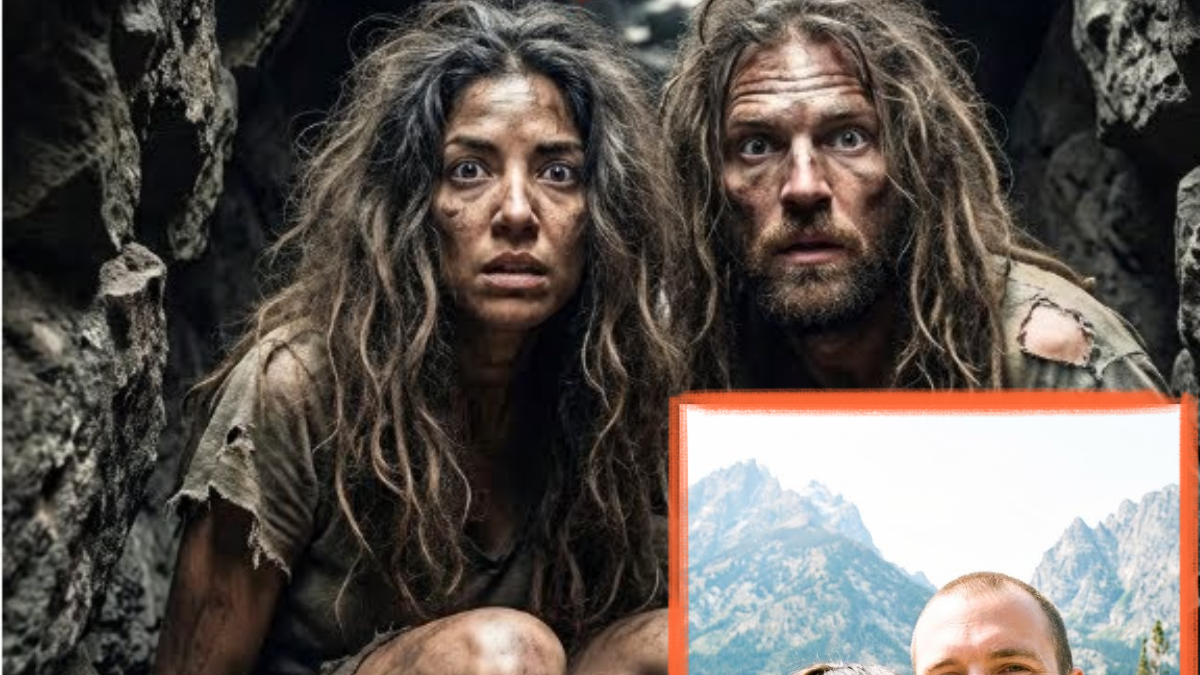
Two figures huddled at the back of the cave, pressed against the stone wall.
They were filthy, clothes shredded and stained, hair matted and wild, feet blackened and bare.
The man had a beard that fell to his chest; the woman rocked back and forth, eyes wide and unblinking, staring into the beam of light as if it were a weapon.
They looked less like survivors than creatures who had forgotten how to be people.
“Are you Daniel and Claire Brenner?” Dawson asked gently.
At the names, the woman stopped rocking.
Her head tilted.
For a heartbeat, something like recognition flickered in her gaze.
Then she shook her head violently, as if shaking off a spider, and retreated deeper.
The man lunged forward — not attacking, but flailing, babbling sounds that made no sense — before dragging her back into the gloom.
Dawson backed away slowly, triggered his emergency beacon, and stood guard, his mind racing.
They were alive.
After two years, they were alive.
But why had they hidden? Why had they not called for help? What were they so afraid of?
Within hours, a rescue team — led by veteran ranger Patricia Langford — reached the cave.
They approached slowly, voices calm, hands empty.
“We’re here to take you to safety,” Langford said.
“No one will hurt you.
”
The man emerged a little way, his face half in shadow.
“We cannot leave,” he whispered.
“They are watching.
They will not let us go.
”
“Who?” Langford asked.
He did not answer.
Instead, he began to speak — fast, breathless, disjointed — of shapes in the trees, eyes in the rock, voices that hummed from the ground itself.
The woman hummed along with him, a low, wordless drone that filled the air.
Langford placed water and energy bars just inside the entrance and stepped back.
Minutes passed.
The man crawled forward, grabbed a bottle, and drank in desperate, ragged gulps.
Then he spoke his name — quiet, hesitant, as if testing a word he had not used in years.
“Daniel.
”
It was him.
Daniel Brenner.
After two years, they had found them.
But as the team stood in the fading light, watching the couple flinch at the sky, watching them shrink from every movement, they realized a devastating truth: the wilderness had not merely kept them.
It had broken them.
And the most terrifying part was not that they had been lost — but that they had chosen to stay lost.
Part 2
They had chosen to stay lost — and as the rescue team guided Daniel and Claire slowly toward the waiting helicopter, it became clear that the fear gripping them was not a fleeting reaction; it was carved deep into their bones.
Every rustle of pine needles made them flinch.
Every shadow stretching across the slope made them pause.
When the helicopter blades began to turn, Claire buried her face in her hands and would not look up.
Daniel stared fixedly at the tree line, whispering that the shapes were watching, that they knew they were leaving.
At St.
John’s Medical Center in Jackson, doctors and specialists waited.
The physical toll was staggering: Claire weighed 30 percent below her healthy weight, her body covered in sores, bites, and scratches.
Daniel showed muscle wasting, early frostbite on his toes, and old fractures in his left hand that had healed crooked.
Both were dangerously dehydrated, starved of vitamins, and fighting infections.
But the psychological wounds were far harder to treat.
For two days, Claire did not speak.
She lay perfectly still, eyes open, staring at nothing.
When nurses approached, she recoiled as if burned.
Daniel spoke, but rarely in ways that made sense — jumping from topic to topic, rambling about rules they had followed, about not making noise, about not eating the red ones.
On the fourth day, Claire spoke her first words.
A nurse set a tray down beside her bed, and Claire turned her head and said, flat and hollow: “They told us not to eat the red ones.
”
When pressed, she offered fragments — shadows that moved when you did not look directly at them, sounds in the night that were not made by animals, a presence deep in the mountain that demanded silence.
Every time they tried to leave the cave, she said, they became lost, walking in circles until they found themselves back at the stone mouth.
An overwhelming dread would seize them, heavy as a physical hand, pressing them back.
Doctors and psychiatrists began to piece together a disturbing picture: shared psychotic disorder — folie à deux — a rare condition where two people in extreme isolation reinforce a shared delusion until it becomes their entire reality.
But the question remained: how had they survived for two years? Where had they found food? And why had searchers never come within miles of them?
Investigators traveled to the cave to answer those questions.
What they found sent a chill through even the most seasoned rangers.
The cave was small — barely 15 feet deep — floored with pine needles and dried grass, a crude bed.
In one corner sat a fire pit of stacked stones, ringed with ash.
Scattered around were remnants of their original gear: a torn scrap of tent fabric, a snapped trekking pole, a few wrappers from the freeze-dried meals they had packed in 2016.
But those wrappers were far too few to sustain them.
The rest of their diet was written in bones — small rodents, birds, rabbit — and piles of gathered plants and fungi.
And there, tucked in a crevice near the entrance, was a notebook.
Its pages were warped and stained, the handwriting shifting from neat and precise to frantic and barely legible.
The early entries matched what they already knew: August 15 — beautiful day, perfect weather.
August 16 — wildlife sightings, clear skies.
August 17 — the last coherent entry, in Claire’s hand: Lost the main trail.
Followed a deer path thinking it would loop back.
Now we are somewhere we do not recognize.
The map does not match the terrain.
Daniel thinks we should head east toward higher ground.
We’ll try in the morning.
After that, the words dissolved into fragments: No signal.
Tried twice.
Saw smoke but could not reach it.
Daniel says we are being followed.
Halfway through, scrawled in large, shaky letters: Do not trust the voices.
The final pages were chaos — sentences overlapping, words upside down or sideways, phrases repeated like prayers: They come at night.
The mountain is alive.
We cannot leave the circle.
Red eyes in the stones.
And on the very last page, a crude drawing — a circle, marks inside it, and lines radiating outward ending in X’s — as if mapping something they dared not name.
Beside the notebook lay their two-way radio — crushed, battered, its battery compartment corroded and empty.
They had possessed the means to call for help the entire time.
And somehow, they had never used it.
Part 3
They had possessed the means to call for help the entire time — and as investigators turned the broken radio over in their hands, they began to understand that the tragedy was not merely that they had been lost.
It was that they had been slowly, terrifyingly unmade.
The physical evidence told a story that no one had expected.
Mixed among the gathered plants at the cave, the park botanist identified specimens of Amanita muscaria — fly agaric — a vivid, toxic mushroom known to cause vivid hallucinations, distorted perception, and profound confusion.
Traces of water hemlock, dangerously poisonous, were also present.
In their desperation, Daniel and Claire had eaten what they did not recognize — and over months, the toxins had warped their minds.
The timeline pieced together by investigators and psychiatrists was devastating in its clarity.
On August 17, 2016, they took a wrong turn following a scenic overlook, strayed onto an animal trail, and became disoriented.
They tried to retrace their steps, but the dense forest and rocky slopes swallowed landmarks.
They attempted to use their radio — but signal was nonexistent in that shadowed basin.
They tried navigating by map and compass, but the terrain was more rugged than their map suggested; everything looked the same.
Exhausted and frightened, they found the cave and stopped to rest, planning to leave at dawn.
But dawn brought no clear path.
Every direction they chose seemed to lead back to the same ridges, the same trees, the same unyielding maze.
Hunger set in.
They ate what they had brought, then began foraging.
At first they were careful — but as supplies dwindled, caution frayed.
They tried plants they were unsure of.
Some made them sick; others produced vivid, terrifying visions — shapes in the mist, whispers in the wind, a watching presence in the forest itself.
Those visions fed their fear.
Fear distorted their judgment.
Every time they tried to leave, the physical difficulty of the terrain combined with the psychological terror planted by hallucinations to drive them back.
The “feeling” that held them was not a supernatural force — it was their own minds, starved, poisoned, and terrified, convincing them that the cave was the only safe place in a world that had turned hostile.
They broke the radio eventually — not out of malice, but because they came to believe using it would draw attention from the things watching.
They stopped building fires where they might be seen.
They stopped calling out.
They simply… vanished into the dark of their own making.
The search of 2016 had never reached them because they had wandered miles from their planned route, into a basin hidden by tree canopy and cliffs.
Without distress signals, without sightings, without a single clue pointing west, searchers had no reason to look there.
They had been so close — and yet unreachable.
In the months following their rescue, the full weight of what had happened settled over them.
Claire recovered first.
With therapy, medication, and steady, gentle care, she began to distinguish memory from hallucination.
She acknowledged the truth: there had been no watching shapes, no sentient mountain, no rules enforced by invisible hands.
There had only been fear, hunger, and the terrible power of the human mind turned against itself.
She spoke publicly once, in 2019, not to glorify their ordeal but to warn — about the dangers of straying off-trail, about the risks of foraging without certainty, and most of all, about the way isolation can erode reason as surely as water wears away stone.
She co-founded a nonprofit supporting missing persons families and wilderness trauma survivors, turning her scars into purpose.
Daniel’s road was harder.
The toxins had left lasting traces in his brain — subtle but real changes in how he processed fear and reality.
He accepted the medical explanation intellectually, but some part of the visceral dread never fully faded.
He struggled to return to his work, to trust his own perceptions, to feel safe outdoors.
He moved to a quiet suburb, wrote privately as a way to process his experiences, and found support among others who understood trauma.
He never spoke publicly.
In 2020, they met once — in a therapist’s office, to close the door on what they had shared.
They acknowledged the bond forged in suffering, the love that had sustained them even when they could not sustain themselves, and the quiet truth that they could not go back to who they had been.
They parted gently.
Their divorce was finalized in early 2021.
By 2024, both had rebuilt lives — not the lives they had imagined, but lives nonetheless.
Claire continued her advocacy; Daniel found quiet peace in routine and writing.
They did not stay in touch, but neither forgot.
Their story became a case study — in survival, in shared psychosis, in the fragile line between what is real and what fear makes us see.
The National Park Service updated safety guidelines in their name, emphasizing check-in plans, reliable communication, and the psychological toll of being lost.
The cave was marked on internal maps and checked occasionally — a quiet memorial, a warning, a place where two people had fought to survive and had come back changed.
No monster had hunted them.
No curse had claimed them.
The horror had been human — hunger, confusion, fear, and the quiet, terrible capacity of the mind to build a prison out of nothing but itself.
They had not been taken.
They had stayed — because they could no longer see the door.
And in the end, what they had found was not a way out of the mountains, but a way back to themselves — slowly, painfully, and one brave step at a time.
This story is entirely fictional and created for entertainment purposes only.
It does not represent any organization or individual, nor does it encourage inappropriate behavior.
The content was generated with AI assistance.








