They Wrote Her Name on the Town Hiring Board Beneath the Oxen and the Mules. When No One Would Take Her Even for Free, the Blacksmith Walked Up and Said: “I’ll Take the One Nobody Wants.”
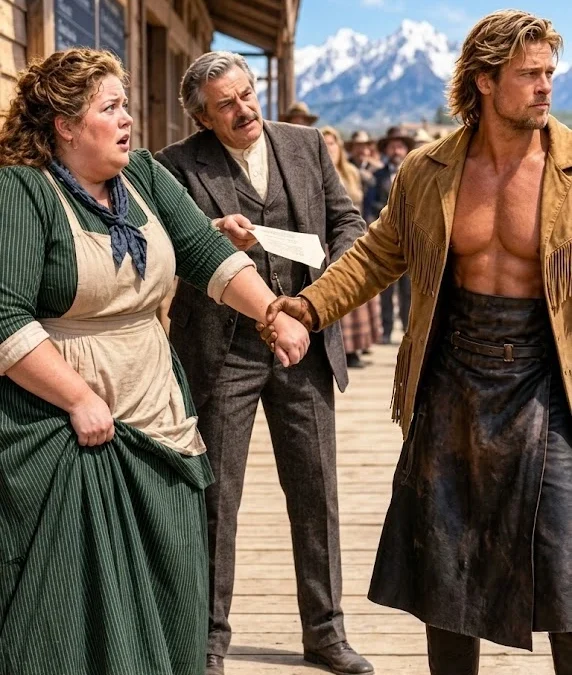
They Wrote Her Name on the Town Hiring Board Beneath the Oxen and the Mules. When No One Would Take Her Even for Free, the Blacksmith Walked Up and Said: “I’ll Take the One Nobody Wants.” ⚒️🔥
PART 1
They wrote her name at the very bottom of the hiring board in Chokecherry Bend, beneath a span of oxen and two mules.
Not one soul in that town thought it strange enough to mention.
Hattie Dunbar read it through the steamy kitchen window while her bread scorched behind her.
A woman could be listed with livestock.
Worse, she had learned, a woman could be priced below it.
She was twenty-three. For two years she had scrubbed the Bend House Hotel kitchen from black morning to black night, until her hands were hard as saddle leather and her back could carry anything the stairs demanded.
She was a big woman: broad through the shoulder, heavy through the hip, built like something the mountains had made on purpose and set down whole.
The town called it grotesque.
Her father had called it good stock.
Then her father died owing Judson Ivy four hundred and eighteen dollars, and Ivy collected it out of her: three years of her labor, signed away in a dying man’s shaking hand at the kitchen table. Two years served. One to go.
Every morning, the housekeeper, Lucinda Prior, counted the biscuits and announced to the dining room how many the hired girl was allowed.
“The Bend House feeds one hired girl,” she liked to say, “and four of her besides.”
The guests laughed every single time.
Ivy owned the hotel, the freight barn, the scale, and every hiring paper in the county. That spring he wanted more. The new mine at Rusk Hollow needed an ore road down the mountain, and Ivy meant to own it and collect a toll on every ton forever.
Through the window, Hattie watched a wagon come off the north road loaded with bar iron and charcoal sacks, one man handling all of it alone.
Caleb Ashby, the blacksmith from Cinder Ridge. He never drank in the hotel. He never weighed his iron on Judson Ivy’s scale.
That evening, while they dried plates, the kitchen girl Nell Sackett whispered under the clatter. “Ivy’s sold three girls’ papers to the winter timber camps in three years. Not one of them ever came back to collect her wages.”
Hiring day filled the boardwalk by eight o’clock: ranch wives, camp bosses, mine cooks, and a crowd that had come only for the show.
Nine girls stood against the hotel wall in a line, straight as fence posts, hands folded.
The buyers walked down that line the way men walk a corral rail. They lifted chins with two fingers. They asked about teeth and temper.
One by one, the girls were spoken for and led away.
Then the buyers reached the end of the line.
A rancher’s wife looked Hattie up and down and laughed out loud into the cold air. “She’d eat the whole profit before the first snow!”
Wade Toliver, Ivy’s man, read Hattie’s terms in a voice meant to carry the length of the street. One year remaining. Kitchen trained. Sound of wind and limb.
Then he called out her weight, as if it were a term written into the contract.
The crowd howled.
He dropped the price to sixty dollars. Forty. Twenty. Finally he offered her paper free, to any man who’d haul one load of stove coal up to the hotel in exchange.
Nobody spoke.
The wind pushed at the awning canvas overhead. Hattie kept her eyes on a knot in the boardwalk plank and made herself into nothing at all.
She was very good at that.
Judson Ivy stepped out of his door with his thumbs hooked in his vest.
“Well, the town has seen the plain truth of it,” he announced. “A thing nobody wants isn’t property. It’s a debt. I suppose I’ll go on carrying it.”
Then boots came up the boardwalk, unhurried.
Caleb Ashby walked through the crowd with coal dust still in the creases of his hands, stopped square in front of Judson Ivy, and said it loud enough for the whole street to hear:
“I’ll take the one nobody wants.”
Ivy’s smile went thin as wire. Slowly, so the crowd could enjoy watching the trap close on a fool, he said, “No unmarried man carries a girl’s paper out of my town.”
Ashby didn’t blink.
“Then fetch the preacher.”
They were married in eleven minutes on the hotel steps, in front of every mouth that had laughed.
He counted out the full four hundred and eighteen dollars in gold, took Hattie’s carpetbag out of Toliver’s hand, and walked straight to his wagon.
Ivy called after him something about the road across Cinder Ridge, and a fair price for a fair grade.
Ashby helped Hattie up onto the seat, climbed on, and clucked to his team.
He never once looked back.
And neither of them knew that Judson Ivy had already paid for Hattie’s grave. ⚰️
👉 Part 2 is in the comments! Can’t find it? Leave any word and I’ll send it to you privately. 👇
PART 2
Neither of them knew that Judson Ivy had already paid for Hattie’s grave. The town fell away into pine. Hattie sat with her carpetbag on her knees, her heart going like a bird in a grain sack. She had been bought, for the price of her father’s debt, by a man she had never spoken to. Every kindness she’d ever been shown had come with a bill attached somewhere at the bottom. So she counted the mileposts and braced for the moment he’d tell her what she owed. Two miles on, he stopped the team, climbed down without a word, shifted a hundred pounds of bar iron from under the seat to the wagon bed, folded a wool blanket four times, and laid it on the seat beside her. “Boards bruise,” he said. That was all. She sat on the blanket and couldn’t for the life of her understand what had just happened. As the road climbed into raw rock and cold wind, he laid a buffalo robe over her lap without looking at her. At camp he fried salt pork and cornmeal and filled her plate first, fuller than his own. She waited for the joke about her appetite. It never came. Instead he looked at her split knuckles and old stove burns and asked how long she’d been carrying water yokes. “Two years.” He nodded slowly, the way a man nods over a well-kept ledger. “Why?” she finally asked. “Why me, when the whole town laughed?” He turned a stick over in the coals. “They put your name under the mules. A town that does that is telling you what it is. It isn’t telling you one thing about what you are.”
At noon the next day, Cinder Ridge opened below them: black rock and green timber, a white creek, a stone smithy breathing steady smoke, a cabin, three charcoal kilns, and a switchback grade cut into the ridge face by hand, one summer at a time. It was the only road that could carry ore wagons off the Rusk Hollow side of the mountain. She didn’t yet know she was looking at the reason a man had already decided she should be dead by spring. She’d braced for a filthy hovel. Instead she found a swept floor, a scrubbed table, a clean bed, and a whole wall of books: volumes on iron and assaying, a cracked Bible, Shakespeare, a mining almanac worn soft. He set her bag at the foot of the bed. “The bed’s yours. I sleep in the smithy loft. The fire wants watching.” “But… we’re married,” she said carefully. “On paper. A paper was the only thing that would get you out of that town alive. Nothing else under my roof will ever be decided by Judson Ivy.” Then he went out to the forge. She sat on that clean bed in a stranger’s house and cried for a long time without making a single sound, out of pure habit. 🥹
The days passed in a quiet she kept waiting to see break. He never raised his voice. He split her kindling small so it caught on the first match and hung a lantern on the path so she’d never walk in the dark. On the fourth morning she baked, then stood by the stove with her jaw set, waiting to be told how much flour she’d wasted on herself. He came in, ate three pieces standing up with his hat still on, looked into the empty pan, and said one word: “More.” She turned to the stove so he wouldn’t see her face. Then she started hauling his ninety-pound charcoal sacks up from the kilns, two at a time, one on each shoulder, never stopping on the slope. “The boy I hired last summer quit over that hill,” he said. She laughed out loud, a real laugh, and it surprised them both. In April, a two-dollar error in his accounts was bothering her, so he handed her the whole tin box without a question. At the bottom lay her indenture paper. Folded inside it was a slip of Bend House stationery: a receipt from the undertaker in Chokecherry Bend. One plain pine box. One grave, dug and paid in full. Made out in the name of Hattie Dunbar. She checked the date three times. It was paid three days before hiring day, before her name ever went on that board. And in the margin, in the clerk’s tidy hand, were three words: “As with the others.”
🔥 What did Caleb do when he saw that receipt, and what happened when Ivy came for Cinder Ridge? Comment “FORGE” and hit LIKE to see Part 3! Once we reach enough comments, I’ll post the ending! ⚒️👇
PART 3
Below the note were two sets of initials Hattie knew well.
Two of the girls who had gone to the timber camps and never come back for their wages.
Judson Ivy had never expected to sell her at all.
He had expected to bury her. The winter camp was only the method. The pine box had been bought and paid for before the town ever gathered to laugh.
She sat down on the smithy step with the paper in both hands. She wasn’t weeping over the grave. She was weeping because a man had sat at a desk, done the arithmetic on her, and decided she came to less than the cost of the box.
Caleb found her there. He read it once, standing in the first drops of rain.
She had never seen a man go that quiet. And she had never seen anything as frightening as what came into his face afterward.
He opened the forge door, fed her indenture into the white coals, and held it down with the tongs until nothing was left to name.
The undertaker’s receipt he folded twice and set back in the tin box.
“That one we keep.”
Then he turned to her. “You’re not bought, Hattie. You’re not held. You can take the wagon to Helena in the morning with money in your pocket, and no man in this territory will ever put a paper on you again.”
“Then what am I,” she whispered, “if I’m not bought?”
“My wife, if you want to be.” His voice was rough. “And worth more than this road, this forge, and every dollar Judson Ivy ever counted.”
She stayed.
Spring climbed the ridge, and the work began to change her.
She learned the great bellows. She learned to read hot iron, straw, cherry, white, the way other women read the weather. She held stock steady on the anvil under a striking hammer, which takes more arm than most grown men have.
On Sunday afternoons, he set tin cans on the fence rail and taught her the rifle. On the ninth Sunday, she put five shots out of six through the same can at eighty yards.
He folded his arms. “You’ve got a smith’s hands and a gunsmith’s eye, and no business ever apologizing for either.”
Then he said the thing she’d waited her whole life to hear without knowing she was waiting:
“Thin doesn’t survive a Montana winter. Substance does. Substance is the only thing this mountain has ever respected.”
In May the pass opened, and assay men from Rusk Hollow began pacing his switchback grade and writing in little books. Hattie kept the tallies and saw what they saw: every ton of ore from Rusk Hollow either crossed Caleb Ashby’s ridge or went a hundred and ten miles around it.
One evening he came up from the creek with his shirt over his shoulder and his hair still wet. Hattie set down the dish she was drying and crossed the yard before she could talk herself out of it.
She kissed him.
He went perfectly still for exactly one heartbeat. Then his hands came up to her face, the way a man handles something he made himself and couldn’t bear to mar.
He called her plentiful. He called her the finest thing that had ever come up that road on any wagon. He said it plainly, in broad daylight, with nothing in the world to gain by it. 💛
By June she had stopped making herself small. She walked her own yard, ate at her own table, and caught herself singing at the bellows on a Tuesday.
That was the week the vultures came.
Judson Ivy drove up in a buggy, in a dark blue coat with a gold watch chain, onto a road he hadn’t built and didn’t own.
“Eleven hundred dollars for the ridge and the grade,” he said. “Generous. A mercy, really, considering the winters up here.”
“The grade isn’t for sale at any figure,” Caleb said.
“Everything in this territory is for sale. And a smith who can’t read a contract will learn to read one in front of a judge.”
Down by the horses, Wade Toliver looked at Hattie, didn’t recognize her for a moment, then grunted like a hog at a trough. His three men laughed on cue.
Hattie set down the tongs she was holding, still glowing.
“Does Ivy pay you by the hour,” she asked, “or by the insult? The Bend House fed me two years, and I grew on it. You’re welcome to test that.”
Toliver stopped laughing. They left.
Nine nights later, all three charcoal kilns burned at once. By the near kiln, Caleb found a bootprint with a squared heel.
In town for iron, Hattie heard the rest from the freight clerk’s gossip. In February, Ivy had signed a contract to deliver a finished ore road by the first of July, with a forfeit that would ruin him. He signed it before he owned a foot of the ridge.
Three days before he paid for her grave.
Outside the freight barn, Ivy found her. “Girls of your… constitution rarely last a winter at that height,” he said pleasantly. “Always thought it a shame.”
“I read a receipt,” Hattie said, “in your clerk’s hand.”
His face didn’t move a hair. “Paper burns easily, Mrs. Ashby. A smith’s shop burns faster.” He touched his hat and walked on.
At the wagon, Nell Sackett caught her arm. “Ivy keeps a black placement book in the hotel safe. Every girl’s name, every fee. There’s a column at the back headed ‘Settled.’”
Caleb loaded the Winchester and the shotgun and stood them by the door.
For four nights riders sat on the rim above the pass, watching the forge smoke. On the fifth, the fence was cut in twelve places and the horses run off. On the sixth, a cold, mean storm came off the divide and tore the lantern from its hook.
At ten o’clock, Hattie heard hooves on the switchback. More than she could count. Not even trying to be quiet.
Torches flared around the corral. The hay shed went up like paper. Six riders, Toliver on foot with a pistol, and far back at the head of the grade, beside a waiting buggy, a dark blue coat standing perfectly still in the rain.
Caleb fired both barrels into the shed doorway and knocked a man from his horse.
Then a rifle cracked from the dark by the corral.
Caleb went down hard on the smithy step, his right shoulder torn open, his hand no longer able to close. The shotgun flew into the mud six feet away.
Toliver came laughing into the firelight. “Leave the smith. A man bleeds out fine on his own. Bring the fat girl out in the yard so the boys can watch her try to run.”
Hattie set the rifle down on the table.
It was fourteen feet out to her husband and back, and she wasn’t going to cover it twice with a gun in her hands.
She went out low and fast, got both hands under his arms, and hauled two hundred and forty pounds of bleeding blacksmith across the sill into his own smithy while the mud sucked at her shoes. She kicked the door shut and dropped the bar.
A body slammed into it from outside a second later.
The anvil sat on its oak stump by the fire: three hundred and ten pounds of good Sheffield iron.
She squared her feet, took it under the horn and the heel, and lifted it clean off the stump. Her back screamed the whole way. She walked it four steps and set it flush against the door.
The next man who threw his shoulder into that door bounced off it and cursed in the rain.
Then she went to the bellows.
She pumped until the coals went past cherry, past orange, into white, and the whole shop glowed like a four-in-the-morning sunrise.
The east shutter cracked in. A man shoved his head and shoulder through the gap.
She met him with eighteen inches of white-hot iron in the tongs, close enough to burn the air. He went out backward, screaming, his rifle stock smoking.
Sparks caught the roof.
The quench trough stood full along the wall: an iron tank on timber legs, over four hundred pounds with the water in it. She set her shoulder under the near end and heaved. The water went up the wall and over the burning shingles in one long sheet, and the fire died with a hiss she felt in her teeth.
Toliver came through the broken shutter into the steam, pistol out.
She grabbed the long sledge, sixteen pounds of iron on a hickory handle, and swung it the way her husband had taught her: from the hips, through the mark.
His forearm broke. The pistol flew into the coals.
She left him hollering on the floor under the tipped trough and walked out of her own smithy into the rain with the sledge still in her hand.
At the head of the grade, Judson Ivy had already turned his buggy, whip raised.
Hattie came off the yard at a dead run, caught the near horse by the cheek strap as the team swung around, set her heels in the mud, and stopped the frightened horses with one arm. Then she hauled the team back a full step against his whip.
Judson Ivy tumbled off the seat into the road.
His strongbox came off the floorboards after him.
The riders still standing were already fleeing down the switchback, two of them carrying a third across a saddle.
Hattie stood alone in the rain with the strongbox under her arm while the hay shed burned itself out behind her.
Inside, she packed Caleb’s wound with clean linen and whiskey, bound it tight, and got him onto the bed by herself.
He woke at gray morning. He looked a long while at the anvil sitting against his door. Then at his wife, asleep upright in the chair beside him.
He called her a Valkyrie. Then he called her queen of the whole cursed mountain. 👑
The strongbox held the black placement book: twenty-two names over six years, each with a fee and a camp, and at the back the column headed Settled.
Four names had a small cross beside them. Hattie matched every cross against the undertaker’s receipts in Chokecherry Bend.
Four out of four. Each grave paid for before the girl ever left town.
She rode to the county seat with the book, the receipts, and the number from her own burned indenture, and sat in the county attorney’s office for three hours without once raising her voice.
Facing twenty years, Wade Toliver, arm in plaster, decided he’d rather talk. He gave up the camp bosses, the fees, and the whole quiet arrangement from the beginning.
At the inquest, they read the four names aloud. Hattie stood in a borrowed black dress and explained what a receipt dated three days early really meant.
Every man on that bench understood her perfectly.
The mining company voided Ivy’s contract within the week and took its forfeit out of his freight barn, his hotel, and the scale he had weighed the county on for eleven years.
Lucinda Prior counted no more biscuits. She left on the eastbound stage, and not one person came out to watch her go.
Judson Ivy went to the territorial prison at Deer Lodge in leg irons. He died there in his third winter, in a cold stone room, owing far more than he had ever taken from anyone’s father.
The ore road ran up and over Cinder Ridge, and the company paid the Ashbys a toll, ton by ton, for eleven straight years.
The forge shod every team that worked the mountain. Caleb added a second fire. Hattie kept the books, and they balanced to the penny every quarter.
She hired girls. She took them off the hiring boards of four counties, paid them wages in their own names at the bank in Helena, and made every one of them sign absolutely nothing.
From Helena to the Yellowstone, they called her the Ridge Woman. Teamsters swore in saloons that she’d stopped a bolting team with one hand in the rain.
For once in her life, the story people told about her size was the true one.
Nell Sackett came up the mountain the second year to run the boarding house at the foot of the grade. There was a boy by then, and later a girl with her mother’s gray eyes, her father’s stubborn jaw, and no fear of fire whatsoever.
The iron sign over the smithy door, which Caleb hammered out himself one winter evening, read:
ASHBY & ASHBY, BLACKSMITHS
Hers was the name he had struck first.
On an evening in her fortieth year, Hattie sat on the porch watching the ore wagons crawl down the grade.
Her husband came out, tipped her face up with two soot-blackened fingers, and kissed her like a man who had never needed to look at anything else.
Below them, the road they had refused to sell went on carrying the mountain down to the world, load by load, in the last of the light.
And the two of them stayed right where they were, and didn’t look away. ⚒️💛
The town priced her below the mules. One man saw what she was really worth, and she proved it to everyone. What was your favorite moment? Tell me in the comments! 👇💬
Disclaimer: This story is entirely fictional and created for entertainment purposes only. It does not represent any organization or individual, nor does it encourage inappropriate behavior. The content was generated with AI assistance.








