Three Best Friends Vanished From a Quiet Ozark Trail. Sixteen Months Later, a Barefoot Woman With Shackle Scars Burst Into a Gas Station and Whispered, “He’s Gone, but He’ll Be Back.”
Three Best Friends Vanished From a Quiet Ozark Trail. Sixteen Months Later, a Barefoot Woman With Shackle Scars Burst Into a Gas Station and Whispered, “He’s Gone, but He’ll Be Back.” 😨
Part 1
On a freezing February night, the bell above the door of a lonely gas station on a Missouri highway rang so violently that the clerk dropped his phone.
The door slammed against the wall.
A woman stood on the threshold, swaying.
She was skeletal, her eyes sunken and burning with fever. She wore a filthy man’s T-shirt that hung off her bones. Her feet were wrapped in rags bound with gray duct tape.
Under the fluorescent lights, the clerk saw the scars on her wrists, deep, ringed, like marks left by plastic ties. Around her neck ran a dark, frayed band, the kind a collar leaves after months of wear. 🕯️
“They’re over there,” she wheezed, pointing a trembling hand into the black night. “He’s gone, but he’ll be back. Please. Help.”
The clerk, a young man named Seth, hit the door lock and dialed 911.
Her name was Karen Warren. She had vanished sixteen months earlier.
It had begun in October 2016, a deceptive month in the Ozarks, still warm by day, bitter by night, the oaks and hickories blazing their last colors before winter.
Three best friends had planned a weekend escape from the city. Karen, twenty-eight, was a pragmatic nurse. Stella Gomez, twenty-nine, was an architect with the soul of an artist. Edna Howell, twenty-eight, was a gentle teacher whose calm balanced them both.
Their families would later say the trip was a symbol of freedom. A short adventure before adult life closed in.
They chose Roaring River State Park.
On Friday morning, they loaded their packs into Stella’s SUV and left Springfield. A grainy gas-station camera in Cassville caught the car pulling off the highway at 10:14 a.m. Karen’s hand appeared in the frame for a moment, tossing a paper cup into a trash can.
It was the last documented moment of their lives in the ordinary world.
They drove to the start of the Fire Tower Trail, a remote route that climbed to an old lookout above the wooded hills. On weekdays, it was almost deserted.
That was why they liked it.
On Sunday evening, Edna missed her call to her mother. She was the most punctual of the three. At first, the family blamed bad reception. By Monday, all three phones were still silent.
A ranger found the SUV in a small gravel lot, neatly parked and locked. A thin layer of dust covered the windshield. Inside lay guidebooks and a couple of sweaters. No forced entry. No struggle.
But there were no purses, no phones, and no keys.
As if the women had meant to be gone only a few hours.
One of the largest searches in the county’s history began. State police, dozens of volunteers, and dog teams combed the undergrowth. Cold rain turned the trails to mud and washed away any tracks.
A German Shepherd named Zeus picked up their scent at the parking lot and led handlers nearly three miles into the woods.
Then, at the crossing with an old, overgrown logging road, he stopped.
He whined. He circled. The scent simply ended, as if three women had vanished into thin air.
At the edge of that road, searchers found one piece of evidence.
A pair of sunglasses, pressed into the dirt. One arm was snapped. The lens was cracked.
Investigators could not say whether it was a sign of struggle, or just something dropped and trampled.
Hunters, rangers, and locals were questioned. No one had seen anything. Some suggested sinkholes or caves. Others, a wild animal. But three experienced hikers do not fall into the same hole without a trace. And there was no sign of a struggle with any animal.
Slowly, a darker theory emerged. A careful, calculating predator using the logging road.
After two weeks, the search was scaled back. The case went cold.
For sixteen months, three families lived in suspended agony.
And now, on a February night, with police lights flashing across the gas-station glass, Karen Warren sat huddled in a corner, shivering.
Between sobs, she gave the officers one thing. She pointed again and again at a faint dirt track leading from the highway into dense, dark forest.
And she repeated a name known only to locals.
“Blackwood Ridge.”
It was a private, isolated tract. People whispered about it.
Twenty minutes later, a SWAT team crept up on an abandoned farm. The house sagged. Its windows were boarded.
It looked dead.
But Karen would not lie.
They breached the door. Inside, a man sat in a rocking chair in the half-dark, staring at a television that showed only hissing static. He did not even look up at the armed officers.
His name was Elias Krenshaw, thirty-six. He offered no resistance. As handcuffs clicked, he mumbled about purification and evil.
But the true secret was not in the house.
In the backyard, under a heap of rotting boards that had once been a barn, they found the entrance to an underground bunker. A steel door, locked with a massive deadbolt.
A hydraulic tool tore it away with a screech.
The stench of damp filth and despair rolled out like a living thing.
In the beams of their flashlights, the officers descended.
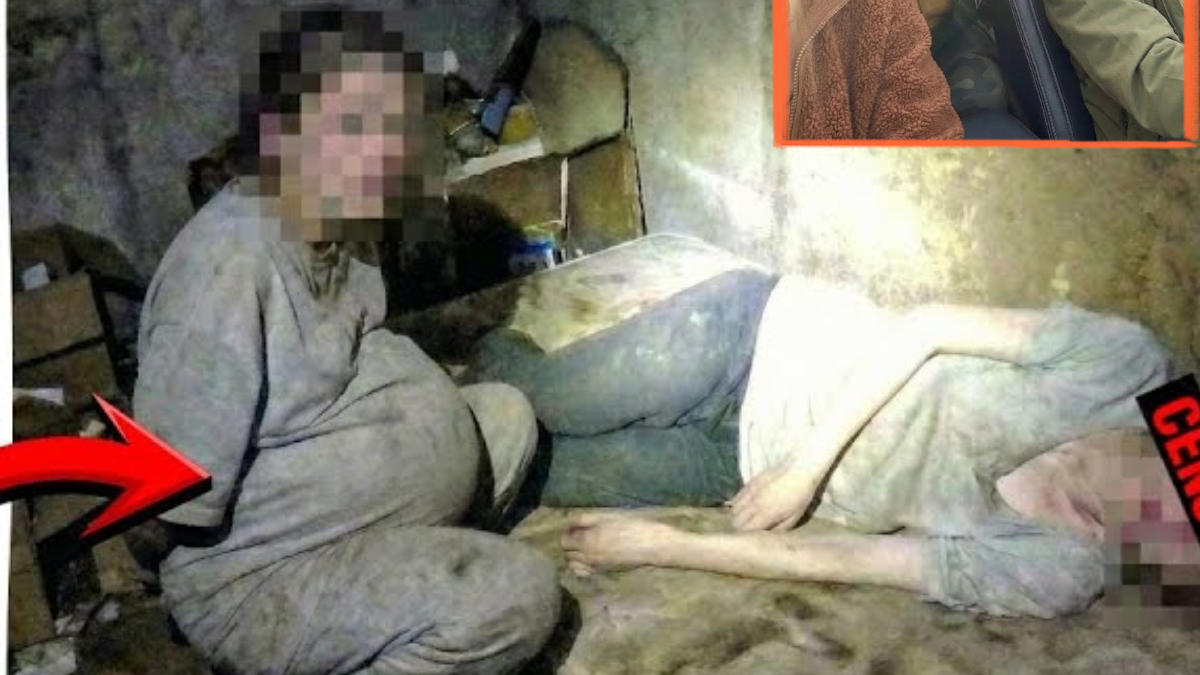
On a soaked mattress in the corner lay a woman in a catatonic stupor, eyes wide, staring at the ceiling. It was Stella Gomez.
Beside her, curled around her to shield her, was Edna Howell. She was anemic and bruised, but conscious.
And she was eight months pregnant.
The team counted the women. They counted the brothers.
One of them was missing.
Part 2
One of them was missing.
Elias had a brother. Silas Krenshaw, thirty-eight, was not in the house, not in the bunker, not anywhere on the property. And in the back of the ambulance, wrapped in a blanket, Karen told them why they must hurry.
“It was him,” she whispered. “The prophet. He chased me. He won’t stop.”
Silas had seen her escape. He had not run back to the farm. He had vanished into woods he knew like the lines on his own hand.
That night, one of the most desperate manhunts in the state’s history began.
To understand how three free women ended up in that bunker, you have to go back to October 2016.
Karen’s memories came out in fragments over hours of questioning, but they all began the same way.
A perfect fall day. Crisp air. Sunlight through the leaves.
A few miles up the trail, they saw two men in camouflage with backpacks. Locals, they assumed. Hunters. One sat on a fallen log. The other stood nearby, looking worriedly at his brother’s leg.
He turned to them with a warm smile. His brother had twisted his ankle, he explained.
Karen was a nurse. Her instinct was to help. She knelt to examine the leg while Stella and Edna stood beside her.
The world narrowed to two sounds. A quiet click. A high, shrill buzz.
A paralyzing pain tore into her neck. Her muscles locked. The last thing she saw was Edna’s wide, frightened eyes as her friend fell too.
It was a perfectly staged trap. And it closed in a heartbeat. 🕯️
When Karen woke, there was only darkness.
It was a darkness she had never known, thick and absolute, without even a hint of light. The air smelled of damp earth, mold, and something sour. She lay on cold concrete.
Then she heard a low moan. Edna. Then another, close by. Stella.
They were together. For one second, that felt like relief.
Then dread flooded in.
The room was a small, soundproofed bunker beneath a farm called Blackwood Ridge. Their captors, the Krenshaw brothers, had built a cruel and insane order.
Each was convinced the outside world was infected by sin and doomed to burn. They believed they were destined to seed a new, pure humanity. And for that, they believed, they needed women.
There was a bucket in the corner for a toilet. Once a day, at no fixed time, the heavy door groaned open and a bowl was thrown into the dark. Sometimes it held scraps from their own table. More often, it was cheap canned dog food.
They set three rules, enforced instantly and severely.
One: Call us fathers.
Two: Never speak to each other.
Three: Always look at the floor.
In the first weeks, the women whispered to one another when they thought the brothers were asleep. But the brothers heard everything.
One day, Edna, weeping from hunger, asked Karen quietly whether they would survive.
The door swung open at once.
Silhouetted in the dim corridor light, a brother stood with a short length of rubber hose in his hand.
He said nothing at all.
The brothers had divided their roles. Elias, the younger, was the overseer. The women called him the executioner. His visits meant pain, and he seemed to need it, the way a child given power over helpless creatures needs it.
Silas, the older, was the prophet. His madness was colder, built on ideology. He read sermons of his own invention, wild mixtures of twisted scripture and paranoid conspiracy, while the women knelt on cold concrete. What followed those sermons, he called sacred rituals.
The law has another word for it. Karen could not speak of it without her voice breaking. The women lived through it daily, reduced in the brothers’ minds to nameless vessels.
Then came May 14, 2017.
Stella, who had held her ground longer than any of them, refused to obey during one of Silas’s sermons. She kept her eyes down and said, quietly, that she hated them.
Silas did not strike her. He looked at his brother and said:
“Bring the box.”
It was a crude coffin-sized crate of rough boards. No adult could straighten inside it, or lie down. Only sit, bent double.
Stella was shoved inside. The lid slammed. The light vanished.
“She will be cleansed by silence,” Silas said.
For twenty-four hours, Karen and Edna heard her screaming and beating on the wood. Elias kicked the crate, demanding quiet. On the second day, the screams dwindled to sobbing, then to incoherent muttering.
On May 17th, after three days, they finally opened it.
The woman they dragged out was someone else. Her muscles were so locked she could not unfold. Her skin was raw. Her eyes stared at nothing.
She never spoke again.
Karen understood in that moment that if any of them were to live, someone would have to take charge.
And then, one evening months later, Elias brought water to the bunker and looked at Edna.
It was not the look of an executioner. It was something Karen had never seen on his face, a strange mix of curiosity and sickening awe.
He did not strike her. He set the bowl gently beside her.
Karen felt cold dread close around her heart.
The rules were about to change.
Part 3
Edna was pregnant.
She had known for days, listening to her body in the dark. First the nausea, which she blamed on the food. Then a deep, inexplicable exhaustion. When the truth finally settled, it was so monstrous she could barely speak.
She whispered it to Karen in a stolen moment.
And when Silas learned, he did not rage. He was seized by a chilling, messianic joy.
For the first time in months, he came down with a flashlight instead of a hose. He studied Edna like some strange sacred object. He declared it a sign from above. She was a chosen vessel, he said, carrying the first child of a new, pure world.
He forbade Elias to touch her. The beatings stopped. In their place came a suffocating psychological terror. Silas sat at the bunker door for hours, reciting his sermons to the unborn child. He brought her slightly better food, sometimes a bottle of clean water.
To him, Edna was no longer a person. She was an incubator for his delusions.
And Elias, denied his favorite victim, turned all his rage on the other two. Karen and Stella suffered more than ever. Stella, already adrift, drew so far into herself that nothing could reach her.
Karen looked at her pregnant, exhausted friend and her silent, broken one, and made a decision.
She was a nurse. She knew what her captors did not. Childbirth in that filth, with no medical care, would kill both Edna and the baby.
No rescue was coming. Hope had died long ago.
If they were going to live, she would have to do it herself. 🌙
Her plan took almost inhuman patience.
During one feeding, she managed to slip a metal spoon against the wall and hide it. That rusty scrap became her only tool.
High on the ceiling, almost invisible in the dark, was a small vent held by rusted bolts. Month after month, whenever the brothers slept or were away, Karen worked the spoon against one of those bolts, risking discovery with every scrape. She stripped the skin from her fingertips. Each squeal of metal sounded like thunder in her ears.
She also kept the others alive. At night, when the hum of the ventilation drowned out sound, she crawled to Stella to massage her wasted muscles and force water between her lips. She split the dog food into equal shares and made them eat, even as her stomach heaved. She whispered about coffee, the smell of rain, the softness of a bed.
She scratched a calendar with her fingernail on a wall where the camera could not see.
The brothers believed their order was unbreakable.
Then, on a bitter February night, 2018, Karen heard them arguing upstairs, then Elias’s drunken snoring. And then, in that silence, she heard something she had never heard before.
A click.
Elias, drunk, had left an inner door unlocked.
With a strength she did not know she had, Karen forced the loosened bars apart, squeezed through the narrow gap, and crept down the hall. She slipped past Elias’s sleeping form and out the back door into the night.
The icy air seared her lungs. But Silas, paranoid, had rigged a single camera on the bunker corridor. On the monitor in his room, he saw an empty hallway.
A furious roar split the farmhouse. Behind her, Karen heard a door slam, Silas shouting, and the cold, mechanical click of a shotgun.
She ran barefoot through thorns and over frozen ground, feeling nothing. Ahead, she saw headlights and ran into the road waving both arms. The car sped past without slowing.
But in the foggy distance, a faint glow.
A twenty-four-hour gas station.
By dawn, Edna and Stella were in an ambulance racing to a trauma center. Elias, passive and broken, was in custody.
Silas was gone.
For the state police it was the start of one of the most desperate manhunts in their history, a fugitive prophet in his own wild kingdom, armed, and at home in the forest.
Searching the farmhouse, forensic teams found dozens of thick notebooks filled with Silas’s fevered handwriting. Rambling sermons. Apocalyptic prophecies. And among them, hand-drawn maps of old abandoned mine tunnels winding through the surrounding hills.
He had a plan. And a hundred places to hide.
Helicopters swept the hills. Dogs followed his trail from the farm, hampered by wet weather and rough terrain. For two days, officers combing the woods felt as if they were being watched. To Silas, they were demons in uniform, messengers of the infected world he was trying to escape.
On the third day, a dog near the old silver quarry froze, then barked furiously toward a rocky ledge. Behind dense brush was a shallow cave. Crushed grass. An empty tin can. Fresh tracks.
The tactical team closed the ring.
A shot cracked from the top of a rubble pile. Then his voice, the screeching cry of a preacher, cursing the officers as servants of the unclean.
He was not trying to escape. He was delivering his last sermon.
The firefight was short. A sniper’s single round struck his shoulder and knocked the rifle from his hands. Even wounded, he fought like an animal until officers pinned him to the stones. As cuffs snapped on, blood soaking his clothes, he kept screaming.
“You have changed nothing! The purge is not complete!”
Back at the farm, investigators found something in an old trunk: a stack of VHS tapes.
The brothers, in their megalomania, had recorded everything. Hours of Silas’s apocalyptic sermons. And fragments of punishment, filmed by a camera on a tripod. The footage was so brutal that after viewing it, the district attorney made an unprecedented decision. The jury would never see the tapes. They would only hear the transcripts.
In the hospital, Edna’s weakened body could not give birth naturally. Doctors performed an emergency cesarean, and a healthy baby girl was born. Staff said they could hardly believe the vitality of a child born in that hell.
Stella’s body recovered, but her mind stayed behind. Psychiatrists described a deep dissociative state, a wall built against the unbearable. She did not speak. She ate when fed.
And Karen became the voice of the prosecution. Exhausted, she still spent hours with detectives, her memory sharp and precise. She described the brothers’ favorite game. After some trivial offense, like spilling water, they would line the three women up and force them to choose which of them would be punished for the group’s guilt.
It was designed to destroy their friendship.
It was the one plan that failed. They never chose. They took the punishment together.
The trial began in spring 2019 and became a national spectacle. The public wanted retribution.
The defense did not dispute the facts. Instead, they argued that the brothers were legally insane.
Psychiatrists testified that both men suffered from profound paranoid schizophrenia, worsened by years of isolation and a rare condition called folie à deux, in which one dominant person’s delusions are completely shared by another. They were not pretending. They truly believed their actions were a sacred duty.
Karen took the stand. The brothers sat at the defense table in anti-bite masks and restraints, nothing like the all-powerful “fathers” of the bunker.
In a steady voice, she recounted sixteen months of hunger, cold, and darkness. She spoke of Edna’s pregnancy, and how it had turned her friend into a “sacred vessel.” She told how they had survived together, whispering through the dark, sharing crumbs, holding on to their humanity.
It was less a testimony than a hymn to friendship.
After days of deliberation, the jury found that the Krenshaw brothers had committed the kidnapping, the assaults, and the torture.
Then the foreman read the verdict on sanity.
Not guilty by reason of insanity.
The country erupted. But the judge explained that, given the unanimous psychiatric opinions, the jury could not have reached any other conclusion. And it did not mean freedom.
Both brothers were committed to a maximum-security hospital for the criminally insane, indefinitely, with no right to review. In effect, a life sentence, not in a prison cell, but in a padded room where their delusions would be their only company.
A few months later, Edna made the hardest choice of her life. She gave her daughter up for adoption to a closed family. She knew she could never look at the child without seeing the place she came from. It was not abandonment. It was the greatest act of love she could offer, a chance for the girl to grow up untouched by the shadow of Blackwood Ridge.
The three friends left Missouri, bound forever by what they had endured. They began the long, painful work of learning how to live again, how to trust, how not to fear the dark.
Their friendship, forged in unimaginable suffering, was the only thing that had never broken.
The nightmare in the Ozark woods was over.
But its echoes, like a quiet whisper in the silence, will follow them forever. 🌙💔
This story is entirely fictional and created for entertainment purposes only. It does not represent any organization or individual, nor does it encourage inappropriate behavior. The content was generated with AI assistance.








