Three Bodies, a Typed Note, and a Husband Who Cried on Cue. 22 Years Later, a Dying Man Looked Into a Camera and Said, “You’ve Got Your Serial Killer.”
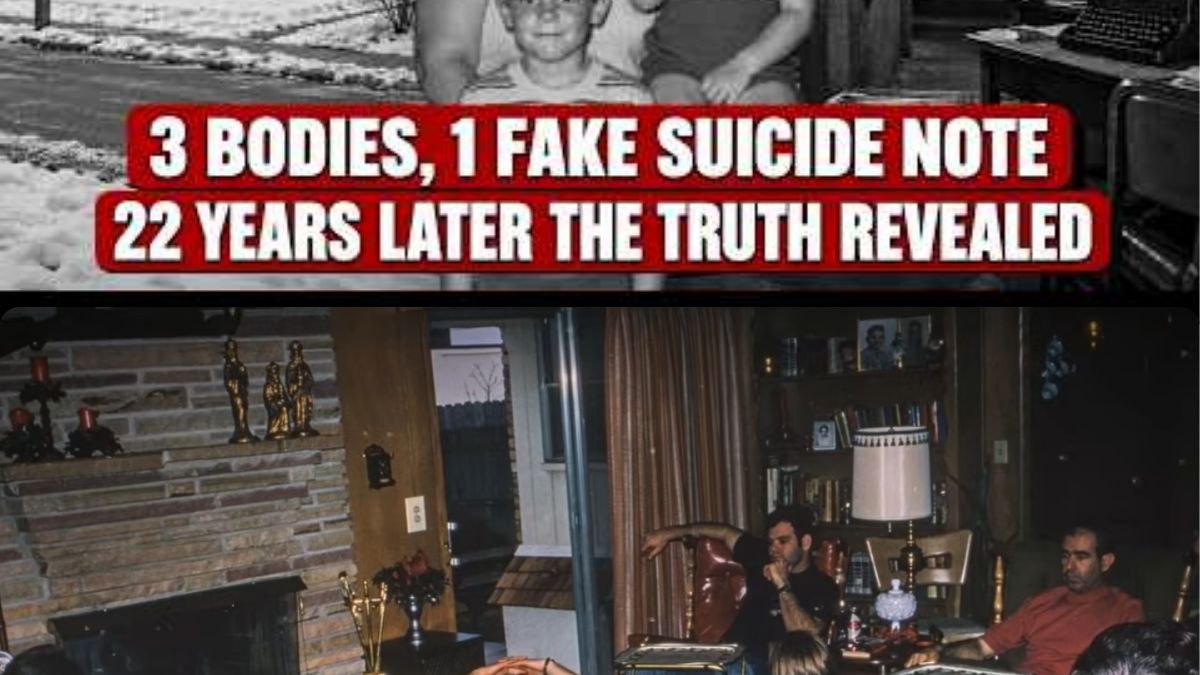
Three Bodies, a Typed Note, and a Husband Who Cried on Cue. 22 Years Later, a Dying Man Looked Into a Camera and Said, “You’ve Got Your Serial Killer.” 😨
Part 1
On the morning of December 30, 1978, police walked into a quiet suburban house outside Denver and found three bodies.
Helen Marsh, forty-five, lay in the basement with a single bullet wound in her forehead. Upstairs, her son Daniel, seventeen, and her daughter Sarah, fifteen, lay dead in their beds.
A .38 revolver rested in Helen’s hand. A typed note sat on the table, signed with a single letter: N.
Her husband, Richard Hale, stood in the doorway, shaking and sobbing. He had gone to work, he said. He had come home to this.
The officers believed him. It was the kind of street where terrible things were not supposed to happen. 🕯️
Helen had been the all-American girl in a small Iowa town, warm and loved by everyone. Richard had been the football star. They married young and moved west, into a tidy brick house with a lawn and two healthy children.
From the outside, they were the postwar dream.
Inside, something was rotting.
In the mid-1970s, Richard turned forty-one and began to feel trapped. His children were “out of control.” His wife had a life of her own. And at the office, he had met a bright, lively woman named Carol Ames.
He moved out for nine months. He barely saw his kids.
Then he moved back and told Helen he wanted to reconcile. She believed him. In her last days, her family said, she was cheerful, making plans for the new year.
She had no idea she was living in a house with a man counting the cost of leaving her.
The county coroner needed only four days.
On January 3, 1979, he ruled it a murder-suicide. A mother, he said, had shot her children and then herself. The file was closed. Most of the physical evidence was returned to Richard or destroyed.
But some things did not fit.
There were no fingerprints on the typewriter. Only wipe marks, clean and deliberate. Why would a woman about to die polish the keys?
Gunpowder residue was found on Richard’s gloves. Not on Helen’s hands.
Helen weighed less than a hundred pounds. She was afraid of guns. Her family said she had never touched the revolver in that house. And the wound sat high in her forehead, a place almost no one chooses to shoot themselves.
Even stranger, the forensic technician who tested Richard’s gloves took him home afterward. He fed him spaghetti and let him sleep under the same roof.
No one asked the obvious questions.
Helen’s family, the Whitlocks, begged anyone who would listen. She would never hurt those children. Never.
No one listened.
Seven months later, on July 14, 1979, Richard married Carol Ames.
He moved her into the same house, the same living room, the same basement, the same bedrooms. Neighbors who had been Helen’s friends watched in disbelief.
Richard did not care. That chapter was over.
For twenty-two years, Helen Marsh carried the label of a mother who killed her own children.
One relative later said it took her all that time before she could enjoy Christmas again.
Meanwhile, Richard’s life moved on at a pace that should have alarmed someone.
Carol was a hiker and a writer who loved the Grand Canyon and her three dogs. She dedicated a book to Richard and called him her soulmate.
But by the mid-1980s, the marriage was cracking. In 1986, Richard visited his elderly adoptive father, ninety-two and healthy. A few days later, the old man fell badly.
No one investigated. He was simply an old man who fell.
In 1988, Richard and Carol divorced. It was long, expensive, and painful, exactly the kind of divorce he hated more than anything.
Two years later, in August 1990, he married again, to Diane Reyes, a fifty-eight-year-old aerobics instructor. They moved to a small mountain town. Richard became a charming morning radio host, and everyone liked him. No one there knew about his past.
Diane was afraid of heights.
Richard’s greatest love was hiking the Grand Canyon, a world of sheer cliffs and no witnesses.
On Easter Sunday, April 11, 1993, hoping to save her marriage, Diane agreed to one last hike.
That afternoon, Richard walked calmly into a ranger station.
His wife, he said, had fallen.
A search team found Diane Reyes at the bottom of a cliff, 140 feet below the edge. The death was ruled an accident.
Her family did not believe it. They knew she was agile and terrified of heights. They knew the marriage was failing.
They also knew something that chilled them: she was the second of Richard Hale’s wives to die.
But there were no witnesses. No evidence. Only a grieving widower with a perfect story.
And a year later, his previous wife, Carol Ames, moved back into his home.
Five months after that, in October 1994, Carol was dead.
Part 2
Five months after moving back in with Richard, Carol Ames was dead.
He said she left a note and swallowed a bottle of pills. He said he found her, carried her to the emergency room, and watched her slip away.
One account says doctors believed she would recover, but that she was left alone in a room with Richard shortly before she died.
There was no meaningful autopsy. No one asked questions. Richard collected twenty thousand dollars from her life insurance, and he no longer owed her alimony.
Carol had told friends before she died that she believed Richard wanted to harm her.
No one listened to her alive. No one asked questions when she was dead. 🌙
Look at it all at once.
1978: a wife and two children, dead. Murder-suicide.
1993: a wife, dead at the foot of a cliff. Accident.
1994: another wife, dead. Suicide.
Three women. Two children. One man standing at the center of every scene, always the survivor, always with a flawless story.
For the first time since that Colorado morning, someone finally looked at the whole pattern.
By the mid-1990s, federal and county agencies in two states began comparing files. Prosecutors pulled the cases together. An FBI agent in Flagstaff was assigned and brought in the Bureau’s behavioral analysts, specialists who study how killers think and how to make them talk.
Their assessment was chilling. Richard Hale was educated, intelligent, charming. No arrest record. No psychiatric history. The kind of man neighbors called likable.
But when a marriage became unbearable, he did not leave.
He eliminated.
And every time, he staged it as something else: suicide, accident, overdose, anything but murder.
The analysts also knew his weaknesses. He was vain. He loved to tell stories. He liked being the smartest man in the room.
Between 1998 and 2000, agents quietly watched him on the Canyon trails where Diane had died. He hiked there many times a year, relaxed and confident, unaware that every step was being logged.
Then, around 1999, time turned against everyone.
Richard was diagnosed with terminal brain cancer.
Doctors gave him months. If he died before he was charged, the truth would die with him. Helen would stay a murderer in the official record. Diane would stay an accident. Carol would stay a suicide.
But the investigators also saw a door opening.
A man who knows he is dying sometimes wants to talk. And a vain man sometimes cannot bear to take his best secret to the grave.
In September 2000, the team flew to Colorado. A federal prosecutor traveled with them to give legal advice on the spot. Because everything depended on whether a confession would hold up, they agreed to record the entire interview on video, from first word to last.
Richard was sixty-seven. He was living in Grand Junction with his fourth wife, whom he had married only weeks earlier. The tumor was growing.
An FBI agent and a county detective knocked on his door.
They told him they were looking into the death of Diane Reyes at the request of her family.
Richard did not ask for a lawyer.
He invited them in and sat down.
And then, as the camera rolled, he began to talk.
Part 3
For hours, Richard Hale spoke in a calm, cooperative voice, exactly as the behavioral analysts had predicted.
No one pounded the table. No one raised their voice. The investigators asked, and listened, and let him talk.
And Richard, who had always loved an audience, talked.
First he confessed to Diane Reyes. He said they had been standing near the edge of the cliff. The idea had been in his head for a while, he admitted. When the moment came, he decided it was now or never.
He pushed her. She fell about a hundred and forty feet. He did not look down.
Then he walked to the ranger station and reported an accident.
The room went still. But he was not finished.
Without being asked, he moved to the morning of December 30, 1978.
He described how weeks earlier, he had typed a note on the basement typewriter. He told Helen it was a Christmas letter and placed it in front of her. She signed her initial at the bottom without reading it.
She had signed her own death warrant and never knew.
On the night of December 29, he staged a loud fight so neighbors would hear and remember her as unstable. The next morning, he took the revolver from the closet and called Helen down to the basement. He told her he had a surprise.
He described what happened next in a voice so level that the veteran investigators felt cold.
He shot Helen. Then he went upstairs, and shot Sarah as she slept. Daniel, taller and stronger, woke when the first shot failed to kill him. The boy fought. Richard did not fire again, because he knew a mother who had really done this would not have shot one child twice.
He used a pillow instead.
Then he arranged the scene. The gun in Helen’s hand. The note on the table. Then he called the police and played the grieving husband.
Why? the investigators asked.
His answer was the most terrible part of all. He was unhappy. He wanted to be with Carol. Divorce was too expensive. Once he had made the decision, he said, he simply carried it out, as if describing a business plan.
He called the act of killing something that required special concentration.
And then he said the words the investigators had waited twenty-two years to hear.
“You’ve got your serial killer.”
He said it like handing over a business card.
He denied killing Carol Ames. He insisted she overdosed on her own. The investigators had no evidence to contradict him, and her death remains the one in the chain he never admitted.
The team left that evening, certain he would reconsider overnight, ask for a lawyer, and take it all back.
The next morning, Richard Hale called the FBI agent himself.
He wasn’t calling to retract anything. He wanted to continue the interview after breakfast. He had more to tell.
That was the moment the analysts understood him completely. It was not remorse. It was vanity. He had held this secret for twenty-two years, shaking hands, telling jokes on the radio, smiling at neighbors, while no one knew how clever he had been. Now that death was close, that silence had become unbearable.
On October 3, 2000, handcuffs finally closed around his wrists.
A month later, Richard pleaded not guilty. He claimed the brain tumor had warped his mind and made him say false things.
But he had a problem he could not talk his way around.
The videotape.
The man on that tape was calm, coherent, and precise. He remembered Helen signing the note without reading it. He remembered which shot failed to kill Daniel. He remembered exactly where and when he pushed Diane. No tumor invents details like that.
The investigators had recorded every minute for exactly this reason.
Faced with the tape, Richard agreed to a plea. A federal grand jury indicted him for the first-degree murder of Diane Reyes, and he was sentenced to life in prison without parole. The confession also backed the murder charges for the three 1978 killings.
For the first time in twenty-two years, the official record told the truth.
Helen Marsh had not killed her children. Helen Marsh had not killed herself. She had been shot in her own basement by her husband.
Daniel and Sarah had not been murdered by their mother. The note was fake. The scene was fake. The story the county had believed for more than two decades was fake.
And the Whitlock family, who had insisted on the truth from the first day, were finally heard.
Richard Hale died in prison in August 2001, of brain cancer, at sixty-eight. He had lived free for twenty-two years after the murders of his wife and children, and spent less than a year behind bars.
Justice came so late that the man almost escaped it. But for the Whitlocks, the sentence was never the point.
The point was Helen.
For twenty-two years, anyone who searched her name found a mother who killed her children. That was the legacy Richard built for her. He had not only taken her life, he had stolen her name.
She was cleared not by a trial, not by DNA, and not by technology, but by the mouth of the man who killed her.
The case is now taught to investigators as a lesson in how behavior can break open a cold case. Even with the physical evidence gone and the file closed, understanding a killer’s psychology made it possible to link deaths no one had connected.
It is also a lesson about failure. A coroner reached a conclusion in four days. Evidence went back to the suspect. No one asked why the powder was on the husband’s gloves and not the wife’s hands. No one asked why the typewriter had been wiped clean. No one asked why a woman afraid of guns would shoot herself in the forehead.
If someone had asked, Diane Reyes might still be alive. Carol Ames might still be alive.
But no one asked.
On the morning of December 30, 1978, a man called his wife down to the basement and told her he had a surprise.
For twenty-two years, the world believed his story.
In the end, it was his own vanity that undid him. He could get away with murder. He just could not bear for no one to know. 🌙💔
This story is based on a real criminal case. Names, places, and some details have been changed. It is written for entertainment and awareness, does not represent any real individual or organization, and was generated with AI assistance.








