THROWN OUT IN THE RAIN FOR REFUSING A 50-YEAR-OLD HUSBAND, SHE OPENED THE ENVELOPE THE COOK SLIPPED HER, AND FOUND THE SECRET HER DEAD FATHER HID FOR 8 YEARS
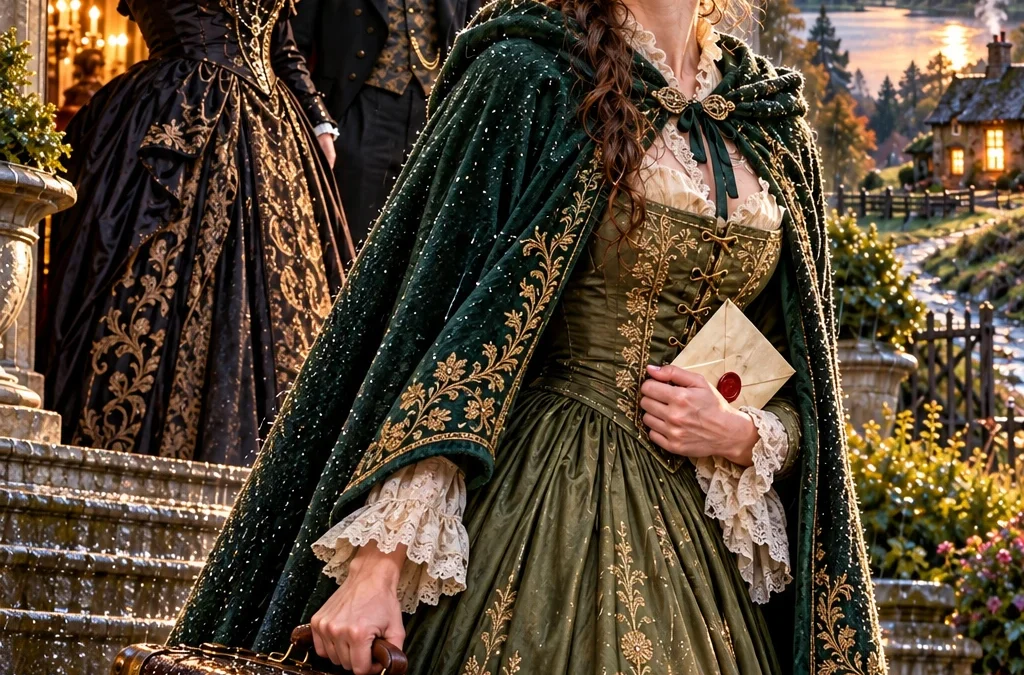
THROWN OUT IN THE RAIN FOR REFUSING A 50-YEAR-OLD HUSBAND, SHE OPENED THE ENVELOPE THE COOK SLIPPED HER, AND FOUND THE SECRET HER DEAD FATHER HID FOR 8 YEARS 😱
Part 1
“If you walk out of this house, Evelyn, you will never be welcome back.”
Beatrice Hartwell said it the way she said everything: softly, perfectly, like a woman reading from a book of manners.
She stood in the drawing room doorway in dark silk, a ring of household keys hanging from one hand. Beside her, Lionel leaned against the mantel with the smug patience of a man who believed hunger would win the argument that words had not.
Evelyn Hartwell was twenty-two years old.
The gentleman they had chosen for her was fifty. 💔
Sir Ambrose Vail was recently widowed, wealthy in appearance and heavily mortgaged in fact. He wanted the modest income attached to her late mother’s settlement. Beatrice wanted his influence with the creditors circling the family estate.
Neither of them wanted Evelyn’s consent.
For a moment, only a moment, Evelyn had almost said yes.
She had seen the unpaid coal bill hidden beneath Beatrice’s writing case. She had heard the servants whispering about wages. Lionel had told her that everyone must sacrifice something for the family, and he had said it while ordering new riding boots.
But then she had read the settlement.
It placed her mother’s income under Sir Ambrose’s management, with no accounting she could ever demand. When she asked to show it to a solicitor of her own choosing, he smiled and called the precaution unladylike.
That smile decided her more than his years ever could.
“Selfish,” Beatrice said.
“Impractical,” said Lionel.
Evelyn looked at them both. “Why must the family’s rescue cost only one person?” she asked. “Her freedom?”
Nobody answered.
“Then I shall not come back,” Evelyn said.
Her voice was so low that Beatrice leaned forward to hear it. That, more than any shouting, seemed to offend her.
An hour later, a carriage left Evelyn beside a toll road in the cold November rain. 🌧️
The driver would take her only as far as Brackenford, where the last of her father’s distant properties was said to stand. Lionel had counted the coins in her purse aloud before dropping them into her palm, one by one, so she would remember how little she had.
Sir Ambrose had not even come down from the drawing room.
But in the entrance hall, just before the door closed, Martha the cook, who had known Evelyn since she was a child, had pressed a narrow envelope into her fingers.
“Your father left this with me,” she whispered. “He said to give it to you only if you had no other door to knock upon.”
Then the door shut. The carriage rolled forward. And Evelyn was carried away from the only home she had ever known.
Her father, Jonathan Hartwell, had died three winters earlier. He had been a quiet man of account books, maps and unhurried promises. His illness had come faster than anyone expected, and his papers had passed into Beatrice’s hands along with the household keys.
Evelyn had searched for a final message from him and found nothing.
She had mistaken that silence for absence.
She waited until the first halt at a coaching inn before she dared to open the envelope. Inside, in her father’s unmistakable slanted handwriting, were three short lines:
Ask Mister Bellamy in Brackenford about Fernwick Hill. He has the registered papers. Trust what is written more than what is said.
No money. No promise of a fortune. No explanation for the strange name.
She read it again while the innkeeper put out the lamps, then tucked it into the lining of her glove.
Brackenford lay beneath the northern hills, its houses clustered around a mill and a narrow stone bridge. When Evelyn arrived the next afternoon, wet wool clung to her shoulders and her boots were ruined.
Mister Bellamy, the solicitor, had died the previous spring.
But his clerk, Thomas Fenwick, still kept the office. He was a thin, exact man with pale eyes and an ink stain on his cuff. The moment he saw Jonathan Hartwell’s handwriting, he forgot to offer her a chair.
“I wondered,” he said quietly, “whether you would ever come.”
From a locked cabinet he drew out a packet of receipts and a signed deed. 📜
Eight years earlier, when Evelyn was only fourteen, her father had quietly bought a cottage and seven acres on Fernwick Hill. He had placed them in a trust for her, to be held by trustees until her twenty-first birthday, and then given to her outright.
And her twenty-first birthday had already passed.
Fenwick turned the deed toward her.
“Miss Hartwell,” he said, “this land has been legally yours for more than a year. Your stepmother never knew it existed. No one at Hartwell House did.”
Evelyn stared at her own name in the ink.
She had walked out of that house believing she had nothing.
And somewhere behind a locked door, a hidden cottage had been waiting for her the entire time.
👇 Want Part 2? Find it in the comments, or drop any word below and I’ll send it to you privately. 👇
Part 2
And somewhere behind a locked door, a hidden cottage had been waiting for her the entire time.
“Why was I never told?” Evelyn whispered.
Fenwick hesitated. “Your father gave no reason in the deed. But he came here twice after the purchase. The second time, he asked whether a married woman’s property could be controlled by her husband.”
Evelyn went very still.
“I told him the law was changing,” Fenwick said. “But that marriage could still bring complications. He asked me to keep the records safe, and to deal with you directly if you ever arrived.”
Evelyn understood more than she wished to.
Her father had feared the very marriage Beatrice had tried to force on her. 😢
That night at the inn, a merchant named Gideon Rusk heard where she meant to go. He laughed into his ale.
“Even the sheep prefer to sleep outdoors up there! Fine reward for a lady who couldn’t keep her engagement.”
Every eye in the room turned to her.
Evelyn could have told them everything. Instead, she paid for her supper and climbed the stairs with her head high. She had learned that an explanation offered to someone determined to mock you was only another gift they did not deserve.
The next morning she walked uphill with her trunk. At the fork in the road, an elderly woman was trimming dead stems from a winter rose.
“Hartwell’s daughter,” the old woman said. It was not a question. “I am Miriam Wren. He used to stand at that gate and look up at the ridge. He asked a great many questions about the old spring.”
“The spring?”
But Mrs. Wren had already turned back to her roses.
“You may find a house up there,” she said. “What he wanted you to find was a way of living.”
The track vanished between hazel trees and thorns. By the time Evelyn reached the clearing, her skirt was caked with mud to the knees.
The cottage stood at its upper edge, half hidden by bramble. The roof was dark with rain. A shutter swung from one hinge. Beside a moss-covered well, a lean-to shed had collapsed.
It looked less like a gift than a difficult question.
Evelyn put down her trunk and laughed once, unexpectedly. Then the tears came, quick and furious.
Not because the cottage was poor, but because it was hers. 🏚️
Beatrice could lock a front door. Lionel could count her coins. Sir Ambrose could withdraw his promises.
None of them could dismiss her from land conveyed by a signed and witnessed deed.
That night, a striped cat crept out from beneath the stairs and sat beside her boots, looking as though he had expected better hospitality.
“I have no milk,” she told him. “But you may share the roof if the roof agrees.”
He blinked slowly. She named him Thistle.
In the morning, she found something strange. Beneath the kitchen window, almost hidden by old paint, someone had carved a tiny lantern. Another was scratched beneath the mantel. In the pantry, a loose shelf bore three shallow notches that matched markings on an old map in a drawer.
Her father had left a trail.
After days of mending shutters and carrying water, she followed it to the north wall. Beneath the third stone, she found an iron ring almost swallowed by lime.
With a borrowed screwdriver, she pried open a small hidden compartment.
Inside lay a copper canister wrapped in oilcloth. 😮
Inside the canister were a key, a notebook marked with her father’s initials, and a folded letter.
Evelyn washed her filthy hands in cold water first, as though ordinary care might steady her. Then she sat at the table and unfolded the letter.
My dearest Evie, it began.
No one had called her that since his funeral.
Her breath caught at the next line.
By now you will have learned what Beatrice is capable of, but you do not yet know what I did to stop her, or what I was too afraid to tell you while I lived…
👇 Want to know what her father confessed? LIKE or COMMENT “REVEAL” and Part 3 will be posted once we have enough comments! 👇
Part 3
…or what I was too afraid to tell you while I lived.
Evelyn’s hands trembled. She made herself keep reading.
Jonathan wrote that he had long understood how precarious her place was in his second household. He loved her, he said, but love that spoke only in private was not protection. He had seen how Beatrice made small cruelties sound like lessons in manners. And he had sat at the dinner table, quiet and cowardly, and let it happen.
Love did not always make me brave, he confessed. That is my shame, and I will not hide it from you.
Evelyn wanted to forgive him at once. She resisted the wish, and kept reading.
He explained that he had bought the cottage when she was fourteen, years before his illness, and had told no one. If he announced it, Beatrice would insist it be sold to meet the household’s debts. So he had separated what savings he lawfully could from his business affairs. He had asked Bellamy to confirm the deed was complete and that nothing was owed on the land.
He had meant to take her there himself after her twenty-first birthday.
He died when she was nineteen.
It was an imperfect plan, he wrote, made by an imperfect father who delayed too long.
Evelyn pressed her hand to her mouth. The truth hurt. But it was more believable than a perfect excuse would have been.
I hope you never need Fernwick. But if you do, remember this: a home is not measured by the people who permit you to enter it. It is measured by the freedom you have to open the door yourself.
She held the paper against her chest and cried until the tears blurred the ink. Then she dried it carefully beside the stove. 🕯️
The notebook held no secret fortune.
It held the hillside. A buried line of an old spring. Stony ground that could still be cultivated. A surviving orchard on the southern slope. The names of families who had once sheltered in the cottage when winter storms closed the road.
And a final entry: Jonathan had dreamed of restoring the place as a small nursery and stopping house, where travellers could warm themselves and seedlings could be raised for struggling farms.
I have not built this for you, he wrote. I have only left you the chance to decide whether it should exist at all.
The key opened the locked rear room. Inside were old benches, stacked clay pots and a rusted seed sorter. Light fell through two grimy windows facing the orchard.
Evelyn stood there a long time, imagining not a hidden inheritance, but a life built from years of ordinary work.
That night she made two columns on a sheet of paper. In one, what she had: land, a leaking roof, untested water, a neglected orchard, and a bank deposit that would shrink with every purchase. In the other, what she lacked: experience, credit, friends, and certainty.
She stared at the second column far longer.
It was easier to love a dream than to pay for it.
Mrs. Wren came two afternoons later with twine and a packet of broad beans.
“Your father asked me whether the ground would still grow anything,” she said. “I would not put his hopes in your mouth before you knew your own.”
They sowed a small trial row against the sheltered south wall.
Then Gideon Rusk rode up to the clearing, without removing his gloves.
“I can relieve you of all this,” he said. “A woman alone cannot keep a hillside. I will pay you before the first hard frost.”
His offer was barely half of what Jonathan had paid.
“The land is not for sale,” Evelyn said. “You may wish I had listened. But the decision will still be mine.”
His face tightened. He left without a farewell.
Days later, she found his offer copied onto fresh paper and pushed beneath her door, with one new sentence added: the lane from the North Fork crossed his pasture.
Now she understood.
He wanted to close the old track and join his two enclosures. Owning Fernwick would let him erase the problem without a quarrel over deeds. His mockery at the inn had never been harmless sport. It had been the opening pressure in a negotiation she had never agreed to enter. 😠
She did not burn the letter. She folded it into the drawer with her receipts.
Trust what is written, her father had said. Written threats deserved the same attention as written promises.
The first storm came before her repairs were finished.
By midnight, water ran down the loft wall. Evelyn was scrambling to protect the papers when a pounding shook the door.
On the threshold stood Nora Mercer, soaked to the skin, holding her six-year-old daughter Maisie by the hand. The child was shivering, her face white. A gust had torn half the roof from their home. Daniel had stayed behind to save the livestock. They had seen Evelyn’s window lamp through the trees.
Evelyn pulled them inside.
She wrapped Maisie in her own blanket, set broth by the hearth, and listened to the child’s breathing until it settled. For an hour, no one spoke.
“I nearly walked past,” Nora admitted at last. “People said you wouldn’t welcome anyone.”
“They’ve been wrong about one thing already,” Evelyn answered.
When the rain eased, she looked around the little room. Three people sheltered beneath the mended shutter, and one striped cat took far more than his share of the warmth.
The cottage felt larger than it ever had before. 🏡
Maisie recovered. Daniel returned with thanks, and soon brought his brother Owen to thatch the roof. Evelyn insisted on agreeing every price in advance. Fenwick wrote down even the small favours between them, so that kindness would never become confusion.
Not everything went well. A late frost killed the first seedlings. She burned a loaf of bread asleep beside the oven. She misread a mason’s price and had to give up new curtains. She ate porridge for a week. Her palms blistered, and some evenings the loneliness was louder than the wind.
Yet every morning, there was something she could do to make the place stronger.
By spring, she and Daniel had followed the old spring line, and clean water began to trickle into a stone basin downhill. Evelyn raised blackcurrant cuttings and herbs. Mrs. Wren introduced her to households needing cheap plants. When the village schoolteacher ordered twelve young apple trees for the schoolyard, Evelyn laughed through tears at her kitchen table. ✨
Then Daniel rode up the hill without his wagon.
Rusk had set new posts across the lower fork. The teacher’s driver refused to risk it. Unless Evelyn delivered by Friday, the order was lost.
She walked down and found a sturdy fence and a small sign: private grazing.
Rusk stood behind it, hands in his pockets.
“You may carry your trees one by one,” he said. “Nothing in your deed compels me to provide a road fit for trade.”
She wanted to smash the gate with a stone. But she pictured Beatrice’s satisfaction if word spread that she had made a scene.
She tried the ridge path instead. It was steep and wet, and two saplings fell and broke when the hired boy slipped. Evelyn sat beside the shattered pots until the rain soaked through her sleeves.
For the first time, she seriously considered selling.
It frightened her to realize the temptation was not to submit to Rusk. It was simply to stop being responsible for everything. 💔
Instead, on Monday, she spread the deed, the estate plan and her father’s notebook across the table, and carried them to Fenwick.
The school’s deadline passed before she returned. The order was lost.
But Fenwick found an older conveyance granting the cottage a defined right of passage for carts. A qualified surveyor checked the boundary stones against the estate plan. The new fence blocked the documented route.
Fenwick sent Rusk the survey and a formal demand.
Rusk disputed the width of the passage. His solicitor replied. A fortnight dragged by before a letter proposed moving the fence to the surveyed line, without admitting fault, each side bearing its own costs.
Fenwick warned her that a court might give her the same result, but the fees could eat the money she needed to keep the house warm. She agreed only after he recorded that her existing right of passage would remain undisturbed.
Daniel and the surveyor watched the fence move.
Evelyn never recovered the lost order, or the money spent proving a right she already held. What she gained was a road she could use without asking permission.
That evening she planted one damaged sapling at the gate. She entered the survey fee in her ledger.
What her father had given her was real. It was not invulnerable. She would have to defend it, and sometimes the defence would cost more than seemed fair.
Soon afterward, Rusk came up the hill alone.
He stood beside the nursery beds, looking at the young trees tied to slender stakes.
“I expected you to leave,” he said. “Many would have. I judged you before I knew you.”
He admitted the words at the inn had been cruel.
He did not become her friend. She did not pretend a brief apology erased months of trouble.
“Thank you for saying so,” she said simply.
When he left, the fence at the bottom of the hill stood on its proper line. 🍎
That summer, two sisters travelling to their aunt’s house sheltered at the cottage during a thunderstorm. Evelyn gave them tea and dry towels. A farmhand with a broken cartwheel waited under the lean-to. Mrs. Wren began leaving books in a wooden box by the door, so village children could borrow them.
No grand institution was announced. The house slowly learned its purpose through the needs of those who arrived.
Evelyn was careful not to promise more than she could keep. She posted a small notice: the cottage offered temporary shelter in bad weather, but was not an inn or a medical station. She kept a reserve for food, fuel and repairs, and kept the nursery’s money separate from what helped travellers.
Her father had left a beginning, not a bottomless purse.
Late that summer, a farmer’s wagon brought an unexpected visitor up the hill.
Martha.
Beatrice had dismissed her after discovering she had kept Jonathan’s envelope. Lionel had tried to make her sign a statement claiming it had been stolen. She had refused.
She had come with a stained recipe book and the small savings she had kept through years of service.
Martha told her that Sir Ambrose had married elsewhere. The Hartwell household was selling furniture to pay its debts. And Lionel was telling everyone that Evelyn would come begging before winter.
Evelyn listened beside the fire. Once, such news would have felt like revenge. Now it sounded like a report from a place where she no longer belonged.
“Have you somewhere safe to go?” she asked.
“No,” Martha said.
“Then stay a fortnight,” said Evelyn. “While you decide.”
They did not form a partnership out of gratitude alone. Martha knew how to preserve fruit, price bread and run a kitchen for ten hungry people. Evelyn knew seedlings and ledgers. They drew up a trial arrangement: wages for Martha, and a share of profits from preserves, while her savings remained entirely hers. Fenwick witnessed it, so neither woman would depend on memory or goodwill.
The plum preserves sold slowly at first. By the third market day, the jars were nearly gone.
Martha asked to stay. 🥹
In September, a letter arrived in Lionel’s hand.
Evelyn knew it before she broke the seal. Beatrice was unwell. The last creditor would accept only immediate payment. The family expected Evelyn to contribute something from the property her father had acquired.
There was no apology. It ended with a reminder of all the years Beatrice had provided her with a home.
It would have been easy to answer in anger. Easier still to send money, just to silence the old accusation of selfishness.
Instead she walked outside, past the gate where the damaged sapling had taken root, and thought of Martha’s wages. Of coal to buy before the frost. Of Maisie’s small hands carrying kindling after the storm.
Those obligations were not less real because nobody at Hartwell House knew their names.
She wrote a short reply. She regretted the household’s difficulties. She would neither pledge Fernwick nor fund debts she had not incurred. Any question concerning her late mother’s settlement should go to the trustees through a solicitor, not to her cottage door.
She wished Beatrice good health.
She did not ask to be welcomed home.
When the letter was sealed, Evelyn felt no triumph. Only the unfamiliar quiet of having said no without waiting to be punished. 🕊️
By the autumn of 1892, nearly a year after she arrived, silver mist lay over the orchard on Fernwick Hill. The nursery was not rich, but it covered food, seed and most expenses. The roof stood straight. The chimney drew well.
A green sign hung beside the front gate, its lettering painted by Maisie with a grown-up’s help:
Fernwick Lantern House.
Mrs. Wren stood beneath it one afternoon, studying the words.
“A lantern,” she said. “Your father would have liked that.”
“He never said I must do any of this,” Evelyn replied.
“No,” said Mrs. Wren. “That is why it was a gift.”
Late that night, after Martha had gone upstairs and the last cup was washed, Evelyn sat by the hearth with her father’s letter on her lap. She knew every line by heart.
For years she had believed he had left her nothing but memories, and a name others were free to use against her.
In truth, he had given her land, a little money, practical notes, and something harder to recognize: the right to choose what became of her own life.
A small knock sounded at the door.
Outside stood Maisie, taller now, with Daniel waiting a few steps behind. She held a cloth-wrapped parcel in both hands. Inside was a lantern with a brand-new pane of glass.
“I bought it with my herb money,” Maisie said proudly. “So people can find you when the weather is bad.”
Evelyn set it on the windowsill and lit it.
Its glow fell across the gate, the mended steps, the narrow track through the hazels, and the first fallen leaves gathering around the young apple trees. She thanked Maisie and watched father and daughter walk home in the last light. 🏮
Then she returned to the door.
Thistle waited inside, his striped tail curled around his paws. Beyond the trees, the village bell rang the hour, and a breeze stirred the sign at the gate.
She could shut the door now, whenever she wished.
No one would ever turn her out again.
Instead, she left it open a little longer. Not because the world had become safe, and not because every wound had healed.
But because this time, the choice was hers.
And on Fernwick Hill, where an old house had once stood empty and forgotten, a lantern burned against the gathering dark. ❤️
This story is entirely fictional and created for entertainment purposes only. It does not represent any organization or individual, nor does it encourage inappropriate behavior. The content was generated with AI assistance.








