TRAPPED IN A HUNTER’S IRON JAWS WITH NO ONE COMING, SHE WAS WAITING TO DIE, UNTIL A MAN WHO NEVER SPOKE HEARD ONE SOUND… AND A YEAR LATER SHE STOOD BETWEEN HIM AND A RIFLE, SPEAKING TWO LANGUAGES
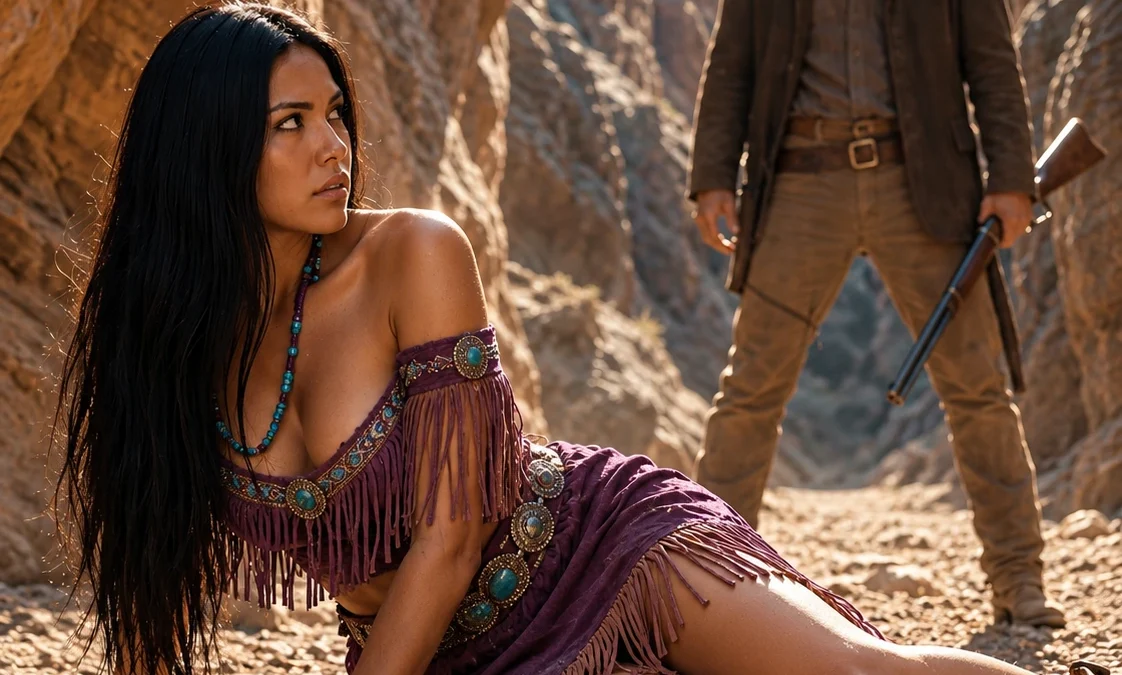
TRAPPED IN A HUNTER’S IRON JAWS WITH NO ONE COMING, SHE WAS WAITING TO DIE, UNTIL A MAN WHO NEVER SPOKE HEARD ONE SOUND… AND A YEAR LATER SHE STOOD BETWEEN HIM AND A RIFLE, SPEAKING TWO LANGUAGES 😱
Part 1
Dying, she kept her hands moving.
And that is how she became his wife.
Nayeli’s fingers had split open at the knuckles after three hours of fighting the steel trap. Her blood ran dark against the iron. The canyon shade was coming in cold. Still she worked the mechanism and tested the stake. The alternative was to lie still and wait, and she was not the kind of woman who waited.
She was twenty-two years old, caught in a hunter’s leg-hold trap in a box canyon nobody knew she had entered. The arithmetic was simple. She would die here unless something changed, and the only thing that could change it was herself.
What changed instead was a cedar root groaning under her weight. The sound carried up the canyon wall to a man on a brown horse who had no reason to come down and investigate.
He did it anyway. 🐎
His name was Caleb Marsh. He was a rancher who almost never talked, and he would carry her out of that canyon on his shoulder. Then he would spend a year slowly working out what he had found.
She would save his life before it was over. She would marry him. She would stand between him and a rifle in the black of a February night, speaking two languages with the certainty of a woman who knew exactly what she was doing.
He found the water. She showed him what he was finding.
It was 1882, in the broken canyon country of the Arizona Territory. Nayeli was Chiricahua Apache, the second daughter of a band pushed west and north since the army took the last good valley they had held. Water hid itself in that land so well that a stranger could walk past a spring all day and die of thirst.
She had followed her uncle’s runaway horse into the east fork. She was reading the ground, not the path ahead. Pine needles had half-covered the pan of an old number-four leg-hold trap, left by a hide hunter who never came back.
The jaws came up around her ankle before she saw it.
She hit the gravel hard enough to skin both palms. The sound she made was not a scream. It was a short breath bitten off before it could travel, because she had been taught since childhood that in this country sound carried, and consequences followed sound.
She lay there taking inventory. Iron jaws on the left ankle. A chain to a cedar root. Blood coming. Nobody within two hours who knew she had come this way.
She worked the spring plate for an hour, because her father had taught her how traps were built. With one leg caught below her, she could not get the angle. She worked the stake the second hour, digging at its base with a flat stone until it had moved a quarter of an inch. Not enough.
In the third hour she looked at the sky and made an honest accounting. The sun was past the west rim. The canyon would be fully in shade within the hour, and the September nights in those foothills could drop below forty degrees. She was already cold from blood loss.
She let herself sit with the truth for two minutes, because a true thing looked at directly costs less energy than one looked away from.
Then she put both hands back on the stake and pressed again.
A woman who stops working while she still has hands is already past the point of help.
That was when the root groaned. Then came the click of a horseshoe on rock at the rim, and the creak of saddle leather as a rider stopped.
She looked up. A man sat on a brown horse with his hat brim cutting the top of his face in shadow, perfectly still. It was not the stillness of fear. It was the stillness of someone reading a situation before deciding what it required.
He came down the canyon wall on foot, crouched six feet from her, and looked at the trap. Not at her. At the trap. You look at the problem, not the animal, when you’re working near something hurt. She noticed that and kept it.
He held up both hands, open. He mimed pressing his boot heel on the spring plate, then pulling her leg free. He waited for her nod.
When she gave it, he set his weight on the plate and pulled the old iron jaws apart one grudging inch at a time. She dragged her leg clear, and the trap snapped shut on nothing. 🩸
He carried her out of that canyon. He cleaned her wound on a bench outside his stone-and-adobe house, and she tested his bandage once with two fingers. He adjusted it without making a thing of it. He had passed a test he didn’t know he was taking.
She stayed four days in his barn. He left the door unlatched, brought blankets and food, and never once looked for gratitude. On the second day she watched him work a young mare and spotted the flaw in his lunge arm. She said it in Apache and showed him with her hand. He fixed it, and the mare ran clean.
On the third day she found something he had missed for three years. Behind a limestone shelf, thirty yards up his own dry creek, water came up around a stick the moment she pushed it in. He built a trough that same afternoon. The water he had been hauling forty miles for all summer had been sitting right there. 💧
On the fourth morning, she stood in front of him and said one word in Apache. The closest English was we are square.
Then she walked north and never looked back.
She was gone three weeks. Caleb told himself he was only thinking about the water.
Then one gray afternoon, Alvarez, his hired man, rode in from Croydon with news delivered sideways, the way he delivered everything dangerous.
Haskell has been talking about the Apache woman.
Caleb only nodded and went back to work.
But that evening, three weeks to the day after she left, a figure appeared on the ridge above his south pasture.
And she was not alone. 😳
Part 2
And she was not alone.
Beside her walked a boy of about twelve, leading two animals on a rope. One of them was a Hereford steer Caleb had given up for lost after it went through the east fence two months back.
The boy was Chato, her cousin’s son. He had been teaching himself English since he was seven, with the grim patience of someone who had decided the language would be useful.
Through him, Nayeli explained. She had found the steer in the canyon country, recognized the brand, and brought it home. Caleb waved at the extra horse and toward her: keep it.
She refused, using the formal Apache phrasing she saved for things that must be understood without ambiguity. Chato translated carefully. A man who gives water back to the land carries no debts.
Caleb looked at the horse, then at her. Then he offered her band the use of the south pasture. No payment. No strings.
She looked at the good grass and the warm slope near the seep hole. She gave the nod. 🌄
That was how it began, one small exchange at a time. She came back six more times. He was always somewhere in her sightline, never hovering. She taught him to read the east ridge for rain, and which pasture would green first in spring. She showed him what the pack rats’ nests said about the coming winter. He asked no questions while she spoke, but she could see on every visit that he had tested what she told him.
Her uncle’s verdict reached her in pieces through Chato. The man found the water but does not yet understand what he found.
She admitted her uncle was not wrong.
Meanwhile Croydon talked. Men rode out to stare at his south pasture with the faces of people hunting for something to disapprove of. They found nothing they could put a legal hand on, so they nursed the opinion and waited.
In November, the waiting ended.
Haskell was a drover who had lost horses and a hired man to Apache raiders, and the loss had hardened into a hatred he carried like a tool. He rode to the south pasture at dusk with two men and planted his horse across the gate. Nayeli stood alone in front of him, and she did not flinch. 😤
He was three sentences into whatever he was building when Caleb came through the gate.
One word, Haskell’s name. Then a plain statement: she has my permission to be on this land, and that is all the right requires.
No anger. No volume. Haskell looked at the men beside him, saw it wasn’t going the way he’d planned, and rode off.
In the darkness afterward, Nayeli realized she was falling for him. She fell the way a precise person falls, not in a flood but in a slow accumulation of small things: the lunge lead, the sound at the trough, the moment at the fence. She was waiting for him to find the words.
December came hard. Army units pushed in from the south. Her uncle’s group of eleven, children and elders among them, couldn’t travel because his chest illness was real. So she laid the facts in front of Caleb plainly, with no begging.
He described the line cabin at the top of the north pasture. One room, stone walls, a stove that worked. They could stay. He hauled flour and salt pork up the mountain without ceremony. Her uncle lived.
But Haskell had not forgotten.
In February he came back with four riders and a county deputy named Pryor. He was young, new to the territory, and he looked like a man who had been told a story on the ride over and didn’t like all of it. Both of Caleb’s hired men were in town.
Caleb stepped onto the porch with his rifle carried loose, making a fact visible, not a threat.
Haskell started his claims. Pryor started on the law.
Caleb asked which law.
Haskell nudged his horse toward the north pasture trail.
And from the scrub oak to the east, a woman walked into the yard alone, a Springfield carbine at her side.
Not raised. Not lowered. Present. 😮💨
Part 3
She walked to the edge of the yard and looked at Haskell.
Then she spoke in Spanish. It belonged to neither of their first languages, which made it the most honest ground between them.
“The cabin is empty,” she said. “My people left three days ago, by their own decision and their own timeline. If my word is not enough for a man carrying a deputy’s badge, I will walk you up there myself and you can look at the empty room.”
There was no anger in her voice and no deference. There was only the certainty of a woman who knew exactly what was true and did not need anyone to be comfortable with it.
Every word of it was true. The band had left on its own schedule. She had not even told Caleb, because she had known this day was coming and had prepared for it on her own terms.
Pryor looked at Haskell. Then he made what was probably the best judgment of his career in the territory. He turned his horse and rode out without a word.
Haskell stayed a moment longer. He had come to find something, and he had found an empty cabin and a woman with a rifle who was right about everything she had put in front of him.
Then he followed Pryor out of the yard. 🌅
The hoofbeats faded. Caleb came down off the porch and crossed the yard. He stopped close in front of her, and five months of everything unsaid hung in the cold February air.
She spoke in English, slowly, each word placed with care. “The band is in good country. My uncle is recovering.” She paused. “I am here.”
He stood silent for a long moment, and she watched him hunting for the sentence.
“I want you to stay,” he finally said. “Not in the barn. Not in the cabin. Here.”
The plainness of it was exactly right. She had known he would find plainness when he got there, because it was what he used for everything that mattered to him.
“You know what they will say,” she answered in Spanish.
“Haskell doesn’t weigh much with me,” he said. “What about your people? What do they say?”
She was quiet. Then she told him some of them thought a man who gave away his cabin in the cold was already family. And her uncle had a phrase for him.
The rancher found the water but does not yet understand what he found.
Caleb turned it over. “What does your uncle mean?”
The dry look came into her face, the one that had taken him months to recognize as humor.
“He means you found the water,” she said. “You did not understand what you were finding.” She let two breaths pass. “And that you are starting to.”
He took her hand. She let him, because she had been deciding this for months, and the deciding was done. 💛
They stood there in the clear cold morning, with the mountains still white to the west and the horses moving quietly in the pasture below. Two people had finally said what was true between them and found it was not surprising.
They married in July, in two ceremonies, because one would have been honest about only half of what they were.
The first was in Croydon, with a justice of the peace who did the whole thing in twelve minutes and kept his private arithmetic behind his face. Caleb respected him for it. Alvarez and Chato stood as witnesses.
The second came three days later at the ranch. Her uncle was there, and the band members who had returned from the north. A blessing was spoken in the old Chiricahua form, and a fire was built at sunrise at the edge of the east pasture. Her aunt wrapped a turquoise-beaded cord around their joined wrists. 🔥
Chato translated the blessing but stopped before the last section. He couldn’t bring it into English, he said.
Caleb told him that was fine. He had come to believe that some things didn’t translate, and that this was no failing on either side.
Walking out of the justice’s office, Caleb had seen Haskell standing on the boardwalk across the street, looking in through the window. Then Haskell walked on. It was the last time Caleb ever saw him. By October the man had sold his cattle and gone east, and Caleb sincerely hoped he found whatever he was looking for there.
Croydon adjusted the way people adjust to irreversible things they didn’t choose: unequally, slowly, with the full range of grace and its absence. The hardware man became courteous within the season. The feed store owner had been courteous all along.
Nayeli had a word in Apache for it. She translated it for Caleb once, into Spanish: the water finding its level. He thought about it for three days, then told her the word was right.
Her uncle died that fall, in the stone cabin on the north pasture.
Caleb had spent July and August there with her brother and two of her cousins. They added two rooms, replaced the old stove with a better one, and cut a window in the west wall. The old man could lie on his blankets and watch the light go off the mountains in the evenings.
He died warm, with the people he loved around him and the mountains in the last light. 🕊️
Nayeli grieved cleanly and completely, and she let Caleb be there for it. That alone said what they were to each other. He sat with her through the evenings of November without trying to fix her grief or hurry her through it.
She had never had that from anyone outside her family. In those evenings she began to understand that he was her family.
Over time she learned him the way you learn someone you live beside. She knew the almost inaudible sound of his concentration at the worktable at night. She knew he went outside before first light each morning for ten minutes alone, and she left that time private. She knew the look on his face when something moved him, which looked exactly like his ordinary stillness to everyone else. Learning to tell the difference had been one of the real projects of their first year.
He was learning her too. She was patient with the parts still in progress, because water is patient with stone. It was not a metaphor she had been taught. It was simply a fact about water and stone that was also true of other things. 💧
The ranch grew through the second year. He bought ten more Herefords, rebuilt the east fence, and dug a second well in the north pasture that struck water at thirty feet. She built out the kitchen garden from seeds her aunt sent, and put up drying racks for chilis, epazote, yerba santa, and the wild oregano she’d found on the limestone outcrops. A new family arrived in Croydon that fall, with no history in the territory and no stories about who she was. They treated her with simple courtesy from the very first day.
It was a useful thing to remember. Sometimes the problem was never the place, only the specific people who had arrived in it first. And the specific people changed over time.
Chato spent the summer with them, learning horses beside Caleb. Nayeli watched them from the garden, the boy and the quiet man working the corral in the long afternoon light. Something in the picture settled deep in her. The boy watched the horses instead of merely working them, and Caleb taught the way he learned: watching, adjusting, letting the thing show him what it needed.
In the spring of the second year, she took Chato to the seep hole.
She stood where she had stood the very first time, in front of the limestone shelf, with the dark damp soil showing behind it. The trough was still running, steady and clear, as it had for a year and a half. She pressed her palm flat against the soil.
And she said, in careful Spanish, to the husband who had quietly come to stand beside her:
“A man who knows where water is looks at what he can see. He does not know there is more.”
She pressed harder against the earth.
“To know the water, you have to know what is behind the stone.”
Caleb looked at her hand on the dark soil. Then he looked at her face. What he had carried for two years was written there, unmanaged and unhidden.
“I think I knew there was more,” he said quietly. “I just didn’t know how to find what was behind it.”
Yes.
That was what her uncle had believed. That was why he had said the rancher was starting to understand. 🥹
The water ran through the pipe into the trough in the low, continuous sound of a problem that had been solved and stayed solved. Herefords spread across the south pasture in the loose, easy pattern of animals that know they’re safe. Late snow still held on the upper ridges of the Dragoons, and the sky above them was the deep blue of the desert Southwest in early spring, before the haze comes in with the heat.
He took her hand in both of his, the way he had that February morning in the yard.
She didn’t speak. Neither did he.
The morning came on over the mountains, clear and wide, and the water ran in its steady voice. They stood in it together: the quiet man who had found the water, and the woman who knew what was behind the stone, with everything they had built between them and the long clear light of the place they had made their home. 🌄❤️
This story is entirely fictional and created for entertainment purposes only. It does not represent any organization or individual, nor does it encourage inappropriate behavior. The content was generated with AI assistance.








