TWO GIANT APACHE WOMEN BLOCKED THE DOORWAY OF HIS NEW RANCH AND ORDERED: “TONIGHT, YOU SLEEP IN OUR BED.” HE HAD SIGNED IT… BUT WHAT HE READ IN THE FINE PRINT SHOCKED HIM
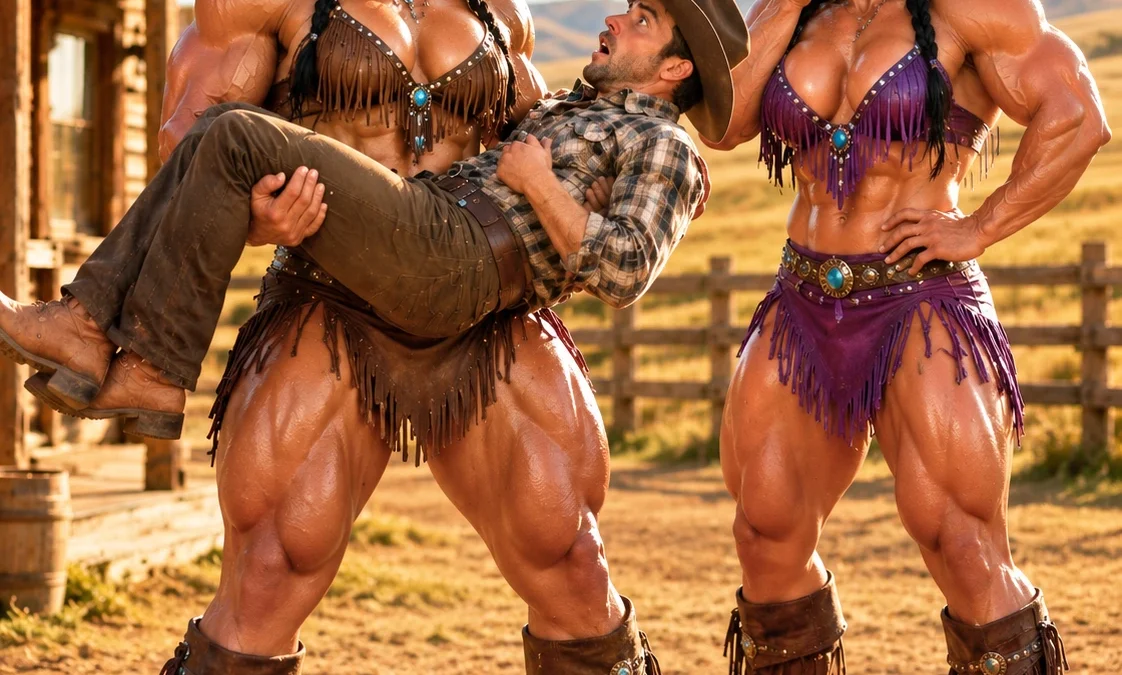
TWO GIANT APACHE WOMEN BLOCKED THE DOORWAY OF HIS NEW RANCH AND ORDERED: “TONIGHT, YOU SLEEP IN OUR BED.” HE HAD SIGNED IT… BUT WHAT HE READ IN THE FINE PRINT SHOCKED HIM 😱🐎
Part 1
The wind in New Mexico Territory did not blow.
It crawled. 🌬️
It dragged itself across the land like something wounded, carrying the smell of dry sage and old bone, and it had been doing so for a thousand years before any white man arrived to give it a name.
Caleb Ross rode into that wind.
He was forty-one years old. His back hurt. It always hurt, especially when the weather turned cold, as it was doing now in the late slant of October light.
Two years ago, a silver mine in Leadville, Colorado had come down on top of him. Three men died that day.
Caleb did not.
The doctor in Denver told him he would walk again, if he was lucky. He was lucky. But he would never swing a pickax again. The mine was finished with him.
So he did what broken men do. He went looking for land.
The trail into Silver Canyon dropped between two low mesas the color of rust. Below, in the basin, he could see the outline of a ranch house, a barn, and a small wooden corral. His ranch now. Bought six weeks ago in a saloon in Las Cruces with every dollar he had left: six hundred. Every cent of his mining settlement, and every cent from selling his mother’s wedding ring in St. Louis.
The deal had moved fast. He remembered the lawyer, a heavy man with soft pink hands and a waistcoat too tight across the belly. Dorsey Pike. He had smiled a great deal. He had poured whiskey. He had pushed paper across the table, page after page, a stack as thick as a family Bible.
Sign here. Sign here. Sign here, too.
Caleb had signed. His back had been aching. The whiskey had been warm. He had not read the appendix.
Nobody reads the appendix.
Now, as his horse picked its way down the last of the trail, he saw smoke rising from the chimney of the ranch house.
He reined up. Smoke meant a fire. A fire meant a person. And the deed, as he understood it, said he was buying an empty property.
He rode closer, slower. His hand drifted to the Colt at his hip. He had not fired it in fourteen years.
The ranch house was larger than he had pictured: a long, low building of silvered pine logs, a broad porch, a heavy front door. A well with a round wooden lid. A single cottonwood, its leaves gone yellow. It was a good place. A man could live here.
A man could end here.
He tied his horse to the cottonwood and knocked twice, politely. No answer.
He pushed the door open, and the world he thought he had bought ended on the threshold. 😳
Two women stood in the center of the main room.
They had been waiting. That was what he understood first. Not that they were Apache, though they were. Not that they were tall, though they were taller than any women he had ever seen, taller than most men.
They had been standing there just like that for a long time. Hours, maybe. Waiting for him to open the door.
The older one spoke. Her English was perfect, too perfect, as if she had practiced every word.
“Tonight, you must sleep in the same bed with both of us.”
Caleb did not move.
“That is the contract. You signed it before you walked through this door.”
She held out a folded piece of sheepskin with a red wax seal. The seal had been broken and pressed down again by a thumb.
“Read it.”
He looked at them. The older woman had a scar running from below her right ear along her jaw to the point of her chin, thin and white and old. Her forearms were corded with muscle. The younger had eyes the color of wet stone, and she carried no weapon he could see. Caleb had lived long enough to know that some people did not need one.
Neither looked afraid. Neither looked angry. They looked like people who had done this before.
He carried the sheepskin to the table by the window and unfolded it. The ink had turned the color of dried tobacco.
Appendix D. Article 7.
The purchaser agrees to maintain the current living conditions on the property. This includes, but is not limited to, the sharing of the primary dwelling and sleeping quarters with the two current residents for a period of not less than six calendar months. Violation shall result in the immediate nullification of the sale and the forfeiture of 100% of the purchase price.
Below it, in his own cramped hand: Caleb Ross.
He remembered now, dimly, a page near the end of the stack that Pike had pushed toward him. “Standard territorial clause. Just a formality.”
“I am not going to sleep with you,” he said, not looking up. “Either of you. I may lose the ranch. But I want one night to understand what is happening in this house. After that, I will decide.”
The older woman’s face did not change. But something behind it did. A small movement of the shoulders. For the first time she looked like a person instead of a statue.
“You are the fourth man to buy this ranch in four years,” said the younger, her voice soft as a knife wrapped in cloth. “Three came before you. All three signed. Two of them are dead. The third rode out at night and never came back. He left his horse. He left his boots by the door.”
“What are your names?”
The older one hesitated, as if no one had asked in a long time.
“Tashina.”
“Winema.”
“Caleb Ross.”
“We know the name on the paper,” said Tashina. “We do not know who you are.”
He turned to go. At the door he stopped and looked back at the scar along her jaw.
“Who signed your name on that paper?”
It was Winema who answered, in a whisper.
“The man who sold it to you. Eighteen years ago, he signed for us the first time. He has been signing for us ever since.”
Part 2
“He has been signing for us ever since.”
Caleb did not sleep. The barn was clean, which surprised him, and the straw was fresh, which surprised him more. A single army blanket lay folded on a shelf, as if someone had laid it out in anticipation.
Before dawn, he understood he was not going to ride out. He had known it from the moment he saw them standing in that room. There was a thing in him, old and stubborn, that would not let him ride away from two women waiting for a man to either save them or fail them.
He rose while the sky was black, built a fire in the kitchen stove, found a tin of ground coffee, and made a pot strong enough to strip paint. He poured three cups and set them on the table.
Then he waited.
Tashina came out first. She stopped when she saw the three cups. She did not ask who the third was for. She sat down across from him and wrapped her hands around the cup as if warming them.
Winema came out a minute later and sat in the third chair. She tasted it.
“You make it strong.”
“Leadville coffee.”
“Our grandfather went there once. He said white men drink tar and call it breakfast.”
The corner of Caleb’s mouth moved. Tashina saw it, and something in her shoulders eased.
As the sun climbed the canyon wall, she told him everything.
Her grandfather, Standing Bear, had been head man of a small Chiricahua band that never went to war with the United States. In 1868, he signed a treaty giving his family permanent right to Silver Canyon: two hundred acres of water, grass, and pine. In perpetuity. As long as the rivers flow.
He died in the winter of 1879. Tashina was sixteen. Winema was twelve. Two weeks after the burial, a young man in a good suit rode into the canyon with a lawyer’s satchel.
Dorsey Pike. He said the government required forms after a treaty signer’s death. He read them a paragraph from a book. They signed with X marks, because that was all they knew. A month later, he returned with a deed in his own name.
He did not throw them out. He said they could stay. He said the territory was dangerous for Apache women alone, especially tall ones. Especially pretty ones.
Then he began to sell the ranch.
The first buyer, a Texas cattleman, talked every night about what he would do to them, the way a man talks about a horse he means to break. He died of a rattlesnake in his boot. They buried him behind the barn.
The second buyer did not only talk.
Tashina stopped. Winema laid a hand on her sister’s forearm.
“I will,” said Tashina in English. “He needs to hear it.” She touched the scar on her jaw. “I carried a knife for two years under my pillow. The first night, before he could reach me, I cut my own face. I thought if I was ugly enough, he would stop.”
Her eyes were dry.
“He did not stop. So I used the knife on him. He did not walk out of this house. We buried him next to the Texan.”
“When Pike came to check on the property,” said Winema, “we told him the truth. We thought he would bring the law.”
“He laughed,” said Tashina. “He said, Good. One less witness. You understand now, girls. You belong to this land, and this land belongs to me. If you run, I will tell the marshal you murdered a white man in his bed, and they will hang you both.”
“And then he added the clause.”
The sleeping clause, Winema explained, was not the point. It was a test. The kind of man who wanted it would walk into their rooms and die. The kind who was ashamed would run in the night. Either way, the ranch went back to Pike, and he sold it again for his three hundred dollars profit.
“And you stay because…”
“Because we have nowhere else to go,” said Winema. “We are not on the rolls. We are tall Apache women in New Mexico Territory in 1886. There is no door in this country that opens for us except this one.”
Caleb thought about Leadville. About the three dead men, one only twenty-three, named Elijah, who had shared his lunch when Caleb had nothing. Every night for two years he had woken at three in the morning, crushed under a weight that was not there, and counted his fingers in the dark. Ten. Still ten. Then the names, aloud, like a list at a funeral. Elijah Belknap. Samuel Courtright. Tom Weaver.
He had asked God for two years why he had lived.
He looked at the two women across the table. Maybe this is why. 🕯️
“There is more to that paper,” he said. “A greedy man does not stop at three hundred dollars four times. There is another clause he does not want anyone to find.”
The sisters looked at each other. Winema went into the back room. He heard a floorboard lift. She returned with a thinner, older sheepskin, the ink nearly gone.
“Our grandfather left this with the priest in Mesilla. It is the real treaty.”
Caleb bent over it and found the line halfway down.
“Should the allotment be conveyed by sale or lease, the new holder shall maintain continuous and uncontested residence for not less than six calendar months. Upon expiration, full and clear title shall vest in the new holder, and all prior encumbrances shall be dissolved, including any claims upon the persons of the heirs, who shall thereafter be deemed free and sovereign citizens of the United States.”
Winema’s voice trembled. Tashina’s mouth hung slightly open.
“Six months,” said Caleb. “If I stay six months without breaking the contract, the ranch becomes mine. And you…”
“We become free,” whispered Winema.
“Free,” said Tashina, as if she had never said the word aloud in English.
“Why show me?”
“Because you brought three cups,” said Tashina. “Not two. You did not wait to see if we would come out. You poured the coffee and sat down, like a man who already knew we were people.”
Caleb picked up his cold coffee and drank it anyway.
“Then we had better get to work.”
Two months passed. He mended the corral. He dug out the well. He slept in the barn, by his own rule, until the six months were up. One night he found two heavy wool blankets and a small cast-iron stove in his stall. Nobody mentioned it.
In November, in town, the shopkeeper Ada Belknap handed him his flour and whispered with her eyes on the window.
“Come back at three o’clock, when the street is empty. I have something to tell you about the house you bought, and the man who sold it to you.”
That same day, outside the courthouse, he said one quiet sentence to Judge Hollis Vane that turned the man’s face the color of ash:
“Did you know, Your Honor, that Dorsey Pike’s legal name used to be Dorsey Vane?”
And behind that judge’s door, a man had been weeping.
Part 3
At three o’clock, the street was empty, as Ada had promised. Caleb tied his horse in the alley and entered through the back. The front door was bolted. A kettle steamed on the stove. Two cups waited.
“My husband, Tobias Belknap, was the court clerk in this town for twenty-two years,” she began, without preamble. “He was a careful man who could not sleep if something wrong sat in his files. In the summer of 1879, he found the original Standing Bear Treaty, deliberately misfiled in a folder about a cattle dispute. He read it three times.”
She sipped her tea. Her hand was steady.
“I told him to put it back. I told him the law here would not protect a clerk who crossed a man like Pike. But my husband was not a man who could put things back. He made one copy at this table, on a Sunday night, and gave it to me. He said, Hold this until you are certain the right person comes. You will know him because he will not ask for it. He will not even know it exists.”
“What happened to him?”
“Four days later, Tobias went hunting on the mesa. They brought him home in a wagon. They said his rifle discharged by accident. The ball had passed through his throat from below.”
Her voice dropped.
“I have kept that copy in my tea tin for seven years. Every morning I opened it, saw the edge of the paper, and closed it again. Every man who bought that ranch was the wrong man. Until you walked through my door and I saw your face.”
She laid her hand on his.
“Mr. Ross, I must ask you something, and you must answer truthfully. Did you work at a silver mine in Leadville in 1884?”
The room shifted under him. “Yes. Until the collapse.”
“Three men died. One was twenty-three.”
Caleb could not speak.
“My son wrote to me every week. In his last letter, which came after he was already in the ground, he wrote about a quiet older miner with a bad back, who once shared his last biscuit on a payday when the money hadn’t come, so that my son would not go hungry.” Tears ran down her face and she did not wipe them. “My son’s name was Elijah Belknap.”
Caleb’s throat closed. Without knowing it, he laid his other hand over hers.
“I did not know he had a mother.”
“Do not say you are sorry, Mr. Ross. Everyone who survives says they are sorry. I do not need a sorry.”
She went to a shelf, took down a tin with a Scottish castle on the lid, lifted out a canister of black tea, turned it over, and tapped it. A folded paper fell onto the cloth, brown with age.
“Take it. Do not let my husband have died for nothing. Do not let my son have shared his biscuit for nothing. You are going to save those two girls, or you are going to die trying. And if you die trying, I will bury you next to Tobias, and I will tell this whole town on the courthouse steps exactly what Dorsey Pike is.”
“I will not die without taking him down first.”
“Drink your tea,” said Ada. “It has gone cold. That is a sin in this house.” 🍵
In December, three men rode into the canyon. One turned his lapel to show a badge. Territorial Collections. A lien of four hundred dollars, filed by Pike the day after Caleb’s purchase but dated the day before. Pay it by the twentieth, or the ranch went to auction, and Pike would be the only bidder.
Caleb had eleven dollars and sixty cents. And fifteen bars of silver in the cellar under the barn.
That night, Tashina came and sat beside him on a hay bale.
“Use the silver. Two bars. He would not know.”
“He would see four hundred dollars in my hand a month after I rode in with eleven. He would know. And he would tear this ranch apart looking for the rest.”
“Then I will kill him.”
“He has a brother, Tashina. The judge. They would hang you.”
“You are afraid for me.”
He did not answer right away. The lantern flickered. Her shadow rose very tall on the barn wall.
“Yes. I am afraid for you.”
She looked at him then, not as a buyer, not as a test, not as the fourth man. As Caleb. She did not touch him. She rested her forehead briefly against his shoulder, like a horse that has chosen to trust another.
Two seconds. Three.
“Sell your horse,” she said at the door. “I will find you a better one when this is over. An Apache horse. You have never ridden a real horse until you have ridden one.”
He sold his horse in Las Cruces for three hundred and ten dollars. Ada counted ninety more from a jar behind her counter and said, “Do not thank me, or I will take it back.” He walked fifty miles home with his saddle on one shoulder and paid the lien on the twentieth.
On a freezing evening, Winema met him at the well.
“I have kept something from you. Dorsey has another brother. An older one. Micah Vane. His name is on the treaty as witness. He lives in St. Louis now, a real attorney for the Department of the Interior. He drafted the treaty himself. He does not know what his brothers have done. Our grandfather gave me his address before he died. I could not write such a letter. And a letter from an Apache girl would have been thrown away, or given to his brothers, and then we would be dead.”
“But now there is you.”
Caleb understood. It was not information she had given him. It was trust, held seven years beneath her tongue.
“I will write tonight.”
“My grandfather said there would be four men. The first three would break. The fourth would hold. He said we would know him by how he drank his coffee. He will take three cups, and he will set the third one down for no one, because he has not yet understood that he is waiting for someone.” She looked at him across the dark yard. “He was ready for you eighteen years ago, Caleb Ross. We have only been waiting.”
That night, with a pencil on the back of a feed-store receipt, he began:
“Dear Mr. Vane, my name is Caleb Ross. I am writing on behalf of two women you have never met…”
A hundred miles south, in Las Cruces, Dorsey Pike stared at a lien receipt, and for the first time in eighteen years, he began to be afraid.
The letter went out on the second of January. In January, snow fell thin and sideways across the canyon. A Mexican rider reached the gate and handed down one folded note in Ada’s script.
They have arrested a Chiricahua woman in the Mesilla jail. The charge is murder. The warrant was signed by Judge Vane. She is not named. Come now.
Caleb understood in one terrible motion. Tashina was in the house cooking beans. Dorsey had arrested an innocent stranger who fit a description, and meant to parade her before the court as Tashina. If Caleb rode to Mesilla, he broke the residence clause, and the ranch was forfeit. If he stayed, the sisters would hang.
At the kitchen table, he laid out four choices, and chose the fourth.
Winema would ride north to the federal marshal at Santa Fe with Ada, carrying the treaty, the lien receipt, and three unopened letters from St. Louis. Tashina would travel south to Mesilla, dressed as a nun, with old Father Mendez, the priest who had kept the real treaty, to visit the accused woman. And Caleb would sit on the porch for five weeks with a rifle across his knees, giving Pike not one inch of reason to say the clause was broken.
“You might not live,” said Tashina.
“I know.”
“Then I have one condition. I take one bar of silver. Not for a lawyer. For a telegram to Micah Vane. We do not wait for mail anymore. We tell him that his brothers have framed one woman to steal a ranch from another, and that he has fourteen days to arrive. Not to write. To arrive.”
“You are better at this than I am.”
“I have been planning it eighteen years. You have been planning it three months.”
“Do not die before we return.”
“I will try not to.”
He sat on the porch for five weeks. Pike came on the ninth day with four men and a smile. Caleb stood at the gate with a rifle held loose and said, “There is no woman living on my property, Mr. Pike.”
On the sixteenth day, seven men crept across the lower pasture at dawn, and a tin can of pebbles rattled on his tripwire at four in the morning. Caleb was a miner. He lit a length of fuse on a buried quarter-stick of dynamite, and let it hiss. Seven men ran. One left a rifle. One left a boot.
He pulled the fuse before it reached the powder. Then he went inside for the first time in five weeks, drank a cup of cold coffee standing up, and cried for ninety seconds with one hand braced on the kitchen wall. 😢
Then he went back to the porch.
On the twenty-second day, a rider brought a writ in Judge Vane’s name, compelling Caleb to appear in Mesilla six days before his six months were up. He read it twice. And he smiled.
A Silver Canyon writ did not run in a Mesilla court without a federal endorsement. Tobias Belknap had explained that over supper in 1877, and Ada had repeated it to him in her back room. Dorsey’s empire was built on paper that looked right and was wrong.
Caleb did not leave the ranch.
On the twenty-seventh day, Father Mendez’s carriage returned. Beside Tashina sat a small thin woman who had not slept in two weeks. Kaya. The priest had spent one bar of Standing Bear’s silver, and a patient Jesuit’s sense of paperwork, producing an affidavit that placed her in the El Paso mission on the night of the supposed murder. The charge had been dismissed. And the warrant against Tashina, daughter of Mangas had nowhere to go, because Pike could not produce her.
“Winema?”
“Six days overdue.”
“Dorsey?”
“Waiting.”
“You?”
“Still here.”
“Then we finish it.”
The next morning, a column of eleven riders came up the canyon. Winema rode in front on a tall bay mare. Ada drove the wagon behind her. Eight deputies in blue coats followed, with a federal marshal named Jonas Teague, scarred and gray at the beard. And beside the marshal, on a gray gelding, rode a thin man in an Eastern suit and steel spectacles, with the same bones in his face as Dorsey. But where Dorsey’s face was soft and pink, this man’s was lined and hard, quiet as a priest’s after forty years of confessions.
Micah Vane. He had read the letter. He had received the wire. He had come.
Teague saluted Caleb. “Mr. Ross, I have warrants for Dorsey Pike and Hollis Vane. Fraud. Forgery. Conspiracy to defraud the United States. Witness tampering. And, for Mr. Pike, suspicion of being an accessory to the murder of Tobias Belknap.”
Behind him, Ada pressed a hand to her mouth.
Micah climbed the porch steps and held out his hand.
“Mr. Ross. I did not know. I left this territory in 1871 because I could not stand what Dorsey had become. I told myself the law would answer for him. I am old and tired and ashamed. I have come to put this right.”
“Tell me their land will be theirs, clear and permanent, and we are square.”
“By the end of next week, the title to Silver Canyon will be in the names of Tashina and Winema, granddaughters of Standing Bear, written so that no court will ever take it again.” He opened his satchel. “One more thing. In 1868, Standing Bear showed me a seam of silver on the north ridge. I filed it with the Bureau of Mines in Washington as a protected claim. It has sat in a federal drawer for seventeen years. It is worth perhaps thirty thousand dollars.”
On the porch, Tashina and Winema looked at each other. They had been fighting for a home. Without knowing it, they had been fighting for a mountain.
“Then let us ride,” said Caleb.
They reached Silver Canyon at two in the afternoon. Hollis Vane had already been arrested on the courthouse steps while eating a sandwich his wife had packed. Dorsey Pike saw the blue coats, his own older brother beside a United States Marshal, and Caleb Ross riding at their side. He drew a pistol from his drawer, and pointed it at himself.
Tashina saw it through the window, up the outside stairs before the marshal could even call his men to dismount, and kicked the door off its hinges. She crossed the room in two strides and took the pistol from his hand. She did not strike him. She did not speak. She only looked down at the man who had laughed at her, and Dorsey Pike wet himself quietly in his chair.
She handed the pistol butt-first to Marshal Teague.
“He is yours now.”
She walked out without looking back. ⚖️
The trial in Santa Fe took three weeks. Micah sat at the prosecution table every day. When the verdicts came, he wept quietly with a hand over his mouth. Dorsey Pike was sentenced to hang. Hollis Vane, who had told investigators everything in exchange for his life, received twenty years at Leavenworth.
Ada Belknap rode three days to see it. She stood at the back of the yard in black, a small cloth bundle in her lap, and did not look away. When the trap fell, she opened the bundle. Inside was a tin of black tea. She held it a moment, then closed it.
“Tobias can rest now.”
Her eyes were dry. She had done her crying seven years ago, alone.
The treaty of 1868 was affirmed in federal court. Title passed to Tashina and Winema in perpetuity. Kaya was released with an apology, fifty dollars, and a job at Ada’s store.
And there was one awkward thing the lawyers could not square. Caleb Ross owned the ranch too. The forged contract had given it to him. The real treaty had given it to the sisters. Both held clear title to the same two hundred acres.
They settled it at the kitchen table one Sunday morning in May, with three cups of coffee between them. Caleb signed a deed conveying his whole interest to the sisters for one dollar. Tashina paid it. Then she signed a second deed conveying twenty acres at the south end, with the well, the barn, and the house, to Caleb, for one dollar. He paid it. They shook hands.
A year later, a wooden school stood at the north end of the canyon, with twelve small desks. Eleven children sat in mixed rows: Apache, Mexican, Anglo, a Chinese boy whose father worked the railroad. People talked about that the first month, then not at all, because the ranch was rich now, and rich things get forgiven in New Mexico faster than poor ones.
Tashina had married a Chiricahua widower named Gray Eagle, a horseman and carpenter who had stopped at the canyon to ask after water and stayed for good. She was expecting a child in July. Winema ran the forge behind the barn and shod horses for every rancher within forty miles, and taught children the old names for things in Apache, Spanish, and English, so they learned that a thing can have three names and still be itself.
Ada closed her store and moved into the ranch house. She called the sisters her daughters, and Caleb her son, out loud, in town, daring anyone to question it.
On the second Sunday in May, at the end of a long warm day, Caleb sat on the porch of his own small cabin with a cup of coffee. Tashina walked up the path slowly, hands on the small of her back, and sat in the second chair.
“Did you ever imagine this?”
“No. I thought I had bought a place to die in quiet. I did not know I had bought a place to live.”
“My grandfather said the fourth man would hold. He did not say the fourth man would stay.”
“Maybe he knew. Maybe I decided myself.”
“We are glad you stayed.”
He looked at the iron plaque he had nailed to the porch post, forged crookedly at Winema’s forge with his own clumsy hammer.
No person is property here.
“I am glad, too.”
She laid her hand on his. Not as a wife. Not as a lover. They had never been that and never would be. They were something older and quieter and stronger: two people who had each walked into a room carrying nothing, and decided between one breath and the next to stand with each other until it was finished.
It was finished. 🌅
Down the canyon, Ada was calling the children in for supper. Winema climbed the path from the forge with soot on her cheek. A lamp was lit in the kitchen window. Smoke rose straight up from the chimney in the still spring air.
A house that nobody owned and everybody did. A ranch bought with six hundred dollars and a signature nobody read, and a lie nobody noticed, which had become, despite everything, a place where the supper bell rang, and the children came running, and nobody was anybody’s property, and nobody ever would be again.
Caleb Ross drank the last of his coffee and set the cup on the porch rail.
He smiled.
It reached his eyes. 💛
💬 Which moment hit you hardest: Ada’s tea tin, the three cups of coffee, or Tashina taking the pistol out of Dorsey’s hand? Tell me in the comments, and share this with someone who believes the right man always reads the fine print… or stays long enough to fix it! 👇
This story is entirely fictional and created for entertainment purposes only. It does not represent any organization or individual, nor does it encourage inappropriate behavior. The content was generated with AI assistance.








