Two Hours Before My Brain Surgery, My Husband Handed Me Divorce Papers. “Sign Now. If You Don’t Wake Up, Claudia and I Will Marry.” What He Didn’t Know Was Who Was Really Paying for His Life.
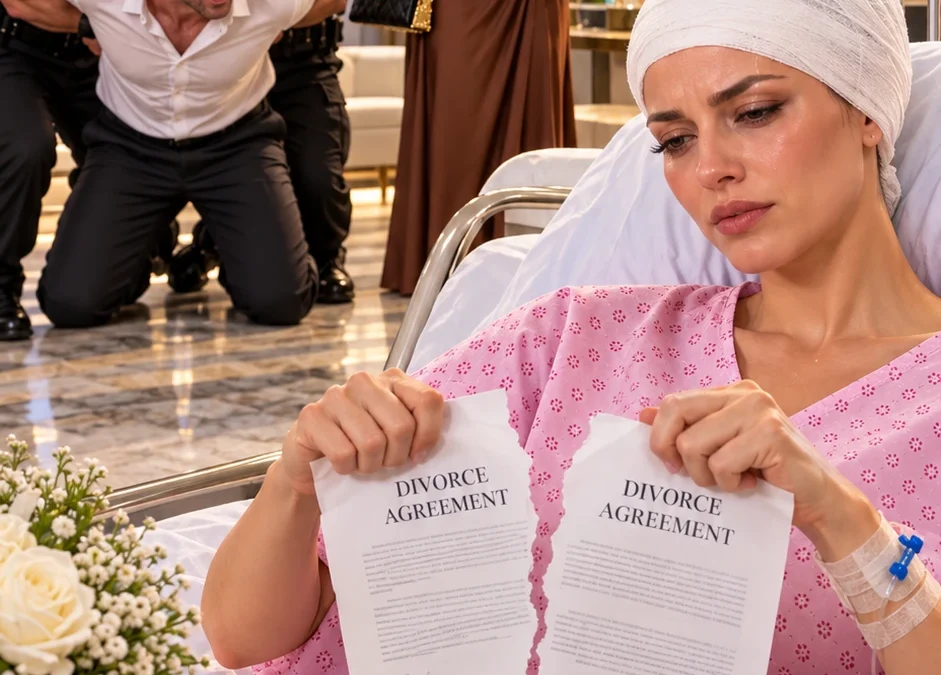
Two Hours Before My Brain Surgery, My Husband Handed Me Divorce Papers. “Sign Now. If You Don’t Wake Up, Claudia and I Will Marry.” What He Didn’t Know Was Who Was Really Paying for His Life.
Part 1
Two hours before they opened my skull, my husband laid a divorce folder across my legs.
My name is Marta Valdés. I’m forty-five. The pre-op room at La Paz Hospital in Madrid smelled of disinfectant and reheated coffee. I had an IV in my left hand and a meningioma pressing on a delicate part of my frontal lobe. The doctors said the odds were good. No statistic could erase the fear on my face.
When Adrián pulled back the curtain, I thought he had finally come to hold my hand.
He didn’t.
He wore a flawless gray suit, the watch I’d given him for our tenth anniversary, and a blue folder under his arm.
“Sign,” he said, without sitting. “The petition is ready. And the property agreement.”
I needed a few seconds to understand. “Now?”
“Now is exactly when it has to be done. If the surgery goes badly, I don’t want to spend months trapped in paperwork.”
Then he said the name that broke something inside me.
“Nuria.”
My best friend since university. The woman who had come to my appointments, slept at my house after the failed fertility treatments, and brought me soup just last week.
Adrián held my gaze. “Nuria and I have been together more than a year. We have an eleven-month-old daughter. I want a family. I can’t keep pretending.”
I stopped crying.
For fifteen years I had protected Adrián’s pride with an almost absurd patience. He boasted of being a brilliant real estate entrepreneur, of buying a penthouse in Salamanca, of supporting his parents, of financing investments “without anyone’s help.”
The truth was different.
The penthouse belonged to Valdés Patrimonio, the company I inherited from my father. The cars were leased through another family company. Our joint accounts received money from me every month. Even his parents’ little furniture workshop in Toledo survived on a periodic transfer he believed came from his own profits.
I never corrected him. I thought caring for a marriage also meant sparing someone humiliation.
He set a pen on my blanket. “I’ve included that each of us keeps what’s in our own name. That way nobody can claim anything later.”
He thought that sentence protected his watches, his car, and a secondary account.
I understood exactly the opposite.
I read the agreement. I signed the uncontested divorce petition. I signed the settlement proposal. I even signed the waiver of any investigation into assets outside each person’s title.
Then I closed the folder and handed it back. “There.”
He smiled for the first time. “I knew you’d be reasonable in the end.”
He left without kissing me.
I waited until I heard the corridor door shut. Then I asked for my phone, called my trusted lawyer, Gonzalo Rivas, and said six words he’d feared for years.
“Activate the total separation protocol.”
He was silent. “Are you sure?”
I looked at the door my husband had just walked through. “Yes. And start with the penthouse.”
At that moment, orderlies came to wheel me toward the operating room. And across Madrid, one by one, the lights of the life Adrián believed was his began to go out.
What happened next still gives me chills. Part 2 is in the comments—or leave any word below and I’ll send it to you privately.
Part 2
What happened next still gives me chills. Part 2 is in the comments—or leave any word below and I’ll send it to you privately.
The surgery lasted seven hours.
When I woke, the first news was medical. The tumor had been removed completely, with no cognitive damage. The second news came by text from Gonzalo.
Adrián’s additional cards were cancelled. The joint account was frozen for new withdrawals. The Salamanca penthouse, owned by Valdés Patrimonio, already had an internal order revoking his access. And the monthly payment to his parents’ workshop had been suspended.
I felt no joy. I felt clarity.
The next morning, Adrián was celebrating with Nuria at a restaurant in Chamberí. He ordered cava, talked about trips, and set his card on the table with swagger.
Declined.
He tried another.
Declined.
He opened his banking app. Available balance: €0.
He assumed it was a glitch, until an email arrived from the penthouse administration. He had forty-eight hours to remove his personal belongings. The property wasn’t in his name.
Nuria looked at him as if she’d just met a stranger.
But the hardest blow landed three minutes later. Gonzalo sent Adrián a copy of the agreement he himself had drafted.
Clause 8, signed in his own hand. Adrián had expressly renounced any claim to assets held solely by me.
And almost everything he called “his life” legally belonged to me.
If you want to know what happened when Adrián stormed into my hospital room, LIKE this post and comment “CLÁUSULA 8.” When enough people comment, I’ll post Part 3. 🧠
Part 3
At 4:40 that afternoon, Adrián burst into La Paz with his tie crooked, his hair damp with sweat, and an expression I’d never seen on him. He no longer looked like the man who, hours earlier, had checked his watch while I waited for brain surgery. He looked like someone who had just discovered the floor beneath his shoes had never been his.
I was sitting by a window on the neurosurgery floor, a white bandage around my head. My face was exhausted, but I was awake, oriented, and Gonzalo was beside me.
Adrián started talking before he reached the bed.
“This is insane. Reactivate the cards. Tell them to let me into the house.”
I watched him in silence. “It isn’t your house.”
“We lived there eight years.”
“Living somewhere doesn’t turn a deed into yours.”
He turned to Gonzalo. “This is retaliation.”
Gonzalo opened a folder. “No. It’s a separation of assets you yourself asked to speed up. The property has belonged, since before the marriage, to a private company of Marta’s. The vehicles you used are company cars. The cards were additional cards on accounts where Marta is the primary holder. And yesterday you signed a proposal insisting each person keep only what is legally in their name.”
For the first time, Adrián seemed to remember every page he’d put in front of me.
“I didn’t know about Valdés Patrimonio.”
“That was exactly the problem,” I said. “You never asked where anything came from. You just got used to it appearing.”
He lowered his voice. “You hid your money from me.”
“I hid how much I had, because every time I achieved something, you turned it into a competition. When my father died, you said you didn’t want to be ‘an heiress’s husband.’ So I let you build your character. You presented yourself as the man who paid for dinners, though the card charged my account. You said you’d bought the penthouse, though the deed was in my company. You told people you saved your parents’ business, though for six years the money came from my estate.”
His jaw tightened. “I did it for us.”
“No. You did it for you.”
The door opened again.
Nuria stood there holding the baby. No perfect makeup this time. Swollen eyes, a diaper bag on her shoulder. She stayed near the entrance, awkward, as if she finally understood there was no version of this scene where she came out well.
“Adrián told me you depended on him,” she murmured. “That the apartment was his. That he was paying for your treatment. That you’d been separated in practice for years.”
I felt a pang deeper than anger. “You were with me when the neurologist said the word tumor.”
She looked down. “I know.”
“You also knew how much I suffered over not being able to be a mother. And still you brought your daughter to my house and called yourself her godmother’s friend.”
Nuria began to cry.
I didn’t raise my voice. “I don’t need you to explain how it started. I need you to understand how it ended. Don’t come back into my life.”
Adrián stepped toward the bed. “Marta, we can stop this. We withdraw the petition, we talk, we do therapy…”
I let out a short laugh with no joy in it. “Yesterday you wanted to be free before they anesthetized me.”
“I was scared.”
“So was I. The difference is I was about to enter an operating room, and you were thinking about marrying someone else.”
Gonzalo laid another document on the table. A preliminary audit had found €126,000 transferred over eighteen months from a joint account to another account Adrián controlled. From it came rent on an apartment in Pozuelo, furniture, trips, and expenses tied to Nuria and the baby.
Adrián went pale. “That money was mine too.”
“That will be argued where it belongs,” Gonzalo said. “What won’t happen is that you keep access to funds while the movements are reviewed.”
That sentence changed the room. Until then, Adrián had believed this was a marital fight. He understood I was no longer negotiating love. I was setting limits.
He sat down. “And my parents?”
I breathed slowly before answering. “The automatic transfer is cancelled. I won’t keep funding a business that didn’t even know I was supporting it. But their employees aren’t to blame. My company will pay three months of payroll directly while they restructure the workshop or find another way. After that, it’s over.”
Gonzalo glanced at me. We hadn’t discussed that.
“I don’t want to destroy anyone, Adrián,” I said. “I want to stop supporting people who despise me while spending my money.”
That hurt him more than any insult.
Over the following days, Adrián tried to change the story. He called relatives, friends, former partners. He said I’d exploited his illness to take revenge. He said he’d always known the wealth was mine. He even claimed he’d given up a life of luxury for love.
But the documents were stubborn. The penthouse had never been his. The cars had never been his. His supposed investment portfolio barely moved. His consultancy’s income had been irregular for years. Everything sustaining his lifestyle came, directly or indirectly, from my estate.
Then something I didn’t expect. Two of Adrián’s former employees asked to meet Gonzalo. They handed over emails in which he bragged about closing deals that had actually been financed by Valdés Patrimonio. Not a crime in itself, but it dismantled the image he’d sold for years.
Nuria started asking questions too. She learned the Pozuelo apartment wasn’t purchased but rented. The car Adrián had promised her was registered to a company. The trips he presented as gifts had been paid from the joint account. The future he’d promised depended on my continuing to put in money without knowing what it was for.
Three weeks later, Nuria left the Pozuelo apartment with her daughter. She didn’t come back to me. She didn’t receive forgiveness. She simply stopped believing in Adrián.
The divorce ran its course. When it came time to ratify the agreement, Adrián tried to back out of some clauses. His new lawyer asked to review the accounts and dispute certain shared expenses. It wasn’t as quick as he’d imagined in that hospital room, but the financial reality was hard to alter: most of the relevant assets were mine alone or belonged to companies that predated the marriage.
After several months of negotiation, we reached a final settlement. Adrián kept his personal belongings, a reasonable sum corresponding to funds he could actually justify, and the obligation to answer for the expenses he’d hidden. I didn’t ask to leave him with nothing. Nor did I agree to keep financing him.
That was the blow that took him longest to understand. He hadn’t been punished with poverty. He had been returned to his real economy. For the first time in fifteen years, he would have to live on what he actually earned.
Meanwhile, I was learning to walk through what felt like a new life.
Recovery was slow. For weeks I tired after showering. Sometimes I forgot a simple word and panicked, until the doctors reminded me that brains need time too. The scar under my hair pulled when the weather changed. Some nights I woke convinced I was back in the pre-op room, Adrián about to walk in with that folder.
Then I’d switch on the lamp, touch the scar with my fingertips, and remember I had woken up.
My younger sister, Laura, moved in temporarily. She cooked tortilla that was too dry, argued with nurses about schedules, and filled the living room with plants I hadn’t asked for. For the first time in years, the house didn’t feel like a showroom designed to impress Adrián’s clients. It felt like a home.
Two months later, I returned to the Valdés Patrimonio headquarters near the Paseo de la Castellana. Until then I’d been a discreet owner. My father taught me the business, but I’d stayed in the background because Adrián grew uncomfortable whenever someone introduced me as the real head of the family group.
That morning I walked into the boardroom with my hair still short around the scar.
Nobody applauded. Nobody gave speeches.
I sat at the head of the table and opened the first report. “Let’s begin.”
That was enough.
Over the following months I sold two assets that had made no strategic sense for years, cancelled inflated projects, and converted part of an old office building into affordable rental apartments for young healthcare workers. The idea came from conversations I’d overheard during my stay: nurses who spent more than an hour commuting because they couldn’t afford to live near the hospital.
I didn’t need to prove I was tougher than Adrián. I needed to remember that power exists to decide what to build after something breaks.
Six months after surgery, I went for my checkup. The MRI came back clean. My neurosurgeon showed me the images and pointed to where the tumor had been.
“There’s nothing pressing here anymore.”
I smiled. The sentence had two meanings.
That afternoon, leaving the hospital, I received a certified envelope. From Adrián.
I didn’t open it on the street. I took it home, set it on the table, and watched it for nearly an hour while I made coffee. Finally I opened it.
No threats. Four handwritten pages.
Adrián admitted he had confused admiration with entitlement. He wrote that for years he’d convinced himself money appeared because he deserved it. He acknowledged that when he learned I might be left with lasting damage, his first thought was protecting his comfort. He also admitted he used the pain of my infertility to hurt me, because he knew it was my most vulnerable place.
He didn’t ask to come back. He asked for forgiveness.
I finished reading, folded the pages, and put them in a drawer.
I didn’t reply. I understood that forgiving doesn’t always mean reopening a door.
Sometimes it means no longer guarding it.
Three years later, I returned to La Paz, this time without a patient bracelet.
Valdés Patrimonio now funded a support program for families of neurosurgical patients and a research line on complex benign brain tumors. Doctors, former patients, nurses, and relatives filled the room.
I climbed the small stage with no wig and no attempt to hide the thin scar still visible beside my temple.
I didn’t speak about Adrián. I didn’t speak about Nuria.
I said that when a person goes through serious illness, they discover with uncomfortable clarity which relationships are built on love and which on usefulness. I said surviving isn’t only leaving an operating room. Sometimes it also means no longer asking permission to occupy your own life.
When I finished, a young woman with a bandaged head approached, her husband behind her holding her coat and a bottle of water.
“They’re operating on me tomorrow,” she said. “I’m terrified.”
I looked at her for a few seconds. Then I took her hand.
“Fear can go in with you,” I said. “What matters is that it doesn’t decide who you are when you come out.”
Across the lobby, afternoon light poured through the windows onto the polished floor.
I thought of the morning Adrián laid those papers across my legs, believing he was abandoning me at the weakest moment of my life. In reality, without knowing it, he had returned something I’d been surrendering for years, bit by bit: the right not to make myself small so someone else could seem big.
I walked out of the hospital alone, in no hurry.
No crown. No need for a public victory.
Just a nearly invisible scar beneath my hair, a company I finally ran under my own name, and a peace that no longer depended on anyone choosing me.
Behind me, the automatic doors closed with a soft sound.
I didn’t turn my head. 💛
Disclaimer: This story is entirely fictional and created for entertainment purposes only. It does not represent any organization or individual, nor does it encourage inappropriate behavior. The content was generated with AI assistance.








