VIRGIN COWBOY SAVED A NATIVE GIRL’S LIFE — BY DAWN, HER TRIBE SAID SHE BELONGED TO HIM
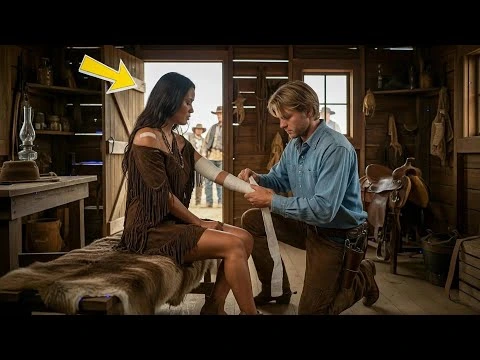
VIRGIN COWBOY SAVED A NATIVE GIRL’S LIFE — BY DAWN, HER TRIBE SAID SHE BELONGED TO HIM
PART 1 — THE WOMAN BESIDE THE CREEK
“Give us a moment, will you? You’re going to heal up just fine.”
In the autumn of 1878, beneath a copper-colored Wyoming sky, twenty-seven-year-old Caleb Mercer rode alone across the frontier, searching for three cattle that had wandered from his ranch.
Caleb was quiet, unmarried, and inexperienced with women, but he was known for one thing above everything else: when he gave his word, he kept it.
That evening, smoke rising beyond a canyon caught his attention.
He rode toward it and found an overturned wagon beside a frozen creek. Two horses were still trapped in their broken harnesses, trembling with fear.
And beside the wagon lay a young Native woman.
She was unconscious, bleeding from a wound at her temple, with an arrow wound buried in her shoulder.
Caleb dismounted without hesitation.
He carried her beneath a cottonwood tree, cleaned her wounds with water from his canteen, built a fire, and covered her with his coat.
He had no idea who she was.
He only knew that if he left her there, she would probably die before morning.
Near midnight, wolves began howling across the canyon.
Caleb sat beside the fire with his rifle across his knees.
Then the woman’s eyes suddenly opened.
Fear flashed across her face. Her hand disappeared beneath her coat and returned with a small knife.
Caleb slowly raised both hands.
“Easy. I won’t hurt you.”
She stared at him for several long seconds before lowering the blade.
“My name is Iona,” she whispered. “Who are you?”
Caleb told her what he had found.
She explained that raiders had attacked her family’s wagon and taken her two companions. She believed they might still be alive.
At dawn, Caleb prepared his horse.
“You need your strength,” he told her. “I’ll get you home.”
Iona looked at him strangely.
“Why would you help me?”
Caleb tightened the saddle strap and answered simply.
“Because leaving you here would be wrong.”
Neither of them knew that before this journey ended, that answer would change both their lives.
But first, three armed riders were already searching the frontier for the woman Caleb had just rescued.
Would Caleb reach Iona’s people before the riders found them—and what would happen when her tribe discovered who had brought her home?
#WesternStory #CowboyStory #NativeAmericanStory #FrontierTales #LoveAndSurvival #OldWestStories #StoryTime
PART 2 — THE TRIBE THAT CAME FOR HER
Caleb and Iona traveled slowly through the mountains, stopping whenever her shoulder began bleeding again.
He never treated her like helpless cargo. Before touching her wounds, he asked permission. When she wanted silence, he gave it. When she spoke, he listened.
That difference began to matter to Iona.
At a lonely trading post, Caleb noticed fresh boot tracks around the building.
Iona recognized them.
“They are looking for me.”
Three riders appeared on the ridge moments later.
Caleb extinguished their fire and pulled Iona behind the trading post. The men claimed they were searching for a stolen horse, but Caleb knew the explanation was false.
They waited until the riders disappeared.
Then they rode through the night.
The following afternoon, Iona finally recognized the valley ahead.
Smoke rose from several distant lodges.
Her home.
Relief filled her face, but it disappeared almost immediately.
“My people may not welcome you,” she warned.
Caleb looked toward the riders gathering on the ridge.
“I understand.”
Iona shook her head.
“No. You saved my life. They need to know.”
Together, they entered the valley.
Dozens of riders surrounded them, bows raised.
Caleb stopped his horse and lifted his hands.
Then Iona called out.
She told them the stranger had rescued her, protected her, and brought her home.
An older man rode forward.
Silver streaked his hair, and his expression was stern.
“My father,” Iona whispered.
His name was Nacoa.
He embraced his daughter first.
Only after confirming she was alive did he turn toward Caleb.
“What do you want in return?”
“Nothing.”
The chief studied him.
That night, Caleb was invited to remain near the fires while Iona sat beside him.
Their conversations became quieter and more personal. Iona spoke of wanting a life where she could choose her own future.
Caleb admitted he wanted the same.
For the first time, they realized that beneath two very different lives, they carried the same desire.
Then, before sunrise, a messenger arrived.
The missing companions had been found.
But the raiders were still searching for Iona.
And this time, they were coming straight toward the valley.
If the raiders attacked before Iona’s people could move, would Caleb survive the fight—and what would the tribe decide about the bond growing between him and Iona?
PART 3 — THE CHOICE THAT BELONGED TO IONA
The attack came before sunrise.
The valley was still wrapped in darkness when the first gunshot shattered the silence.
Horses screamed.
People rushed from their shelters.
Gunfire echoed against the pine-covered hills as the raiders opened fire from the eastern trail.
Caleb was already awake.
He grabbed his rifle and ran toward the sound while Nacoa rallied his defenders.
Iona refused to stay behind.
She carried water, gathered bandages, and helped the wounded move away from the gunfire.
Caleb saw her once across the valley.
For a brief second, their eyes met.
Then another shot cracked through the trees.
Caleb turned toward the ridge.
A rider was moving directly toward Iona.
The man raised his rifle.
“Iona!”
Caleb fired.
The bullet struck the man’s weapon, knocking it from his hands.
The raider fell from his horse and scrambled toward the trees.
Caleb started after him, but then he heard Iona calling his name.
He stopped.
For the first time since the fighting began, Caleb realized that chasing the enemy no longer mattered as much as knowing she was safe.
He turned back.
Iona ran toward him.
Dust covered her face, and tears filled her eyes.
“I thought they killed you.”
“I’m all right.”
She threw her arms around him.
Caleb held her carefully.
Neither spoke.
The battlefield around them was still loud with gunfire, but for those few seconds, everything seemed distant.
By midday, the attack had ended.
Several raiders had been captured. Others had fled into the mountains. The horses they had stolen were recovered, and the wounded were being treated.
The valley slowly became quiet again.
But Caleb soon learned that the most difficult moment of the entire journey was not the battle.
It was the council that followed.
That evening, Nacoa summoned Caleb and Iona before the elders.
The chief spoke about the rescue beside the creek, Caleb’s journey across the mountains, and the courage he had shown during the attack.
Then he explained an old tradition within the fictional story’s community: when one person had saved another from certain death through extraordinary courage, the families could recognize a lifelong bond of protection and belonging.
Some elders understood that bond as a possible marriage.
Others saw it as something broader—a promise between families.
But Nacoa made one thing clear.
No tradition could force Iona to marry a man she did not choose.
Still, not everyone agreed.
One elder argued that Caleb had already proven himself worthy of becoming part of the family.
Another reminded the council that Iona’s freedom mattered more than any custom.
Caleb listened in silence.
Finally, Nacoa turned toward him.
“What do you want?”
Caleb looked at Iona.
His answer came slowly.
“I want her to be free to choose.”
The entire camp became silent.
“I helped her because she was hurt,” he continued. “I protected her because someone had to. If she ever chooses to stand beside me, I want it to be because she wants me there—not because anyone believes I earned the right to have her.”
Iona stared at him.
Then she stepped forward.
“When I met Caleb,” she told the council, “he never asked what I could give him. He never asked for gratitude. He never treated my life as something he had purchased by saving it.”
Her voice softened.
“If I choose him someday, it will be because I love him.”
Nacoa nodded.
Then he placed a hand on Caleb’s shoulder.
“You are welcome here as a friend of this family.”
He turned toward his daughter.
“And the choice is yours.”
Iona looked at Caleb.
For a moment, neither moved.
Then she stepped closer.
“I want you beside me,” she said quietly. “If you are willing.”
Caleb smiled.
“I am.”
They did not marry the next morning.
They did not suddenly pretend that two different worlds had become identical.
Instead, they gave themselves time.
That winter, Caleb remained connected to the community while helping Nacoa’s scouts understand the mountain trails and routes around his ranch.
Iona spent time at Caleb’s home as well, learning the rhythms of ranch life while deciding what kind of future she actually wanted.
They disagreed.
They laughed.
They worked.
They sometimes misunderstood each other.
And slowly, they learned how to listen.
Their affection became stronger precisely because neither demanded that the other surrender who they were.
By spring, Caleb had repaired the ranch and expanded the house.
Not because he wanted to build a place where Iona would be expected to obey him, but because he wanted her to have a room, a garden, and a corner of the property that belonged entirely to her.
Iona planted herbs near the house and taught Caleb which mountain plants could survive the dry soil.
Caleb taught her how to handle cattle, read a nervous horse, and prepare for the brutal Wyoming winters.
One evening, they sat outside while the sun disappeared behind the mountains.
Iona looked across the fields.
“Do you remember the creek?”
Caleb smiled.
“I remember being certain you were going to stab me.”
She laughed.
“You frightened me.”
“I was trying very hard not to.”
“You were terrible at it.”
Caleb laughed.
For a while, they watched the sunset.
Then Iona reached for his hand.
This time, there was no council watching.
No tradition.
No expectation.
Only a choice.
Their wedding came later.
It was simple, bringing together people from the nearby settlement and members of Iona’s community.
There were horses tied outside, blankets laid beneath the trees, music carried across the valley, and food shared around a long table.
The mountains turned gold beneath the setting sun.
Caleb looked at Iona.
She looked back at him.
Neither needed to explain why they were standing there.
They had chosen one another.
Years later, travelers passing through Wyoming heard stories about the young cowboy who found a wounded Native woman beside a lonely creek.
Some told the story as a great frontier romance.
Others exaggerated the danger and added details that had never happened.
Caleb rarely corrected them.
Iona simply smiled whenever someone called their story a legend.
Because the truth was quieter.
And, to her, far more important.
Love had not begun with a ceremony.
It had not begun with a promise from two families.
It had not begun because a tradition declared that two people belonged together.
It began beside a cold creek when a young cowboy saw an injured stranger and chose compassion.
Then it grew because that stranger chose to trust him.
It survived because neither tried to own the other.
And that was the lesson Caleb carried for the rest of his life:
Belonging is not something one person can claim from another. It is something two people freely choose to build together.
Every winter, when the Wyoming wind swept across the ranch and snow covered the distant mountains, Caleb remembered that first night beside the creek.
He remembered the frightened woman holding a knife.
He remembered raising his hands and saying, “Easy. I won’t hurt you.”
And he remembered what happened after.
A stranger became a companion.
A rescue became a friendship.
A friendship became love.
And two people who had been born into completely different worlds discovered that the strongest bond between them was never ownership.
It was choice.








