“We Only Invited You Out of Pity,” My Mother Whispered at Dad’s 70th Birthday. I Finished My Champagne and Walked Out Without a Word. Three Weeks Later, the Family Lake House Was Gone, and 49 Missed Calls Were Waiting for Me at 7:03 A.M
“We Only Invited You Out of Pity,” My Mother Whispered at Dad’s 70th Birthday. I Finished My Champagne and Walked Out Without a Word. Three Weeks Later, the Family Lake House Was Gone, and 49 Missed Calls Were Waiting for Me at 7:03 A.M. 💔
PART 1
The candlelight in my parents’ dining room made everything look softer than it really was.
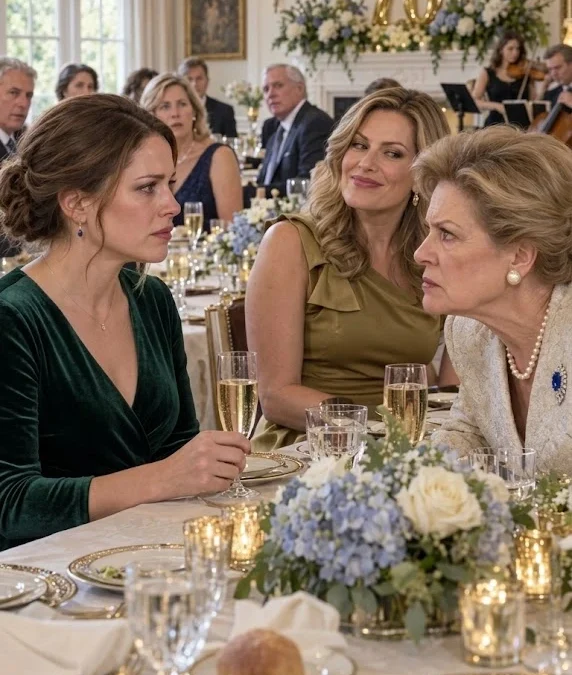
Crystal glasses. White roses. A string quartet in the sunroom playing Debussy. Forty guests in tailored clothes toasting my father, Harlon Prescott, on his 70th birthday. I had flown across the country from Seattle that morning, rented a white sedan at Logan Airport, and driven to Newton with a carefully wrapped gift on the passenger seat. It was a first-edition book I knew he’d love. It was sitting unopened on the gift table, buried under bigger, shinier boxes.
I was halfway through my glass of champagne when my mother leaned toward me.
Coretta Prescott, 68 years old, smelled of expensive perfume. Pinned to her silk blouse was a sapphire brooch, my grandmother’s brooch. Grandma had left it to me. My mother had taken it before the will was even read.
She smiled for the room. Then she whispered, close enough that only I could hear:
“We’re only inviting you out of pity. So don’t stay long.”
Beside her, my older sister Ranata let out a laugh. Not a nervous one. A delighted one. She was 40, three years older than me, wearing a Boston boutique dress that cost more than my monthly rent.
At the far end of the table, my father was laughing with his golf buddies. He didn’t hear a thing. Or maybe he’d just gotten very good at not hearing.
I looked down at my glass. Still half full.
And I remember thinking, very clearly: I will not leave a full glass behind.
It felt important. A small piece of dignity I could still hold onto. So I lifted the flute and drank slowly, every last sip. I set it down with a soft click. I folded my napkin. I stood up.
I didn’t look at my mother. I didn’t look at Ranata.
I walked past the quartet, past the foyer piled with presents, and out the front door. I didn’t slam it. I didn’t cry in the driveway. I got into the rental car and drove.
I want you to understand something: I wasn’t planning revenge. I wasn’t planning anything. I was just numb, the kind of numb where your hands steer the car while your heart goes somewhere far away.
I drove past the coffee shop where Ranata, at 15, told me I’d never be as pretty as her because I’d “inherited Dad’s chin.”
Past the high school where my mother skipped my graduation to attend Ranata’s college graduation the same weekend.
Past the church where, at Grandma’s funeral, my mother rearranged the seating so I ended up in the third row while cousins I’d never met sat up front.
I ended up at a small hotel in Cambridge by the Charles River. I checked in under my married name, a name my family had never once used.
Because none of them came to my wedding.
Not one. Ranata had a spa weekend. My parents had a wine tasting in the Berkshires. My husband Denver, the kindest, most patient man I’ve ever known, held my hand at the altar and said nothing while the pew reserved for my family sat completely empty.
Three years ago, Denver died. Pancreatic cancer. He was 41.
My family sent one bouquet, with a card signed by all three of them in Ranata’s handwriting. None of them came to the funeral. My mother told me on the phone that funerals were “depressing,” and she was “going through a rough patch with her book club.”
I sat on the edge of that hotel bed for a long time, thinking about Denver. He used to say my family was a puzzle I’d never solve, because the pieces had been cut wrong from the start. He’d start to say “You deserve better, Marlo…” and I’d always change the subject. Hearing it meant I’d have to do something about it.
But Denver was gone. I was 37. And my own mother had just used the word pity.
I opened my laptop. I didn’t cry. Not yet. For the first time in years, my head was completely clear.
Because there were things my family didn’t know about me. Things they’d never once bothered to ask.
When Denver died, his share of the biotech firm he co-founded in Seattle was bought out. Add his life insurance and the sale of our home in Bellevue, and my lawyer politely called what I had “generational money.” I’d barely touched it. I lived in a small rental, worked as a freelance editor, and never said a word.
And there was one more thing.
The family cabin on Lake Winnipaki in New Hampshire: four bedrooms, a wraparound porch, a private dock, nearly three acres of shoreline. My family spent every summer there. Ranata’s kids learned to swim off that dock. My father hosted his golf friends there every September. My mother held her book club retreat there every August. They had keys, a stocked pantry, a boat in the water.
They called it “the family cabin.”
But before she died, my grandmother had quietly made a decision. And she left me a handwritten note I hadn’t opened in years:
“Use this however you need to, my brave girl.” 🕯️
I pulled up the document on my screen and stared at it until the words blurred.
The deed to that cabin, worth over $1.4 million, didn’t say Prescott Family.
It had only one name on it.
Mine.
And the one place my family had built every summer of their lives around was legally, quietly, entirely mine.
👉 Part 2 is in the comments below. Can’t find it? Leave any word and I’ll send it to you privately! 👇
PART 2
And the one place my family had built every summer of their lives around was legally, quietly, entirely mine. It was almost midnight when I called my lawyer, Anise Halvorson, the woman who had handled Denver’s estate. She answered on the second ring, like always. I told her everything: the whisper, the laugh, the champagne, the drive. Then I told her what I wanted to do. There was a long silence. Then, in her calm Norwegian accent, she said a sentence I’ll never forget: “Are you absolutely certain, Marlo? Because once we start, we do not stop.” I looked out at the lights shimmering on the Charles River. I thought about Denver. I thought about my grandmother. I thought about the word pity. “I’m certain,” I said. “Start tomorrow.”
By 10 a.m. the next morning I had signed every document she sent me from the hotel business center. And by 11, Anise had uncovered something that made my hands go cold. Back when I was 21 and fresh out of college, my parents had me sign paperwork at the kitchen table for “family joint accounts,” money for emergencies, cabin upkeep, property taxes. My mother poured coffee while I signed without reading. What none of us understood was that the paperwork made me the primary account holder. My Social Security number anchored every account. My credit built every credit line. For 16 years, my parents had used those accounts to pay the cabin’s taxes, cover Ranata’s overdrafts, fund Dad’s golf membership, and landscape their house. Legally, every dollar was mine: just over $95,000. I could close all of it, without notice and without permission.
I didn’t feel triumphant. I felt tired, like setting down something heavy I’d carried so long I forgot it was heavy. “Do it,” I said. “Then start on the cabin.”
Anise brought in Bertram Kfax, a 72-year-old real estate attorney in New Hampshire. When he heard my name, he laughed softly. “I’ve been wondering when you’d finally do something about that cabin.” My grandmother had visited him a year before she died. She’d paid him a retainer to protect me if anyone ever contested the deed. She told him her daughter “had a way of taking things that weren’t hers.” I sat on that hotel bed and finally cried. Not for my mother. For the grandmother who had seen everything I refused to see. By that evening, Bertram had a cash offer from a retired surgeon and his wife: $1,380,000, no contingencies, closing July 15th. I said yes.
Then I called the one person in that family who had ever been kind to me: Ranata’s husband, Percy. I told him everything. He was quiet a long time. Then he said, “Some lessons only land when they arrive without warning. I won’t tell her.” He asked only one thing: would I still be an aunt to his kids, Fenna and Torven? “Always,” I said.
Anise sent my parents a formal letter. Accounts closed. Tax payments revoked. Cabin under contract. Belongings to be removed by July 15th. All future contact through her office. I flew home to Seattle and waited. On the fourth day, the bank letters landed in Newton. My phone started buzzing at 7 a.m. and didn’t stop. I replied once, “Please direct all communication to my attorney,” and the calls only got angrier. That night I turned my phone off and slept better than I had in years.
At 7:03 the next morning, I turned it back on. ☕📱 49 missed calls. Dozens of voicemails. Most were exactly what I expected: rage, guilt, threats. But the very last one was from my father. His voice was shaking. And what he said made my coffee go cold in my hands…
🔥 Part 3 is coming! Comment “BRAVE” and hit LIKE to see how it ends. Once we hit enough comments, I’ll post the ending! 👇
PART 3
“Marlo… your mother told me you left because you were tired from the flight. Please. Just tell me you’re okay. I don’t understand what happened.”
I set the cup down and played it again.
He didn’t know. Forty-nine calls, and the only person who sounded truly lost was the one who’d never been told the truth.
I went through the rest of the voicemails one by one, saving the transcripts for Anise and writing notes in a little notebook. The first ones were confused. Then my mother’s turned furious: I was a thief, ungrateful, cruel, “just like your grandmother,” as if that were an insult. Then Ranata took over. The cabin belonged to all of us, Grandma had promised it to her kids, and her lawyer was going to “have my head.” Near dawn, my mother switched tactics. She’d been drinking, she said. She didn’t mean it like that.
I underlined my father’s messages and set them aside.
Ranata’s lawyer, a suburban divorce attorney named Grover Howerin, sent a six-page letter accusing me of theft, fraud, and emotional abuse. He demanded I stop the sale, restore the accounts, and pay Ranata $50,000 for “emotional distress.”
Anise actually smiled while reading it to me. “He never asked to see a deed,” she said. “Ranata isn’t even a signer on those accounts.” Her two-page reply attached the deed, the will, and Bertram’s confirmation, and politely reminded him that frivolous lawsuits come with attorney’s fees.
Within 24 hours, Ranata left Anise a five-minute voicemail. She was cursing and crying, and finally admitted Howerin had dropped her. There was no case.
That afternoon I called my father through Anise’s office line. He picked up on the first ring.
“Marlo. Oh, thank God.”
I told him everything, including the exact words.
Silence. So long I thought the call had dropped. Then, barely a whisper: “She said what to you?”
I repeated it. “We’re only inviting you out of pity. So don’t stay long.”
“Oh my God,” he breathed. “Oh my God, Marlo.”
He asked why I hadn’t told him at the party. “Because you were laughing at the other end of the table,” I said. “Because you never opened my gift. Because every time I tried to tell you about Mom or Ranata, you asked me to keep the peace.”
He cried quietly, the way old men cry when they realize how much they’ve lost. I didn’t comfort him. That wasn’t my job anymore.
“I’m not undoing anything, Dad,” I said. “If you want me in your life, it’ll be on completely different terms.”
The cabin sale closed on July 15th, right on schedule.
That evening Bertram called me from the porch. The buyers had left, and the loons were calling across the water. “Your grandmother would be proud,” he said.
My family never came for their things. Bertram packed everything into a storage unit, but he kept my grandmother’s belongings separate and shipped them to Seattle.
Seventeen boxes.
I spent a whole weekend on my living-room floor with them. Her childhood photo albums. Recipe cards in her looping handwriting. My grandfather’s letters from the Korean War. A gold locket holding a photo of me at four.
And at the very bottom, wrapped in tissue paper…
The sapphire brooch.
The same one my mother had worn at the party three weeks earlier. My hands trembled as I turned it over. Engraved on the back in tiny letters:
For Marlo, on her wedding day. — A.M.
Somehow, at some point, my grandmother had taken it back from my mother and hidden it in the cabin. She’d been waiting for me to find it.
I pinned it to my shirt and wore it all day. Then I sat on the floor and cried for the wedding day she never got to see. 💙
My mother didn’t give up easily. A misdirected tax bill reached her house, and she called Anise screaming that it “proved” she owned the cabin and she’d sue to get it back. Anise calmly explained the taxes had been paid at closing and the bill was a mistake.
Afterward Anise called me. “Twenty-six years of practice, Marlo, and I’ve never seen a family react like this. People who’ve used someone as a resource their whole lives can react very badly when it’s gone. Be careful.”
That night, I locked the deadbolt. Not because I was scared. Because I was ready.
But it wasn’t my mother who knocked first.
On a rainy Tuesday in August, I looked through the peephole and saw my father. He was 70, in a wrinkled blazer, soaking wet, holding a little bookstore bag. He hadn’t told my mother he was coming.
“I opened it,” he said, holding up the book. “I read most of it on the plane. It’s wonderful. Thank you.”
My eyes filled. I let him in.
At my kitchen table, he talked for two hours. My mother had always made him feel small, he said, and agreeing with her had become easier than fighting. She had once said I was “Harlon’s baby, not hers,” and that she’d never wanted a second child. When I was eight, my grandmother had pulled him aside and warned him: “If you don’t protect that girl, you’ll lose her one day, and it’ll be your own fault.” He stopped speaking to her for a year. He never apologized before she died.
He told me about Denver’s last visit, and the snide comments my mother made at dinner while Dad said nothing. At the door, Denver shook his hand and said, “Take care of yourself, Harlon.”
“He knew I was a coward,” my father whispered. “He was too kind to say it.”
We were both crying by then.
“I have one condition,” I told him. “I will never again be in a room with Mom. Not holidays, not birthdays, not funerals. Not even yours. If you want to see me, come here. If you call, call yourself. If you send a card, sign only your name.”
He nodded slowly. “I accept.”
Then I said something I hadn’t said since I was a little girl.
“I love you, Dad.”
His face just crumpled.
He stayed four days. At Pike Place Market he bought me a little hand-painted ceramic bowl with blue flowers. “Something from me that’s chosen,” he said, “not obligated.”
When he got home and told my mother where he’d been, she threw a crystal vase at the wall behind his head. For the first time in 48 years of marriage, he packed a bag and spent the night in a hotel. She cried and promised counseling, and he went back. But something had cracked open, and it never closed again.
Ranata, meanwhile, was falling apart.
Percy told me in careful pieces. She had bounced three checks in one week once the joint accounts disappeared. Worse, months earlier she had taken out a $30,000 personal loan against her “future share” of the cabin and spent it on a kitchen renovation. Now it was due, and there was no share. Percy refused to touch their savings.
Then, quietly, from his car in a parking lot: “I filed for divorce two weeks ago.”
In October, I came home from a walk and froze at the corner.
My mother was sitting on my front step in a beige trench coat, holding yellow roses. She looked older, smaller than she had in June.
I turned around, walked to the coffee shop, and called the non-emergency police line, exactly as Anise had told me to. Forty minutes later an officer called back. She had left in a cab and been warned not to return.
The roses were still on the step. I put them in the recycling bin.
That night she left one last voicemail. It was quiet, almost broken.
“What I said to you at the party was the ugliest thing I’ve ever said to anyone. I know why I said it. I’m just not ready to say it out loud yet. I’m sorry.”
I listened twice. I saved it. I didn’t call back. But for the first time since June, what I felt wasn’t anger. It was a small, tired sadness.
I started building a life that was finally mine.
With the cabin money, the accounts, and Denver’s estate, I put $500,000 into a foundation named after my grandmother, the Adelaide Marquetti Fund. It gives grants to women escaping controlling families, covering deposits, therapy, moving costs, and legal fees. Our first grant went to a 24-year-old in Tacoma whose family had taken her paychecks since she was 16.
I set up a quiet college trust for Fenna and Torven. In December I bought a little bungalow in Ballard with a fireplace and morning light, and paid cash. At Christmas my father sent a card signed only by him, with a $25 check, the same amount he gave me every Christmas as a child. I framed it. I’ll never cash it.
In January, Percy’s divorce was finalized. He got primary custody.
In March I flew to Boston for the kids’ spring break. Fenna, 11 now and nearly my height, had planned the whole week: museums, a bookstore, the aquarium, a specific pancake place. On the drive home she asked why I hadn’t visited before.
“Some grown-ups in our family weren’t always kind to me,” I said gently. “I needed to step back to protect myself.”
She was quiet. Then: “My mom was one of them, right?”
“Yes,” I said. “But she’s your mom, and I’ll never say bad things about her to you.”
She looked out the window. “She’s not always nice to me either. But my dad is. And I have you now. So I think I’m okay.”
I had to pull the car over to hug her. 🥹
Before I left, I met my father for coffee in Cambridge. He was in therapy on his own, writing notes in a little notebook as I talked about my work and my garden. Ranata had asked him whether I’d ever speak to her again.
“I told her it isn’t my place to ask for her,” he said. “And to be ready for the answer to be no.”
A year earlier, he’d have begged me to forgive her. “I’m proud of you, Dad,” I said. His eyes went wet.
In April, an eight-page handwritten letter arrived from Ranata.
I let it sit three days before I opened it.
She confessed that she was the one who first said the word “pity,” at lunch with our mother days before the party. When I walked out, she had felt a rush of pleasure, and now she was ashamed of it. She had spent her whole life competing for a love that only worked if someone else was being crushed. She was in therapy. She had come to understand that Grandma’s choice to leave me the cabin was correct.
“I’m not asking for anything,” she wrote. “I’ll keep the door open on my side. But I won’t knock on yours.”
Two weeks later I wrote back, three paragraphs. I was glad she was doing the work, but the work had to be for herself and her kids, not to win me back. If we ended up at the same birthday or graduation, I’d be civil.
“Civil is the ceiling,” I wrote. “Anything more will take years of consistent action. Not letters.”
She replied once: “I understand. I won’t push.”
It’s been a little over a year since that party.
I turned 38 in my little Ballard bungalow, surrounded by people who actually love me. Odelise and her wife baked the cake. Fenna and Torven sang to me over video, and Fenna held up a drawing of us watching a whale: “My Aunt Marlo is the best aunt in the whole entire world and I mean it.” My father called and sang off-key, then cried a little.
My mother sent a card: “I’m thinking of you. I love you. I’m sorry.” I read it once and put it in the box with the others.
Ranata’s said simply, “Wishing you good things. — R.” That one went in a different drawer.
This Thanksgiving, Percy is bringing the kids to Seattle. Fenna’s making the pies. Torven’s setting the table. And my father is flying out, alone, for his first Thanksgiving away from my mother in nearly 50 years.
“I’m scared,” he told me. “But excited.”
“Me too, Dad.”
I don’t know if my mother will ever earn her way back. I don’t know if Ranata and I will ever truly be sisters. But I know this:
At 7:03 that morning, 49 missed calls lit up my screen, and I didn’t feel afraid. I didn’t feel guilty. I didn’t feel small.
For the first time in my life, I was standing on my own two feet.
If someone has ever used love or family as a leash on you, remember this: love doesn’t keep score. Boundaries aren’t punishment. And family isn’t only the people you were born to. It’s the people who show up.
You’re allowed to fold your napkin and walk out. 🕊️
On important days, I still wear my grandmother’s brooch. Every time, I hear her voice:
“You have a strong heart, my brave girl. Use it.” 💙
Disclaimer: This story is entirely fictional and created for entertainment purposes only. It does not represent any organization or individual, nor does it encourage inappropriate behavior. The content was generated with AI assistance.








