While My Aide Fed Me Lunch in My Own Home, I Learned My Fiancée Had Been Canceling My Rehab for Months. Then I Saw a Document Dated 3 Weeks Before the Attack That Put Me in This Chair.
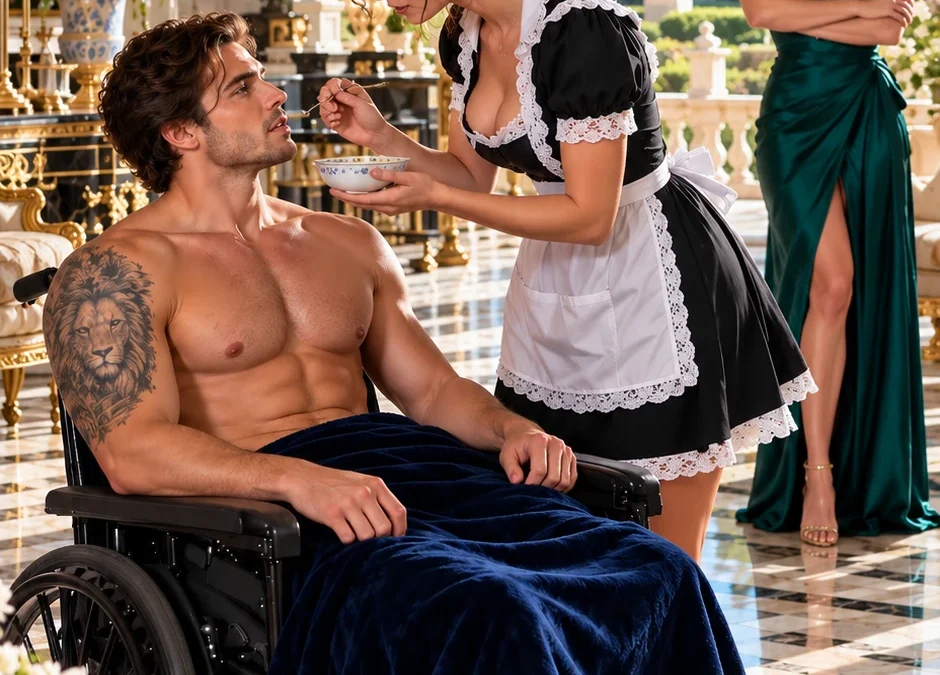
While My Aide Fed Me Lunch in My Own Home, I Learned My Fiancée Had Been Canceling My Rehab for Months. Then I Saw a Document Dated 3 Weeks Before the Attack That Put Me in This Chair.
Part 1
The day I found out my fiancée had been sabotaging my rehabilitation, I found something worse.
She had started preparing everything three weeks before the attack that put me in a wheelchair.
I’m Adrián Valcárcel. I’m thirty-nine. Until six months ago, my life was the port of Málaga, meetings with shipping lines, and construction crews on logistics expansions. I’d built a family company into one of the strongest in the south. I was used to deciding fast and walking faster.
Then came the attack outside a business dinner in Marbella.
Now my life was a silent villa, a wheelchair, and a body that answered slowly. The doctors were careful. Nobody could promise I’d walk again. But they insisted on one thing: constant rehabilitation was my best chance at strength, balance, and independence.
My fiancée, Clara Montenegro, had slipped into the role of the perfect woman. She planned the wedding, took calls, spoke with doctors, and told everyone she would never leave me.
That morning she stood at the mirror in an emerald green dress, hair flawless, wearing a coldness I’d spent weeks trying not to name.
“Marcos needs you to sign some papers for the port expansion.”
“Tell him to come here.”
She snapped her purse shut. “You don’t need more stress.”
“I’ve been hearing that for six months.”
She looked at me in the mirror. “People get uncomfortable seeing you like this.”
I held her gaze. “I’m sitting down, Clara. I haven’t stopped being me.”
She walked out without saying goodbye.
Twenty minutes later, Lucía Serrano came in. She was thirty-two, the aide a private agency had sent two months earlier. Hair pulled back in a rush. A habit of talking to me like an adult instead of a patient.
“Your left ankle is more swollen.”
“Good morning, Lucía.”
“Good mornings don’t reduce swelling.”
I smiled. She didn’t.
While adjusting my cushion, she avoided my eyes. “Clara cancelled your physiotherapy this afternoon.”
My smile died. “Why?”
“She said, ‘There’s no point in continuing anymore.'”
The courtyard fountain suddenly sounded louder.
“Did the clinic agree?”
“Clara is listed as your primary contact. She’s been changing your appointments for months.”
I gripped the armrest. “Months?”
“Today wasn’t the first time.”
“How many?”
“I don’t know. But I called the physiotherapist and told him to come anyway.”
I stared at her. “They could fire you for that.”
“I know.”
“Then why get involved?”
She took a breath, reached into her uniform pocket, and pulled out some folded pages. “Because last night I found these in the office printer.”
I recognized my company’s letterhead. Then I read it: an authorization to limit outside treatments, transfer medical decisions to a representative, and activate an internal protocol for prolonged incapacity.
At the bottom was Clara’s name.
And a date.
Three weeks before the attack.
A dry chill crept through my chest.
I didn’t call Clara. I didn’t ask for explanations. I dialed my lawyer and gave a single order: block every power of attorney, authorization, or signature filed in my name.
When I hung up, Lucía pointed to the bottom margin.
There was a second signature.
Marcos Beltrán. My chief financial officer. One of the men I trusted most.
Footsteps sounded in the hallway.
Clara was coming back.
And for the first time since the attack, I understood I had to pretend I still suspected nothing.
What happened next still gives me chills. Part 2 is in the comments—or leave any word below and I’ll send it to you privately.
Part 2
What happened next still gives me chills. Part 2 is in the comments—or leave any word below and I’ll send it to you privately.
Clara walked in smiling and set a folder on the table.
“Marcos will come after lunch. Just two signatures.”
I slid the document under my blanket. “Perfect.”
Lucía lowered her eyes, but Clara noticed her.
“Don’t you leave at one?”
“They changed my shift.”
Clara frowned, barely.
At 2:10, the physiotherapist arrived. Clara’s smile vanished.
“I cancelled the session.”
“The patient reactivated it,” he answered.
That sentence changed the air in the room.
That same afternoon, my lawyer confirmed something worse. For four months, Clara had been filing requests to expand her powers of representation. Marcos had signed as a witness on two of them.
And there was a third thing.
The document Lucía found wasn’t a draft. It had been electronically registered three weeks before the attack.
I asked to review cameras, emails, and corporate movements. Meanwhile Clara kept talking about flowers, guests, and the wedding menu.
By nightfall, Lucía received an email from her agency: service cancelled by decision of the family.
Clara already knew someone had started to disobey her.
But before leaving, Lucía pressed a USB drive into my hand.
“I found it inside Marcos’s folder.”
I opened it.
The first file had a simple name: “Contingency Plan.”
The date was before the attack.
And the first line read: “Following Adrián’s incapacity, activate phase 2.”
If you want to know what “phase 2” really meant, LIKE this post and comment “FASE 2.” When enough people comment, I’ll post Part 3. ♿
Part 3
I didn’t sleep that night.
I waited until the villa went quiet, closed my bedroom door, and opened every file on the drive. For years I’d read contracts looking for what people hide inside innocent words. This time no euphemism could calm me.
Phase 2 had nothing to do with medical care.
It was about control.
Marcos had prepared a reorganization to remove me from the board for prolonged incapacity. Clara would assume my representation and vote in my name. The wedding was the key: our family pact gave priority to a spouse as temporary representative.
I had approved that clause years ago to protect my family. Now they were using it against me.
But what hurt most wasn’t the figures or draft minutes. It was a folder of medical reports that predated the attack.
Emails from Clara asking which injuries could cause prolonged loss of mobility. Messages with Marcos about “the ideal timeline.” A €48,000 transfer to a consultancy with no real activity. And weeks later, another transfer to an intermediary connected to the man under investigation for the Marbella attack.
I pulled my hands off the keyboard.
For the first time since I woke up in the hospital, the memory of that night stopped looking like an absurd blow of fate.
I had no definitive proof of who ordered the attack. But I had enough to stop believing Clara was merely tired of caring for me.
At 6:30 I called my lawyer, Javier Navas.
“I want a forensic copy of everything. Don’t touch the originals.”
“I’m already sending an expert.”
“And private security at the house. Clara can’t know what we have yet.”
Javier was silent for a few seconds. “Adrián, if this is what it looks like, this is no longer a couple’s conflict.”
“I know.”
“It isn’t only a corporate problem either.”
“I know.”
That morning Clara walked in as if nothing had happened, carrying a cup of coffee and a catalog of venues.
“I was thinking we could move the wedding up six weeks.”
I looked at her calmly. “Why the rush?”
She smiled. “After everything that’s happened, I don’t want to wait.”
I looked at the hands I’d held for four years. Now all I could think about was signatures.
“Do what you think is best.”
She leaned down and kissed my forehead.
I didn’t pull away. I needed her to believe I was still in control of nothing.
For the next five days, the house became a stage. Clara talked about the wedding. I faked fatigue. Marcos appeared with folders. Behind the scenes, Javier, an expert, and an investigator went through emails, powers of attorney, and company movements.
Lucía could no longer enter as my aide, but she didn’t disappear. She texted the physiotherapist from her personal phone, coordinated sessions at different hours, and twice came through the service door with a bag of food from her mother so no one could say she was working there.
“My mother says a decent tortilla cures more than most promises,” she said the first time.
“Your mother’s a doctor, I assume.”
“No. She’s Andalusian. She thinks that’s enough.”
I laughed, a real one, the first in weeks. It didn’t fix anything. But it reminded me of something important: I could still laugh.
Rehab became daily again. No miracles. The first gain was tiny: I voluntarily activated my left quadriceps for four seconds.
Lucía clapped once. “Again.”
“You could show a little more excitement.”
“When you hit five seconds.”
While my body recovered small responses, the investigation recovered other truths. Marcos had spent nearly a year diverting contracts to two companies tied to his brother-in-law. Clara had received payments labeled image consulting and events. Neither seemed to have imagined I would personally review those details from a rehab schedule.
They found something even more revealing. Two days before the attack, Clara had sent Marcos a message:
“After Friday, he won’t be able to stop anything for months.”
It didn’t say how she knew.
Javier delivered everything to the National Police and the Prosecutor’s Office. The original attack, stalled for lack of direct evidence, was reopened from a different angle.
I wanted to confront Clara that same afternoon. Javier stopped me.
“If you scare her, she can destroy evidence or run.”
“She’s living in my house.”
“Precisely.”
I hated waiting. But in six months I’d learned patience could be a form of strength.
The opportunity came nine days later.
Marcos organized a private meeting at the villa with a notary, two advisers, and Clara. The pretext was urgent: the company needed to authorize an €18 million transaction tied to the port expansion. The real aim was my last signature before they filed to suspend my management powers.
Clara chose a white jacket and tucked the blanket over my legs before the meeting.
“You don’t have to talk much,” she whispered. “I’ll handle it.”
I looked at her. “You’ve done that for months.”
She smiled, thinking it was gratitude.
In the main salon, Marcos, the notary, and the advisers were waiting. So was Javier, introduced simply as my legal representative.
Marcos opened the folder. “We only need your signature here and here.”
I didn’t touch the pen. “First I have a question.”
His smile held. “Of course.”
“What is phase 2?”
The silence was so abrupt I heard the clock in the hallway.
Clara stopped breathing for a moment. Marcos closed the folder. “I don’t know what you’re talking about.”
I slid a copy of the document across the table. “Then you’ll want to read it.”
Clara reacted first. “Adrián, you’re exhausted. This isn’t good for you.”
“Don’t ever decide what’s good for me again.”
Her tone shifted. “I was only trying to protect you.”
Javier set a second folder beside the first. “Here are the rehab cancellations, the representation requests, the system access logs, and the recorded payments.”
Marcos stood. “This is absurd.”
“Sit down,” I said.
He didn’t. But he never reached the door either.
Two officers entered from the foyer, accompanied by another official. No shouting. Just identification, curt instructions, and faces that stopped pretending.
Clara looked at me as if she still expected to find the man who had trusted her.
“You called the police on me?”
“I handed over documents.”
“After everything I’ve done for you.”
That sentence did wound me. Not because it was true, but because for months I’d said something like it myself, defending her to friends, doctors, family.
Clara is sacrificing everything. Clara handles it all. Clara hasn’t left.
Now I understood that staying could be a strategy too.
“You cancelled my recovery,” I said.
“Because the doctors didn’t promise anything.”
“That gave you no right.”
“You were broken. You weren’t the same.”
I set both hands on the armrests. “That’s where you’re wrong. That’s exactly why I’m still the same.”
Clara looked at Javier, then Marcos, then the officers.
“I had nothing to do with the attack.”
Nobody had asked her that.
The room went still. Javier said nothing. Neither did I.
One officer asked Clara to accompany them to give a statement. Marcos was called separately.
When the door closed, I felt something that wasn’t victory. It was emptiness. I had loved Clara and imagined a whole life with her. Discovering the betrayal didn’t erase what I felt. It only proved that story hadn’t meant the same thing to both of us.
Lucía appeared an hour later. No uniform now. Jeans, a white T-shirt, a light jacket.
She looked at the salon full of folders. “I guess I missed something.”
I exhaled. “The wedding is cancelled.”
She raised an eyebrow. “That solves the menu problem.”
I laughed. Then stopped. “I don’t know what you do after this.”
She leaned on the doorframe. “Tomorrow you have rehab at nine.”
“That’s all?”
“For tomorrow, yes.”
It felt more honest than any promise about the future.
The following weeks were exhausting. Marcos was removed, several operations frozen, an audit launched. I returned to every important decision. The criminal case moved slower. The payments, messages, and ties to the intermediary didn’t prove by themselves who organized the attack, but they opened new lines. Months later, prosecutors filed charges for financial crimes and document forgery, while each person’s connection to the attack remained under investigation.
I learned some answers take time. So does a body.
At two months, I stood between parallel bars for eleven seconds with help. At three, I took two steps in braces with my physiotherapist holding my waist. At four, I could transfer from bed to chair with far less assistance.
It was no cinematic miracle. It was real, and every inch belonged to me.
One November afternoon, the same salon where Clara had tried to get my signature filled up again. This time no lawyers, no financial advisers. Physiotherapists, my sister, two old port employees, Lucía’s mother, and an enormous paella nobody knew where to put.
Lucía argued with her mother for bringing food for twenty when only nine were coming.
“There’s always leftovers,” her mother protested.
“You say that before my brother shows up.”
I watched them from my chair. For months I’d confused caring with deciding for someone. Clara screened calls, cancelled sessions, and spoke in my name. Lucía did the opposite. She told me the truth even when it hurt. She asked before touching my chair. She handed me things when I asked and left them out of reach when she knew I could get them myself.
She didn’t give me back the life I’d had. She helped me reclaim the right to steer the one I still had.
Javier arrived late and dropped an envelope on the table. “The judge annulled the last authorizations filed in your name. It was also formally recognized that several signatures were used without valid consent.”
I closed my eyes for a second. Not complete justice. But a beginning.
“And Clara?”
“Her case is still open.”
I nodded. I no longer needed to ask every day.
That night, after everyone left, Lucía walked me out to the terrace. The garden was dark, and the fountain still sounded the same as the morning she handed me those pages.
I looked at the portable rehab bars the physiotherapist had left by the glass doors. “I want to try again.”
“You’re tired.”
“Does that mean you’re going to cancel my session?”
She smiled. “Not a chance.”
She set my chair in front of the bars and locked the wheels. I planted my hands, breathed deep, and pushed.
My legs shook. My body protested. For a few seconds, nothing happened.
Then I rose.
Lucía kept her hands close, without gripping me.
I was standing. Not entirely alone. Not forever.
But standing.
The fountain kept running behind us. I looked at the house I’d felt as a cage for months, and I understood that what mattered most wasn’t whether I’d ever walk like before.
It was that nobody would ever convince me my life was over while I still had a voice to decide the next step.
And when my legs began to fail, I felt no shame.
I sat back down. Rested. Smiled.
And asked to try one more time. 💛
Disclaimer: This story is entirely fictional and created for entertainment purposes only. It does not represent any organization or individual, nor does it encourage inappropriate behavior. The content was generated with AI assistance.








