“WHITE MAN, YOU HAVE SOMETHING THAT IS NOT YOURS”: 50 ARROWS SURROUNDED HIS BARN AT DAWN, AND THE DYING GIRL HE HID INSIDE WAS THE KEY TO A MURDER THAT HAD HAUNTED HIM FOR 3 YEARS
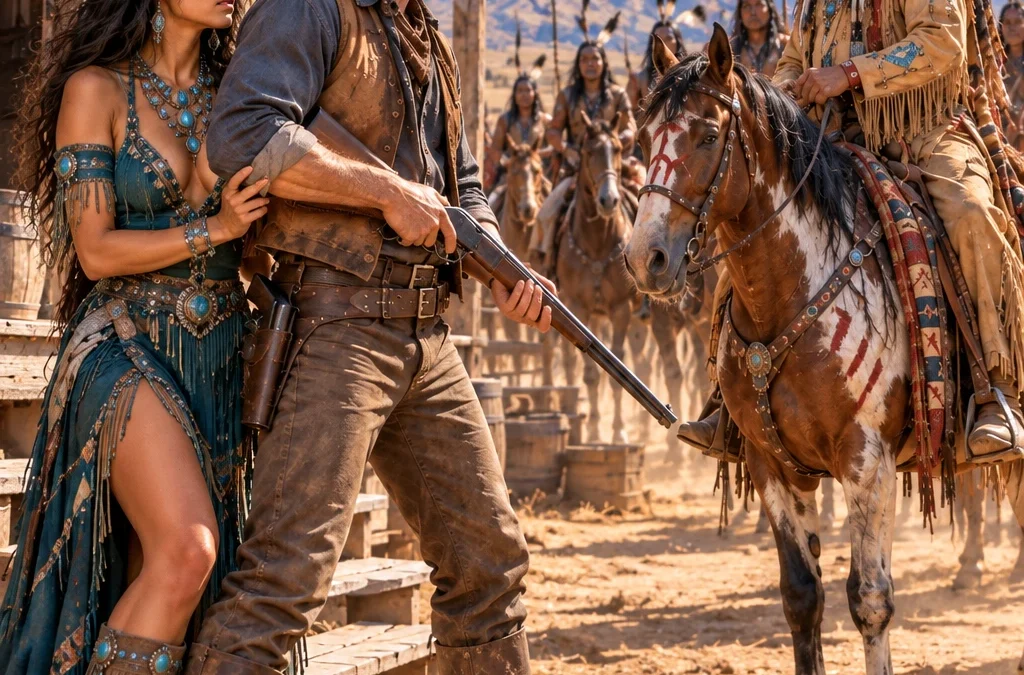
“WHITE MAN, YOU HAVE SOMETHING THAT IS NOT YOURS”: 50 ARROWS SURROUNDED HIS BARN AT DAWN, AND THE DYING GIRL HE HID INSIDE WAS THE KEY TO A MURDER THAT HAD HAUNTED HIM FOR 3 YEARS 😱🔥
Part 1
“White man, you have something that is not yours.”
Fifty riders. One barn door. And Nate Colton standing in it with nothing left but a truth nobody would believe. 😨
“She’s alive,” he called out. “Your daughter’s alive. But she’s hurt bad. And if you storm this barn right now, you’ll finish what that army bullet started three days ago.”
The war chief did not move. Did not blink.
Behind Nate, the hay shifted.
“Don’t,” Nate said, low. “You’re not strong enough for this.”
She was already past him.
Halona came through that doorway on legs that shook like a newborn colt’s. Her tan buckskin dress was torn and dark with blood at the shoulder. Turquoise beads caught the gray dawn light. Cold sweat stood on her forehead. Fever burned in her eyes.
And still she stood.
“He didn’t take me,” she said, her voice thin as paper. “He saved me.”
Fifty riders leaned forward at once. Nobody lowered a bow. 🏹
Nate had counted them twice, because the first time his hands were shaking too hard to trust the number. Circling his ranch in the gray before sunrise. Quiet as smoke. Quiet as men who had already decided how the morning would end.
His shirt stuck to his back with sweat despite the cold. Funny, he thought, how a body kept shaking and remembering how to be afraid long after the mind had resigned itself. Rebecca used to tease him that his hands gave away every card he ever tried to hide.
Rebecca.
Three years earlier, a wagon road ran along the base of the Davis Mountains, a thin brown line through country that did not care whether a person lived or died on it. Rebecca Colton rode that road in the back of a supply wagon, laughing at something the driver had said. That was the last thing anyone saw her do.
She had a laugh that came from low in her chest. Not polite. Not the kind women were taught to use in front of company. Nate had fallen for that laugh a full year before he worked up the nerve to fall for the rest of her.
Twelve years of marriage. A woman who argued with him about fence lines and cattle prices and the proper way to can peaches. Who never once let him win an argument he hadn’t earned. Who used to stand on the porch with her arms crossed, watching the mountains go purple at dusk, and say she didn’t know how anyone lived anywhere else once they had seen that color happen every night for free.
Nate wasn’t there. That was the part that never let him sleep.
He was two ridges over, mending a fence that didn’t need mending half as badly as he told himself. Hearing nothing. Not the shots, not the screaming. Nothing, until the horse came back alone. 💔
Lathered white. Reins torn. Eyes rolled wide with the fear horses only carry when they have watched something no horse should watch.
The sheriff came the next day, walked the ground with his hat in his hands, and told Nate it was Apache. A raiding party down from the mountains. Nate believed it, because what else was there to believe? Because the whole territory said it over supper tables and church steps until the story hardened into something that didn’t need proving. A lie repeated enough stops sounding like a question and starts sounding like weather.
He buried his wife on a small rise behind the house, where she could see the mountains. He built a white fence around the grave with his own hands, working two days without sleep. The only white fence for fifty miles.
And something in him closed like a door.
For three years he lived alone with it. The neighbors stopped inviting him to supper. He talked to Rebecca’s grave marker more than he talked to living men. Only one man never stopped coming. Hank Puit, an old soldier with a limp in wet weather, who rode up once a month to sit on the porch and remind Nate that the world still had people in it.
“A man can grieve a woman his whole life,” Hank told him once. “Don’t mean he has to grieve alone the whole time, too.”
Then, three days before the riders came, Nate was checking cattle near Willow Creek when gunshots cracked across the flats.
Three spaced and deliberate. A fourth, panicked, right on their heels.
Every rancher in Texas knew the rule. Somebody else’s trouble is somebody else’s trouble. Ride home. Bar the door.
His horse turned toward the sound before his mind gave the order. Some part of him that had been sleeping for three years wanted to feel something besides the slow gray nothing.
Behind a fallen cottonwood, he found blood. A lot of it, dark against pale buckskin.
A girl, maybe eighteen. Her dark eyes came up to meet his, and there was no pleading in them. Only flat, exhausted defiance, the look of someone who had decided that dying was better than being helpless in front of a stranger.
His hand went to his rifle. Old instinct. Old grief wearing the shape of a reflex.
The smart thing, the safe thing, was to let her bleed out and ride home.
Then she said something in Apache. He didn’t know the language. He didn’t need to. Stay back. Kill me if that’s what you’ve come to do. Don’t touch me first.
Her breathing was getting shallower. And her refusal to beg, even while dying, snagged on something old in him. Rebecca never begged for anything either.
Nate dismounted, hands empty.
“I’m not going to touch you unless you let me. But you’re dying, girl, and I can’t just stand here and watch that happen.” 🕯️
He carried her to his barn. He heated a knife blade in the fire. And for twenty minutes, he dug fragments of an army bullet out of her shoulder while she bit down on a leather strap and refused to scream.
On the second night, checking her bandages by lantern light, his fingers brushed something small and hard tucked into her collar.
A silver pin, handworked, shaped like a bird with its wings spread flat.
The floor of his stomach dropped out.
He had seen that exact pattern before. Three years ago, on the wagon road, half buried in the dirt beside his wife’s body. Forgotten by everyone but him. He had kept it in a drawer ever since, never knowing what it meant.
Now it hung at the collar of a girl wounded by the United States Army.
Which meant the story he had believed for three years, the story that built the wall around his heart brick by patient brick, might be wrong from the very first stone. 😶
Part 2
Wrong from the very first stone.
Nate sat up until dawn turning that pin over in his fingers, while the hatred he had carried for three years cracked just enough to let in something colder. Doubt.
The sheriff who never once asked which band, which chief, which direction the raiders rode. The goods from the wagon that were never recovered, never traded, never seen in any market. A dozen threads he had never pulled, because a grieving man needs a story that holds together more than he needs the truth.
What he didn’t know was that the girl beside him understood far more than she let show.
Two winters before, a tired widow who called herself Sister Agnes had come through the foothills, caught by an early freeze. Halona’s people had sheltered her. And over three nights by the fire, the old woman had taught the chief’s daughter letters and words in a language none of the elders thought would ever matter.
“You’ve got a good ear,” Agnes had told her. “Better than most grown men I’ve taught.”
So Halona lay in the hay with her eyes closed, listening. Learning. Information was the only weapon she had left.
When Hank found them the second morning, he took one look at the barn and said, “Tell me that’s not what I think it is.”
“Depends what you think it is.”
“An Apache girl in your barn with a bullet hole in her.”
“Then you’d be right.”
“Nate. Rebecca.”
One word, and the whole morning went quiet around it.
“I know,” Nate said. “You think I haven’t been carrying that name in my chest every hour since I found her? She was dying, Hank. And I’ve spent three years watching people I love die in front of me and doing nothing about it. I wasn’t going to do that again.”
Hank was silent a long moment. Then he sighed.
“Well. Guess I better teach you how to hold a rifle like you mean it.”
It wasn’t approval. But from Hank, it amounted to the same thing.
And far away, the night before Nate ever heard those gunshots, two hundred Apache had gathered at a council fire, arguing over a treaty. Chief Yanosi, Halona’s father, stood against signing it. Halona stood beside him, the only woman allowed a voice in that circle. “They have not honored the last three,” she told them. “Why would this one be different?”
The council broke before dawn without resolution. Restless, she rode out with a scouting party to check trails her father’s scouts had sworn were clear.
They were not clear. Someone had made certain the army knew exactly which trail the chief’s daughter would ride, and exactly when.
Now, on the fourth morning, fifty horses stamped in a slow circle around Nate’s fence line. At their center, a war chief on a painted stallion, gray streaking his braids, old scars crossing his chest like a map.
“Show me,” said Yanosi.
And Halona came walking out of the barn on shaking legs.
“I’m here,” she said in her own language. “He didn’t take me. He saved me.”
Two women rode forward. One was Doya, the healer, Halona’s aunt, silver threaded through her braids and a bag at her hip clinking with bone and glass. She peeled back the bandage with fingers that had done this a thousand times. She pressed around the wound, watching for any sign of rot.
There was none.
“Who closed this wound?” she demanded.
“I did,” Nate said. “Knife, fire, whatever I had on hand. Wasn’t pretty.”
“The stitching is even,” she said, mostly to herself. “No poison working underneath.”
Bows began to lower. Inch by careful inch.
All except one.
A young warrior with fresh scars across his cheek and eyes burning with something that had nothing to do with Halona’s wellbeing rode right up to Nate, close enough that his horse’s breath fogged against Nate’s collar.
“You lie,” he said in broken English. “She is chief’s daughter. You keep her. Make slave. All white men lie same way.”
His name was Chogan.
“Ask her yourself,” Nate said.
“She is sick. Confused.”
“I am not confused, Chogan.”
His name landed in the morning air like a stone dropped into still water.
The young warrior’s jaw tightened. Whatever calm he had ridden in wearing began, in that moment, to come apart at its seams. 😳
She told it slowly, swaying, her voice steady as water cutting through stone. How Chogan had ridden a little ahead the whole way. How, near the second creek crossing, he had reined up and told them he wanted to check the far bank. How he crossed and vanished behind the mesquite.
“And that was when the shooting started.”
Soldiers. Three directions at once. Two of her riders down in the first volley.
“He rode ahead before the guns ever came. Not after. Before.”
Yanosi’s voice came quiet and terrible. “Why would you lead my own daughter into army guns?”
Chogan’s hand drifted toward the rifle across his back.
“Money,” Halona said. “Somebody paid you to put us in their path. A major. Yellow hair. They call him Ashford. I have seen you meet him.”
At that name, something tightened in Nate’s chest. He didn’t yet know why. But the way she said it told him it would matter.
Chogan’s rifle came halfway off his shoulder before three warriors closed around him.
“Enough,” the chief said.
It should have ended there. But Nate still had one more thing in his coat pocket, burning a hole through everything he thought he understood.
He stepped forward. “I need to ask you something.”
He held up the silver pin.
Chogan’s eyes widened for the barest fraction of a second. Then he smoothed his face over.
“I have never seen that thing in my life.”
But Doya was watching. And something sharp crossed her weathered face.
“That pattern,” she said slowly, in careful English. “That is not our work. We do not carve birds that way. That pattern belongs to the trading post at Fort Davis. The one the soldiers use.”
The morning went cold.
“Three years ago,” Nate said, shaking now, “my wife was killed on the wagon road. I was told it was your people.”
“It was not,” Doya said.
“Then who?”
He already knew. He looked at Chogan.
“Say it out loud. Say that you were there.”
Chogan’s hand moved. Not toward a confession.
Toward his rifle.
Part 3
Everything happened at once.
Chogan swung the rifle up. For one terrible heartbeat Nate didn’t know whether it was aimed at him or at Halona, the only living witness who could name this man before the whole council.
The chief’s arm moved. A tomahawk left his belt. Doya threw herself sideways, dragging Halona down out of the line of fire. And Nate, driven by three years of grief finally finding somewhere useful to go, closed the distance in two strides and drove his shoulder into the flank of Chogan’s horse.
The animal reared. The shot cracked harmlessly into the barn roof.
Then both men were on the ground, rolling through dust, fighting over a weapon that had already done more than enough damage for one man’s lifetime. Chogan caught him hard across the jaw. The whole yard tilted. Nate spat blood and came back low, and this time there was nothing fair left in him. A rock, not a fist.
Chogan went still. Breathing. Unconscious. A thin line of blood tracking down into the dust.
Silence.
“You struck him before I could,” said Yanosi, lowering his tomahawk, his arm trembling faintly. Not quite anger in it. Not quite gratitude.
“Wasn’t planning on it.”
“Three years you believed a lie. And still you saved my daughter’s life before you ever knew the truth.”
“Didn’t know any truth when I found her bleeding out behind that cottonwood. Just knew she was dying in front of me, and I couldn’t stand to watch that happen a second time.”
Something shifted in the chief’s face. Not trust. Not yet. But the place where trust starts, which is usually nothing grander than the absence of a good excuse to keep hating someone.
Halona found a moment alone with him, still leaning on her aunt.
“You could have let him shoot me. No witness left to name the man who killed your wife.”
“Didn’t cross my mind. Not once.”
“That is either very foolish of you,” she said, “or the first honest thing a white man has said to me in longer than I care to remember.”
“Maybe both.”
She almost smiled. The first real one he had seen. 🌅
It should have ended there. Fifty riders turning slowly to leave. A traitor slung over a saddle. A father trusting just barely that his daughter would still be breathing when he returned.
Then the ridge above the ranch caught the early light on metal that belonged to neither Apache rifle nor rancher’s shotgun.
“Down!” Nate shouted. “Get down, all of you!”
The first shot took a rider clean off his horse.
Then a second. A third. And the whole ridge came alive with muzzle flashes. Twenty rifles at least. Fifty riders who had come to grieve and judge and reclaim what was theirs found themselves caught in open ground.
Because someone had known exactly where this council would gather, and exactly when.
Nate dove behind the water trough as bullets splintered the wood inches from his hand, and understood who that someone had to be. Major Ashford wasn’t cleaning up a scouting mistake anymore. He was erasing every witness who could say his name in front of a judge. 💥
Doya dragged Halona behind the same trough. The chief’s stallion screamed and went down. Hank came riding hard from the south with three ranchers behind him, drawn by gunfire the way every man within ten miles is drawn out here.
“What in the hell did I miss?”
“Everything. Get down.”
“Why’s the army shooting at Apache and at you?”
“Because the man giving those orders killed my wife three years ago,” Nate said, and saying it aloud for the first time felt like tearing open something that had scarred over crooked. “And there’s a girl down here who can prove it.”
Hank didn’t ask another question. He checked his rifle and settled in beside his oldest friend.
“Reckon we’d better make sure the right man answers for it, then.”
But Chogan was waking.
He slid off the saddle without a sound, found a fallen rifle half buried in the dust, and began moving toward the water trough. If Halona died here, no one would be left to repeat what she had said about him.
Nate saw the movement first. A shape, low in the gunsmoke, moving with purpose where every other living person moved only for cover.
“Halona!”
Yanosi saw it too. He crossed twenty feet in three long strides, and when Chogan’s rifle came level, aimed squarely at his daughter’s chest, the chief’s bare hand closed around the barrel and shoved it skyward the instant it fired.
The shot cracked into empty sky.
He did not kill him. Everyone who was there agreed on that, in every version told around every fire in the years after. Instead he wrenched the rifle away and stood over the traitor with something colder than rage.
“You will not die easy. You will live, and you will answer for this before the whole council. Before every family whose blood you have spent for silver.”
“Kill me,” Chogan whispered. “It would be kinder.”
“I know. That is precisely why I will not.” ⚖️
Up on the ridge, something was breaking too.
Sergeant Wallace, barely past twenty, had followed orders faithfully for two hours. He had watched, through his sights, an old woman drag a wounded boy behind a wellhouse. And when Ashford ordered him to keep firing on the water trough, where a healer tended a wounded girl, he lowered his rifle.
“With respect, sir, I did not sign up to shoot women hiding behind a horse trough.”
“You signed up to follow orders, Sergeant.”
“I signed up to serve my country. Not to help you bury whatever you did on that wagon road three years ago.”
Ashford’s hand moved toward his sidearm. Wallace threw himself sideways, rolled down the back slope, and ran. Not away from the fighting but toward it.
He came stumbling into the yard with his hands raised, shouting that he had proof. Nate grabbed him by the collar.
“Proof of what?”
“Ashford. Three years back, a wagon was attacked on the Willow Creek Road. He ordered it personally. Paid a scout under a false name to lead the party straight into it. Told everyone afterward it was Apache raiders. I’ve seen the requisition records.”
Nate went completely still. “Say that again. Slowly.”
“He killed a woman on that wagon. Made it look like a raid so he could clear this whole stretch of land. There’s silver under it. Under your ranch, mister. Under the mountains behind it. He’s spent two years quietly buying mineral rights. He needed the Apache gone and anyone asking questions gone with them.”
Three years. Three years spent grieving a lie that had a name, a face, and a military rank. Standing right now on a ridge above him.
“Rebecca,” Nate said, very quietly. Just her name. It was all the room he had left for words. 🕊️
The battle turned after that. Not because of numbers, but because the truth arrived at the exact moment it was most needed. The ranchers who had ridden in with Hank had known Rebecca Colton. Danced at her wedding. Eaten at her table in hard winters. And once they understood what Wallace was telling them, something shifted in the whole tenor of the fight.
Old Pete Murdoch rode straight up the ridge road with his rifle across his saddle and didn’t wait for anyone’s order. Behind him came his vaquero, Ramón, who put himself between two of Ashford’s retreating soldiers and a wounded Apache rider without being told to.
Nobody organized it. It happened the way decency sometimes happens in a crisis, quietly, without stopping to ask permission.
Ashford saw the tide turn. He didn’t run. He walked down off that ridge with his pistol raised, like a man determined to finish this on his own terms, and found Nate standing alone in the yard.
“You,” he said, almost admiring. “I did wonder whether you’d ever put it together.”
“Took me three years. Took a girl you shot yourself to show me the truth you buried.”
“Nothing personal. Your wife was simply in the wrong wagon on the wrong road. There’s silver enough under these mountains for ten men to live like kings. You could have sold up and moved on like every sensible rancher. Instead you buried her, built your little fence, and stayed. A witness I couldn’t afford to leave standing.”
“So you sent Chogan to finish it.”
“I sent him to watch. I used what was useful.”
It was the closest thing to an admission the man would ever offer, and it did nothing to loosen the cold thing behind Nate’s ribs.
His hand found the rifle at his side. Ashford’s pistol was raised and steady. The whole yard held its breath, waiting to see which kind of man Nate Colton was underneath three years of grief.
“Don’t.”
Halona had dragged herself up from behind the trough, one hand pressed to her wound.
“He deserves it,” Nate said, eyes fixed on Ashford’s face.
“Maybe he does. But you deserve better than becoming what he already is.”
It was a strange thing to hear in the middle of a gunfight, from a girl who had every reason to want this man dead as badly as he did. But it landed somewhere true. Because Rebecca had spent twelve years married to a good man. Not a man who killed in cold blood because he had finally been handed the chance.
Burying Ashford in her name wouldn’t return a single day they had shared. It would only leave two graves marked by the same violence instead of one.
Nate lowered the rifle.
“Take him alive. Let a judge finish what a bullet has no business finishing.” ❤️
Three ranchers and two warriors closed around Ashford before he could decide whether to test his luck. His pistol was in the dirt before he finished raising his hand.
Colonel Ridgeway arrived an hour later with two companies and a white flag raised well ahead of him. He walked the ground first, hat in hand, crouching beside two of his own dead soldiers. He took in the wounded warriors. The rancher with blood on his shirt. And Major Ashford, sitting in the dirt with bound hands, refusing to meet a single eye.
“Somebody,” Ridgeway said, “is going to explain every part of this to me, starting now.”
It took the afternoon. Wallace’s testimony, given twice to make certain it matched. The requisition records hidden inside his coat. Doya’s account of the wound, and the pin that belonged to no Apache craftsman. And Chogan’s confession, finally dragged out of him by the crushing weight of a chief standing over him in front of every person he had ever betrayed.
By sundown, Ashford was in chains, bound for a court-martial that would strip him of rank, freedom, and every mineral claim he had stolen. The trial took less than a week. He never took the stand. There was no defense left to offer.
Chief Yanosi stood in Nate’s yard as the light failed.
“Three years,” he said. “Your grief pointed itself at my people. And the whole time, the true wound stood among the soldiers you trusted.”
“I know it. Wish to God I’d known sooner.”
“Grief rarely waits for the truth to be ready. It only needs somewhere to stand while it works itself out. You are far from the first man to plant it in the wrong ground.”
He drew a medicine bag from his belt, beaded over many careful months, and pressed it into Nate’s palm.
“This will not bring your wife back. But it says what I do not have easy words to say. That my daughter was saved by a man who had every reason to let her die. That is a debt my people do not forget. Not across generations.”
Doya added quietly, “Each bead was chosen by hand. This one for courage. This one for a wound that heals clean. My sister sewed this for her husband forty years ago. She would have wanted it given to a man who understands what it costs to keep breathing after losing someone.”
Nate closed his fingers around it, unable to find a single word.
Hank stood a little apart, giving them room. He caught Nate’s eye once across the yard and gave him a small nod that said more than either of them could have said aloud. Some friendships, Nate would think later, exist for exactly this. Not for the easy years. For the one morning a man needs someone standing beside him who won’t ask why before deciding to stay. 🌄
Halona stayed two more weeks, far longer than the two days her father allowed. The wound healed slower than anyone liked. And she wasn’t in any particular hurry to leave.
She taught Nate words in her own language on the porch in the long evenings, laughing outright at his clumsy attempts. “You say it like a man with rocks in his mouth.” He taught her the shapes of his letters in return, tracing them into the dust with a stick.
“This word,” she asked one evening, pointing to a page. “What does it mean?”
“Forgiveness.”
She turned it over for a long moment.
“Hard word.”
“Hardest one there is, far as I’ve found.”
On another evening she asked whether he still talked to his wife’s grave.
“Sometimes. Feels foolish saying it out loud.”
“It is not foolish. My grandmother spoke to her husband’s grave every morning for thirty years. She said it was not for him to hear. It was so she would not forget the sound of telling someone.”
Nate thought about that for a long time.
“You do not always need the words,” said Halona. “Only the telling.”
When she finally rode out to rejoin her father’s band, strong again in the saddle, something in his chest ached in a way that surprised him. Not the old grief, worn smooth after three years. Something newer. Something with room, for the first time, to hold more than one kind of loss and more than one kind of hope at once.
The chief kept his word completely. No raid ever touched Colton land again. When other ranchers found themselves in disputes with the band, they came to Nate first, because his ranch had become the one piece of ground both sides trusted enough to meet on.
Halona grew into exactly the woman her father had always suspected she would become. At every negotiation between her people and the settlers, she read every treaty carefully before a single line was signed, using the letters Nate had first traced for her in the dust. She learned which clauses the army’s lawyers liked to bury in the middle of a page, hoping tired eyes would skim past by the third sheet. More than one treaty that would have cost her people dearly went back across the table for revision.
Years later, a young army clerk wrote home to his sister that he had watched an Apache woman read a treaty aloud in front of a room full of officers, stopping twice to point out clauses that contradicted each other. The officers, he wrote, had looked like men who had never once considered that the person across the table might read their language better than they did.
He didn’t know her name.
Everyone at Nate’s ranch would have known it without asking. 📜
Late in her own long life, a granddaughter asked about the scar beneath her collarbone. Halona would only say that a rancher with sad eyes had once decided a stranger’s life was worth more trouble than his own grief, and that she had spent the rest of her years trying to be worth that decision.
She never said it like a debt. She said it, her granddaughter would remember, the way a person speaks of the moment they finally understood what kind of life they meant to live.
Nate never remarried. But he was never again as alone as he had been in those three long years. The small white fence around Rebecca’s grave stayed exactly where it had always stood, but now, on some quiet evenings, he sat beside it. Not with the old anger. Not with the tight, closed grief of a door that never opened. With something quieter. Something that had finally learned the difference between the story he had been told to believe and the truth he had to bleed to uncover.
The medicine bag hung from his belt for the rest of his life, worn soft and dark with handling.
When he died, many years later, surrounded by neighbors, both Apache and white, who had long since stopped counting which was which, they buried him on that same small rise, beside the woman he had loved and never stopped grieving, beneath mountains that had quietly watched the whole long truth of it unfold.
A granddaughter of Chief Yanosi, grown by then with children of her own, rode two full days to stand at that graveside. Her grandfather had made her promise long before his passing that a debt like this one did not end simply because the man who was owed it had stopped breathing.
Some debts, it turns out, take a full lifetime to pay.
And some of them are worth every single year it takes to settle. ❤️
THE END
This story is entirely fictional and created for entertainment purposes only. It does not represent any organization or individual, nor does it encourage inappropriate behavior. The content was generated with AI assistance.








