Widow Facing Certain Death Found A Hidden Stone Shelter — Then The Blizzard Revealed Its Impossible Secret
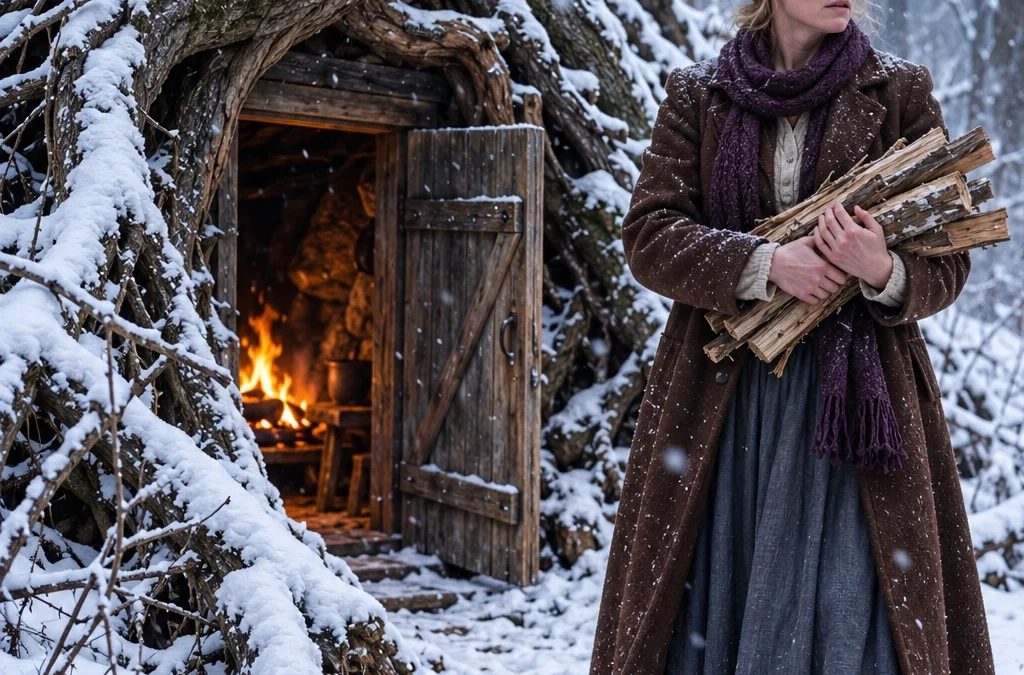
Widow Facing Certain Death Found A Hidden Stone Shelter — Then The Blizzard Revealed Its Impossible Secret ❄️😱
Part 1
The snow hadn’t even started falling in earnest when Hannah Mercer saw it.
It wasn’t a boulder left by some ancient glacier.
It wasn’t a trick of light against the limestone ridge.
It was a perfect, deliberate right angle — carved straight into the rock, half-buried under tangled dead vines, standing exactly where nothing square should have existed.
She’d walked the edge of the Devil’s Wash ravine a dozen times that November, canvas sack slung over her shoulder, counting every fallen branch like a starving person counting crumbs.
She’d never seen this before.
Or maybe she had, and her mind — worn thin by grief, hunger, and the biting Dakota cold — had simply refused to process it.
She brushed the vines aside.
Beneath them lay a heavy cedar door, iron-banded, weathered gray, solid as a vault.
Four days earlier, Hannah had stacked the very last of her firewood against her cabin wall.
Her husband Samuel was gone — claimed by fever back in September, before he’d even finished cutting their winter supply.
What little he’d left would last maybe twelve days if she let the fire die to embers every night and slept fully clothed.
Winter stretched four long months ahead.
Silas Thorne, the town merchant, had told her plainly: “You can’t stay.
Sell me the claim.
I’ll send you east before the prairie freezes you solid.
”
She’d looked him in the eye and said she’d think about it.
She had no intention of selling.
This land was everything she and Samuel had built together.
But as she stood there at the edge of the ravine, the math was unforgiving.
Twelve days of wood.
Four months of cold.
She pushed the door.
It didn’t budge.
She leaned her shoulder into it, and the iron hinges shrieked — the sound of something waking after half a century of sleep.
Inside, the air hung perfectly still.
It smelled of dust and ancient ash.
The space was small, roughly squared off, built into the natural cave — and in the center sat something that took her breath away.
A massive structure of pale firebrick, nearly half the room.
A stone bed, thick and solid, with a tiny iron firebox at one end and a chimney rising from the far side — not directly above the fire, but far away.
Scattered around were faint traces of a life left behind: a three-legged stool, a rusted tin cup, a folded wool blanket that crumbled to dust when she touched it.
No bones.
No sign of struggle.
Whoever had built this place had simply walked away one day and never come back.
Hannah knelt by the firebox.
She remembered her grandfather, a clockmaker from Prussia, writing about these — masonry heaters, he’d called them.
Unlike ordinary stoves that sent most heat straight up the chimney, these were designed to burn fast and hot, trapping the warmth inside thick stone that would radiate it gently for hours.
She moved her things down over the next three days — her flour, her skillet, her blankets, the last of her split ash.
The town would call it folly, living in a hole in the ground.
Hannah didn’t care about gossip.
She cared about seeing April.
Her first fire seemed perfect at first — then choked.
Smoke poured back into the room, thick and stinging.
She dragged the burning wood out into the snow, gasping, shivering as twilight settled in.
The ancient heater was broken.
The chimney blocked.
The flues collapsed.
She walked back to the cabin in the dark, her spirit finally cracking.
She’d gambled her last resources on a ruin.
Silas had been right.
She was going to die here.
Part 2
But Hannah was her father’s daughter — raised in a clockmaker’s shop, taught to take things apart and see how they worked.
If something failed, it wasn’t the machine’s fault.
It was a sign she hadn’t understood it yet.
Before dawn, she returned to the ravine with a lantern, a length of stiff wire, and a small hand mirror.
For two days she worked.
She pried open the access plates along the heater’s side.
She snaked the wire through the winding stone passages — cleared out a few old nests and dust, but the channels themselves were intact.
She angled the mirror upward and saw a pinprick of daylight far above.
The chimney was open.
The flues were clear.
She sat back on the stool, studying the room not as a desperate woman seeking warmth, but as an engineer.
The cedar door was heavy and sealed tight.
The walls were solid limestone.
There were no drafts — no cracks to feed the fire air.
Then she spotted it: a fist-sized hole near the floor, stuffed with rotted rags.
She pulled the rags free.
Cold air rushed in.
Understanding hit her hard.
A fire this large needed massive amounts of oxygen.
When the door was shut, the room was nearly airtight.
The fire had consumed all available air, created a vacuum, and the smoke had nowhere to go but back inside.
That small opening was the air intake — the missing piece of the design.
She laid a second fire.
This time, she left the hole clear.
The flames caught and roared like a living thing.
Cold air hissed steadily through the floor opening, feeding the blaze.
Smoke did not return.
It vanished into the stone passages, pulled strongly upward.
Two hours later, the fire burned down to ash.
The room was still freezing.
She touched the outer stone — cold.
Disappointment rose in her throat.
Had she fixed the draft only to find the stone itself too old to hold heat?
She curled up on the stool, exhausted, and fell asleep.
Four hours later, she woke to darkness — and something impossible.
She unbuttoned Samuel’s heavy coat.
The air around her was warm.
Radiant, gentle, all-encompassing warmth — like standing in sunlight in July.
She pressed both hands to the stone.
It was hot.
Deep, steady heat had traveled slowly through the brick and was releasing itself into the room.
The heater wasn’t dead.
It had simply been waiting.
The real test came after Christmas.
The barometer dropped sharply.
The sky turned a bruised, sickly yellow.
By mid-afternoon, the Great White Hurricane of 1886 descended — winds screaming, temperature plummeting to 30 degrees below zero.
Hannah had only three logs left.
She lit the final fire, closed the door, and settled in.
Outside, roofs tore away, cattle froze standing, people were trapped in their own homes.
But inside the shelter, something astonishing happened: the fiercer the wind howled above, the stronger the draft pulled.
The storm itself was feeding the fire.
She sat by lantern light, warm in her shirt sleeves, knitting socks, while the blizzard raged outside for three days and nights without pause.
Part 3
On the fourth morning, the wind fell silent.
The stillness was absolute — heavy, thick, and eerie.
Hannah opened the cedar door.
The world outside was buried under drifts higher than a man’s head.
The sun shone brilliant and blinding over a landscape turned entirely white.
Far away, toward the settlement, she could see nothing but endless snow.
Silas Thorne set out that same morning with snowshoes, a shovel, and a heavy heart.
He fully expected to find Hannah’s cabin buried, her body frozen inside — another casualty of the prairie winter.
He’d seen it too many times before.
When he reached her claim, his worst fears seemed confirmed.
The cabin was buried to the eaves.
The front door hung open, half-torn from its hinges, the interior packed solid with drifted snow.
He took off his hat and bowed his head.
He should have made her leave.
He should have forced her onto the stage.
He turned back toward town, already planning where they would dig the grave come spring — and then he saw it.
A thin, steady column of gray smoke rising from the jagged rim of the Devil’s Wash.
He frowned, adjusted his snowshoes, and fought his way down the treacherous slope, chest-deep in drifts, slipping on hidden ice.
When he rounded the limestone ridge, he stopped dead.
The heavy cedar door stood open.
Hannah Mercer stood in the doorway holding a tin cup of steaming coffee.
She was not shivering.
She was not thin or pale.
Her cheeks were pink and healthy.
The warmth pouring out behind her was so tangible it met him like a gentle hand.
Silas stared.
He looked past her at the massive stone structure glowing with quiet heat.
He looked at the small stack of firewood in the corner — enough for a few days in any ordinary cabin, yet she had survived the worst storm in living memory.
He looked back at her, alive and whole, when he had come to bury her.
“I brought a shovel, Hannah,” he said, his voice rough with disbelief.
“I came to dig you out.
”
Hannah took a slow sip of coffee.
Steam curled around her face.
“Put the shovel away, Silas,” she said calmly.
“The ground here is already spoken for.
”
He returned to town that day and told everyone exactly what he’d seen — the stone bed, the firebox, the warmth that held through days when the temperature dropped so low mercury froze.
He described the air intake, the winding flues, the way the heat stayed for hours after the fire was gone.
No one called her “the Widow’s Folly” after that.
By the following autumn, three families were building their own masonry heaters.
They came to Hannah, and she drew them diagrams, explained how the air fed the fire, how the stone held what the wood gave, how to build so the wind above would pull rather than push.
The shelter never brought Samuel back.
It did not erase the grief or the long, quiet nights.
But it gave her something pity and sympathy never could: mastery.
Independence.
A place where she was safe.
Years later, she would sit beside that great warm stone and reflect: the stranger who built this place had not been trying to hide.
They had been trying to share wisdom — a way to survive not by fighting the cold with brute force, but by understanding it.
By capturing what the cold tried to steal.
And the hardest winters, she would tell the young ones who came to learn, are not the ones that freeze you.
They are the ones that teach you how warm you can truly be.
This story is entirely fictional and created for entertainment purposes only.
It does not represent any organization or individual, nor does it encourage inappropriate behavior.
The content was generated with AI assistance.








