“Winter Will Decide Which of Us Is Wasting Time.” He Mocked the Ragged Drifter. Three Nights Into the Blizzard, That Same Man Was Crawling Through a Whiteout on a Rope
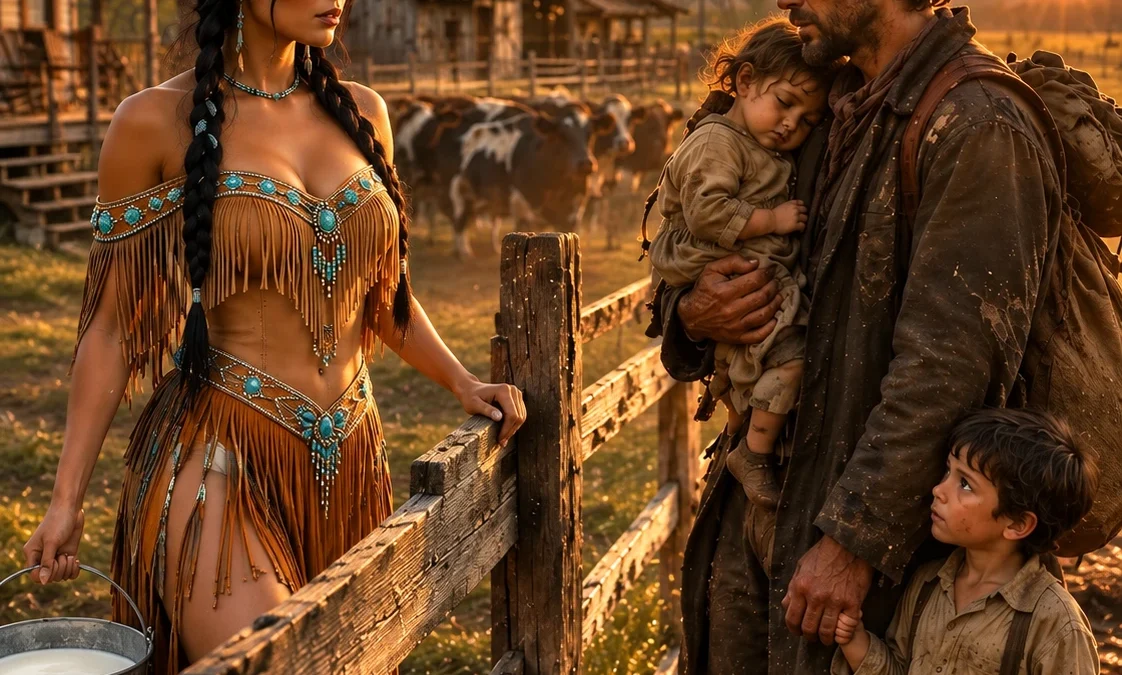
🔥 “Winter Will Decide Which of Us Is Wasting Time.” He Mocked the Ragged Drifter. Three Nights Into the Blizzard, That Same Man Was Crawling Through a Whiteout on a Rope. 😱
Part 1
By the third night of the Whitehorn, Antelope Wash Ranch had disappeared.
Wind ran past sixty-five miles an hour. The cold had fallen to thirty-three below. Somewhere out past the barn, a section of woven willow had torn loose from its posts.
Caleb Whitfield had a rope tied around his waist.
Etenia held the other end in both hands, braced against the doorframe, her boots dug into the packed snow. 😰
If that wall gave way, the wind would find the barn door and pack it shut before morning. Inside, a cow was fighting to deliver a calf that had turned the wrong way. A boy was counting marker posts through the whiteout. A baby was crying behind a canvas curtain.
Six weeks earlier, this same man had walked onto her land with nothing but a plea for milk.
Late in September of 1887, Caleb came over the last rise above the Chiricahua Basin with a handcart, a coat patched in two kinds of cloth, and two children who had stopped asking how much farther.
He was thirty-four, though the trail had put closer to fifty years into his face. Nine-month-old Wren rode against his shoulder in a sling made from an old grain sack. Eight-year-old Micah walked beside the cart wheel without complaint, his shoes worn soft at the heel.
Caleb had spent years fixing barns, pumps, freight wagons, and grain sheds along the rail supply stations. He could read a leaking roof or a failing well the way other men read a newspaper.
But his wife Sarah had died of a fever three days after Wren was born. Now no crew boss would take a man with two babies and a handcart. A man like that slowed the wagon train down, and nobody on the supply road had time to slow down.
So he walked south alone, looking for one ranch willing to trade shelter for skill.
Three ranches had already turned him away. The first had work but no bed for two children. The second gave them a night in a hayloft and pointed them back to the road by sunup. The third, not unkindly, suggested a girl as small as Wren would do better with a family that already had a mother in the house.
Caleb answered none of them back. He picked up the cart handles and kept walking, the wheel squeaking the same complaint, mile after mile.
On the last night before Antelope Wash, he watched his son quietly break his cornbread in half and tuck one piece deep inside his coat, even after Caleb promised there would be food tomorrow.
He understood then what the boy truly believed.
Tomorrow was not a thing Micah trusted anymore. 💔
Then the ranch appeared past a wind-scoured rise.
Antelope Wash sat low against a shoulder of red rock, the only green for miles running along a slow creek. The barn roof sagged in the middle. Its doors faced straight into the northwest wind. A row of willows stood too close to the building, half of them already dead.
But inside the corral, the milk cows were still on their feet. To Caleb, that was worth more than anything he had seen at the last three ranches combined. A ranch that fed its stock before its pride was a ranch worth asking.
A woman stood at the stock trough, breaking a skin of early ice with the back of a hammer. Her sleeves were rolled to the elbow. A feed ledger was tucked under her belt. One glove had gone smooth and pale from years of holding reins.
She watched the stranger and the children come up the track. She did not move to help. She did not move to turn them away.
She simply put one question to him.
This was Etenia, a young Chiricahua Apache widow who had run Antelope Wash alone since the winter that took her husband. Nothing about the way she stood suggested a woman who needed rescuing.
“What kind of work do you know?”
“Barn frames. Hand pumps. Water troughs. Wagon wheels. Roofs. Chinking. Hay storage.”
“And what do you need?”
His eyes went to Wren, who had stopped crying and was chewing the corner of her blanket, because hunger had worn out even her tears.
“Give my kids milk. Let us sleep somewhere out of the wind. I’ll fix what winter is about to break on this place.”
She looked past him toward the barn. “What makes you think anything here is broken?”
He lifted one hand toward the buildings. “Your barn doors face straight into the northwest wind. Your hay’s pulling damp up out of the ground. That water line’s going to freeze solid before the first real cold front gets here.”
Silence stretched between them. Confidence was easy to come by out here. Proof was not.
Etenia looked at Micah, then at Wren. She stepped forward without answering a word of his claims and lifted the little girl out of his tired arms.
“The milk comes first.”
She was already turning for the house. “Your claims can wait for morning.”
Inside, she warmed fresh milk with a little water, tested it against her wrist, and nodded for Caleb to feed it to Wren slowly. Her stomach’s been empty too long to rush. A bowl of stew, cornbread, and dried apples went in front of Micah.
Before he finished, the boy slid the last of his cornbread into his pocket, the way he always did now.
Etenia noticed. She let it pass without a word. She only set another piece down beside his bowl, as if it had always belonged there.
That evening she carried a cradle down from the loft, one her husband Talako had started building years ago and never finished, one rail still rough where it had never been sanded smooth. She had kept it all this time instead of burning it for kindling on some hard night.
Caleb didn’t ask why. He understood.
That night Wren slept in the unfinished cradle for the first time in weeks. Micah fell asleep with his hand curled tight around the bread hidden in his coat. 🥹
Before sunrise, Caleb was already walking the ranch, and he didn’t pick up a single tool. He watched first. A strip of wool by the barn door showed him how the wind curled through the opening. A shovel beneath the haystack found the bottom layer sitting in damp earth. He poured water into the trough and timed how long it took to drain. Inside the house, a seam of frost had crept into the chinking.
Etenia followed without a word. When he finally explained, he pointed instead of waving his hands.
“The barn’s not losing heat because the walls are thin. It’s losing heat because the wind walks straight through that door.”
Last, he looked at the dying willows. “Those trees stand too close. Last winter the snow drifted right where you needed a clear doorway.”
Etenia folded her arms. “Talako planted those willows.”
“He wasn’t wrong to. They cut spring wind. Winter storms come from a different direction. The trees stayed the same. The weather didn’t.”
Something eased in her face, just slightly.
“Six weeks,” Caleb said. “Water first. Hay second. Then the windbreak, the offset entrance, fresh chinking, marker posts. Before the first real storm gets here.”
Etenia studied him a long moment, then pointed toward the tool shed.
“You get one week. Then I’ll decide whether you see problems, or whether you invent them.”
Caleb picked up the shovel.
But across the basin, a man named Garrett Coe had already heard about the stranger. He was the largest rancher in the Chiricahua Basin, and he had a standing offer on Antelope Wash that Etenia had turned down flat.
And Garrett had a promise for the drifter who thought he could save it.
“Winter will decide which one of us is wasting time.”
Part 2
Caleb started with the jobs least likely to start an argument.
The hay came first. He, Etenia, and Micah pulled away the bottom layers of the stack, and a sour, wet smell rose up where moisture had pooled against the ground. Caleb built a raised crib eight inches off the dirt from old pine rails lying behind the shed. Instead of piling the hay back into one solid mound, he split it into smaller sections with narrow gaps of air between them.
Micah’s job was simple. He measured every gap himself and counted the spaces out loud, more words than he had spoken since they arrived. 💛
Next came the water line. Caleb opened a test trench and found the pipe buried just over two feet down. It needed to sit at four and a half, with enough fall to empty itself after every use.
“We don’t have time to dig the whole line before the cold sets in,” Etenia said.
“Then we don’t dig the whole line. We protect the stretch between the well and the milk cows first.”
Late that afternoon, Nettie Voss, an elderly widow from a neighboring spread, drove her cart up the track with fresh goat’s milk and news nobody had gone looking for. She had made it her business to know which ranches in the basin were struggling before their owners admitted it. Her eyes caught the bread Micah had tucked into his pocket, and she glanced at Etenia.
“Should I leave just the one loaf?”
“Leave both.”
By the third day, stakes marked the outline of Caleb’s windbreak across the open ground, thirty-four feet northwest of the barn. Not pressed against it. Far enough out to break the wind’s strength before it ever reached the buildings. The frame would run in an L-shape, rising to seven and a half feet, lodgepole pine for the posts and willow woven between them, loosely enough that the wall would never try to stop every gust outright.
Etenia added something of her own. Her father had shown her how the old camps banked snow into low walls on the north side of a shelter. Never solid. Always broken in places, so the wind lost its temper before it found the fire.
“Weave it the same way. Let it breathe, or it will only build a drift where you don’t want one.”
Then Garrett Coe rode up to the fence line.
He climbed down without greeting anyone. He looked over the half-built frame and smiled.
“So this is Whitfield’s willow wall. All that’ll do is catch snow and bury your own barn for you.”
“If I set it too close, you’d be right,” Caleb said. “Distance matters more than height.”
Garrett turned to Etenia. “Since when does a drifter get to play engineer on your land?”
“He’s not a drifter.” She never looked up from the survey stakes. “He’s my foreman, until the work proves otherwise.”
The words caught Caleb off guard as much as Garrett.
“You’ll still need my freight road once the passes close,” Garrett said, gathering his reins. “Put it in writing if you want to talk business.”
He rode off. Micah watched until the horse vanished over the rise.
“What if he’s right?”
Caleb picked up the next willow pole. “Then we change it before the snow does.”
The first hard squall came sooner than anyone planned. Caleb had tied strips of cloth to the willow posts to see how the air actually moved. The answer came within minutes.
The center of the wall was woven too tight. Wind climbed straight up and over, rolled down the far side, and slammed into the ground behind it. Snow started drifting toward the barn door. One panel tore loose entirely. Across the basin, two of Garrett’s hands stopped their wagon just long enough to watch. 😬
Caleb didn’t defend the mistake. He cut away nearly a fifth of the willow from the center.
“Weave the next section on the diagonal,” Etenia said. “Let the wind spread out through it instead of fighting one solid face.”
They worked until the light gave out. When the next gust hit, it passed through the willow, lost its force, and never reached the barn.
“A wall that stops everything just becomes a different kind of cliff,” Caleb said. “It only needs to take the strength out of the wind.”
That evening, Etenia handed him the willow cutters. “Your wall.” She glanced at the cloth strips dancing in the wind. “My wind.” A small smile crossed her face. “We’ll fix them both.”
A week later, the county livestock inspector, Thomas Rourke, rode out after hearing Etenia was rebuilding her barn ahead of winter. He didn’t laugh. He asked hard questions. A tighter barn traps moisture. Deep bedding builds ammonia. A raised crib can heat itself from the inside. A homemade water line can pull dirt into the trough.
Caleb met every one without arguing. Before leaving, Rourke made one request.
“Keep records. Three weeks minimum. Temperatures, firewood, hay, how wet the bedding runs. Every time you break ice on that trough.”
Etenia hung a ledger on a nail by the kitchen door and handed a pencil to Micah. “Write down today’s numbers.”
The boy marked the first line carefully, like it mattered more than anything he had ever written.
Then the cold ran its own test. The first batch of chinking failed. Caleb had mixed too much clay, and after two cold nights the seams pulled away from the logs.
“We start over.”
“My father sealed winter shelters the old way,” Etenia said. “Less clay. More animal hair, more rye straw. Scratch the first layer rough before the second, so the two grip.”
The new batch held.
While searching the loft for rags, Caleb found an old canvas roll with the stitching still tight along its edges. “Sarah made this. We used it as a draft curtain at a freight camp, before Micah was born.” He hesitated. “You don’t have to use it.”
“I want to.”
They hung it between the sleeping room and the main room without cutting a single stitch. While they worked, Caleb described Sarah for the first time since arriving. She never feared the cold, but she would check a child’s wrist for warmth before she checked the fire.
Etenia’s mouth curved. “Talako used to set two tin cups by the stove every morning, whether anyone was there to drink from them or not. A house should always look ready for company, he said.”
The next morning, two cups sat by the stove again. Neither of them mentioned why. ☕
Meanwhile Etenia cared for Wren without ceremony, warming milk, walking slow circles by the stove. At first she held the baby too stiffly, the way anyone holds what isn’t theirs to hold. Then something in her eased. Wren stopped crying the moment she heard Etenia’s boots cross the floor.
One afternoon Micah, shelling beans beside her, looked up. “Why don’t you have children?”
“Some rooms get built and never get filled.”
He glanced at the cradle. “That one’s filled now.”
She had no answer ready. But the next morning, the leftover cornbread sat untouched on the table where Micah had left it. For the first time since Sarah died, his son had gone to sleep believing there would still be food tomorrow. 🥹
Then the first real cold snap hit, ten above zero. The old barn had once struggled to hold above eighteen. Now, behind the willow wall, it held steady between thirty-one and thirty-four.
Then the water stopped.
The coupling out by the trough had frozen solid. Rourke had been right about that stretch. Where the pipe crossed into open air, it had become a cold bridge.
Caleb broke the ice away with an axe. “I missed it.”
They worked until midnight, boxing the coupling in dry wool and tarred cloth. Etenia brought two tin cups of hot chicory coffee.
“I said I’d fix this ranch.”
“You did.”
“The water still froze.”
She blew across the steam. “You promised to fix it. You never promised to guess right the first time.”
Caleb finally understood. She wasn’t measuring him by whether he ever failed. She was measuring him by whether he stayed until the failure was gone.
For three weeks the ledger filled, and slowly the numbers built their own argument. Fewer armloads of wood. Hay use down almost twenty percent. The trough hadn’t frozen once since the repair.
Then Garrett Coe rode in again.
“Once the snow comes, my freight road closes unless you sign your spring water rights over to my herd.”
“No.”
He shrugged. “A few cold nights aren’t winter yet.”
After he left, Caleb asked one question. “How many days of hay if his road stays closed?”
“Seventeen, by the old numbers.”
He studied the gray sky over the ridge. “We prepare for twenty-four.”
The sky began to change three days before the storm. Sable, the old cow, turned her back to the northwest wind and refused to graze. The air went heavy and still. Just before sunset, the wind died completely and the birds went quiet.
Marker posts went into the frozen ground every twenty feet, strips of pale cloth tied to each. A guide rope was strung from house to barn. Etenia carried an old stake carved with Talako’s mark to the post nearest the house herself.
Then a warning arrived from Rourke. An arctic front. Winds above sixty-five miles an hour. Once the snow started, no one was to leave shelter for any reason.
The Whitehorn arrived before dawn, first as a low roar beyond the ridge, then as a wall of white that swallowed the fence line, the creek, and finally the barn roof.
The willow wall bent hard and held. Snow piled where it was supposed to, well clear of the doors. Behind Sarah’s canvas curtain, the children’s room held its warmth.
Late on the first afternoon, a dull pounding sounded beyond the windbreak. Caleb followed the posts into the whiteout and found a man half buried beside a marker, his horse long gone, his cheeks going white with frostbite.
Jed Colby. One of Garrett’s own hands.
“I saw the cloth,” Jed managed. “That’s why I kept walking.”
Caleb carried him inside. And when Jed’s breathing finally steadied beside the stove, he whispered what he had come to say, and the whole room went silent.
“Garrett’s north barn. The wind’s blowing straight through it. The cattle are packed in one corner. And Garrett…”
He swallowed.
“Garrett doesn’t know I’m gone.”
Part 3
Nobody had anything to say to that.
Jed’s eyes went to the canvas hanging between the rooms. Only days before, he had laughed at Whitfield’s willow wall from the saddle of his own horse. Now that same wall had carried him home alive.
The storm tightened its grip through the night. The cold dropped lower.
Before sunrise, Clover, the oldest milk cow on the place, went into labor weeks earlier than anyone had counted on. One look was all Etenia needed to know something was badly wrong.
The calf had turned.
Dr. Amos Reyes, the veterinarian who rode a circuit across the basin, had no way to reach them. Every road for miles sat buried under drift. There would be no help beyond whoever was already standing in that barn.
While Caleb checked the water line and the windbreak lashings one more time, Etenia washed her hands in warm water, tied Clover’s tail back, found the calf’s front legs by feel, and worked slowly with boiled calving straps, the way Dr. Reyes had shown her years before, back when Talako was alive to hold the lantern. Back when she first learned that a steady hand mattered more than a strong one.
Micah held the light this time. His hands shook.
“Watch her eyes,” Etenia said, quiet and even.
He obeyed.
Caleb came back in just as the final pull was needed. The calf slid onto the dry straw and didn’t breathe. Etenia cleared its mouth with two fingers. Caleb rubbed hard at its ribs with a fistful of clean straw. Without being asked, Micah pressed a dry towel into Etenia’s free hand.
For one long moment, nothing happened. The wind screamed against the barn boards and nobody dared breathe.
Etenia laid her palm flat against the calf’s ribs, waiting, the way she had once waited beside Talako over a different animal in a different winter.
Then the calf drew its first breath. 🥹
Everyone in that barn went completely still.
From the house, Wren began to cry. Jed, still weak from the cold, pulled the old cradle closer to the stove and warmed a bottle of milk on his own, no one having to ask him twice. Nobody stood outside the work anymore, not that night.
The dry bedding kept the calf off a frozen floor. The offset entrance held the wind out of the calving stall. Running water made clean hands possible in the middle of a blizzard. Micah finally let go of the breath he had been holding since the calf hit the straw.
The third day brought the worst wind of the whole storm.
Just past noon, a lashing on the north section of the windbreak gave way, torn clean through at the knot. The woven panel shook hard against its frame. If it failed completely, the wind would pour through the offset passage and start burying the barn door from the inside. Within hours, the cattle could be sealed in with no way to reach them.
Caleb reached for the rope.
Etenia caught the other end without a word passing between them. 😰
Outside, the storm erased everything past the next marker post. Caleb crawled from stake to stake on hands and knees, the wind flattening him twice before he’d gone ten feet. One post had broken off at the base. The loose willow lattice slammed into him and knocked him flat into a drift. His repair bag burst open, tools scattering across the snow, and only Sarah’s old leather strap kept the bag itself from blowing off into the dark.
Inside the barn, Clover bellowed. From the house, Wren’s crying carried over the wind loud enough to reach him even out there.
Etenia held the rope in both fists, her arms burning. Then she felt three sharp tugs, their signal.
Give line.
She fed more rope into the storm, hand over hand, refusing to let herself think past the next foot of it.
Caleb reached the broken section and braced it with a spare willow pole set across the frame, instead of trying to rebuild the whole wall. It didn’t need to hold forever. Only until morning.
The rope finally went still in her hands.
Etenia pulled.
A figure crawled out of the white on one arm and one knee, and she hauled him the last few feet by the collar of his coat.
Caleb pushed himself upright, breathing hard. “It’ll hold until morning.”
Etenia looked past him at the storm still tearing across the basin.
“Morning’s enough.” 💛
By the fourth morning, the wind had finally begun to weaken. Nobody celebrated. They just started counting.
Every animal was alive. The newborn calf carried only a small patch of frostbite on one ear. The bedding was dry. Water still ran through the trough. The hay crib showed no heat and no rot. The barn doors opened without anyone digging through snow first.
Jed Colby stood on his own two feet again.
Caleb walked the ranch with a notebook instead of any sense of relief. One brace had been too light. Two marker posts needed to sit deeper. The cloth strips needed stronger stitching. The cover over the water coupling needed a better roof.
“You’ve counted every weakness before you’ve counted what survived,” Etenia said.
He closed the notebook. “The living can wait an hour. A weakness that hides behind one good outcome finds you again eventually.”
Later the clouds broke just enough to show a strip of gray sky. Steam rose off the cattle as they blew warm air into the freezing morning.
“The children have their milk,” Caleb said.
He studied the broken section of the willow wall. “The ranch still needs fixing.”
Neither of them brought up spring. Neither of them brought up leaving.
That evening, Etenia set his dry gloves beside the two tin cups near the stove, as naturally as if they had always belonged there.
When the roads finally opened, people came to Antelope Wash looking for answers instead of rumors. Rourke arrived first. Dr. Reyes followed. Then neighboring ranchers who had spent four days digging their own cattle out of drifts by hand.
Rourke inspected everything without hurry. He felt the bedding with his bare hand, counted the surviving herd, measured the hay left standing, and read every page of the ledger, from the first entry three weeks before the storm to the last line written during it.
At last he closed the book.
“The barn stayed drier than any I’ve inspected in this basin. The herd burned less feed than I’d have guessed. Steady water made the real difference. That windbreak stood exactly where the snow wanted to settle instead of where your doors needed to open, and every flaw you two found early got fixed before the blizzard showed up to test it.”
He tucked the ledger under his arm like a man closing out a court record. He would recommend the same three weeks of numbers to every rancher who asked him for advice from now on.
“I’d be dead in that snow if those marker posts weren’t standing,” Jed said.
Garrett Coe came last.
His own ranch had lost cattle. Part of his north barn roof had torn clean away. He gave no apology for any of it. Instead he looked out at the willow wall a long moment.
“How far’d you set it from the barn?”
“Thirty-four feet through the middle. Then we adjusted for the ground under it. And you never weave it tight enough to stop the wind dead. It just needs to lose its strength.”
Garrett nodded once.
“Show me.”
Caleb walked beside him across the snow without another word. Within the month, ranches all through the Chiricahua Basin, Garrett’s included, had adopted some version of the same winter plan. 🌨️
Later, after everyone else had gone, Etenia led Caleb into the ranch office and laid a folded paper on the desk.
It granted him a share of the ranch’s earnings, authority over the water systems, the structural work, and every winter preparation going forward. One line stood apart from the rest, set off on its own.
Micah and Wren will always have a home at Antelope Wash, no matter what happens, or doesn’t happen, between the two adults signing their names to this.
Caleb looked up. “Why give me part of something that’s always been yours?”
Etenia met his eyes without hesitation. “I’m not giving you what was mine.” She turned the paper toward him. “I’m naming what you already carried onto this land.”
That evening, after the paper was signed, they sat by the stove while the ranch settled into its first quiet night since the storm. The fire burned low between them. Neither hurried to fill the silence.
“I came here asking for milk,” Caleb said, looking into his cup. “I never meant to owe you a life.”
“You don’t owe me one.” She glanced up. “But there’s one here, if you mean to share it.”
Caleb smiled for the first time in months. “I’ll stay until the snow’s gone.”
Etenia looked toward the window, where ice still clung to the fence rails. “Stay until the grass comes back.”
He lifted his eyes to hers. “Longer than that.” 💍
They didn’t marry the moment the roads reopened. The work came first, the way it always had between them. In the weeks that followed, they rebuilt the damaged section of the windbreak together.
It wasn’t until early May that they held a quiet wedding, witnessed only by Dr. Reyes and Inspector Rourke. The celebration lasted just long enough to sign the papers, because Clover had gone into labor again that same afternoon and someone needed to be there.
Garrett never came himself. But a few days later, a neat bundle of straight willow stakes appeared leaning against the fence, a silent blessing from a man who was still not much for words.
A few days after the wedding, Micah looked up from the ledger where he was marking the morning temperature.
“Do I have to call you something else now?”
“You never have to call me anything you don’t mean.”
He gave one firm nod. “Etenia.”
For a while, that was enough for both of them. But weeks later, tripping near the marker posts out past the barn, he blurted, “Ma, Etenia,” and caught himself halfway through.
She hurried over to brush the dirt off his hands and let the half-finished word pass without ever letting on that she had heard it. 🥹
Spring came back slowly to the Chiricahua Basin. The last hard drifts thinned along the fence line. The creek ran loud and full for the first time in months. The willow wall Caleb had once staked out in the frozen dark stood green and budding at the base, half alive even in the worst of any season, just as Etenia had promised a windbreak should be.
For the first time since Talako’s death, Antelope Wash looked like a ranch built for the years ahead instead of just the winter in front of it.
One morning, beside the barn post where Micah had just carved a fresh line marking the year’s first snowmelt, little Wren took careful, unsteady steps toward Etenia across the yard.
“Ma.”
The small voice carried clean across the open ground.
Etenia didn’t rush to meet her. She knelt where she stood and waited, patient, while the girl finished the last few steps entirely on her own. 🌱
Caleb’s eyes moved over the repaired windbreak, the open barn doors, the cattle grazing loose across the flat.
“It still needs fixing.”
“That’s a good thing.” Etenia handed him the second tin cup. “You promised you’d stay as long as there was work.”
Antelope Wash didn’t survive that winter because the cold showed any mercy. It showed none at all. It survived because every weakness in it got found and fixed before the storm ever arrived to test it.
Caleb and Etenia never rescued each other, not really. They simply stopped mistaking their own loneliness for strength.
And out here on the edge of the Chiricahua Basin, that is a lesson that outlasts any winter that comes to test it. ❄️🌾
This story is entirely fictional and created for entertainment purposes only. It does not represent any organization or individual, nor does it encourage inappropriate behavior. The content was generated with AI assistance.








