“You Think You Can Do Better?” the Duke Sneered at His Wife in Front of His Entire Staff. By Sunset, Every Worker on His Estate Was Waiting for Her Orders.
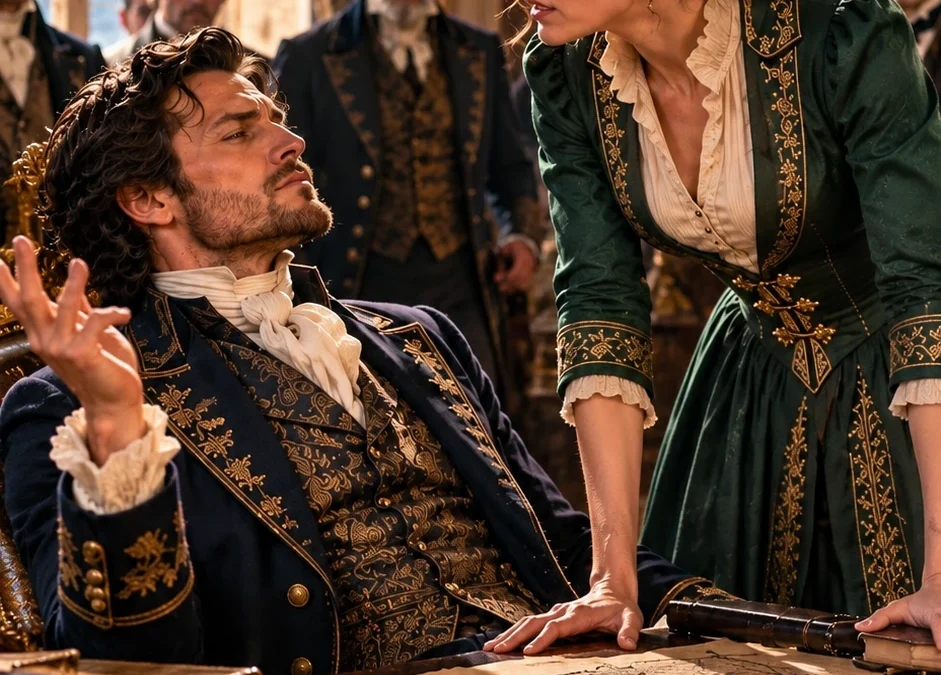
⛈️ “You Think You Can Do Better?” the Duke Sneered at His Wife in Front of His Entire Staff. By Sunset, Every Worker on His Estate Was Waiting for Her Orders. 😳
Part 1
The church bell began ringing in the middle of the afternoon.
Not for worship. Not for a funeral. This was the emergency signal. 🔔
Casara Vain stepped onto the terrace of Dunmir Park as another frantic peal rolled across the estate. Below her, workers were running in from the north fields. Wagons wheeled sharply onto the roads. Stable boys dragged fresh horses toward the gates.
Then she looked west, and her stomach dropped.
A wall of black clouds stretched across the horizon, heavy as a bruise.
A rider burst through the gates, his horse white with foam. He nearly fell as he dismounted. Kelrich, the estate steward, reached him first.
“What happened?”
“Hail,” the rider gasped. “Rain. Wind strong enough to tear roofs away. It destroyed the fields at Westmir less than two hours ago.”
Kelrich’s face tightened. “How long until it reaches us?”
The rider looked toward the black horizon. “Before nightfall.”
Casara stared across thousands of acres of ripe grain. Half of Dunmir’s wheat had been cut, and much of it still lay in bundles on the ground. The rest stood golden and helpless beneath a darkening sky.
Within minutes, Duke Orund Vain summoned his senior officers to the estate room. Kelrich arrived with Bran Toiver, the head agricultural foreman. Olan came from the stables. Field supervisors crowded around the long map table, boots still caked with dust.
Orund wasted no time.
“Every available hand goes north. Stop the orchard work, the repairs, everything that can wait. Put every wagon into service. Cut as much wheat as we can and move it to the main granary.”
The order sounded sensible. A violent storm was coming. More hands meant more grain cut. More wagons meant more grain saved. Bran nodded slowly. Kelrich began assigning supervisors.
But Casara was studying the map.
“How many loaded wagons can Miller’s Crossing take at once?”
The room went quiet. Olan answered carefully. “Three safely, Your Grace. Perhaps four, but I wouldn’t risk four loaded.”
“And how long to unload at the main granary?”
“Twelve minutes if the crew is ready. Longer if the carts arrive together.”
Casara traced the roads with one finger. “How many wagons will approach that bridge if every field follows the Duke’s order?”
Olan looked down. She watched him calculate, and she watched his expression change.
“More than seventy in the first rotation.”
Casara lifted her eyes to her husband. “You’re sending too many people to cut.”
Several officers glanced at one another. Orund stared at her as if she’d spoken in a foreign language.
“A storm is coming, Casara. I can see that.”
“Then perhaps you can explain why more hands harvesting will save more grain. Cutting isn’t the problem.” She pointed to Miller’s Crossing. “Moving it is. If the crews cut faster than the wagons can clear the fields, we only create more exposed grain. And if every wagon uses the same granary, they’ll sit in a queue while the storm reaches them.”
“We have managed harvests at Dunmir for generations,” Orund said, his voice hardening, “and not with five hours’ warning. You’re comparing us with Red Haven again.”
“I am comparing wagons with roads.”
A few men lowered their eyes. Red Haven was the small family farm where Casara had grown up, and every person in that room knew how the Duke felt about it.
“Red Haven was a modest farm,” Orund said coldly. “Grain doesn’t become easier to move because the man who owns it is a duke.”
The silence was brutal. 😶
Orund walked slowly toward her, pressure and pride sharpening his face. Then came the half smile, the one she had learned to dread over years of marriage.
“You think you can do better.”
Casara said nothing.
He gestured grandly at the map. “Go ahead.” His eyes held hers, and his voice dropped, soft and cutting. “Do better.”
He expected her to retreat. He expected the blush, the lowered gaze, the quiet no, of course not, my lord. Every man in that room expected it too.
Instead, Casara reached up and slowly removed her gloves. She laid them beside the map, one atop the other. 🧤
Under the lamplight, the officers saw something they had never noticed in all her years as their duchess. Across her fingers ran two faint, pale scars, the kind a person only earns with hard work.
“All right,” she said.
The smile fell off Orund’s face.
She turned to Kelrich without breaking eye contact with her husband. “How many hours until sunset?”
“Five, Your Grace.”
“Then stop sending everyone north.”
The Duke folded his arms, a cold, dangerous calm settling over him. “You wanted to prove your point, Duchess. You have until sunset.”
And then Casara Vain said something that made every officer at that table stop breathing:
“First, we stop cutting the distant fields.” 🌾
👉 Want Part 2? Find it in the comments, or leave any word below and I’ll send it to you privately. ⛈️
Part 2
“First, we stop cutting the distant fields.”
Bran frowned. Even Kelrich looked uneasy.
Casara nodded. “I know how that sounds. But we cannot move what they cut before the storm. Standing wheat has a better chance than bundles lying on soaked ground.” She pointed elsewhere on the map. “Second, we save what is already cut. That becomes the priority. And third, we stop treating the main granary as the only roof on Dunmir.”
She marked building after building: the old wool store, the mill loft, the empty carriage sheds, livestock barns that could be cleared, tenant barns on high ground.
Orund leaned closer. “You intend to scatter my harvest across half the estate.”
“For tonight. Tomorrow we move it properly.”
“That isn’t how Dunmir operates.”
“Neither is losing half your wheat before supper.”
The first test came almost immediately. Six loaded wagons rolled down from the north fields, following the Duke’s original route toward Miller’s Crossing. Casara stepped into the yard.
“Send them to the old wool store.”
Olan hesitated and looked toward Orund. The Duke’s face revealed nothing.
“You heard the duchess,” he said at last.
That was when the others began to see how she worked. Casara never simply gave orders. She asked.
“How many teams can make two trips before dark?”
“Twelve. Perhaps fourteen if we change horses.”
“Don’t exhaust the horses for fourteen. Give me twelve.”
“Which tenant barns are actually dry?” she asked Mara Fenlock, who had arrived with the tenant representatives. When Mara named three and warned that Pel’s west wall leaked, Casara took only the three.
When Kelrich said the carriage shed could hold fifteen loads, she asked whether the floor was raised. Only the eastern half was, so she cut the number to seven.
She remembered Red Haven, her mother’s chalkboards in the grain office, listing not only the acres ready but how many carts were sound, which barns leaked, and which roads turned to mud. But memory couldn’t tell her what Dunmir’s soil would carry. Only the people who lived on it could. 📋
Within an hour, Dunmir’s roads began to change. North wagons turned toward the wool store. Eastern teams carried grain to the mill loft. Empty wagons returned by different routes. The great line Orund had expected at Miller’s Crossing never formed.
He rode out there himself. The bridge was almost clear.
A messenger galloped toward him, and Orund braced for bad news.
“Your Grace! The Northfield teams are asking where her Grace wants the next wagons.”
Not his instructions. Hers.
The wind strengthened before the third hour. Clouds swallowed the western light. Casara moved her command point to the crossroads, where messengers could reach her without climbing the hill.
And then her plan broke.
Three heavy wagons had been sent toward the western farms, where cut barley needed moving. The first crossed safely. The second struggled. The third sank almost to its axle in the soft ground.
Bran rode back, furious. “I warned you the ground was soft!”
Casara stared at the stranded wagon, the wind whipping at her hair.
Then the Duke arrived. Every worker froze. Hundreds of eyes turned toward the duchess, and toward the husband who had been waiting five hours for her to fail. ⚡
The first drops of rain struck the dust like thrown pebbles.
Casara opened her mouth to speak…
👉 What do YOU think she said? Did she defend herself, or did something happen that nobody expected? LIKE this post and COMMENT the word “DUCHESS” 🌾 and Part 3 drops as soon as we hit our goal!
Part 3
“Bran was right.”
The words fell into the silence like a stone into still water.
Casara could have defended herself. A lesser leader would have. Instead she turned to the furious foreman. “I thought the teams could manage. They can’t. Pull the heavy wagons out.”
Bran blinked. He had been ready for a fight, and she had just handed him the victory.
She turned to Mara. “Your tenants use smaller carts on that ground?”
“Yes, Your Grace.”
“Can they carry the barley?”
“Less each trip. But they won’t sink.”
“How many can you gather?”
“Give me twenty minutes.”
“Take them.”
Mara rode off. And Orund, standing silent in the rising wind, saw something he had never understood before. He saw the difference between being challenged and being defeated. Casara had made a bad decision, and correcting it mattered more to her than protecting her pride.
Soon small tenant carts streamed toward the western farms. The whole estate transformed. Messengers galloped between fields carrying revised instructions. Colored cloth markers appeared outside temporary storage buildings. Stable hands rotated tired horses. Older workers swept the carriage sheds and raised grain sacks off stone floors. Mill workers cleared the loft. Farmers opened their barns.
Bran reorganized field crews by which grain faced the greatest exposure. Kelrich kept a running count of storage capacity. Olan controlled the horses and wagon rotations. Mara relayed conditions from the tenant farms.
And Casara stood at the center of it, at the crossroads where all their knowledge met. She did not know everything. She did not need to. She needed to listen quickly enough to keep Dunmir moving. 🐎
When Orund returned from the western fields, the black clouds were overhead. He stopped his horse at the edge of the crossroads. For several seconds, nobody noticed him.
A foreman hurried toward Casara. “North teams are finished. Where next, Your Grace?”
“Half to field eleven. Bran says its bundles are lowest.”
A messenger arrived before she finished. “The mill loft is nearly full. Where do you want the eastern wagons?”
“Kelrich?”
“Two more loads safely.”
“Two there. Everything after goes to Varys barn.”
Olan approached. “I can spare six teams from the south.”
“Give four to Bran. Keep two resting.”
Then another rider. Then another. Foremen waited. Drivers waited. Tenant representatives and estate officers waited. Not because they had rejected the Duke, and not because they loved the duchess more, but because her system had been working for hours, and every part of Dunmir now depended on knowing where the next load should go.
By sunset, Orund’s entire estate was following his wife’s orders.
Nobody laughed. Nobody needed to. For once, the Duke stood at the edge of his own operation, and nobody was waiting for him to speak. 😶
Casara finally noticed him and walked over. Orund looked across the moving wagons. “How much?”
Kelrich answered for her. “Almost everything that was already cut, Your Grace. Some barley remains west. Most of the distant wheat remains standing.”
Orund looked at Casara. “And if you’re wrong about leaving it, tomorrow I will tell you that you were wrong.”
She glanced at the clouds. “But tonight, this is our best chance.”
“Our best chance,” he said quietly. “Not yours.”
The first rain fell shortly after nightfall. Then the storm broke. ⛈️
Wind tore branches from trees. Hail hammered Dunmir’s roofs. Rain turned roads into streams. A section of the orchard was battered nearly bare, trees fell across the eastern road, and one tenant barn lost part of its roof. Some of the standing wheat flattened beneath the wind.
Dunmir did not escape. But inside the wool store, the mill loft, the carriage sheds, the granaries, and the tenant barns, thousands of bundles stayed dry.
Morning revealed the cost. Orund rode out with Kelrich through mud and broken branches. They inspected the orchard, the damaged roofs, the flooded tracks. Finally they reached one of the distant wheat fields Casara had ordered left alone.
Much of it still stood, bent and certainly damaged in places, but standing.
Orund dismounted and walked between the wet stalks. “If we’d cut this yesterday…”
Kelrich looked across the field. “It would have waited hours for transport. Most of it would have been lying on saturated ground when the rain came.”
“How much would we have lost?”
Kelrich understood the real question. “If we’d continued with yesterday’s original orders…” He paused. “At least twice what we lost.”
Orund said nothing.
He found Casara later in the small crossroads office, asleep in a wooden chair, still in yesterday’s muddy dress, maps spread across the table beside her. One hand rested over the armrest, and he noticed the two faint scars across her fingers.
Hours later, when she woke, he asked about them.
She looked at her hand. “A binding machine broke when I was seventeen.”
“You were operating it?”
“I was helping clear a field.”
“You worked the fields?”
“When necessary. My mother couldn’t afford enough seasonal workers that year.”
Orund frowned. “Why didn’t you ever tell me?”
Casara looked at him for a long moment. “I did.”
He stared at her.
“Our first year of marriage. I told you about the failed barley season at Red Haven. About working the harvest beside my mother and the tenants.”
The memory returned slowly. He remembered laughing, not cruelly, almost affectionately. Your little farming childhood, he had called it. Then he had changed the subject.
Casara’s voice stayed calm. “You keep asking why I never told you what I knew.” She looked toward the rain-darkened window. “I keep wondering why I had to prove it before you thought it worth hearing.”
There was no accusation louder than that. 💔
Orund sat opposite her. “I thought listening to you in front of my men would make me look uncertain.”
She met his eyes. “And did it?”
“No.” He looked down. “Not listening did.”
The apology did not erase years of dismissal, and Casara did not pretend it did. She did not become Dunmir’s chief steward. She didn’t want Kelrich’s position, Bran’s fields, Olan’s stables, or Mara’s farm. But Dunmir changed.
Before major agricultural decisions, field supervisors were asked what conditions looked like on the ground. Tenant representatives were included when their farms would carry the consequences. Transport capacity was considered before grand targets were announced. And when Casara spoke, Orund listened before deciding whether he agreed.
Months later, at the first planting-season meeting, Casara sat with Orund, Kelrich, Bran, Mara, and Olan around the same map table. They disagreed over which fields should be planted first. Orund proposed the northern acreage. Casara disagreed.
The room went quiet. Everyone remembered the harvest.
A small smile touched Orund’s mouth. He looked at his wife. “You think you can do better?”
For half a second, the old insult hung in the air. Casara raised one eyebrow.
Orund leaned back. “Then explain it.”
This time there was no mockery. Casara laid out her reasoning. When she finished, Bran shook his head. “You’re both wrong.”
Orund looked at him. Months earlier, the room might have frozen. Instead, the Duke said, “Why?”
Bran showed them the drainage reports. Mara added figures from the tenant fields. Olan pointed out that one proposed route would overwork the spring teams. In the end they chose a third plan. 🌱
That was the proof Orund had changed. Not that Casara always won, but that everyone could now be questioned.
Later, Casara stood on Dunmir’s terrace. The fields were green again, and below her workers prepared for the new season while wagons rolled between the barns. Orund joined her and noticed her staring at a loading crew.
“What?”
“Nothing.”
“That expression has never meant nothing.”
She pointed toward three wagons. “They’re loading those carts incorrectly.”
He studied them. “You’re certain?”
“No.” She smiled. “But I’d ask Olan before they leave.”
The old Orund would have dismissed it. Instead, he called for the stable master. Olan inspected the wagons, tested one load, then immediately shouted for the crew to stop and redistribute the weight.
Orund looked at Casara. She tried not to smile.
“Don’t,” he said.
Casara laughed. 💛
Duke Orund Vain had believed authority meant having the final word. Then one afternoon, with a storm racing toward his fields, his wife questioned him. He could have listened. Instead he mocked her. “You think you can do better?” He expected the question to put her back in her place.
Casara answered it. Not with a speech, not with a title, not with some secret fortune or hidden authority. She answered with wagons moving where they were needed, with grain disappearing beneath dry roofs, with exhausted horses rotated before they collapsed, and with farmers, foremen, and laborers discovering that someone had finally organized the chaos around them.
She had not taken his authority from him. She had simply done what he challenged her to do. 🌾
💬 Tell me in the comments: could you forgive a husband who underestimated you for years, if his change was genuine? Or would respect that arrives this late never be enough?
If this story moved you, share it with someone who needs to be reminded that the strongest person in the room is the one willing to listen. Follow for more stories where pride meets its consequence. ❤️
Disclaimer: This story is entirely fictional and created for entertainment purposes only. It does not represent any organization or individual, nor does it encourage inappropriate behavior. The content was generated with AI assistance.








