“You Were Never My Choice,” the Duke Said on Our Wedding Night. I Curtsied, Walked Out, and Spent One Year Making Him Regret Every Word
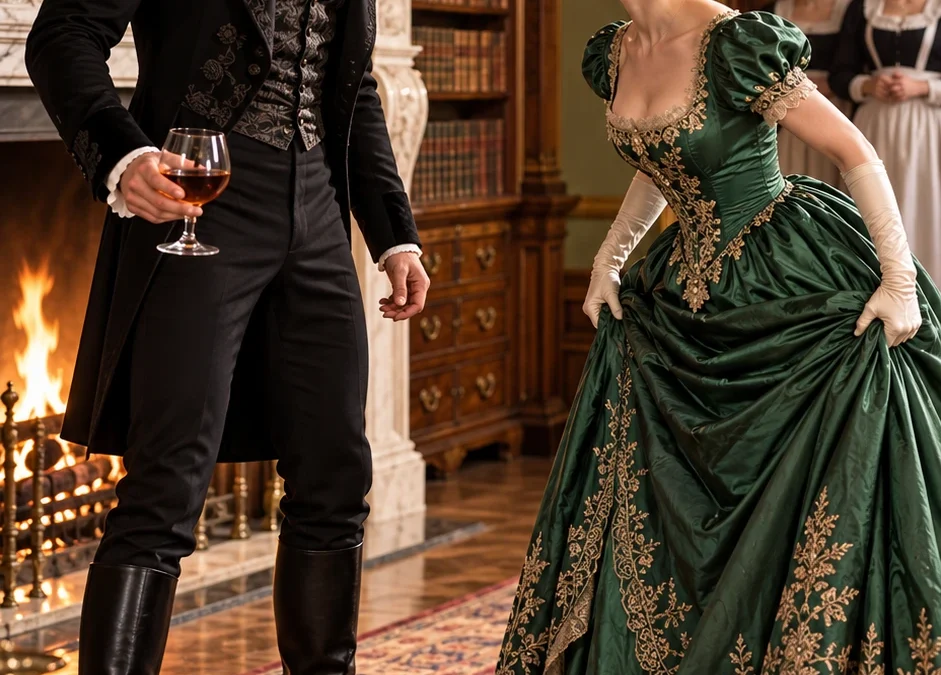
“You Were Never My Choice,” the Duke Said on Our Wedding Night. I Curtsied, Walked Out, and Spent One Year Making Him Regret Every Word 😳
Part 1
He didn’t yell. That was the worst part.
He simply stood by the cold fireplace, pouring himself a glass of cheap brandy, and said the words that would define their entire marriage.
“You were never my choice.”
He expected tears. He expected a plea, or a hysterical fit.
Instead, Amelia smoothed the skirts of her heavy velvet gown, sank into a flawless, mocking curtsy, and walked out the door without a backward glance. 💔
Welcome to the reality of a grand society marriage.
The church had smelled of damp wool and ancient dust. Amelia remembered that detail above all others. Not the vows. Not the heavy gold ring sliding onto her finger. Just the overwhelming scent of decay seeping from the stones of St. George’s.
It was a fitting aroma for the day she bought a husband.
Aiden Somerset, the Duke of Rothbury, was practically a ghost. His family’s fortune had dried up two generations ago, leaving him an echoing estate in the country, a crumbling townhouse in Mayfair, and a mountain of creditors waiting to drag his pristine name through the mud.
Amelia’s father, Thomas Osgood, had the opposite problem. He had more money than God, pulled from the soot and sweat of northern coal mines. But his blood was common, and he wanted a duchess for a daughter.
So a transaction was made.
Now the wedding breakfast was over. The guests had gone, whispering behind their hands about the bride’s plain face and the groom’s grim expression. In the sprawling library of Rothbury House, the fire was unlit.
Coal was expensive, even if Amelia’s father owned the mines.
Aiden stared at the empty grate, his broad shoulders stiff beneath his tailored coat. Amelia waited near the door in a traveling gown of dark blue velvet. It dragged at her shoulders. She wanted nothing more than to unlace her corset and sleep for a week.
He didn’t turn around when he spoke. His voice was low and aristocratic, stripped of any warmth.
“Let us dispense with the theatricals, Amelia. I have no interest in playing the blushing groom, and I assume you are pragmatic enough to drop the charade of the hopeful bride.”
Amelia said nothing. She folded her hands over her stomach.
Aiden finally turned. His eyes were a startling pale gray, beautiful eyes set in a sharp, unforgiving face. Right now they were filled with simmering resentment.
“You have your title,” he continued, taking a slow sip. “Your father has his prize. My debts are paid. We have done our duty.”
The glass clicked sharply against the mantel.
“But do not look at me with those wide, expectant eyes. Do not seek me out in the dark, hoping for a romance that does not exist. You were never my choice. Had my father not gambled away our legacy, I would have married a scullery maid before aligning myself with your family’s soot-stained money.”
The silence that followed was absolute.
Aiden watched her, bracing for the explosion. He had seen women weep, scream, throw vases, collapse into strategic swoons. He thought he was doing them both a favor. Better to sever the limb now than let it fester with false hope.
Amelia felt the words land like physical blows. Her ribs ached. Her throat tightened.
She had known, of course. She wasn’t an idiot. She knew he didn’t love her. But the sheer cruelty of laying it bare, of stripping away even the polite fiction of their arrangement, was breathtaking.
She looked at the defensive set of his jaw. She saw the pride eating him alive from the inside.
She did not cry.
Crying was for women who had something to lose.
Amelia stepped back. She lifted the heavy velvet in both hands. Her spine was rigidly straight, her chin parallel to the floor. She sank into a deep, mathematically perfect curtsy, the kind one offered to a monarch or an enemy.
She rose slowly. Her brown eyes met his gray ones. No smile. No frown. Only a terrifying, blank neutrality.
“Then I shall leave you to your brandy, Your Grace.”
She turned on her heel. The heavy oak doors clicked shut.
Aiden stood alone in the library. He picked up his glass.
His hand, he noticed with intense annoyance, was shaking.
Two days later, Amelia arrived at Fenwick Castle in a separate carriage from her husband, by mutual unspoken agreement. It was not a home. It was a monument to a dying dynasty. The courtyard was choked with weeds. The stone walls were black with damp. The west wing roof sagged like a crushed top hat.
Inside it was worse. The air was frigid. The tapestries were moth-eaten. The few elderly servants looked at her not with deference, but with sullen, protective suspicion.
And Aiden? He took his horse and vanished into the moors, leaving his new wife standing in the grand foyer among her trunks.
A weaker woman would have locked herself in a bedchamber and wept into her pillow.
Amelia tied a linen apron over her silk daydress and summoned the housekeeper, a sour-faced woman named Mrs. Gable.
“I would like the estate ledgers.”
Mrs. Gable sneered. “The Duke handles the accounts, Your Grace.”
Amelia flipped open the first leather-bound book, scanned a single page, and replied evenly:
“The Duke has evidently been handling them with a blindfold on.” 😏
She looked up.
“Fetch me a pot of strong tea, Mrs. Gable. And send for the village carpenter.”
But as she turned the pages, her blood ran cold. Buried deep in the ledgers, in the steward’s careful handwriting, was something that had nothing to do with leaking roofs.
Money was disappearing from this estate. Not slowly. Systematically.
And someone inside Fenwick Castle had been bleeding the Duke dry for years.
Amelia slowly closed the book, her pulse pounding.
Someone in this house was a thief. And whoever it was, they were about to learn exactly what kind of woman the Duke had married.
👇 Want to know who was robbing the Duke, and what Amelia did about it? Part 2 is waiting in the comments! Can’t see it? Leave any word below and I’ll send it to you privately. 💬
Part 2
Amelia slowly closed the book, her pulse pounding. Someone in this house was a thief. And whoever it was, they were about to learn exactly what kind of woman the Duke had married.
She did not confront anyone that night. She was her father’s daughter. She knew you never show your hand until the trap is set.
For three days she studied the numbers. Timber sales that never reached the accounts. Tenant rents recorded at half their value. A steward named Pruitt, whose own cottage, she discovered, had a brand-new slate roof. 🏚️
On the fourth morning, she summoned him to the study.
He strolled in with a smug, oily smile. “You wished to see me, Your Grace?”
Amelia didn’t look up. She slid a single page across the desk.
“Explain this, Mr. Pruitt.”
The color drained from his face.
“You’re dismissed,” she said quietly. “Pack your things. If you are not off this estate by sunset, I will send these ledgers and my father’s solicitors to the magistrate.”
By the end of the month, Amelia had replaced him with a sharp, hungry young man from London. She brought in roofers. She bought coal, mountains of it.
Fenwick Castle began, slowly, to thaw.
And Aiden watched it all with baffled irritation. He would return from punishing rides across the moors to find fires blazing in every hearth. The gnawing chill that had lived in his bones since childhood was simply gone. Boiled mutton became roasted pheasant. 🍗
His martyrdom was being systematically dismantled by a woman who barely acknowledged he existed.
They lived like two ghosts haunting the same house. At dinner they sat twenty feet apart at the mahogany table. When they passed in corridors, she offered a shallow nod.
“Your Grace.”
“Madam.”
That was the full extent of their marriage.
Then came the thunderstorm.
Rain lashed the dining room windows. Aiden spoke, for the first time in three weeks, his voice loud in the silence. “The roof in the west wing usually leaks in weather like this. The buckets will need to be set out.”
Amelia didn’t look up from her plate. “I had the slates replaced on Tuesday. There are no leaks.”
A strange, sour feeling twisted in his gut. It wasn’t gratitude. It was emasculation.
“You shouldn’t have done that without consulting me. This is my house.”
Amelia lifted her eyes, dark and ancient in the candlelight.
“This is your house,” she agreed softly. “But it is my money keeping the rain off your head. If you prefer to sit in a puddle for the sake of your pride, do let me know. I can have the slates removed tomorrow.”
She stood, placed her napkin on the table, and walked out.
Aiden sat alone, listening to the rain beat harmlessly against the repaired roof, feeling like an absolute fool.
Then, in late November, the isolation shattered.
A grand carriage rolled up the drive bearing the crest of the Earl of Lynfield. Out stepped Aiden’s sister, Lady Clara, a woman who had married well and delighted in looking down on those who hadn’t. 😈
She swept into the foyer, eyes narrowing at the polished floors and the absence of cobwebs.
“You must be the Osgood girl.”
“I am the Duchess of Rothbury,” Amelia corrected, her voice mild and pleasant.
Clara laughed. It sounded like breaking glass.
At dinner, she waited until the salmon was served, then smiled sweetly across the table.
“Tell me, Amelia, did you learn to scrub floors in your father’s collieries before he bought his way into a parlor?”
Aiden stiffened. Something fierce and protective flared in his chest. He opened his mouth to intervene.
He never got the chance.
Amelia dabbed her lips with her napkin and looked at Clara with an expression of gentle pity.
“I never scrubbed floors, Clara. My father employed people to do that. Thousands of them, actually.” She tilted her head. “It also, as I understand it, currently holds the mortgage on your husband’s hunting lodge in Yorkshire.”
The table went dead silent.
Lord Lynfield choked on his wine. Clara’s face flushed a violent red.
And Aiden, staring at his wife, felt a shocking jolt in his chest. It was a laugh. He swallowed it down, terrified it would escape.
Later, by the drawing room fire, he watched Amelia calmly open a book of poetry as if she hadn’t just destroyed an Earl’s wife. He saw her differently now. The rigidity of her posture wasn’t awkwardness.
It was armor.
He stepped closer, voice dropping. “You handle yourself beautifully, Amelia.”
She closed her book. No warmth. No fluttering lashes.
“Do not mistake my defense of my family for a desire to impress you. I am perfectly capable of surviving your sister, just as I am perfectly capable of surviving you.”
She curtsied, the same flawless, mocking dip from their wedding day, and walked away.
Leaving behind a man who was suddenly, terrifyingly aware of exactly what he had thrown away.
But what neither of them knew was that the real test was coming. On a bleak January morning, a mud-splattered doctor would pound on the castle doors, and he wouldn’t ask for the Duke.
He would ask for the Duchess.
And what Aiden did next, in front of the entire village, would change everything. 😱
👇 Want to see Part 3 and find out how this arranged marriage ends? LIKE and comment “REVEAL” below! Part 3 will be posted once we reach enough comments! 🔥
Part 3
Winter descended on Fenwick Castle, not with a picturesque snowfall, but with a biting frost that turned the ground to iron.
Aiden found himself doing something he hadn’t done in years: staying indoors.
The halls were warm now. The house was alive. But the woman who had resurrected it was a ghost.
He began to track her, not by decision but by habit. Breakfast at seven, alone in the morning room. From eight until noon, barricaded in the study with the new steward and a mountain of ledgers. Afternoons spent directing the army of staff she had recruited from the villages.
He started finding excuses to be in her orbit. He noticed what he’d been blind to on their wedding day: the way she tucked a stray lock of dark hair behind her left ear when she did mathematics in her head. The scent of bergamot and clean soap. The fact that she never wore the ostentatious jewels her father had given her.
Her only adornment was the heavy gold wedding band, worn like a shackle.
The indifference he had demanded was now choking him.
On a bleak Tuesday in December, he walked into her study, a smear of ink on her right index finger catching the gray light.
“The timber contracts for the Northern Ridge,” he said clumsily. For three years he had let the forests rot. He knew nothing about timber.
Amelia slid a folder across the desk without mocking him. “They are fair. The previous buyer was underpaying by thirty percent. The profits will cover the tenant cottages by spring.”
“You work too hard,” Aiden said. The words slipped out.
“I am protecting an investment, Your Grace. My father invested heavily in this estate.”
The reminder felt like a slap.
“You are not a businessman, Amelia. You are my wife.”
She leaned back slowly. “Am I?” she asked, voice dropping to a near whisper. “I recall a very specific conversation in the library of Rothbury House, where I was informed otherwise. I believe the phrase was, ‘You were never my choice.’” 💔
Aiden felt the blood drain from his face. Hearing his own words returned in that quiet, even tone was agonizing.
“I was angry. I was proud, and I was backed into a corner by men who saw my name as a commodity.”
“I understand entirely,” she said, picking up her pen. “Which is why I expect nothing. We have a highly functional arrangement. Let us not ruin it with sentimentality.”
“It doesn’t have to be just an arrangement. We have fifty years ahead of us.”
The scratch of her nib was the only sound in the room.
“The contracts are in the folder, Your Grace. Please close the door behind you.”
He stood there for five agonizing seconds, then walked out.
The moment the door clicked shut, Amelia’s hand trembled, sending a jagged black line across the immaculate ledger. She pressed the heels of her hands against her eyes and waited for her pulse to slow.
Then came the invitation to the winter solstice ball at Harrington House, not a request but a summons. Lord Harrington, the oldest peer in the county, viewed new money with the revulsion one reserves for a rat in the pantry.
Aiden insisted they go. He told himself it was about appearances. In truth, he wanted to pull her out of her fortress.
In the carriage, Amelia wore midnight-blue silk cut daringly low, a heavy diamond pendant at her throat. It was the first time she had worn her father’s jewelry.
It was armor.
“You look beautiful,” Aiden said.
She didn’t blink. “Thank you. My dressmaker in London is very expensive.”
At the ball, the snubs were silent but surgical: turned shoulders, conversations that died as they approached, hollow smiles aimed at the coal miner’s daughter. When a viscount deliberately stepped into her path, Aiden’s temper flared. Amelia merely sipped her champagne and navigated the hostility with terrifying, flawless grace.
“Dance with me,” he said, as a waltz began.
“I do not think that is wise.”
“I don’t care what is wise.”
He took her glass, set it on a passing tray, and pulled her onto the floor. Her waist was narrow beneath his hand. She moved perfectly, but every muscle in her back was rigid.
“They are vultures,” he murmured. “You don’t have to be perfect.”
“I am not pretending. I do not care what these people think of me. They are irrelevant.”
“And what about me?” The music swelled, drowning his voice to anyone but her. “Am I irrelevant?”
For a fraction of a second, the mask slipped. Raw pain flashed in her eyes, gone almost before he saw it.
“You are my husband,” she said smoothly. “We are dancing.”
The carriage ride home was worse. The silence was pressurized. When a rut threw her against him, she recoiled to the far edge of the seat, and the rejection snapped the last wire of Aiden’s patience.
“Stop it! Stop acting as if my touch will burn you!”
Amelia went terrifyingly still.
“You do not get to draw a line in the sand, tell me I am a burden, and then complain when I refuse to cross it.”
“I made a mistake! I was a bitter, humiliated man who lashed out at the only person standing in front of him. I see you now. I see what you’ve done for the estate. For me.”
“You see my usefulness,” she snapped, the ice finally shattering. “Do not confuse gratitude with affection. It is insulting to us both.”
“It isn’t gratitude.” He grabbed her wrist. Her pulse hammered against his thumb. “Amelia, please.”
She yanked her hand away. “Do not touch me.” Her voice cracked. “You told me to drop the charade. Well, I dropped it. I built a life where I do not need your approval, your affection, or your choice. I survived you. Do not dismantle my survival because you were suddenly bored of the quiet.”
Aiden sat back in the shadows, whiskey burning his throat, and realized with a sickening drop that an apology would never be enough.
He didn’t just have to win her. He had to convince her she was safe enough to let him try.
So he stopped forcing conversation. He stopped lingering in doorways. Apologies were cheap air. He needed to pay in a different coin. 🪙
Then January brought a brutal wet freeze, and with it, the fever.
Dr. Harrison, overworked and perpetually stained, arrived at dawn. He did not ask for the Duke.
He asked for the Duchess.
Aiden stepped into the foyer to find Amelia pulling on a plain wool cloak while Mrs. Gable packed a basket with broth, linens, and lye soap.
“There is an outbreak of sweating sickness in the lower village. Five families are down.”
“I will send the footmen,” Aiden said instinctively.
“The footmen are boys. They will catch it and bring it back here. The doctor and I have survived it before. I am going.”
She walked out before he could protest.
The old Aiden would have retreated to his study, certain a duke’s place was above the fray.
This Aiden pulled off his silk cravat, put on a scarred leather jacket and boots, and followed her.
The smell hit him first: sour, metallic, unwashed bodies and damp wool. He found Amelia in the blacksmith’s cottage, sleeves rolled past her elbows, plunging sheets into a boiling copper vat, dark hair plastered to her flushed forehead. She looked nothing like a duchess.
She looked like a laborer.
She froze when she saw him. “You shouldn’t be here. It’s highly contagious.”
“So are you,” Aiden said quietly.
He walked past her, took a dull hatchet from the blacksmith’s terrified son, and began chopping wood.
For fourteen hours, the Duke of Rothbury hauled water from the freezing river until his hands bled inside his gloves. He held down screaming, feverish children while the doctor forced medicine down their throats. He dragged soiled mattresses into the rain to be burned.
He never spoke to Amelia. When she reached for a heavy bucket, his hand was already on the handle. When the fire dipped, he was there with split timber. He became her extra set of hands, her silent shadow. 🔥
Late that night, in a young widow’s cottage, the woman’s fever finally broke. Aiden sat on a three-legged stool by the fire, covered in soot, mud, and someone else’s vomit.
Amelia handed him a battered tin cup. “Hot water and honey. It will strip the soot from your throat.” His fingers brushed hers. She didn’t flinch.
“Why are you here, Aiden?” It wasn’t an accusation. It was an exhausted, genuine question. “This is not your world. You loathe the dirt.”
He looked up, letting her see the utter depletion in his gray eyes. No armor. No pride.
“Because you are here. And because I am beginning to realize that the dirt is the only place where anything real is built.”
Her throat worked. She stared into the fire, arms wrapped tightly around her waist, holding her walls together by force.
She said nothing. But for the first time since their wedding day, she didn’t walk away.
The fever broke ten days later. Two elders had passed, but the children and working men survived.
On the long gravel drive back to Fenwick, in the bruised-plum twilight, Amelia tripped on a loose stone and fell hard to her knees. Aiden caught her. She was trembling, a deep tremor that started in her bones.
“I’m fine,” she slurred. “I’m just tired.”
“Stop fighting me, Amelia.” No heat. Only a weary plea. “Just for five minutes, let me carry the weight.”
He swung her into his arms. Her hands pressed against his chest to push him away, but she had no strength left. Her head dropped against his shoulder.
He carried her upstairs, built a fire in her chamber, and knelt before her armchair with a basin of warm water. He took her right hand, raw and bleeding from lye soap, and began to wash the grime away.
“I can do that,” she whispered.
“I know you can. You can do everything, Amelia. You’ve made that perfectly clear. But tonight you don’t have to.”
He washed her left hand, carefully cleaning around the gold band he had placed there months ago in a cold, damp church.
“You could have died,” she murmured. “My life is a matter of utility. Yours is a matter of lineage.”
“My lineage is ash, Amelia. The only thing of value in this entire house is sitting in this chair.”
A single treacherous tear cut a clean track through the soot on her cheek.
“Don’t,” she pleaded. “Don’t be kind to me. I can survive your cruelty. I can survive your indifference. I built a house out of your rejection, and I know how to live in it. But if you make me hope, and then your pride rears up again…” Her voice broke. “I will not survive that. You will break me.” 💔
Aiden felt the words slide like a blade between his ribs. It wasn’t the fear of a tyrant. It was the terror of a woman who had calculated exactly how much pain she could endure, and knew hope would destroy the equation.
He didn’t pull her into his arms. He didn’t make grand promises. He knew his words were bankrupt.
He dried her hands gently and stood. “The bathwater is ready. I will have Mrs. Gable bring your tea.”
At the door, his hand on the brass knob, he paused without looking back.
“I broke you once, Amelia. It is the greatest failure of my life. I’m not asking you to dismantle your house. I’m only asking you to leave the door unlocked. Let me sit on the porch. I will wait as long as it takes.”
The door clicked softly shut.
Amelia looked down at her clean hands. For the first time in six months, the gold ring no longer felt quite so much like a shackle.
Spring arrived as a slow, agonizing thaw. And Aiden kept his promise. He sat on the porch.
He didn’t crowd her. He didn’t touch her. Instead he embedded himself in the machinery of her days. While she parsed planting budgets, he was in the fields arguing soil drainage with the steward, returning each evening smelling of turned earth, his hands calloused, his skin burnt a healthy brown by the wind. The tenant farmers no longer lowered their eyes in resentment. They called out to him.
She watched him shoulder a mired cart out of a ditch beside two laborers, ruining a very expensive coat without a second thought. He quietly took over the correspondence with her father’s solicitors because he noticed the letters gave her headaches.
It was terrifying. It had been easy to hate the cruel duke in the library. It was nearly impossible to keep a fortress up against a man who patiently held a broom instead of a battering ram.
One evening in late April, Aiden walked into the dining room. Amelia sat at her usual place, twenty feet away. He looked at the polished expanse between them, said nothing, picked up his heavy chair, carried it the length of the room, and set it down at the corner beside her.
Amelia froze, spoon halfway to her mouth.
He sat, shook out his napkin, and said conversationally, “The timber yields are ten percent higher than projected. I believe we can replace the roof on the lower barns after all.”
“The lower barns,” she managed, voice remarkably steady. “Yes. That would be practical.”
From that night on, the distance was bridged. They spoke of crop yields and roof slates, never of love. But the silence between their words was no longer a weapon. It was a shared, comfortable quiet.
Then, in May, a letter arrived sealed in black wax. Her father was coming to inspect his investment.
Amelia waited for the flinch. This was the trigger, the moment the proud duke would bristle at a coal merchant treating his ancestral home like a factory floor.
Aiden sipped his coffee. “Excellent. We should put him in the queen’s suite. It has the best draft protection.”
“Aiden, he’s coming to audit us. He will treat you like a subordinate.”
He leaned across the table, gray eyes steady. “Amelia, let him audit. He will find ledgers balanced to the penny. And he will find that he is a guest in my house. I am not the desperate, drowning boy he bought a year ago. The only person in this world whose judgment I fear is sitting across from me.”
When Thomas Osgood arrived, he blustered and pointed a thick, gold-ringed finger at the barns, giving gruff advice. Aiden listened politely and deflected every attempt at authority. When Osgood questioned the steward’s wages at dinner, Aiden smiled.
“You must direct your inquiry to the duchess, sir. She is the architect of our financial success. I merely execute her vision.”
Amelia watched her father, a man who terrified shipping magnates, blink in stunned silence, disarmed by a duke with no ego to bruise. 👏
Then came June, and their first anniversary. Neither mentioned it. Amelia locked herself in the study with the master ledger. At nine that evening, she drew a single thick black line under the final column.
The estate was solvent. The debts were paid. The farms turned a profit. The transaction was complete.
She carried the ledger down the shadowed hall to the library. A fire crackled in the hearth, a stark contrast to the cold, dead grate she remembered from a year ago. Aiden stood at the window in shirtsleeves, whiskey in hand.
“You work too late,” he murmured.
She set the ledger on the desk with deliberate care. “It is finished. The final debts to the London creditors were cleared this morning. The estate is running at an eight percent profit.”
His warmth faded into guarded apprehension. “I don’t understand.”
“It means the contract is fulfilled.” Her voice dropped to a whisper. “You are no longer bound to my father’s money. You have your title, your home, your independence.” She took a slow breath. This was the moment she gave him back the choice he had been denied. “If you wish, we can establish separate lives. You can take a residence in London. I will remain here and manage the northern accounts. You would be free.”
The silence returned, the same oppressive silence as their wedding day, but this time it crackled with electricity.
Aiden’s face drained of color. He stared at the ledger as if it were a venomous snake.
“Is that what you want?” Flat. Dead.
“It is what you wanted a year ago. You made it very clear.”
“I asked you a question, Amelia.” He stepped closer. “Is this what you want?”
She closed her eyes. The urge to lie, to stay cold and safe, was a physical ache. But she remembered the soot on his face in the village. His hands washing her knuckles. A year of quiet, unglamorous devotion.
She opened her eyes.
“No.” The word shattered in the air. “No, it isn’t what I want. But I cannot hold you hostage to a marriage you did not choose.”
Aiden exhaled a harsh, jagged breath. He closed the final distance and cupped her face in his large, rough hands, thumbs against her cheekbones.
“You foolish, brilliant woman,” he murmured, voice thick with desperate relief. “You think you are keeping me hostage? You think I am looking for an exit? I was a terrified, arrogant fool who didn’t know the value of gold until it was dropped in his lap. I don’t care about the ledger. I don’t care about the debts or the profits or the title.”
His forehead rested against hers.
“You were forced upon me, and it was the greatest stroke of luck I will ever possess. I did not choose you then, Amelia. But I am choosing you now. Every day, for the rest of my miserable, fortunate life.”
His breath was warm against her lips.
“I choose you.” ❤️
Amelia let out a ragged, breaking sob. The fortress crumbled entirely into dust around her feet. She buried her fingers in his hair and pulled him down to her.
Aiden kissed her, with no hesitation and no polite restraint. It was a kiss built on a year of repressed longing, of shared labor, of desperate, terrifying hope. She kissed him back with fierce hunger, tasting the salt of her own tears.
When he finally drew back, he didn’t let her go. He buried his face in the curve of her neck, inhaling bergamot and clean soap.
Amelia rested her head against his chest, listening to the steady, strong beat of his heart. Over his shoulder, the heavy leather ledger sat closed on the desk.
The debts were paid. The contract was over.
The marriage had finally begun.
And the Duke and Duchess of Rothbury had found their way through the ruins of an arranged marriage. Real romance isn’t always born in ballrooms. Sometimes it’s forged in cold mud and the quiet devotion of a shared life. 🕯️
If you loved watching Amelia hold her ground and Aiden earn his place by her side, share this story with someone who believes in hard-fought love. 💌
This story is entirely fictional and created for entertainment purposes only. It does not represent any organization or individual, nor does it encourage inappropriate behavior. The content was generated with AI assistance.








