“You’re Just a Clerk. Carry My Bags on Induction Day,” My Sister Sneered at Her West Point Party… She Had NO Idea Whose Signature Decided Her Fate
🎓 “You’re Just a Clerk. Carry My Bags on Induction Day,” My Sister Sneered at Her West Point Party… She Had NO Idea Whose Signature Decided Her Fate 😱
PART 1
I sat at the far end of the table in a plain gray blazer instead of my Army uniform.
To everyone at that fancy Boston club dinner, I was simply the quiet older sister who “worked somewhere in West Point’s administration.” A clerk. A paper-pusher.
Fourteen years in uniform, and my family had shrunk it down to paperwork, because medals don’t look as nice next to designer handbags.
“If only Tabitha cared half as much about presentation,” my mother, Miriam, sighed, adjusting the diamond bracelet on my younger sister Priscilla’s wrist. “But military offices always need dependable employees.”
Employees. Not officer. Not soldier. Not leader.
I kept cutting my steak. 🥩
Inside my blazer pocket sat the only family heirloom I ever cared about: my grandmother’s worn silver pocket watch. Years ago she’d pressed it into my hand and said only one thing: “When the time comes, you’ll know why this matters.”
She never explained. I touched the cool metal once with my thumb.
My father, Gideon, raised his glass. “West Point isn’t just admitting another cadet. They’re welcoming the future!” He pointed proudly at Priscilla.
Everyone applauded. Everyone except me.
Priscilla pulled out a cream-colored folder stamped with a congressional seal and held it up so the whole table could see. “My nomination arrived three days ago.”
An investor actually whistled.
Then she slid the folder down the table until it stopped right in front of me.
“I’ll probably have more luggage than most cadets,” she said sweetly. “Since you already work there, you can carry my bags on Reception Day.”
A few people chuckled.
“It’ll be nice for you to finally contribute to my success.”
Nobody corrected her. Not my mother. Not my father. Not a single guest. They all believed exactly what she believed: that I answered phones and stamped forms.
They had no idea what my office actually looked like. Or whose signature decided whether a candidate ever became a cadet. 😶
“That’s a practical arrangement,” my father nodded.
“You know everyone there, right?” Priscilla asked.
“I know enough,” I said.
I glanced at the nomination letter just long enough to note the district number. Then I gently pushed it back. “You should keep it.”
“Oh, don’t worry,” she laughed. “Soon I’ll have plenty of documents worth framing.”
That night, driving home, the weight of Grandma’s watch pulled me back to a place I’d tried to forget.
The attic of our Beacon Hill house.
At sixteen, that dusty attic was my classroom. While Priscilla practiced smiling for charity galas, I memorized engineering formulas until my eyes burned. Every morning at 4:38, I laced up worn sneakers and ran through the icy streets along the Charles River. Five miles. Then seven. Then ten.
When I came home, Priscilla would be eating Belgian waffles, and Mom would only say one thing:
“You’re tracking mud through the hallway.”
Never “Good morning.” Never “How was your run?”
One winter morning, I set my stopwatch beside my cereal bowl. A personal record.
“For what?” my father asked from behind his newspaper.
“West Point’s fitness assessment.”
“You know there are easier colleges.”
“I don’t want easier.”
He shrugged. “Suit yourself.”
I got my appointment with no connections, no donations, no favors. Just every mile and every grade. When the acceptance came by certified mail, I signed for it myself, because no one else bothered to answer the door. I opened it on the attic floor and cried. For once, because something beautiful had happened. 🥲
Four years later, I came home in full dress gray with my commissioning certificate. Only Grandma cried. “Your grandfather would’ve stood a little taller today,” she whispered.
That evening, I found Mom holding my framed graduation photo. I thought she was finally going to hang it.
Instead she frowned. “A girl in uniform ruins the family’s debutante aesthetic.”
I laughed. I thought she was joking.
She wasn’t.
She carried it to the attic, lifted a loose floorboard near the chimney, slid my photo underneath, pressed the board down with her heel, and dusted off her hands. “There. No one needs to see that.”
Years later, while the house was being renovated, I went back up there with a flashlight. In a box labeled “VACUUM PARTS,” under rusted screws and cracked hoses, I found it all. My original commission, still sealed. My awards. My recommendation letters. Newspaper clippings about my service.
Packed away with broken machine parts.
They hadn’t forgotten what I’d achieved. Forgetting is passive.
This took planning. 💔
The Monday after that dinner, I unlocked my workstation at 7:42 a.m. in the Admissions Registrar’s office overlooking the frozen Hudson River. My Common Access Card. My fingerprint. My review queue: forty-three candidate files.
Most were routine. A missing vaccination record. An unsigned doctor’s note. One kid accidentally uploaded his marching band schedule instead of his résumé.
I made handwritten notes beside my keyboard, the way my first platoon sergeant taught me. “People notice details when they write them down.”
At 10:11 a.m., I opened the next file.
And my pen stopped moving.
ASHCROFT, PRISCILLA ELIZABETH.
My sister’s entire future was sitting on my desk.
And the very first page I opened… was already wrong. 😨
👇 Part 2 is in the comments! Can’t find it? Leave any word below and I’ll send it to you privately. ❤️
PART 2
And the very first page I opened was already wrong. Inside these walls, she wasn’t my sister. She was Candidate 24-NE-1187, and the standards don’t recognize family. Her fitness scores were perfect. Not excellent. Perfect. Every single event landed on the exact same top percentile. Real athletes are uneven. This was symmetrical. The certifying evaluator was a private trainer named Brandon Keller, employed by Iron Summit Performance Group. I dug one layer deeper. Iron Summit was owned by Ashcroft Development Holdings. My father’s company. Then I checked her 500 “volunteer hours.” Three organizations had no record of her. One listed her as “invited but absent.” One certificate claimed she’d led a youth leadership retreat in Massachusetts in mid-July. Federal travel records showed her passport leaving Boston for Nice, France, on July 9. Attached was a photo from customs: Priscilla in white linen and designer sunglasses, holding champagne on the deck of a 183-foot yacht called the Celestial Crown off Monaco, timestamped forty-three minutes after she was supposedly mentoring military families in Worcester. 🛥️ I wasn’t shocked. Just disappointed. I documented everything. Timestamps. Chain of custody. No opinions. Only facts.
That night my father called. He’d hired an investigator to find out what I really did. “So you work in admissions,” he said, pleased. “You’re in exactly the right place to help your sister. Skip one verification. Mark one document confirmed.” “No.” “Don’t insult my intelligence.” “No.” His voice turned cold. “If your stubborn pride destroys your sister’s future, I’ll stop paying for your grandmother’s care.” Grandma’s memory-care facility cost $8,940 a month, paid from a family trust he controlled. “I already spoke with the trustee,” he said. I looked at Grandma’s silver watch ticking on my coffee table. “The Honor Code isn’t negotiable,” I said quietly. Neither was I. He hung up.
The next morning I placed a black portfolio on Colonel Clashing’s desk. Thirty-six pages. He read every one. “Any personal relationship with the candidate?” “She’s my younger sister, sir.” He nodded once. “You documented everything before disclosing the conflict. Well done, Major. You protected the institution before you protected yourself.” The committee met. I applied the official Registrar seal to their final decision, exactly as procedure required. Three days later, an embossed invitation arrived: The Ashcroft Family invites you to a West Point Send-Off Celebration honoring Future Cadet Priscilla Ashcroft. Nobody in my family had opened their email. ✉️
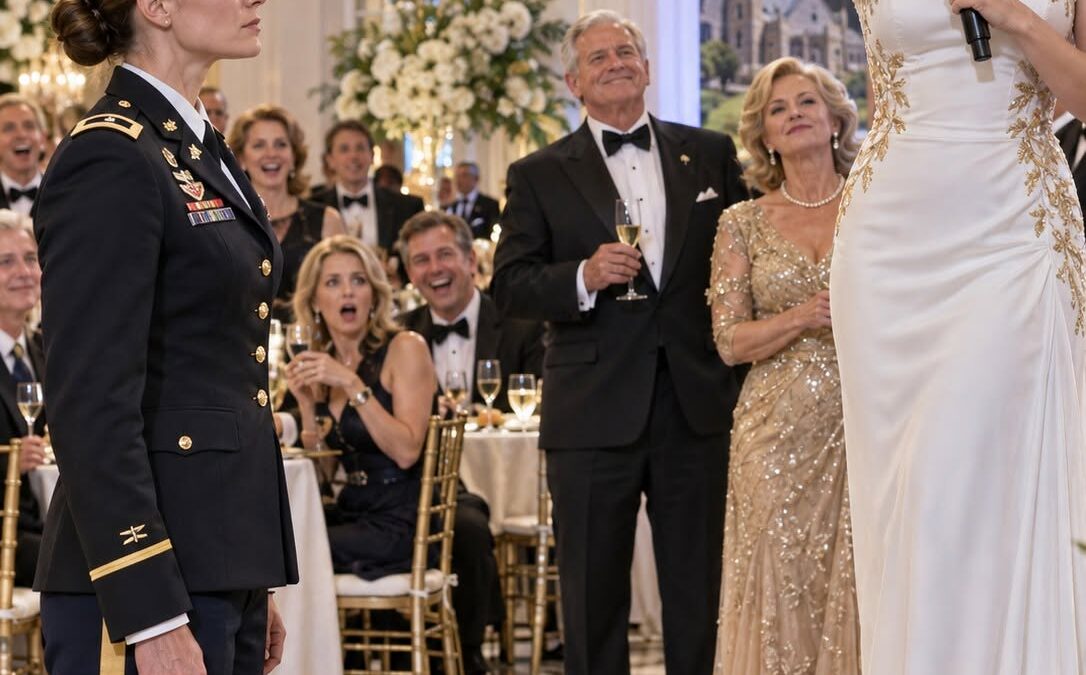
At the Grand Meridian Hotel ballroom, two hundred guests sipped champagne beside a $6,700 ice sculpture of the West Point crest. I came straight from an Academy function in my Army Dress Blues. “Tonight isn’t about you,” Mom hissed. “Stay in the back. And help the staff with coats.” Then Priscilla took the stage in a white gown, spotted me in the spotlight, and laughed into the microphone. “My big sister finally made it! While I prepare to lead the nation, she spends her career stamping forms in a basement.” The ballroom roared with laughter. I said nothing. I walked to the audiovisual booth, handed the technician an encrypted government flash drive, then climbed the stage stairs. “What are you doing?” Priscilla whispered. “This isn’t your moment.” “It never was,” I said, and took the microphone. “Good evening. My name is Major Tabitha Ashcroft, Associate Registrar of Admissions at the United States Military Academy.” My father’s smile froze. I nodded toward the booth. Behind us, the giant twenty-foot screen flickered… and lit up… 😱
👍 Want Part 3? LIKE this post and comment “HONOR” below! Once we hit enough comments, I’ll post the ending right here. 🔥
PART 3
West Point’s official seal appeared first.
Then the authenticated admissions record. Committee certification. Registrar verification. Federal archive confirmation. Every line stamped with a digital timestamp no one could fake.
Priscilla’s face drained of color. “No…” she whispered.
The final page loaded. Her full legal name. Her candidate number. And in the center of the screen, in bold crimson letters large enough for every table to read:
REJECTED FOR APPLICATION FRAUD.
The ballroom went dead silent. No whispers. No clinking glasses. No music.
Then one more line appeared beneath it, even larger.
PERMANENTLY BARRED FROM FEDERAL SERVICE ELIGIBILITY REVIEW.
The red letters reflected faintly off the melting ice sculpture of the West Point crest. For a strange moment, the only movement in the entire room was water sliding slowly down its edges. 🧊
I hadn’t raised my voice. I hadn’t insulted anyone.
I had only let the truth introduce itself.
Then my father exploded.
“This is a LIE!” He shoved past the front-row tables and stormed onto the stage, his polished shoes skidding on melted ice. “Turn that screen off! This is a petty family fabrication! My older daughter has always been jealous of her sister!”
For years, that explanation had worked. Whenever I achieved something, they called it envy. Whenever I stayed quiet, they called it weakness.
Tonight, neither story fit the evidence glowing twenty feet high behind him.
“That document isn’t authentic!” he shouted.
I didn’t argue. I unlocked my government tablet and tapped once.
Page two appeared: PAYMENT HISTORY – IRON SUMMIT PERFORMANCE GROUP. Twelve monthly transfers from Ashcroft Development Holdings. And beside them, the name of the trainer who certified Priscilla’s “perfect” fitness scores. Brandon Keller.
A murmur rolled across the room.
“That proves nothing!” my father barked.
“It proves employment,” I said calmly. “It proves financial dependence.”
Tap.
Side by side: a certificate claiming Priscilla supervised a youth leadership program in Massachusetts… and French immigration records showing her passport entering Europe that same week.
Tap. A Monaco customs stamp.
Tap. Priscilla on the deck of the Celestial Crown, champagne in hand, the Mediterranean shining behind her.
Tap. The volunteer attendance sheet. Same date. Same hour. Four thousand miles away.
No dramatic effects. No accusations. Just documents.
And the room began to change. Not emotionally. Mathematically. Guests stopped staring at me and started comparing dates, signatures, company names.
“Look at the timestamps…”
“That’s his company…”
“I know that trainer…”
An investment banker quietly closed tonight’s sponsorship folder. My mother tried one last smile. “There must be some misunderstanding.” No one even looked at her.
Then a chair scraped across the marble.
Congressman Whitmore’s district director rose from his table, phone in hand. Earlier, he’d clapped louder than anyone.
“I received a federal notification twelve minutes ago,” he announced. “Based on documented fraudulent representations, our office formally withdraws its congressional nomination, effective immediately.”
He turned to my father. “Mr. Ashcroft… I trusted your family.”
Then he walked down the center aisle and out the doors without looking back. 🚪
That was all it took.
One investor stood. Then another. A banker gathered her purse. People pulled out phones, not to take pictures, but to protect themselves.
“Where are you going?” my father demanded.
A partner he’d known for fifteen years simply shook his head. “I can’t be associated with this.”
Another told his assistant, “Pull every pending project.”
A third looked at my father and said quietly, “If these records are real…” He didn’t finish. He didn’t have to. Everyone understood: if Gideon Ashcroft had manipulated something this important, what else had he manipulated?
The network my father spent decades building was unraveling in real time.
Priscilla hadn’t said a word since the first page appeared. Her mascara was running. She looked from the screen, to me, to her father, to the crowd that had adored her only minutes ago.
She stepped backward. Her designer heel slipped on spilled champagne by the podium.
And she fell, her white gown dragging through melted ice and golden champagne.
Nobody rushed forward. Not out of cruelty. Simply because the performance was over. 😢
I looked across the ballroom one last time. My father stood alone under the bright spotlights, surrounded by everything money could buy. Crystal. Luxury. Influence.
He had never looked so completely alone.
For years, he believed his empire was built on wealth.
Tonight, everyone finally saw what it was really built on.
Lies.
I set the microphone down on the podium and walked off the stage. I didn’t look back.
I never returned to Boston after that night. There was nothing left to say.
The investigations unfolded the way federal procedures do: slowly, methodically, and without caring about anyone’s last name. Every appeal Priscilla’s expensive lawyers filed was denied, because none of the evidence had changed.
Facts have a remarkable quality. They don’t become less true when you hire a pricier attorney.
My father’s problems grew far bigger than one admissions file. Investigators found inconsistencies in his company’s financial reports. One audit became two. One subpoena became several. Banks delayed financing. Partners demanded compliance reviews. People who once waited months for a meeting with Gideon Ashcroft now returned his calls through lawyers.
His empire didn’t collapse in one afternoon. It simply lost the one thing every reputation depends on.
Credibility.
My mother stopped hosting charity galas. Society magazines quietly dropped her photos. The invitations dwindled. Then stopped altogether.
But the change that mattered most never made the newspapers. 🤍
Three weeks after the gala, I sat in a conference room with military legal counsel and an independent trustee. Because the family trust was now under legal review, protections kicked in for vulnerable beneficiaries.
After hours of paperwork, Grandma’s monthly care payments were permanently transferred into a protected trust, completely outside my father’s control.
When the last document cleared, I called her care facility.
“Mrs. Eleanor Ashcroft’s care will continue without interruption,” the administrator said warmly.
I sat in silence for a long time after I hung up.
My father thought he had the power to decide whether my grandmother kept her dignity. He never owned her dignity. He only controlled the money.
Those were never the same thing.
That Saturday I visited her. Her memory drifted more often now, but sometimes the clouds parted. She took my hand and studied my face.
“You look lighter,” she said.
“I feel lighter.”
“You finally stopped carrying everyone else’s weight.”
I smiled. “I think I did.”
Then she pressed something into my palm. The silver pocket watch.
“It belongs with you now.”
She never asked about the scandal. Not once. Not because she didn’t care, but because she’d always known what I was only just learning: peace doesn’t come from winning arguments. It comes from refusing to hand your character to people who keep demanding it. ⌚
Now I stand at Trophy Point, high above the Hudson, turning that watch over in my hands. Its silver is covered in tiny scratches collected across generations.
It isn’t beautiful because it’s perfect. It’s beautiful because it endured.
“When the time comes, you’ll know why this matters.”
Now I know.
The river below doesn’t care about the label on your coat, your family name, or the zeros in your bank account. It only respects what’s solid. What’s real. What stands steady against the current.
For years, I believed exposing my family’s lies would destroy them.
But I didn’t destroy my family. Their choices did that long before I ever opened that file. All I did was refuse to build one more floor on top of a crumbling foundation.
When my sister carried beautifully wrapped lies to the gates of West Point, she believed appearances could replace character. She mistook my silence for surrender. She forgot that the quietest person in the room is sometimes the one guarding the record.
I didn’t tell the truth for revenge. Revenge fades fast.
I told it because the truth deserves defenders, especially when defending it is uncomfortable.
So if you’re shrinking yourself right now to keep the peace in a family, a job, or a relationship that only values you when you’re useful, please remember this:
You are not required to pay for someone else’s illusion with your own dignity.
Stand where your principles stay clean. Speak when the evidence is ready. And never apologize for choosing integrity over approval.
I’m not the forgotten daughter. I’m not the quiet clerk. I’m not anyone’s convenient sacrifice.
I’m exactly who I earned the right to become.
And that is finally enough. 🇺🇸
THE END.
Disclaimer: This story is entirely fictional and created for entertainment purposes only. It does not represent any organization or individual, nor does it encourage inappropriate behavior. The content was generated with AI assistance.








