“YOU’RE LUCKY I’M MARRYING YOU AT ALL,” HE SNEERED AT THE ALTAR, IN FRONT OF HALF OF BATH. SHE SMILED, AGREED, AND WALKED OUT… BUT THE INK ON HER FINGERS HID A SECRET THAT WOULD SHOCK ALL OF ENGLAND 😱📖
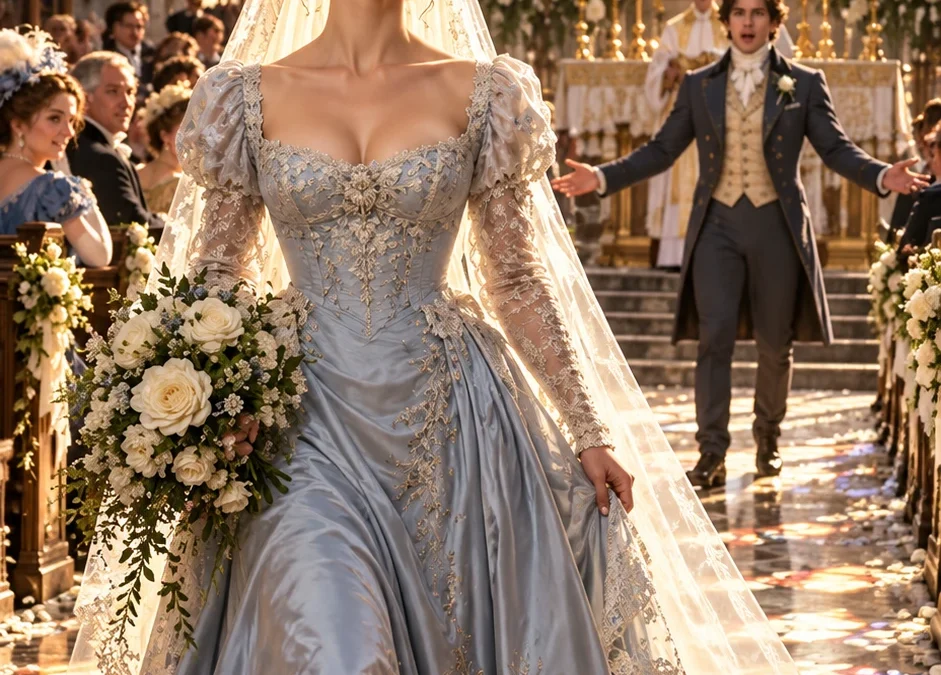
“YOU’RE LUCKY I’M MARRYING YOU AT ALL,” HE SNEERED AT THE ALTAR, IN FRONT OF HALF OF BATH. SHE SMILED, AGREED, AND WALKED OUT… BUT THE INK ON HER FINGERS HID A SECRET THAT WOULD SHOCK ALL OF ENGLAND 😱📖
Part 1
Hester Lowe finished the last chapter of her novel at a quarter to six on the morning of her wedding.
She wrote it at the little table by the window of her bedroom above the bookshop on Milsom Street in Bath, by the light of one candle and the gray dawn creeping over the rooftops. She had not meant to. She had meant to sleep as a bride should, and wake rested, calm and pretty. But at three in the morning she had woken with the ending clear in her head, every word of it, and she had known that if she did not write it down at once, it would be gone by the time she came back from church.
So she lit the candle and wrote eleven pages. The heroine walking out of a drawing room into the rain. The last line.
She sat back and felt what she always felt when she finished a book: a deep, quiet, private joy, like a door closing on a warm room. 🕯️
Then she looked down at her hands.
The first two fingers of her right hand were black with ink. Not a smudge. Stained into the skin around the nails, the way they always were after a long night of writing. She scrubbed at them with soap, pumice and lemon juice for half an hour before her maid came with the hot water. They faded a little. They did not go.
Nobody will notice, she told herself, pulling on her long white wedding gloves. Nobody looks at a bride’s hands.
She was wrong about that.
Hester was twenty-nine years old. Bath considered this a great age for a bride. Bath considered a great many things, and said most of them out loud.
She had lived above the bookshop her whole life. Her father had kept Lowe’s Books and Circulating Library for thirty years: a long, narrow, dusty, beloved shop with shelves to the ceiling, a ladder on wheels, and a smell of old paper, leather and beeswax. Half the ladies of Bath borrowed their novels from Lowe’s. When her father died four years ago, Hester simply carried on, because there was nobody else. She kept the accounts. She bought new books from London each month and mended old ones at the workbench in the back.
And at night, after the shop was closed and her mother asleep, she wrote.
Nobody knew. Not her mother. Not the girl who helped in the shop. Not one single person in Bath.
Two years ago, a London publisher named Mr. Henry Pike had brought out a three-volume novel called The Patience of Miss Ward. On the title page, where the author’s name should have been, it said only: By a Lady. It told the story of a clever, plain, overlooked governess, mocked by the family she works for, who refuses again and again to be made small. It was funny and sharp and, in places, unexpectedly sad. It sold out its first printing in a month, then its second, then its third. Ladies quoted it to one another in the Pump Room. A bishop preached against it. Everyone in England had a theory about who the lady might be.
Lowe’s had sixteen copies on its shelves. Every one was out on loan, every week, all year.
Hester Lowe had written every word of it at the little table by her bedroom window, after midnight, with ink on her fingers. 🤫
Mr. Frederick Mallory had proposed in March.
He was thirty-two, the younger son of a baronet with an estate in Wiltshire. He was handsome in a fair, well-fed, self-satisfied way, with excellent manners in public and a great many opinions he shared freely. He had come into the shop one wet afternoon to buy a newspaper, stayed to talk, and come back the next day, and the next.
He had no money of his own. Younger sons seldom did. But he had a good name. And Hester’s mother, who had waited eleven years for her daughter to marry, looked at him across the counter and saw the answer to every prayer she had ever said.
“He is a gentleman, Hester. A baronet’s son, at your age. Think of it.”
Hester had thought of it. For a long time.
She did not love him. If she was honest, she did not even like him much. He talked over her. He corrected her in front of customers. Once, picking up a copy of Miss Ward from the counter and tossing it down again, he said that novels were silly things written by silly women for other silly women, and he hoped she did not read them herself.
She had said nothing. She had smiled, and put the book back on the shelf.
But she was twenty-nine. Her mother was unwell. The shop was hers, and so was the building, which her father had bought outright thirty years ago when Milsom Street was nothing much. And there was a part of her, the part she was least proud of, that was tired of being poor Miss Lowe from the bookshop, and wanted just once to be somebody’s wife.
So she said yes.
It was only much later that she understood the building had been the point all along. 🏠
The wedding was at the Abbey at eleven.
Bath Abbey was enormous: a great golden church with fan vaulting like the inside of a seashell, and windows so tall that the light came down in long bars of ruby, gold and blue. It was far too grand for a bookseller’s daughter, Frederick had insisted. A Mallory does not marry in a parish church on a back street.
The front pews were full. Frederick’s mother, Lady Mallory, tall, thin and disapproving in gray silk. His brother, Sir Henry, who had come from Wiltshire under protest. Half the fashionable people of Bath, who had come to see the baronet’s son marry the girl from the bookshop, and to say afterward that they had been there.
Hester walked up the aisle on the arm of her mother’s cousin, old Mr. Pell, who had known her father. She wore ivory silk, long white gloves, and a veil of her mother’s lace. She felt all of Bath watching and did not mind it as much as she had expected. She was thinking about eleven pages on a table by a window, and the last line.
Frederick waited at the altar, looking pleased with himself. He looked, she thought, like a man collecting something he had ordered.
Mr. Pell put her hand in his and stepped back. The vicar began. “Dearly beloved, we are gathered together here in the sight of God…”
And Frederick glanced down at her right glove, where, through the thin white kid, at the tips of her first two fingers, two faint dark smudges had come through from the stained skin underneath.
He looked at them for a moment. Then he laughed: a short, contemptuous breath through his nose.
“Good God, Hester,” he said, in the same carrying voice he used to correct her in the shop. The vicar stopped. The whole front of the Abbey heard. “Ink. On your wedding day. Scribbling your shop accounts at dawn like a clerk.” He shook his head, half amused, half disgusted, loud enough for his mother in the front pew to hear every word. “A bookseller’s daughter of twenty-nine, with ink on her hands, in my family’s church. You do understand, don’t you?”
He smiled.
“You’re lucky I’m marrying you at all.”
In the front pew, Lady Mallory gave a small, satisfied nod. 😡
The Abbey was silent.
Hester stood at the altar and looked down at her gloved hand in his. At the two faint dark smudges on the white kid. The ink from the last eleven pages of a novel that half of England was waiting for.
She thought of Miss Ward, standing in a drawing room while a family laughed at her.
I know what Miss Ward would do, she thought. I wrote it.
She lifted her head, looked at Frederick Mallory, and smiled.
💬 Want Part 2? Comment “PART 2” or leave any word below and I’ll send it to you privately!
Part 2
She lifted her head, looked at Frederick Mallory, and smiled.
“You’re quite right, Frederick,” she said, clearly and pleasantly, at exactly the same carrying volume he had used. “I am lucky.”
He blinked.
“I am lucky you said it now,” said Hester Lowe, “and not after the vows.”
She took her hand out of his. She handed her white roses to the astonished vicar. She turned and walked back down the long aisle of Bath Abbey, through the bars of ruby and gold light, past the fashionable rows with their mouths open, past Lady Mallory in her gray silk, toward the great west door and the June sunshine beyond.
She did not hurry. She did not look back.
Behind her at the altar, Frederick Mallory stood with his arms half spread, staring after her as though someone had taken away a parcel he had already paid for. 😳
She walked home. Down the hill from the Abbey, along Union Street, up the slope of Milsom Street in her ivory silk and lace veil, with her gloved hands at her sides. People stopped on the pavement to stare. A small boy selling newspapers shouted, “Look, it’s a bride!” and his mother pulled him back by the collar.
Hester felt light. That was the strangest part. She had expected to feel crushed. Instead she felt as though she had put down a heavy trunk she had been carrying up a long hill, and had only just noticed how heavy it was.
She let herself into the shop by the side door. It was dim and quiet, smelling of paper and beeswax, the way it always had. On the shelf, sixteen empty spaces where The Patience of Miss Ward should have stood.
She stood in the middle of her father’s shop in her wedding dress, looked at those empty spaces, and began to laugh. 😂
Her mother came home an hour later and cried most of the afternoon. “A baronet’s son, Hester! In the Abbey, in front of everyone! What will become of you?”
“I will run the shop, Mama. The way I have for four years.” Hester had changed into her old brown work dress, and sat beside her mother on the sofa, holding her hand. “Mama, did you hear what he said to me at the altar?”
Her mother lowered the handkerchief.
“He said I was lucky he was marrying me at all. In front of his mother, the vicar and half of Bath. Because I had ink on my fingers.” She held up her right hand. “If he said that at the altar, what would he have said at the breakfast table every morning for forty years?”
Her mother looked at the stained fingertips for a long time. Then she took her daughter’s hand in both of hers.
“Your father had ink on his fingers every day of his life. I used to tease him about it. I never once thought it was something to be ashamed of.” She was quiet. “I am sorry, Hester. I wanted it so much for you. I did not look at him properly.”
“Neither did I,” said Hester. “Until this morning.”
She opened the shop at nine on Monday, exactly as usual. She did it on purpose. She knew what Bath would say if Lowe’s stayed closed: the poor jilted bookseller, hiding upstairs, weeping.
So she turned the sign to OPEN, stood behind the counter in her brown work dress with her hair pinned plainly, and waited.
They came. Of course they came. In twos and threes all morning, the ladies of Bath came to return books they had not finished and borrow books they did not want, so that they could look at her. They searched her face for signs of tears. They looked at her hands. They said “Good morning, Miss Lowe” in soft, pitying voices, and whispered the moment they were out of the door.
Hester served every one. She stamped their cards, wrapped their parcels and took their pennies. She did not explain anything to anyone.
By afternoon, the story was all over Bath in two versions. In the first, told by those who had sat close enough to hear, a gentleman had said “You’re lucky I’m marrying you at all,” and the bride had agreed, handed the vicar her flowers and walked out. The second came from Lady Mallory’s drawing room in the Royal Crescent. In that version, Miss Lowe was a nervous, overwrought old maid who had taken offense at a harmless joke and humiliated a gentleman who had been doing her a great kindness. Poor Frederick, so generous, so badly repaid. It only showed what came of marrying into trade.
Bath repeated both with equal enthusiasm.
On Wednesday at four, when the shop was quiet, Frederick came in. He did not come to apologize. He had the look of a man who has decided to be patient with a foolish woman and expects to be thanked for it.
“Hester. I think we have both had time to calm down.”
“I have been calm since Saturday, Frederick.”
“Then you will be ready to be sensible.” He leaned on the counter. “I am prepared to overlook what happened in the Abbey. My mother is less forgiving, but she will come round. We can have the banns read again and be married quietly in August. Nobody need make a fuss.”
Hester looked at him. “Why?”
“Why what?”
“Why would you want to marry me in August, when on Saturday you told the whole Abbey I was lucky you would have me? You do not think much of me. You have made that very clear. So why come back?”
For the first time, he looked uncomfortable. His eyes flicked around the shop: the tall shelves, the ceiling, the walls.
“You are being foolish.”
“This building,” said Hester slowly. “My father bought it thirty years ago for four hundred pounds. Mr. Pell told me last month it would fetch four thousand now. Milsom Street is the most fashionable street in Bath.” She watched his face. “My marriage settlement would have made it yours, would it not?”
He did not answer. He did not have to. 😠
“You were going to sell it. My father’s shop.”
“It is a shop,” said Frederick impatiently. “A dusty little shop full of old books. You would hardly have needed it once you were Mrs. Mallory. My brother’s estate has debts, Hester. Mine too. A gentleman has expenses. Four thousand pounds would have…”
He stopped.
Hester walked to the front door and opened it, so that the bell above it rang, and stood holding it.
“Thank you for calling, Frederick. I will not be marrying you in August, or at all. And this dusty little shop full of old books is not for sale.”
His face went red. He snatched up his hat. “You will regret this. You are twenty-nine years old. You smell of glue and old paper. Nobody else will ever ask you. Do you know what they are saying about you in the Royal Crescent?”
“Yes,” said Hester. “I sell them their newspapers. Good afternoon.”
That night, after the shop was shut and her mother asleep, she sat at the little table by her window, lit the candle, and took out a sheet of paper.
She was not going to write the novel. The novel was finished. She was going to write a letter.
For two years, letters had come to her through Mr. Pike, who forwarded them in a bundle every month. Most were kind, some silly, a few rude. She read them all and answered almost none, except one.
The first had come eighteen months ago from a reader who signed himself only G. It said that The Patience of Miss Ward was the truest book about loneliness he had ever read, and asked one question about a scene in the second volume, where Miss Ward stands alone in a garden at night after a ball. How did you know? This is exactly what it feels like.
She had written back. She did not know why. Perhaps because nobody had ever asked her a real question about her book before.
For eighteen months, a letter had gone from Bath to London every two or three weeks, addressed to G, care of Mr. Pike, and a letter had come back. Neither had ever said who they were. She knew he lived in the country, read a great deal, had a dog called Homer, and had lost his father young. He knew she lived in a town, loved her work, and had lost her father four years ago. They wrote about books, and grief, and being lonely in a crowded room.
His letters were the best thing in any month. She had not written since her engagement. She had not known how.
Now she dipped her pen.
Dear G, I was to be married on Saturday. I am not married. At the altar, in front of half the town, the gentleman looked at the ink on my fingers and told me I was lucky he was marrying me at all. I told him he was quite right, handed the vicar my flowers, and walked home. I have never felt so free in my life. I have finished the new book. The heroine walks out into the rain at the end. I wrote that chapter at dawn on my wedding day, which is how I got the ink on my fingers. I suppose you could say the book saved me. — A Lady.
His answer came in eight days. It had never come so fast.
Dear Lady, I have read your letter eleven times. I think he was a fool, not because he insulted you, though he did, but because he looked at the ink on your fingers and saw something to be ashamed of. I have spent eighteen months reading letters written by those fingers. They are the best thing in my life. You have done the bravest and wisest thing I have heard of in years. I am glad you walked out into the sun.
I have been meaning to tell you that I will be in your part of the country this summer on family business. I will not ask where you are. I gave you my word long ago that I would never try to find out who you are, and I keep my word. But I wanted you to know that for a few weeks this summer I may be closer to you than usual. I find that I like the thought. — G.
Hester read it four times, sitting on her bed with the candle burning low.
My part of the country.
She had never told him where she lived. Only that it was a town with hills and a river and old stone buildings the color of honey.
She folded the letter and put it in the box under her bed with the other forty-one, and lay awake a long time, looking at the ceiling. 💭
The Duke of Summerton came to Bath in the third week of June.
Bath talked of nothing else. A duke who had never been seen there before, thirty-four, unmarried, one of the richest men in England, and a known recluse who lived alone in Somerset with his books and his dogs, and who had refused, it was said, eleven invitations from the Prince Regent himself. He took a house in Gay Street. He walked alone in the Parade Gardens with a large shaggy gray dog at his heels. Every mother in the Royal Crescent sent him a card. He answered none.
Hester heard all of it across her counter. She did not think about it much. Dukes did not come into bookshops on Milsom Street.
He came in on the twenty-fourth of June, a Tuesday, at a quarter past three.
She was up the ladder at the back of the shop, shelving new books from London, when the bell rang. “One moment, please!” she called, and came down with her sleeves pushed up and a smear of dust on her cheek.
A tall man stood in the middle of the shop, hat in hand, looking up at the shelves. He was dark-haired, lean, plainly dressed in a brown country coat that had seen a good deal of weather, with a quiet, angular, serious face and a way of standing still. At his feet sat a large shaggy gray dog with its tongue hanging out.
“I am sorry,” said Hester. “We do not usually have dogs in the shop.”
“He will not touch anything. He is very well behaved. Sit, Homer.”
The dog, who was already sitting, thumped his tail on the floor.
Hester stopped at the foot of the ladder. Homer. There were a great many dogs in England. Some of them must be called Homer. 😳
“Can I help you find something, sir?”
“I hope so. I am looking for a novel. The Patience of Miss Ward. I have read it, but my copy is falling apart. I have tried four shops this morning. They all laughed at me.”
“I am afraid we shall laugh too. We have sixteen copies. Every one is out on loan, and there is a waiting list of forty names.”
He turned and looked at her for the first time. He had gray eyes, steady and direct. He looked at her face. Then at her hands, at her sleeves pushed to the elbow, at the faint dark stains of ink that never quite came off the first two fingertips of her right hand.
He did not laugh. He did not frown or look away. He simply looked, the way a man looks at something he has heard about and never seen.
“Then may I put my name on the waiting list? I am in no hurry.”
She opened the ledger and dipped her pen. “What name, sir?”
He hesitated, just for a moment. “Vere. Gideon Vere.”
Hester wrote it down. G. V. Gay Street. Number forty-one.
She did not know, as she wrote, that she was writing the name of the Duke of Summerton.
💬 Want to know what Hester discovered about the Duke, and what happened when she stood up in a crowded room full of people who once laughed at her? Like and comment “REVEAL” below. Part 3 will be posted once we have enough comments! 🔥
Part 3
She found out the next morning from Mrs. Drew, who came in to return a book of sermons and said breathlessly, “Miss Lowe, is it true? Was the Duke in your shop yesterday with his great gray dog?”
Hester looked down at the ledger, at the name she had written. G.
She told herself it was a coincidence. Half the men in England had names beginning with G.
He came back on Thursday. He did not ask about his place on the waiting list. He asked whether she had anything by a writer named Crabbe, and she found him two volumes, and he stood at the counter and talked to her about Crabbe for half an hour while Homer slept by the fireplace. He came on Saturday, and the Tuesday after.
He was not like any duke she had imagined. He was quiet, plain-spoken and a little awkward, the way people are who spend most of their time alone. He did not flatter her. He asked questions about books, listened to the answers, and argued with her when he disagreed. Once, when she said something sharp and funny about a famous poet, he laughed out loud, a sudden startled laugh, as though it surprised him.
She found she looked forward to Tuesdays, Thursdays and Saturdays. She also found she was listening to him. Every time he spoke, she was listening for one particular thing.
On the third Saturday, she heard it.
They were talking about a scene in a novel where a young woman goes out alone into a garden after a ball. He stood at the counter, turning his hat in his hands, and said almost to himself, “Nobody writes that properly, except one. There is a scene in Miss Ward, in the second volume, where she goes out alone into the garden after the ball and stands by the fountain in the dark. I read it and thought, How did she know? How did she know that this is exactly what it feels like?”
Hester stood very still behind the counter.
How did you know? This is exactly what it feels like.
The same words. Exactly the same words.
She looked down at the counter so he would not see her face.
“Perhaps,” she said carefully, “she had stood in a garden like that herself.”
“Perhaps,” said Gideon Vere. He looked at her across the counter for a long moment, in the quiet afternoon light, with the dust drifting in the window. “I have always thought she must have.”
Frederick Mallory heard about the Duke from his mother.
Lady Mallory heard everything in Bath eventually, and she heard this from Mrs. Drew, who had now seen the Duke of Summerton go into Lowe’s seven times in three weeks, and come out each time after more than half an hour.
“Seven times,” said Lady Mallory, in the drawing room in the Royal Crescent. “A duke in a bookshop with that girl.” Her thin mouth tightened. “She is setting her cap at him, Frederick. It is perfectly obvious. The impudence of it.”
Frederick said nothing at first. He had been thinking ever since the Abbey about four thousand pounds, and his debts, and his creditors in London who were growing impatient. And now he thought about the Duke of Summerton, who had forty thousand a year, was said to be lonely, and had come to Bath for no reason anyone could discover. A duke could be very useful to a younger son with debts. A duke who liked books.
“Is it true the Duke has read The Patience of Miss Ward?”
“Mrs. Drew says he asked for it in every shop in Bath.”
“No reason,” said Frederick.
But the next afternoon, while Hester was at the bank, he paid the shopgirl a shilling to let him borrow one of the copies from the back of the waiting list. He sat up two nights in his rooms in Gay Street, which by chance were three doors from the Duke’s, and read all three volumes. He did not enjoy it. But he learned four or five good passages by heart. 😏
Mr. Henry Pike arrived in Bath on the first of July.
He came to the shop that evening after closing, through the side door: a round, quick, cheerful little man in spectacles with an enormous appetite for gossip. He had been Hester’s publisher for three years and her friend for two. He was the only person in England who knew who a lady really was.
He sat in the little parlor behind the shop with a glass of her father’s old Madeira.
“The new book is the best thing you have ever written. I read it on the coach. I cried twice. My clerk cried three times. It will sell twice as many as Miss Ward. I would stake my business on it.” He leaned forward. “Hester, they want to know who you are.”
“They always want to know.”
“No, this is different. Lady Ashton is holding a literary evening at her house in the Circus on Saturday. Every person of consequence in Bath will be there. She asked me, as a great favor, to read from the new book before it is published. I said yes. And I said I would ask the author whether she wished to be known.”
Hester was silent for a long time.
For three years she had hidden. She had let her mother, her customers and Frederick Mallory believe she was a plain spinster who scribbled shop accounts at dawn. She had hidden because she was afraid of exactly what Frederick had said at the altar: a bookseller’s daughter of twenty-nine, with ink on her hands. She had been afraid people would laugh at the book because of who had written it.
She looked down at her two ink-stained fingers.
“Who will be there?”
“Everyone. Lady Mallory. Her son. Half of the Royal Crescent.” He looked at her over his spectacles. “And the Duke of Summerton. Lady Ashton is his godmother. It is the only invitation in Bath he has accepted.”
Hester looked at him. “Mr. Pike. You have been forwarding my letters for eighteen months. The ones from G.”
His round face went perfectly blank. “I never open my authors’ correspondence, my dear.”
“But you know where they come from.”
Mr. Pike looked at her a long moment. Then he finished his Madeira.
“I gave my word to both of you that I would never tell either who the other was. I have kept it for eighteen months. I shan’t break it now.” He stood. “But I will say this. On Saturday evening, after I have read the last chapter, I am going to ask the room whether they would like to know the name of the author. If you stand up, I will tell them. If you do not, I won’t. It is entirely your choice.”
Lady Ashton’s drawing room in the Circus was full by eight on Saturday. Two hundred candles. Every fashionable person in Bath in silk and lace, in rows of gilt chairs facing a small table with a lamp and a reading stand. The windows stood open to the warm July night. The talk was all of one thing. A Lady. The new book. Who could she be?
Hester came late, alone, in her best dress, a plain dark green silk she had owned four years, and her mother’s pearls.
She did not wear gloves. She had thought about it a long time in front of the mirror, and in the end left them on the dressing table. 🧤
She found a chair at the end of the last row, by the door. Heads turned. She heard the whispers. The bookseller. The one from the Abbey. In the front row, Lady Mallory turned all the way round to stare.
Near the front, Frederick stood beside the Duke of Summerton. He had positioned himself there with great care the moment the Duke came in. He was talking eagerly, with his most charming smile, and she could see from the Duke’s face, polite, closed and patient, that the Duke was not enjoying it at all.
Then the Duke turned his head, looked down the long candlelit room, and saw her.
His whole face changed. Not a large change. A man across the room would barely have noticed. But Hester had watched that face across her counter three times a week for a month. The closed politeness simply fell away, and something warm and surprised and glad came into his gray eyes.
He began to walk toward her down the side of the room. Frederick, seeing where he was going, went after him.
They reached the back row together.
“Miss Lowe,” said the Duke quietly. “I did not know you would be here.”
“Lady Ashton was kind enough to invite me, Your Grace.”
“Your Grace,” said Frederick, with a little laugh. “I see you have met our local bookseller. Miss Lowe and I were very nearly married this summer, you know. A little misunderstanding at the Abbey.” He smiled down at Hester. “She is a great reader of novels, aren’t you, Hester? Though I would hardly have expected to see her at a literary evening. This is rather different from a circulating library.”
The people in the last two rows had stopped talking. They were listening.
The Duke turned and looked at Frederick Mallory. It was a long, level, quiet look.
“Mr. Mallory. I heard about the Abbey. I believe the misunderstanding was yours.”
Frederick’s smile faltered.
“I believe you told Miss Lowe she was lucky you were marrying her at all. Because she had ink on her fingers.” He did not raise his voice. “I have been in Miss Lowe’s shop seven times. She knows more about books than anyone I have met in ten years, including several professors at Oxford. If you had the sense to see what that ink meant, Mr. Mallory, you would not have said what you said. You would have thanked God for it.”
A stunned silence fell over the back of Lady Ashton’s drawing room. Frederick went red, then white. And because he could think of nothing else, he tried to recover the way he always did: by showing off.
“Your Grace is a great reader yourself, I understand. Of The Patience of Miss Ward, I am told. So am I. A remarkable book. I think there has never been a better line written by any woman in England than the one at the end of the first volume.” He smiled, pleased with himself. “I am not small because you have decided not to look at me. Pure genius. Whoever she is, A Lady is the finest mind of our age. I would give a great deal to meet her.”
Hester, sitting in the last row in her four-year-old green silk with no gloves on, looked up at him.
“It is I am not small because you have chosen not to see me,” she said.
Frederick looked down at her.
“You have it wrong,” said Hester pleasantly. “It is chosen not to see me. Not decided not to look at me. Page two hundred and eleven of the first volume, in the drawing-room scene after the dinner.” She paused. “You should have borrowed the book for longer than two nights, Frederick.”
The Duke was no longer looking at Frederick. He was looking at Hester, at her bare right hand resting on the chair in front of her, at the two ink-stained fingertips. And Hester watched his face as he heard what she had just said, page two hundred and eleven, and something moved behind his steady gray eyes, slowly, like a lock turning. 🔑
At the front of the room, Mr. Pike tapped the reading stand with his spectacles.
“Ladies and gentlemen, if you would take your seats. I have the great honor of reading to you, for the first time anywhere, the final chapter of the new novel by the author of The Patience of Miss Ward. It is called The Lady Who Walked Out.”
He read for twenty minutes. It was the chapter she had written at dawn on her wedding day, by one candle, with ink running onto her fingers. A young woman in a drawing room full of people who have spent the whole evening telling her what she is worth. A gentleman who has just told her, in front of them all, that she is lucky he would have her. And the young woman who agrees with him quite pleasantly, stands up, walks out of the room and out of the house into the rain, and keeps walking.
“It was raining very hard,” Mr. Pike read, “and she had no umbrella, and she did not care. She had spent eleven years being grateful for things that were not gifts. She found, standing in the rain at the end of the street, that she was not grateful anymore. She was free, and freedom, it turned out, was a great deal warmer than she had ever been told.”
He closed the book.
Lady Ashton’s drawing room was silent. Two hundred people sat in the candlelight without moving. Somewhere near the front, a lady was crying quietly into her handkerchief. 😭
“Ladies and gentlemen,” said Mr. Pike. “For three years, all of England has asked me who A Lady is. For three years I have refused to say. Tonight, for the first time, the author has given me permission to tell you, if she chooses to be known.” He paused. “Madam. Do you choose?”
Nobody moved. Every head turned, searching the rows. Lady Mallory craned toward the front, where the countesses sat.
In the last row, by the door, Hester Lowe stood up.
She stood in her plain green silk and her mother’s pearls, with no gloves on her hands. She said nothing. She simply looked down the long candlelit room at Mr. Pike, and nodded once.
It was the widest smile she had ever seen on his round face.
“Ladies and gentlemen, the author of The Patience of Miss Ward, and of The Lady Who Walked Out, is Miss Hester Lowe of Lowe’s Books and Circulating Library, Milsom Street, Bath.”
For a moment there was no sound at all.
Then two hundred people turned around in their gilt chairs to stare at the bookseller in the last row. And half a step from her, with his mouth open and his face the color of candle wax, Frederick Mallory stood absolutely frozen.
He had just told the whole back of the room that A Lady was the finest mind of the age, and that he would give a great deal to meet her.
He had met her. He had stood beside her at the altar of Bath Abbey, looked at the ink on her fingers, and told her she was lucky he was marrying her at all. 😱
The applause began at the front. Lady Ashton started it, a tall, white-haired old lady in purple, who rose from her chair, turned to face the back row, and began to clap slowly and firmly. Then the lady who had been crying. Then the row behind her. Then the whole long candlelit room was on its feet, two hundred people in silk and lace, applauding the bookseller from Milsom Street.
Hester did not know what to do with her hands. She had imagined this once or twice, late at night, as a terrible thing. Everyone staring, everyone laughing at the plain spinster from the bookshop.
She had not imagined this.
In the front row, Lady Mallory had not stood. She sat rigid, her thin mouth open. And beside Hester, Frederick turned without a word, walked out of the drawing room, down the stairs, and out into the July night.
Nobody watched him go.
It took her an hour to reach the terrace. Everyone wanted to speak to her. Ladies she had sold newspapers to for years pressed her hands and said they had always known she was clever. A bishop’s wife asked her to sign a copy of Miss Ward on the spot, in pencil. Mr. Pike stood beside her through all of it, beaming like a man who had won a large bet.
When she finally escaped through the tall French windows, the terrace was dark, cool and empty, except for a tall man in a dark coat at the stone balustrade, looking out over the lamplit gardens, with a large shaggy gray dog at his feet.
He turned when he heard her step. For a long moment, neither spoke.
“Page two hundred and eleven,” said Gideon Vere at last.
“I am sorry. I should not have said it like that in front of him. I just could not bear to hear him get it wrong.”
“I know. You have never been able to bear that. You wrote to me once about a man in your shop who misquoted Crabbe for ten minutes, and how you had to stand in the back room and count to a hundred.” He paused. “March. The eleventh letter.”
She stood very still. “How long have you known?”
“Since you told me about the garden.” He did not move toward her. He stayed by the balustrade with his hands at his sides, as though afraid of startling her. “Perhaps she had stood in a garden like that herself. I went home to Gay Street and sat up all night with your letters, all forty-two, and read them again. The bells you hear on a Sunday. The hills. The honey-colored stone. The shop you inherited from your father. The ink.” He looked at her hands. “You wrote in the second letter that you could never get it off the first two fingers of your right hand. I have thought about it for eighteen months.”
“You said you would never try to find out who I was.”
“I did not. I swear to you. I gave you my word. I never asked Pike. I never opened a directory.” He was quiet. “But I guessed, last winter, from the letters. Bath. I was not certain. And then you wrote in May to say you were engaged, and I did not hear from you for six weeks, and I thought I had lost the best friend I had. Someone I had never met.”
“So you came to Bath.”
“I told myself I would only walk in the streets. I would not look for you. And then your letter came, the one about the Abbey. And I walked into a bookshop because a lady in the Pump Room said that if anyone in Bath had Miss Ward, it would be Miss Lowe on Milsom Street. And you came down a ladder with dust on your face and ink on your fingers.” His voice was low. “I knew at once. I did not let myself believe it. Not until tonight. Not until you told Mallory it was page two hundred and eleven.”
Below them the garden was quiet. Somewhere in the house, someone was playing the pianoforte. Homer lifted his shaggy head, looked from one to the other, and thumped his tail on the stone. 🐕
“You came into my shop three times a week for a month,” said Hester slowly, “and talked to me about Crabbe and gardens, and never said a word.”
“I could not. If I had told you, you would have known I had guessed. You would have thought I broke my word, and I would have lost the letters.” He paused. “And I would have lost the shop. I found I could not bear to lose the shop, either. Tuesdays, Thursdays and Saturdays. They have been the best afternoons of my life.” 🥹
Bath talked of nothing else for the rest of the summer. Not about the Duke. About Hester.
The Lady Who Walked Out was published in September. It sold out its first printing in nine days. On the title page, for the first time, in plain black letters, it said By Hester Lowe. On the morning it came out, there was a queue outside Lowe’s on Milsom Street, not to borrow books but to buy them, and to have them signed by the author, who stood behind her father’s old counter in her brown work dress with her sleeves pushed up and signed four hundred and twelve copies before closing time, with ink all over the first two fingers of her right hand. ✍️
Lady Mallory sent her maid to borrow a copy from the circulating library. The maid was put down as number eighty-seven on the waiting list. Lady Mallory did not send her again.
As for Frederick Mallory, Bath simply stopped inviting him anywhere. It was not cruelty, exactly. It was worse. It was laughter. Everyone in Bath had read the last chapter by October, and everyone knew who the gentleman in the drawing room was meant to be, though Hester had never once said so. The line he had spoken at the Abbey became a joke that went round the Pump Room, the Assembly Rooms and every card table in town. A gentleman who lost at whist would say to his partner, “Well, you are lucky I am playing with you at all.” And the whole table would laugh.
His creditors in London stopped being patient in November. He went abroad to Brussels at the end of the month and did not come back. Hester heard it from Mrs. Peabody across the counter. She listened, nodded, and went back to the ledger. She found she did not think about Frederick Mallory at all anymore.
He had stopped being important somewhere around page two hundred and eleven.
The Duke of Summerton did not go home to Somerset at the end of the summer. Every Tuesday, Thursday and Saturday at a quarter past three, he came into Lowe’s with Homer at his heels. Homer lay down by the fireplace, and the Duke stood at the counter and talked to Hester about books.
Nothing else had changed, except that now, on Mondays, Wednesdays and Fridays, a letter came from Gay Street to Milsom Street, three doors and a hill away, addressed to Miss Hester Lowe, in the same plain, square, careful hand that had written forty-two letters to a lady.
And Hester wrote back. They had both decided, without discussing it, that they did not want to stop.
He asked her to marry him on the first Saturday in December, a little before closing time, with the snow just beginning to fall outside the shop window. He did not kneel. He stood at the counter where he always stood, took a small bundle of papers from his coat, and put it down in front of her. It was tied with a faded blue ribbon.
She knew what it was before she touched it. Her letters. All forty-two, from a lady to G. The paper was soft with handling.
“I have carried these with me since June,” said Gideon. “I have read every one more times than I would like to admit. I know them better than any book on your shelves.” He looked at her across the counter. “I want to write to you for the rest of my life, Hester. From the next room, from across the breakfast table, from wherever you are. And I want you to keep this shop, and keep writing under your own name, and have ink on your fingers every day of your life. I will never ask you to wash it off.” He paused. “Will you marry me?”
Hester looked down at the bundle of letters on her father’s counter. Then at her own right hand resting beside it, with its two ink-stained fingertips.
“Yes,” she said. “Gideon. Yes.”
He reached across the counter, took her right hand, and gently, the way a man handles something precious, turned it over and pressed his lips to the ink on her fingers. 💖
They were married at Bath Abbey in May, at eleven in the morning. Hester had chosen it. The same church, she told Gideon. I want to walk up that aisle again and have it end the right way. He agreed at once.
The Abbey was fuller than it had been the June before. Half of Bath had come, and a good part of London, and Mr. Pike in a new waistcoat in the second row. Lady Ashton was in purple. Hester’s mother sat in the front pew, crying into a lace handkerchief, but they were the right kind of tears this time. And at the back, standing against the wall, were dozens of the ladies of Bath who had borrowed their novels from Lowe’s for twenty years, and had come to see the bookseller marry the Duke.
Hester had written the first chapter of her third novel at dawn that morning, at the little table by her bedroom window, above the shop, by one candle. She had done it on purpose.
She walked up the aisle of Bath Abbey on old Mr. Pell’s arm, in ivory silk and her mother’s lace. She was not wearing gloves. And on the first two fingers of her right hand, for everyone in the Abbey to see, were two dark stains of ink.
The Duke of Summerton waited at the altar. He watched her come up the aisle through the bars of ruby and gold light, his grave, quiet face wide open. When she reached him, and old Mr. Pell put her hand in his, he looked down at it. At the ink on her fingers.
He smiled. And he said quietly, but not so quietly that the front pews could not hear, in the same Abbey, at the same altar, in front of half the same people:
“I am the lucky one.” 💫
And that is the story of Hester Lowe: the bride who was told she was lucky anyone would marry her, agreed, and walked out of Bath Abbey to become the most famous novelist in England. 📖✨
This story is entirely fictional and created for entertainment purposes only. It does not represent any organization or individual, nor does it encourage inappropriate behavior. The content was generated with AI assistance.








