“YOU’RE TOO BIG… YOU WON’T FIT ME.” — THE SHY RANCHER ORDERED A MAIL-ORDER BRIDE, BUT THE WOMAN WHO STEPPED OFF THE WAGON LEFT THE WHOLE TOWN SPEECHLESS
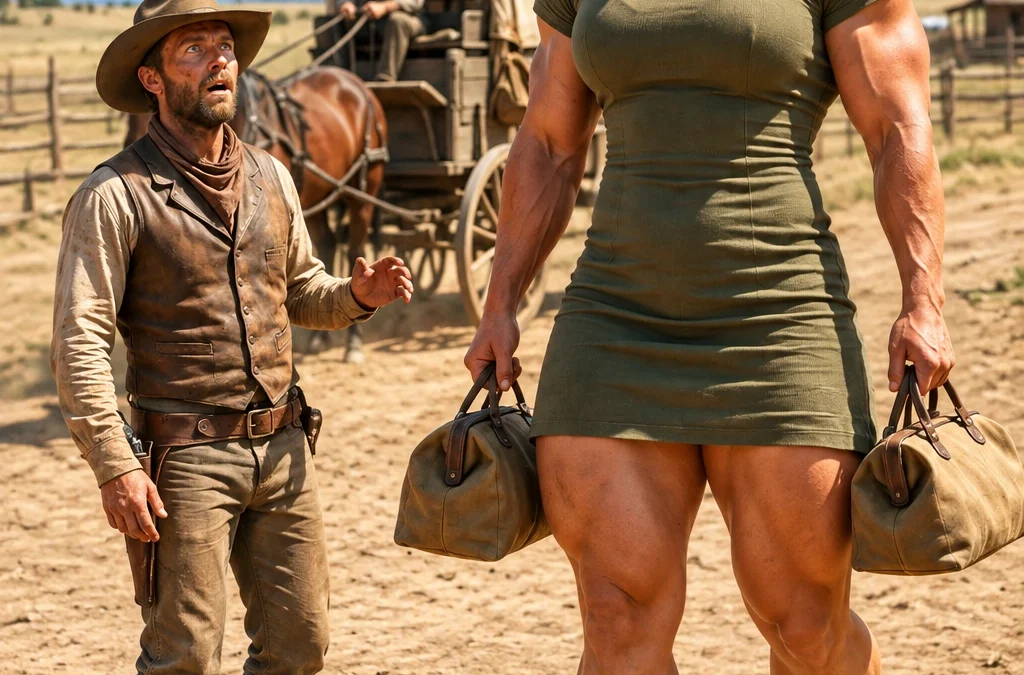
“YOU’RE TOO BIG… YOU WON’T FIT ME.” — THE SHY RANCHER ORDERED A MAIL-ORDER BRIDE, BUT THE WOMAN WHO STEPPED OFF THE WAGON LEFT THE WHOLE TOWN SPEECHLESS
Part 1
There is a drawer in the back bedroom of the Sloan Ranch house that almost nobody opens anymore.
Inside it are three things: a folded letter, a tin button that belonged to my father, and a small oak ring.
The ring is the reason I am telling you this story.
I carved it during the brutal winter of 1886, from a branch torn off the old oak beside the creek. For three months, I worked on it by lamplight, sanding the wood until it was smooth enough to slide onto the finger of a woman I had never met.
There was only one problem.
When that woman finally arrived…
the ring was far too small.
My name is Emmett Sloan. Back then I was thirty-three, a rancher in Harlan’s Creek, and shorter than most men in a country where size seemed to count for more than it should.
My father, Thomas Sloan, had never cared.
“You don’t need to be strong,” he used to tell me, “if you’re willing to be slow.”
We had built Sloan Ranch together after my mother died. We raised cattle, repaired fences, survived winters, and slowly turned stubborn ground into something resembling a home.
Then my father got sick.
His lungs failed him little by little until, one cold night, he gripped my arm and whispered the last promise he would ever ask of me.
“Keep this land, Emmett. Don’t let it end quiet.”
He died in March of 1885.
I buried him beneath the oak tree.
And for the next two years, I lived alone.
At first, solitude seemed manageable. There were cattle to feed, fences to mend, fields to work.
But loneliness does not always arrive like grief.
Sometimes it falls like snow.
An inch today.
Another tomorrow.
Until one evening you realize you haven’t spoken to another human being in nine days.
That was the night I wrote the advertisement.
Nine drafts.
Nine embarrassing attempts to describe myself to a stranger.
What I wanted to write was:
I am a small man in a country that has little patience for small men. I have land, honest work, and a promise to my dead father. But when evening comes, this house is unbearably quiet.
Instead, I wrote something simpler.
I said I was an honest rancher seeking a companion for frontier life. I wasn’t wealthy, but I was steady. I believed partnership meant two people making each other stronger—not one making the other feel smaller.
Weeks later, one letter arrived.
Her name was Willa Blaine.
Thirty-one years old. Raised on a Montana cattle ranch.
Her words were intelligent, practical, almost startlingly honest.
She understood loneliness.
We began writing.
Letter after letter crossed the territory until I knew how her mind worked without knowing what her face looked like.
Then Willa agreed to come.
I began carving the ring.
By late April, Fletcher Knox’s wagon finally appeared on the road.
Unfortunately, half of Harlan’s Creek seemed determined to witness my humiliation.
Mrs. Henderson stood near my fence pretending she’d come to return a bucket my father had supposedly loaned her years before.
Young Tommy Morrison sat openly on the fence.
Others simply stared.
I stood in the yard with the oak ring hidden in my vest.
The wagon stopped.
The door opened.
And Willa Blaine stepped down.
My heart nearly stopped.
She was enormous compared with the woman I had imagined.
Nearly six feet tall in worn boots, broad-shouldered and strong, with weathered hands that clearly knew ropes, horses and hard labor.
And she stared down at me.
Actually down.
The entire fence line went silent.
I felt the tiny wooden ring against my chest.
For three months I had carved it for the delicate woman my imagination had invented.
That woman did not exist.
Willa walked toward me.
I could hear whispers behind us.
She stopped close enough that I had to tilt my head upward.
“You must be Emmett.”
“Yes.”
Her gray eyes studied me.
“I suppose we should talk.”
I wanted the earth to swallow me.
But before we could talk, Fletcher Knox started unloading Willa’s enormous trunk.
I grabbed one end.
It barely moved.
My face burned.
Then, without laughing or embarrassing me, Willa simply lifted the other end.
Together, we carried it inside.
That tiny moment should have warned me.
This woman had not traveled hundreds of miles looking for someone to impress her.
She had come looking for a partner.
That evening we ate beans, salt pork and cornbread.
Afterward, we finally addressed what neither of us could ignore.
Neither of us had described our appearance in the letters.
I had imagined her smaller.
She admitted she had imagined me taller.
We both laughed, awkwardly.
Then Willa proposed something practical.
Seven days.
No promises.
No wedding.
No pretending.
We would spend one week working beside each other and then decide whether the life we had imagined in letters could survive reality.
I agreed.
The next morning changed everything.
A pounding came at the door.
“Emmett! Your bull!”
Dakota—my eighteen-hundred-pound bull—had broken through the north fence and wandered straight into Mrs. Henderson’s garden.
By the time Willa and I arrived, Dakota had demolished flowers, vegetables and a good portion of the fence.
Samuel Morrison was there with his sons.
Morrison owned the biggest ranch in the valley and had been trying to buy my land since my father died.
His men tried moving Dakota.
The bull became more agitated.
One man backed away.
Another nearly fell.
Then Willa stepped forward.
“Willa,” I warned.
She kept walking.
“Willa!”
Everyone froze.
Dakota lifted his massive head.
Willa continued toward him.
No weapon.
No rope in her hands.
No fear I could see.
She began speaking softly.
The bull snorted.
One hoof scraped the earth.
Samuel Morrison whispered, “Woman’s going to get herself killed.”
I almost ran after her.
But something stopped me.
Willa wasn’t reckless.
She was watching Dakota—not challenging him.
She moved closer.
And then something happened that nobody in Harlan’s Creek forgot.
Dakota lowered his head.
Willa touched him.
Minutes later she slipped a halter over him, turned around…
…and the enormous bull followed her out of the ruined garden like a sleepy farm dog.
Nobody spoke.
Not Morrison.
Not his sons.
Not me.
Willa passed me and said calmly, “That north fence post. We should fix it today.”
Then she walked toward Sloan Ranch with Dakota beside her.
But Samuel Morrison remained standing next to me.
And the expression on his face had changed.
For two years, Morrison had looked at me like a man waiting patiently for something he believed would eventually become his.
Now he was looking at Willa.
Then at my ranch.
Then back at me.
And for the first time…
Samuel Morrison looked worried.
Because Willa’s arrival hadn’t merely changed my lonely house.
It had interfered with something Morrison had been planning since before my father died.
And three days later, he rode onto my property carrying the secret that could take Sloan Ranch away from me forever.
Find Part 2 in the comments—or leave ANY WORD below and I’ll send it to you privately. 👇
Part 2
And three days later, he rode onto my property carrying the secret that could take Sloan Ranch away from me forever.
Samuel Morrison tied his gray horse at my fence and removed his hat. He spoke politely, which somehow made what followed worse.
There was, he explained, an old filing connected to my father’s early years on the ranch. Thomas Sloan had needed equipment credit. Morrison had acted as guarantor. The paperwork had never been properly completed before my father became ill.
My stomach turned cold.
Morrison looked toward the north pasture.
Thirty acres.
Rocky ground, mostly—but carrying valuable water rights.
Give him that parcel, he suggested, and he would “assist” in resolving the old obligation.
“No urgency,” he said before riding away.
But we both knew there was urgency.
I spent that evening pretending everything was fine. I didn’t tell Willa immediately because saying it aloud meant admitting the land I’d offered as the foundation of our future might not be entirely secure.
But Willa noticed.
She noticed everything.
And while I worried, she acted.
She went into Harlan’s Creek and found Beaumont, a circuit lawyer who knew the county records. When she returned, she sat at my kitchen table without even removing her coat.
“The obligation is real,” she said.
My heart sank.
Then she continued.
Morrison had not told me everything.
His guarantee was not the same as a lien. The original supply company had dissolved years ago. Morrison could create trouble, challenge the title and force the matter into county proceedings—but he could not simply take Sloan Ranch.
And if he tried?
The entire matter would become public.
Including the fact that one of Harlan’s Creek’s most respected ranchers had quietly sat on a dead neighbor’s unfinished paperwork for two years before demanding thirty acres from the man’s son.
“You did all this today?” I asked.
“You were worried,” Willa replied simply.
I stared at her.
I had spent my entire life believing strength meant handling your burdens yourself.
Willa was teaching me something different.
“What do we do when Morrison comes back?”
“You tell him the north pasture isn’t available.”
“Just like that?”
“Just like that.”
“He won’t like it.”
“No.”
“And if he fights?”
“Then Beaumont fights with us.”
Us.
That single word struck deeper than anything else.
Morrison returned two days later.
I met him in the yard.
He expected fear.
Instead, I told him I’d spoken with Beaumont.
For the first time, Samuel Morrison’s confidence cracked.
I explained that the filing would be resolved through proper channels without transferring one inch of Sloan land.
Morrison stared at me.
Then his eyes moved past my shoulder.
Willa stood beside the barn.
Silent.
Steady.
The woman who had walked toward an eighteen-hundred-pound bull without panicking was now watching Samuel Morrison with exactly the same expression.
And suddenly he understood.
I wasn’t alone anymore.
His plan had depended upon the quiet, uncertain son of Thomas Sloan remaining exactly that.
But there were two people standing on Sloan Ranch now.
Two people repairing fences.
Two people asking questions.
Two people willing to fight.
Morrison slowly removed his hat.
Then he said something I never expected.
“Your father was a better man than I gave him room to be.”
I said nothing.
And then Morrison confessed the truth about why his relationship with my father had really changed—and why he’d underestimated me from the beginning.
But what happened after that confession was even more important, because before my seven days with Willa were over, I finally took the tiny oak ring from my pocket.
And when I tried to put it on her finger…
it wouldn’t fit.
👉 LIKE this and COMMENT OAK if you want Part 3. Once there are enough OAK comments, I’ll post the complete ending.
Part 3
The ring stopped at Willa’s knuckle.
For one dreadful second, neither of us spoke.
There it was.
Three months of carving.
Three months of imagining.
Three months of building a woman in my mind from words written on paper.
And I had made the ring too small.
Willa looked at it.
Then at me.
I felt heat rise into my face.
“I can explain.”
One corner of her mouth moved.
“I imagine you can.”
But before I could say anything else, my thoughts went back to Samuel Morrison standing in my yard.
His confession had changed something between us.
“Your father was a better man than I gave him room to be,” Morrison had said.
Then he told me about his niece, Clara.
Years earlier, Clara had apparently asked about me.
Morrison had discouraged her.
He’d called Sloan Ranch “not a sound proposition.”
She eventually married someone else.
Morrison insisted she was content, and perhaps she was. That wasn’t the point.
The point was that Samuel Morrison had decided long ago what men like my father and me were worth.
Too small.
Too uncertain.
Too unlikely to succeed.
My father had never fit Morrison’s picture of the kind of man who conquered frontier land.
And neither had I.
Morrison had carried that judgment for years.
When my father died, he watched.
He made offers for Sloan Ranch.
I refused.
So he waited.
Then he learned about the incomplete filing.
And still he waited.
But Willa’s arrival had disturbed the entire calculation.
She had walked into my life and seen things neither Morrison nor I had understood.
Morrison finally admitted he’d underestimated Thomas Sloan.
Perhaps he was admitting he’d underestimated me too.
He didn’t apologize beautifully. Men like Samuel Morrison rarely do.
But he let the land matter go.
That was enough.
And now, standing beside the paddock with Willa and holding a wooden ring that wouldn’t fit her hand, I understood something strange.
Samuel Morrison had been wrong because he’d judged my father using an incomplete picture.
And I had done exactly the same thing to Willa.
Not cruelly.
Not intentionally.
But I had done it.
I had imagined a quiet woman with small hands.
Someone delicate.
Someone who would enter the life I had already built and fit neatly inside it.
Instead, Willa Blaine had stepped from Fletcher Knox’s wagon nearly six feet tall, strong enough to carry her half of a trunk without effort, skilled enough to calm Dakota, and sharp enough to uncover a legal problem I’d been too frightened to investigate.
The ring in her hand was proof of how little I had understood.
“It can be resized,” she said.
“It can.”
“You’d have to split it.”
“Yes.”
“Add another piece.”
“Yes.”
“The grain would show the join.”
I looked at her.
“It would.”
She turned the ring between her fingers.
Then she said something I’ve remembered all my life.
“Three months.”
“What?”
“You spent three months making this for a woman you’d never met.”
I nodded.
“Based only on letters.”
“Yes.”
She studied the ring.
“Do you know what that tells me?”
I shook my head.
“It tells me that when something matters to you, you take it seriously.”
I almost laughed.
“Seems to me it tells you I guessed wrong.”
“You did.”
That was Willa.
No unnecessary comfort.
No false reassurance.
Just truth.
“But wrong isn’t the same as worthless, Emmett.”
She held the little ring up between us.
“You made this honestly. You just made it from an incomplete picture.”
Those words struck somewhere deep.
Maybe because I had spent my entire life fearing that being insufficient in one way meant being insufficient altogether.
Too short.
Too quiet.
Not forceful enough.
Not Samuel Morrison.
But Willa had spent seven days showing me that partnership wasn’t about compensating for weakness.
It was about combining strengths.
During those seven days, nobody saw the moments that mattered most.
They saw Willa tame Dakota.
They saw Morrison ride into my yard.
They heard rumors about Beaumont and the land dispute.
But they didn’t see Willa notice my cough one cold morning and quietly change what she was doing so the stove stayed hotter.
They didn’t see me repair a gate she’d been struggling with before she had to ask.
They didn’t see her find my old sketchbook containing designs for the oak ring and put it back exactly where she’d found it.
They didn’t see us learning how to occupy the same kitchen without colliding.
Or the evenings when we spoke very little because silence had stopped feeling lonely.
Seven days.
That was our agreement.
And by the seventh morning, I knew.
I had spent years believing my father’s final words were about preserving property.
Keep this land. Don’t let it end quiet.
But perhaps he’d meant more than fences and acreage.
Maybe land survived through the lives built upon it.
I looked at Willa.
She placed the ring back into my palm and closed my fingers around it.
“Ask me.”
My heart stumbled.
“What?”
“Ask me, Emmett.”
She stepped closer.
“Not because of the advertisement. Not because I traveled here. Not because everyone expects us to.”
Her gray eyes held mine.
“Ask because you want to.”
So I did.
“Willa Blaine, will you marry me?”
She didn’t answer immediately.
I kept going.
“Not because this was the plan. Actually, almost nothing has gone according to my plan.”
That finally made her smile.
“I noticed.”
I laughed.
Then my voice became serious.
“I want to marry you because these seven days have been the least lonely days I’ve had since my father died.”
Her smile faded into something softer.
“Because you see things I don’t. Because you don’t make me feel small when you’re stronger at something. Because when trouble came, you didn’t take over my life—you stood beside me.”
I opened my hand.
The undersized ring rested there.
“And because I think we’re building something neither of us could build alone.”
Willa stared at me for a long moment.
Then she said:
“Yes.”
I nearly forgot to breathe.
“But I have conditions.”
Of course she did.
“What conditions?”
“You teach me your woodworking.”
I blinked.
“My woodworking?”
“I want to understand what your hands know.”
“All right.”
“And I’m making you a ring.”
I looked at her hands, then at mine.
“You’ve never made one.”
“Neither had you.”
Fair point.
“And,” she continued, “we resize mine together.”
I looked at the little oak circle.
“The seam will show.”
“I know.”
“You don’t mind?”
Willa smiled.
“No.”
So we split the ring.
Added another piece from the same oak branch.
Matched the grain as closely as we could.
But the seam remained visible.
At first, it bothered me.
I’d spent three months trying to make that ring perfect.
Now there was a line across it announcing that my first attempt had failed.
Willa loved the line.
“It tells the truth,” she said.
“What truth?”
“That something can be changed without being ruined.”
I never forgot that.
Neither did she.
We did not marry immediately.
Willa refused to let our wedding become the conclusion of a week-long adventure.
“We’ve established that we can survive Dakota and Samuel Morrison,” she said. “I’d like to establish that we can survive ordinary Tuesdays.”
So we waited.
Spring became summer.
Summer leaned toward autumn.
Willa learned the ranch, though “learned” is not quite right because within weeks she was teaching me things about cattle behavior that I had never noticed.
I taught her woodworking.
She was terrible at first.
Her impatience with delicate tools became a running argument between us.
“You’re forcing it,” I’d tell her.
“I’m encouraging it.”
“With a drawknife?”
“It responds to confidence.”
“It responds to grain.”
Eventually she improved.
And secretly, she began making my ring from what remained of that same fallen oak branch.
Her ring wasn’t perfect either.
One side was slightly uneven.
There was a place where she’d cut too deeply.
I loved every flaw.
We married six months after she stepped from Fletcher Knox’s wagon.
The church in Harlan’s Creek was packed.
Mrs. Henderson cried before the ceremony even began, though she later denied it.
Fletcher Knox sat near the back wearing the uncomfortable expression of a man who suspected he had accidentally played a significant role in someone else’s happiness.
Even Samuel Morrison attended.
He stood quietly with his family.
When our eyes met, he gave me a small nod.
Nothing more.
Nothing was needed.
Willa and I stood before the preacher holding two oak rings made from the same branch.
When I slid hers onto her finger, it fit perfectly.
The seam was visible.
She looked down at it and smiled.
Then she placed the ring she’d made onto my finger.
Hers was rougher.
Uneven.
Beautiful.
The preacher cleared his throat after we said the words.
“Well,” he announced, “that’s done then.”
The church erupted in laughter.
And somehow that plain sentence suited us better than anything poetic could have.
We returned to Sloan Ranch as husband and wife.
The following harvest was the best since my father had died.
The garden recovered from Dakota’s invasion.
Mrs. Henderson replanted her flowers and eventually forgave the bull, although she continued reminding anyone who would listen exactly how many cabbages he’d destroyed.
Willa transformed the cattle operation.
She could spot sickness in an animal before I saw a single obvious symptom.
I became better at listening.
Not only to her.
To everything.
The herd.
The weather.
The land.
My own instincts.
Sloan Ranch never became the largest operation in Harlan’s Creek.
It didn’t need to.
We became known for something else.
Steadiness.
If a fence needed repair, it got repaired.
If an animal needed attention, Willa usually noticed first.
If accounts needed balancing, she handled them because numbers behaved better for her than they ever had for me.
If something needed building, repairing or patiently fitting together, it generally found its way to my workbench.
Two people.
Different strengths.
One life.
Years passed.
The oak beside the creek grew thicker around the letters I’d carved into its bark.
THOMAS SLOAN.
Sometimes I sat beneath it and wondered what my father would have thought of Willa.
Actually, that’s not true.
I knew.
He would have liked her immediately.
And she would have argued with him within a week.
He would have liked that too.
One evening, many years after our wedding, Willa and I sat outside as darkness settled over the valley.
I had brought out the little box containing my father’s button and the original version of the ring—the first, too-small circle of oak I’d kept.
Willa picked it up.
“You kept this.”
“Yes.”
“Why?”
I thought for a while before answering.
“Because it was made honestly.”
She waited.
“It was wrong,” I continued, “but it wasn’t worthless. It was the best picture I could make with what I knew then.”
Willa turned the ring slowly between her fingers.
“That sounds familiar.”
“I’ve had time to learn.”
She placed it back in my palm and closed my fingers around it.
“Keep it.”
“I intend to.”
We sat quietly.
The creek moved over stones below us.
Somewhere in the pasture Dakota shifted his enormous old body with the gravity of an animal completely satisfied with where life had placed him.
Then Willa spoke.
“Emmett.”
“Yes?”
“Third post from the gate on the east fence.”
I sighed.
“I noticed.”
“When?”
“This morning.”
“And?”
“I was going to fix it tomorrow.”
“All right.”
That was it.
No dramatic declaration.
No music.
No great speech.
Just a fence post that needed fixing tomorrow.
And the woman beside me.
I am past fifty now.
I’ve told this story many times.
People always want to hear about Dakota.
They love the part where the enormous woman walks calmly toward an eighteen-hundred-pound bull while grown men back away.
Others prefer Samuel Morrison and the fight over Sloan Ranch.
Some like the mail-order-bride story itself—the short rancher standing in his yard while a woman nearly a foot taller than he imagined steps from a wagon.
But those weren’t the moments that built our life.
The important moments were smaller.
A cough noticed.
A gate repaired.
A question asked.
A burden shared.
A person trusted.
A silence that no longer felt empty.
And an oak ring that didn’t fit.
Because that ring taught me something I wish I’d understood when I was thirty-three.
We spend enormous portions of our lives constructing pictures of how things are supposed to look.
A husband should look like this.
A wife should behave like that.
Strength should be large.
Courage should be loud.
Love should arrive beautifully and fit immediately.
But life rarely respects the dimensions we imagine for it.
Sometimes the person who changes everything arrives looking nothing like the person you expected.
Sometimes strength is a six-foot woman calming a frightened bull.
Sometimes strength is a small man admitting he needs help.
Sometimes love isn’t finding someone who fits perfectly into the life you’ve already built.
Sometimes love means splitting the old shape open…
adding something unexpected…
and building a new shape together.
Yes, the seam may show.
Perhaps it should.
Because the seam proves you changed.
It proves something happened there.
It proves two lives did not simply fit by accident—they were adjusted deliberately, patiently, honestly, until there was room for both.
My father once told me:
“You don’t need to be strong if you’re willing to be slow.”
It took me years to understand him.
Patience built Sloan Ranch.
Patience made that first ring.
But partnership made it a home.
Sometimes I still open that stubborn little drawer.
I take out the first oak ring and hold it in the same small hands that carved it all those years ago.
From somewhere outside, I can usually hear Willa.
Talking to a horse.
Working in the garden.
Calling my name because some fence post needs attention.
And I think about the lonely man who once sat at his kitchen table surrounded by nine discarded letters, desperately trying to describe himself well enough that somebody might choose him.
He got many things wrong.
He imagined the wrong face.
The wrong hands.
The wrong height.
He even made the wrong-sized ring.
But somewhere inside all those mistakes, he wrote one thing that turned out to be exactly right:
Real partnership means two people making each other stronger—not one person making the other feel smaller.
And that, in the end, was the promise Willa and I kept.
❤️
Disclaimer: This story is entirely fictional and created for entertainment purposes only. It does not represent any organization or individual, nor does it encourage inappropriate behavior. The content was generated with AI assistance.








