29 Beautiful Brides Failed to Win Him. Then a Woman the World Called “Too Big” Walked Through a Blizzard With Nothing but Courage
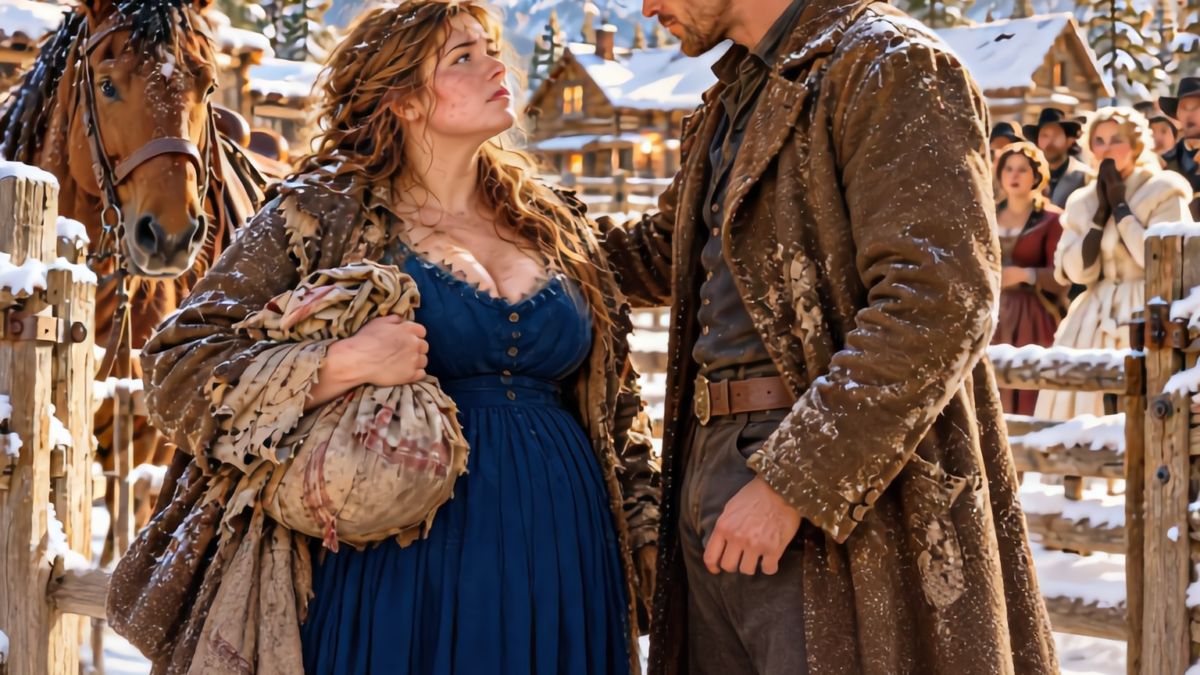
PART 1: THE WOMAN AT THE GATE
The fire had burned down to coals, and Gideon Sterling didn’t bother feeding it.
He sat behind his cedar desk and studied the woman across from him: the silk gown, the white gloves, the curls arranged with an engineer’s care. He felt absolutely nothing.
Evelyn Davenport had arrived three weeks earlier with two steamer trunks, a letter from a senator, and a smile that never quite reached her eyes. She had spent most of those three weeks opening every drawer, cabinet, and locked chest in his house, hunting for the land patents to Black Ridge Ranch.
He had let her look.
He slid an envelope across the desk. Inside was a one-way ticket to Helena.
“I did not travel four hundred miles to be dismissed like a serving girl,” she said.
“No. You traveled four hundred miles to get your hands on my land patents. The difference is that I know it, and now so do you.”
The smile slid off her face, and what was left underneath was colder and more honest. “They told me you were a scarred, soulless brute,” she hissed. “You deserve to die alone up here.”
Gideon opened a slim leather ledger and wrote a single line on its last page:
Evelyn Davenport. Helena, M.T. Departed November 14, 1883.
That made twenty-nine names. They had come sent by lawyers, by land syndicates, by ambitious fathers who believed a scarred cattle baron with fifteen thousand Montana acres was a prize worth acquiring. One had been nearly charming, right up until his foreman caught her copying survey maps in the barn at two in the morning.
Not one of them had been real.
The door cracked against its frame as Evelyn swept out. Gideon closed the ledger and looked through the window at the valley. The sky had gone flat gray. The timber on the ridge was bending, and the cattle had bunched tight in the lower pasture.
They could feel what was coming.
By two o’clock it was a whiteout. The wind drove the snow sideways out of the northwest, and you couldn’t see twenty feet. Gideon was at the forge reworking a cracked axle when Hector, the seventeen-year-old stable boy, burst through the barn door red-faced and gasping.
“Mr. Sterling, there’s a wagon at the gate. Wheel’s cracked. She’s down in the snow.”
The cold hit Gideon like a swung plank. At the iron gate he found a buckboard that had seen thirty hard years. Its front wheel was split clean through, and the rig sagged into the drift. One horse stood with a foreleg lifted off the ground.
Beside that horse, kneeling in the snow, was a woman.
She was big, broad through the shoulders and solid through the back and hips, and Gideon could see at a glance it was the kind of solid that comes from labor, not leisure. Her wool coat was patched at both elbows. Her hands were bare. She had turned her body into the wind, using her own bulk to shield the lame animal, one palm flat against its neck.
Gideon lifted his Winchester across his chest. “Hey.”
She looked up. Her face was wind-burned raw, her lips split and bleeding, and frost had gathered on her eyebrows. Her dark brown eyes were sharp and steady, and there was no apology in them.
“This your land?”
“It is.”
“Wheel’s gone. Biscuit’s leg has been off since Darby, and I’m not leaving him in this.”
“Who are you?”
“Orla Finch. From Missoula.” She pushed herself up, stiff from the cold, and did it without asking for a hand. She was nearly two feet shorter than he was, and she had to tilt her head back to meet his eyes. She met them anyway.
“I didn’t travel through this godforsaken blizzard to be your mail-order bride, Mr. Sterling. I came for work. A fair day’s labor for a warm meal and a dry spot on your barn floor.”
In twenty-nine encounters, not one woman had ever opened with that.
“I don’t take in strays,” he said.
“I’m not a stray. I’m a working hand with nowhere else to be tonight. I can muck stalls, shoe horses, haul water, fix tack, and cook if I have to. I’m not asking for charity. I’m asking for honest work.”
He looked at her hands. The knuckles were cracked and dark, not from tonight but from years before it. Nobody’s hands looked like that from standing around.
He lowered the rifle. “You sleep in the barn.”
“That’s what I said.”
He turned back toward the house, then stopped. “Bring the lame one in too. We’ll look at the leg in the light.”
Behind him he heard a woman murmuring low and steady to a frightened horse, as if it understood every word.
Inside the barn, Jubal waited by the doors. He was a lean, weathered man who had lost an eye to a raiding party in ‘71 and kept the other one sharp enough to make up for it. “Twenty-nine,” Jubal said. “And now here’s number thirty, showing up in a blizzard.”
“She’s not number thirty,” Gideon said, and brought the hammer down on the iron. “She’s a ranch hand. If she’s half as useful as she claims.”
That night, for the first time in years, he opened the ledger and wrote nothing at all.
She was working before dawn. Nobody told her where to start. She walked the length of the barn once and then began: stalls mucked, ice broken out of the buckets, a sagging rail hammered back into place. When Jubal appeared with two mugs of coffee, he looked over what she’d done and silently brought her a plate. Then he picked up a pitchfork and worked the other end of the barn beside her.
Gideon assigned her the salt blocks, sixty to eighty pounds apiece, to be hauled up an iced ramp that even the strongest hands hated. It was the kind of job meant to make a person quit.
She didn’t quit. She found a timber lever, rigged a sled out of scrap wood, and worked the blocks up the slope in stages.
The hired men watched from the fence. “Somebody ought to tell old Sterling he hired a hog for the winter instead of a hand,” Cal drawled.
Denny laughed and raised his voice. “Idle sow. Wonder how many salt blocks she weighs herself.”
Orla stopped, her back still to them. Steam rose off her shoulders into the cold. One second passed, then two.
Then she shouldered the lever and walked down for the next block. She didn’t turn and she didn’t answer. Men like Denny live for the flinch, and she gave him nothing.
Thirty feet away, Gideon said nothing either. But he looked at Denny until Denny found something else to look at.
At four o’clock, young Rafe slipped on the glassy ramp beneath a loaded ore cart. His leg slid under the wheel housing, and the cart began to roll.
Orla covered the distance in five strides. She jammed her lever between wheel and ice, planted her boots wide, and seized the loose brake chain with her bare hands. The frozen iron tore the skin from both palms. She wrapped the chain twice around her forearms and held the cart there while the boy dragged himself free.
“You all right?” she asked him, wiping her bleeding hands on her trousers.
The men had come running at the noise. Then Maeve, the ranch’s sixty-year-old housekeeper, walked straight past them. She was lean as winter, iron-haired, and she had buried a daughter in this valley. She stopped in front of Denny and slapped him so hard his head turned.
“Open your blind eyes,” she said, measured as scripture. “That flesh and bone is pure, honest labor. It is not a punchline for cowards like you.”
The yard went dead silent. Nobody ever called Orla a name on Black Ridge again.
That night, passing the cramped tack room, Gideon stopped in the doorway. Orla sat on a crate by a single candle, stitching her own palms shut with a sewing needle and waxed thread. She worked slowly and methodically, the way someone does who has stitched herself before.
She didn’t make one sound.
He thought of twenty-nine women in silk who had looked at this land and seen only a deed. Then he went down to the forge and hammered iron far harder than the job required.
At dawn, a scream tore through the barn.
Goliath was Black Ridge’s prize stud: sixteen hands of Kentucky blood, worth more than most men earned in three years. He was hurling himself against the walls of his stall. Jubal was pressed flat against the barn wall with a cracked rib. Low on the stallion’s flank, a festering wound pulsed hot and swollen.
Gideon drew his Colt.
“Don’t.” Orla stood in the barn door with her boots unlaced. “That’s an abscess. It needs lancing, not a bullet. He’s not vicious, he’s terrified. That’s a suffering problem, not a behavior problem.”
“He nearly broke Jubal in half.”
“My father shod horses for thirty years. I grew up in his smithy. Give me twenty minutes.”
Jubal’s one eye found Gideon’s. Gideon holstered the gun.
She heated a thin blade in the forge until it was sterile, shrugged off her coat, and slowed her own breathing before she touched the latch. When she stepped inside, Goliath wheeled on her with his ears pinned and his teeth bared. Orla planted her feet and stood as still as a fencepost, and began to murmur: a low, unbroken sound with no edges at all.
Minute by minute, the stallion’s ears loosened. Step by step, she closed the distance. Finally she pressed her whole body along his shoulder. She wasn’t restraining him. She was grounding him, giving him something warm and solid against the pain.
Then one clean cut.
Goliath screamed, shuddered, and dropped his great head onto her shoulder like a stone.
Jubal stared at her with the face of a man whose understanding of the world had just been rearranged.
“Where did you learn that?” Gideon asked her afterward.
“My father. Meet a frightened animal’s fear with force and you only double it. You have to bring the calm and let them find it.”
That night Maeve set two bowls of turnip broth on the kitchen table, then a third, and said nothing about it. Gideon came in and sat down.
Orla told it plainly. She had been married at seventeen to Thomas Finch. He drank, and when he drank he was cruel. He died two years ago and left her his debts. As a child she’d had a thyroid illness, the kind that runs in her mother’s family, and it had changed how her body held weight no matter how little she ate or how hard she worked.
“And I worked very hard, Mr. Sterling,” she said.
“That’s apparent.”
She met his eyes. “Men call your scars heroic because they came from gunfire. They call my body grotesque because it was shaped by disease and bitter toil. But blood bleeds the same. Never measure a human soul by the cut of her waistline or the lace on her collar.”
Gideon touched the white scar that ran down his jaw, the one from the Powder River ambush of ‘74. He had been called brave for it all his life. He had never once had to defend what it said about his worth.
He found he had nothing worth saying. So he refilled his coffee and let the kitchen stay warm.
Spring came slow and mean. Orla moved into a proper room off the barn without anyone announcing it. Gideon started taking supper in the kitchen.
Then Jubal rode in with bad news. Burl Thorson of the Iron Creek Coal & Rail Transit Company had twenty armed riders and stacks of dynamite in Devil’s Throat Canyon. The canyon sheltered the underground creek that fed every ranch and homestead in the southern valley. If Thorson blasted the bedrock and diverted that water, he would own the valley.
When crossfire pinned Gideon and Jubal behind a boulder on the canyon floor, Orla was on the ridge road driving a wagon loaded with cordwood. She could have turned around.
Instead she snapped the reins, drove four horses straight down into the gunfire, and jackknifed the wagon broadside across the canyon mouth, building a wall of seasoned hardwood between the men and the snipers. When a hired gun came scrambling over the buckboard toward Gideon’s back, she broke his forearm with an iron trenching spade and tossed his rifle to Gideon.
Thorson retreated. Orla stood afterward with blood soaking down her sleeve.
“It’s fine,” she said.
In his quarters, by the coal stove, Gideon sewed the wound closed: six careful stitches. Their scarred hands were very close, and the room was very small. She told him she had been reading his land-law primers at night, every one on his shelf. “I hope that’s all right.”
“Keep reading,” he said.
Then came the bank letter. Black Ridge’s operating loans were “under review,” to be discussed at the Bitterroot Spring Gala. Thorson had friends at that bank.
“You know those survey discrepancies better than any banker alive,” Gideon told her. “Come as my legal records assistant.”
“They won’t receive me well.”
“No. They won’t.”
Maeve’s seamstress friend Clara Hodge built her a gown of emerald velvet cut to celebrate her frame rather than fight it. When Orla saw herself in the mirror, she didn’t look vain. She looked like a woman meeting someone the world had never let her be.
At the gala, heads turned. Evelyn Davenport whispered behind her fan. Then a drunken politician’s son flung bourbon across Orla’s emerald sleeve and laughed. “Lord, I’d need a bigger glass to cover all that.”
The room laughed with him.
Orla blotted the stain, folded her handkerchief, and turned away as if nothing had happened. She had carried moments like this alone for years.
Gideon set down his glass, crossed the floor, and held out his hand.
“Dance with me.”
He didn’t lead her to the edge of the floor. He led her to the center of it, set his hand firmly on her waist, and they moved. The quartet played. The couples drifted back. The snickering died. Orla’s chin rose, the velvet caught the lamplight, and for the first time in her life she let herself be exactly where she stood.
Then the windows exploded.
Rifle butts smashed through three panes at once. Women screamed. The sheriff stormed in with two federal marshals, irons drawn. Behind them walked Burl Thorson, holding an arrest warrant in one hand and, between two fingers of the other, a cheap iron ring.
He tilted it toward the lamplight so the whole room could read the inscription scratched inside.
“Orla Dugan Finch,” he said pleasantly. “Daughter of a Butte blacksmith. Signatory, ten years ago, to a perpetual lease granting Iron Creek sole rights to this valley’s water.” He let it sink in. “She was planted inside your ranch, Sterling, to destroy your boundary records. She is a fraud.”
Gideon looked at her.
He couldn’t help it. Twenty-nine old wounds tore open at once, and the doubt flickered across his face for one terrible second.
Orla saw it.
The iron cuffs snapped around her wrists. She straightened her spine, raised her chin, and spoke one word, his given name, for the very first time:
“Gideon.”
Then the marshals marched her into the freezing night, and the doors slammed shut.
He stood alone at the center of the silent floor, the cheap iron ring lying at his boot.
PART 2: FIRE AND IRON
The Cooper’s Mill jail was built of river stone and bad intentions. Orla spent three nights in a cell two arms wide, wearing a gray shift that smelled of its previous occupant, with bruises darkening around her wrists.
On the fourth morning, Thorson pulled a chair up to her bars and laid out an affidavit. If she signed it, confirming the lease was valid, she would walk free.
“Circuit judge arrives from Billings next week,” he said softly. “Two to five years in the territorial penitentiary for a woman with no family, no money, no lawyer.” He leaned in. “No one is coming for you, Mrs. Finch.”
She let the words land. Refusing to feel a thing doesn’t make it smaller. It only leaves you unprepared.
Then she stepped toward the bars. “My father taught me to read iron. Hot and cold look the same in the dark. One you can work. The other burns you. You’re cold iron, Mr. Thorson, and you always will be.” Her voice did not shake. “The Hallorans have three children under eight. The Vasquez brothers have worked that land for fifteen years. I will not sign a death warrant for people whose names you never bothered to learn.”
“You have until Friday.”
When the corridor door clanged shut, she pressed her back against the cold stone and thought about Gideon’s face in that one flickering second. She understood it. She knew what twenty-nine betrayals do to a man’s instincts.
But four days had passed, and no word had come from Black Ridge.
At Black Ridge, Gideon had not left his study in two days. The whiskey bottle was half gone, and the ledger of twenty-nine names lay open in front of him. He told himself that doubt was the only rational answer to a pattern repeated twenty-nine times.
He didn’t believe it, and that was why he kept drinking.
On the third morning, his study door came off its hinges. Jubal’s boot sent it crashing to the floor.
Maeve walked in over it and dropped Orla’s canvas carpet bag on the desk. “Open it.”
He expected documents, maybe stolen surveys, the tools of a woman working an angle. Instead he found a change of clothes, worn work gloves, a tin of pine-pitch salve, and, bundled with twine, hundreds of scraps of paper: almanac margins, feed-store receipts, flattened flour sacks.
Every scrap carried the same four words in handwriting that grew steadier from page to page, practiced by candlelight over months:
Gideon. Black Ridge. Justice. Dignity.
He sat down slowly.
“Ten years ago, when that lease was signed, she couldn’t read or write a single word,” Maeve said. “Her husband pressed her thumbprint onto it while she slept. Everything she knows, the land law, the surveys, she taught herself from scratch. She decided ignorance was a condition, not a destiny.”
Jubal spoke from the empty doorframe, low and level. “You let twenty-nine vultures blind your common sense. You trust the ink of crooked politicians over the blood she shed shielding you from rifle fire. If you let that woman rot in there, you’re the biggest coward walking this valley.”
Coward. Gideon had worn every other word, scarred, bitter, cold, until they almost fit like a coat. That one cut beneath the scar tissue to whatever was still alive underneath.
He walked to the window and poured the rest of the whiskey out into the spring mud.
“Pull the door back up,” he said. “We’ve got work to do.”
“She told Thorson no,” Maeve added from the doorway. “He offered to drop every charge, and she wouldn’t sign away the homesteaders’ water to save herself.”
That night, a folded note dropped through Orla’s cell window, tied with thread. It held four words in a square, unfamiliar hand:
Thursday. Don’t sign anything.
For the first time since the cuffs closed, she slept through the night.
At three o’clock Thursday morning, while Cal and Rafe staged a loud argument over an imaginary runaway mule, Jubal picked the padlock on Thorson’s private railway car and pried open the document cabinet inside. In it were the original surveyor’s maps under the territorial seal. They showed the Iron Creek easement a full quarter mile east of where Thorson’s filed copies placed it, far from Devil’s Throat Canyon.
The filed copies had been doctored.
By nine o’clock the courthouse was packed. The Hallorans were there, and the Vasquez brothers, and family after family from the South Valley in their working clothes, land patents folded in their coat pockets. They had decided this was the day they stopped watching things happen to them.
When the deputies brought Orla in, bruised and pale but upright, she saw the full benches. She saw Gideon at the front of the room. Something crossed her face that wasn’t quite relief. It was the look of someone who had kept faith in the dark and found, in daylight, that it had been warranted.
Thorson’s lawyer rose to push the lease through first. Gideon rose faster. “Objection. Under Territorial Statute 47, no water-rights validation may close without hearing documented stakeholders. There are fourteen in this room.”
The judge, Clement Ware, was Thorson’s man, and everyone knew it. But the statute was the statute, and the room was full of witnesses. One by one the homesteaders stood, gave their names, and stated their claim to the water.
Then Gideon laid three documents side by side on the bench: the 1873 federal survey, the stolen originals, and Thorson’s forgeries. The shifted boundary was plain even from the back row.
“A federal survey supersedes any territorial lease,” he said. “Those filed copies are doctored. And the lease bearing Orla Finch’s mark was executed when she was sixteen, a minor, without court approval. It was void the day it was signed, if she ever signed it at all. She couldn’t write her own name.”
He turned to face the room.
“You thought a woman without family, money, or painted beauty was a stray dog you could kick into an unmarked grave. On this frontier, justice is forged through blood and truth, not crooked leases signed by cowards.”
Judge Ware looked at the documents, then at the full benches. He was a political creature, and he could read a room.
“Charges against Orla Finch are dismissed. The Iron Creek claim is stayed pending federal review. Court adjourned.”
The room broke open with weeping and laughter. Gideon crossed it in five strides and gently took her bruised wrists in his burn-scarred hands.
“You’re all right,” he said. It came out less like a question than he meant it to.
“I told you it was fine,” she said hoarsely. “Where did the original maps come from?”
“Jubal acquired them from Thorson’s railway car.”
“You broke into his railway car?”
“Jubal did. I was here reviewing documents.”
Her laugh came out rough and real, and it lasted two seconds before she pressed her lips together. “Thank you,” she whispered.
Through the window, Thorson mounted his gray horse and rode north without looking back.
Gone was not the same as finished.
Three weeks later, Orla found three orphaned children hiding in the south barn’s hayloft: Dimitri, nine, with careful watching eyes; Anna, six; and little Pyotr, four. Their Ukrainian father had died in a collapse at an Iron Creek mine. She fed them stew in Maeve’s kitchen.
“Fine,” Gideon said when she told him, and that was the whole conversation. The children stayed.
On a cold Thursday night at the end of April, Orla woke to the smell of kerosene.
The south barn was burning, and it was no accident. The fire was racing up the walls from an accelerated base, and riders were vanishing into the timber. The children slept in that barn’s loft.
She hit the door with her shoulder and plunged into the smoke and orange light. She crawled up the loft stairs and found Dimitri pressed against the east shutter, holding his siblings. She pounded the frozen iron latch bar until it gave, threw the shutter open, and lowered all three children one at a time into Jubal’s waiting arms below.
Then she turned for the stairs, and the floor tilted under her.
A burning roof beam crashed down across her hips and pinned her to the boards. She pushed with everything she had, and it moved half an inch. Smoke filled her lungs. The heat climbed toward the point where nobody survives.
Below, Gideon counted the children, then the people around them. He was one short.
He went in through fire. He climbed burning stairs. He drove his bare hands under a beam that was blazing along its top and heaved upward with his legs and back and lungs, roaring.
“Roll left!”
She rolled. He dropped the beam, seized her arm, and dragged her to the shutter. They jumped, and an instant later the barn collapsed behind them in a thunderclap of sparks, fire boiling up into the falling snow.
They staggered fifty feet into the snowfield. Then a figure stepped out from behind the woodpile.
Thorson. His revolver was leveled at Orla’s heart from thirty feet away, and his hand was perfectly steady.
“I gave you both every chance,” he said.
Gideon’s hands were burned raw, and his draw should have been slow.
It wasn’t. Twenty years of hard country moved his hand before his mind could. The Colt cleared leather, the hammer fell, and a single .45 round cracked across the valley and came echoing back off the ridge.
Thorson fell backward into the snow and did not move.
Shaking, Orla and Gideon stood side by side and watched sparks rise into the dark. Dimitri pressed close against her side without a word, the way a child stands near the one person he has decided is safe.
Gideon touched her sleeve, brief and deliberate. She laid her hand over his burned one, carefully, and then they walked to the house together through the snow.
PART 3: THE MOUNTAIN HE KNELT TO
Spring came to the Bitterroot slowly, then all at once.
Tom Halloran arrived with timber before the ashes had cooled. The Vasquez brothers brought cedar planks, Amos Pryor brought nails and wouldn’t take a cent, and forty pairs of hands from across the valley raised a new south barn in three weeks. Orla ran the whole build: beam placement, joint notching, sequencing. She did it with her burns still bandaged, and she showed Dimitri how to sight down a board for true.
Gideon watched her and thought. He had been thinking since the moment he drove that burning beam upward. Facing the thought of her pinned beneath it, every other consideration had fallen away, and what was left was very simple.
Orla was thinking too.
One Sunday night in June, she packed her carpet bag. She told herself it was the right thing. Gideon was a prominent man now. He had beaten a railroad syndicate. He would need a partner the bankers and commissioners would receive without raised eyebrows. She had known that since the first night in the blizzard, and she had set it aside because there was work to do.
The work was done. She would head south to the Hallorans in the morning.
At seven, she was knee-deep in creek mud, roping a pregnant heifer free of the bank, when hooves stopped above her. Gideon slid down beside her without a word, took the rope, and hauled while she pushed. When the heifer finally sucked free and wandered off as if the whole thing had been someone else’s idea, they stood there filthy to the shoulders.
“Where’s your bag?” he said.
She kept coiling the rope.
He took it from her hands and dropped it in the mud. Then he pulled the carpet bag off her shoulder and threw it six feet into the creek, where it landed with a wet thud.
“Where the hell do you think you’re going? Do you think I need a porcelain parlor doll to prove my net worth?”
“Gideon. Look at me.” Her voice held, but barely. “I’m heavy. I’m rough. I carry the scars of every hard season. I am not the lady society picks for a cattle baron.”
He dropped to one knee right there in the deep June mud. He took her hand in both of his burned ones and pressed it flat against his chest, where his heart was hammering harder than he would ever admit.
“Twenty-nine women sat in my parlor waiting for me to hand them an empire,” he said. “Not one would have stood beside me in a storm. You shed your blood for this land, and you dragged my soul out of its grave.” His voice broke. “You are my mountain, Orla. You are the only woman I will ever bend my knee to.”
The last wall inside her came down all at once. She made a sound she had been holding back for a lifetime.
He slid a plain gold ring onto her finger, no stones and no filigree, only one claim. It fit. He knew her hands that well.
She pulled him up out of the mud and into her arms. They held on, and both of them were crying, which both would later swear they never do. Up on the hill, Dimitri saw them, turned around, and quietly went to find Jubal, with the discretion of a child who has found something worth protecting.
Autumn set the valley burning in gold aspen and red scrub oak.
On a bright October morning, Gideon and Orla signed the Free Water Compact at the Territorial Land Office. It placed the waters of Devil’s Throat in the hands of every homestead in the valley, forever, so that no single man could ever own them. Beneath his upright signature, Orla wrote her name slowly and deliberately, with the care of someone who came to writing late and has never once taken it for granted. Beside it, the clerk had typed: Co-Director, Full Legal Authority.
Outside, she stood in the sun with the folded copy in her hands. Gideon said nothing. He let her have the moment. She had paid for it in a currency most people never have to spend.
“All right,” she said. “Let’s go home.”
On the ash-cleared ground where the old barn had burned, the valley built a school with windows facing south and east, an iron stove, and benches for thirty. On the first morning, eleven women and fourteen children filled it, from four-year-old Pyotr to sixty-year-old Agnes, who had waited her whole life to read.
Orla thought of a sleeping girl whose thumb had been pressed onto a paper she couldn’t read. She picked up the chalk.
“We’ll start with your names,” she said. “Your name is the first thing that’s yours. You should be able to write it with your own hand.”
In the back row, Agnes sat up very straight.
That evening Black Ridge threw open its gates. There were plank tables in the yard, Maeve’s venison stew and Maria Vasquez’s tamales, guitars and dancing, and Amos Pryor telling stories that grew taller with every glass of blackberry wine. Jubal stood at the fence with his coffee and said nothing, and he was entirely content.
Gideon found Orla on the grassy ridge above the house, where the whole valley opened below them: creek beds, pastures, and homestead fires scattered across the dark land like stars that had come down to earth.
He came up behind her and wrapped his arms around her, his hands closing over hers on the fence rail.
“The wild frontier never needed porcelain dolls to survive,” she said quietly, as much to the valley as to him. “It needed hearts of iron, tempered by trial and wrapped in honest, unyielding warmth.”
He didn’t answer. He didn’t need to.
Below them, in the little schoolhouse, thirty names stood chalked on the board in thirty different hands, some halting, some careful, some already finding their shape.
And on the ridge, two scarred people with calloused hands held on to each other in the autumn wind and did not let go.
THE END








