He Saved an Apache Huntress From a Rattlesnake’s Bite. Then Her Sisters Gave Him a Choice: “Pass Three Trials, or Leave Her Forever”
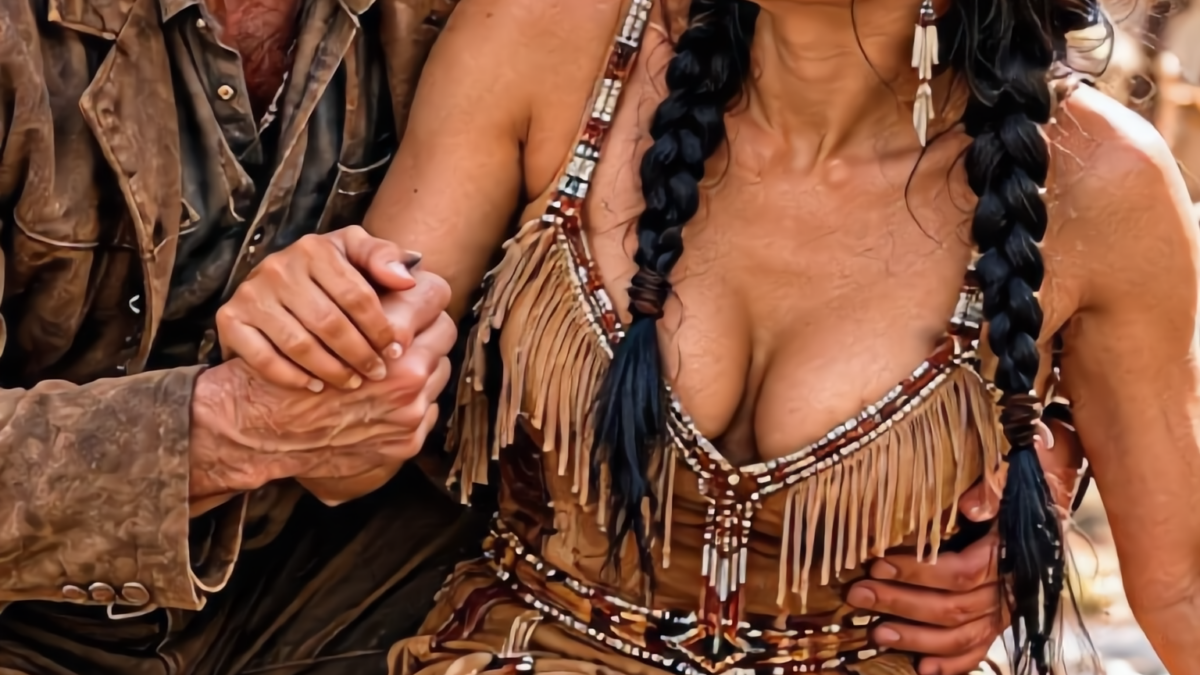
PART 1: The Fang and the Knife
The Dragoon Mountains had a way of killing you quietly. No warning, no ceremony. Just the sun bearing down on cracked earth and a silence between the rocks so long and deep it began to feel like a living thing.
Colt Bridger had ridden through enough of that silence to know better than to trust it.
He’d lost the heifer somewhere in the third arroyo west of his cabin, and he was following her trail toward a dry wash lined with pale cottonwoods when he heard it: a dry, papery rattle. Fast and urgent. Not the lazy warning of a sleepy snake. The sound of a diamondback already coiled and already certain.
Half a second later came a woman’s voice, short and sharp, bitten off at the end as if she were trying to hold the pain inside her teeth. Then the sound of something heavy hitting the ground.
He found her beneath the largest cottonwood, half sitting, half fallen against the roots. Apache, by her moccasins and the woven gathering bag spilled open beside her. The snake was gone. All that remained were two puncture marks just above the edge of her moccasin, already swelling dark against her skin.
Her right hand had cleared the sheath at her hip. The bone-handled knife was perfectly steady, pointed at him.
Whatever the venom was doing to her body, it hadn’t touched her eyes.
“Easy,” Colt said. He didn’t raise his hands. Raised hands meant panic, and panic was contagious. “I heard you go down. I’m not here for trouble. The snake’s gone. But what it left is still working. You’ve got maybe twenty minutes before that leg stops being useful.”
“I know what a snakebite is.” Her English was clean and deliberate, each word placed with precision.
“Then you know you need to stop moving it.”
She didn’t answer. But she didn’t lunge, either, which he took as permission. He crouched slowly to her eye level, keeping his hands visible.
“I have Army surgical training. I’m not going to cut you, or pour whiskey on it, or any of the other fool things scared men do to look useful. I’m going to wrap it to slow the spread, and get you to the cool clay at the spring near my cabin. But you have to let me touch the leg.”
The knife stayed up. “My sisters know where I am.”
“Good,” he said, and meant it. “If you’re not back by dark, they’ll come looking. That works in your favor. And mine, maybe, if it keeps you from doing something with that blade you’ll regret.”
Slowly, with the tension of a bowstring held at full draw, she let the knife angle down. Not sheathed. Just lowered. She would not pretend to trust him.
He respected that.
He folded his bandana into a firm band and wrapped it below her knee. Not a tourniquet. He’d seen men lose legs to tourniquets. Just steady, measured pressure. He talked as he worked, because patients did better when they understood what was happening to them.
“Moving it hard spreads the venom faster. Cutting just opens a road for infection. Whiskey thins the blood. Best thing you can do is stay still and stay calm.”
“I am calm,” she said through a jaw clenched so tight he could see the muscle working.
He glanced up. She was pale around the mouth, but she hadn’t made a sound since he’d touched the wound.
“Yes,” he said. “You are.”
The light had turned wrong. That brassy, filtered yellow that meant a dust squall was rolling in from the southwest. He helped her stand. She tried first on her own, and when the leg buckled, he stepped in and took her weight before she had to ask.
His cabin was low and rough, built against a sandstone shelf, and he got her inside just as the storm slammed into the canyon wall like a freight train. He closed the shutters, lit the oil lamp, and went to work by its amber light.
He packed cool spring clay around the bite, then bruised dried plantain leaves between his palms and layered them over it. Apache healers had used clay like this long before his Army surgeons had, and the surgeons smart enough to notice had started using it too.
“What do I call you?” she asked.
“Colt Bridger.”
A pause. “Talon.”
“The venom’s going to work on you a while yet, Talon. You’ll get chills. Maybe shaking. That’s not a personal failing. That’s just biology.” He set a wool blanket within her reach.
The shaking started an hour later, first a fine tremor in her hands, then her shoulders, until she was shivering hard with her jaw locked against her chattering teeth. He brought her hot broth. When it wasn’t enough, he took a second blanket and sat on the edge of the cot near her.
She went rigid.
“I’m not touching you,” he said quietly. “I’m just near you. That’s all this is.”
Slowly, reluctantly, the rigidity eased. She didn’t lean into him. But she didn’t pull away. He kept his eyes on the far wall, on his farrier’s hammers hanging in neat order beside the small surgical kit from his Army days, because she deserved not to be watched while her body fought.
Sometime in the night, her breathing deepened into real sleep.
He woke in his chair before dawn to the sound of movement.
Talon sat upright on the cot, staring at the workbench. At the tarnished brass cavalry ordnance pin he’d set there while mending his jacket collar.
He watched her look at it. He watched her pick up the knife.
She moved faster than he’d thought possible after what the venom had done. The blade pressed flat against his jugular. Her arm didn’t tremble at all.
Colt kept his hands on the armrests and said nothing for a long moment.
Then: “If that steel settles your blood feud, drive it home. But if you bleed out tonight from venom, your sisters lose their shield.”
Silence. Far down the wash, a coyote called.
She held the blade there long enough that he could feel his own pulse against its flat. She wasn’t deciding whether he was dangerous. She already knew men like him were dangerous. She was deciding something more complicated than that.
Finally, she lowered it. Not sheathed. Laid across her knee, within reach.
“The pin,” she said.
“I know what men wearing it have done,” he said. “And I wore it. I won’t pretend that makes me different from what you think I am. I’ll only tell you you’re alive, and your leg’s going to hold, and by morning you’ll walk out of here under your own power.”
“My sisters will come. They will not come gently.”
“I expect that too.”
He heard the horses before the sun cleared the ridge. Six of them, coming hard.
He could have barred the door. He could have gone out with his hands up and been shot mid-sentence. Instead, he stood in the center of the room, unbuckled his gun belt and left it hanging open. Not removed. That felt like theater. Just available, and deliberately unused.
The door came off its frame.
Two riflemen swept in first, then trackers with bows half drawn. Then a young girl with a permanent tilt to her gait who went straight to Talon’s side. And last, the one who already owned the room before she entered it: tall, lean, with an obsidian-tipped arrow drawn and aimed at the exact center of Colt’s forehead.
“Step away from her,” she said.
“I’m not near her,” Colt said. “I’ve been in this chair.”
“Step away from her.”
He took two steps sideways, putting more space between himself and the cot.
The girl, Keeley, he would learn, peeled back the wrap, studied the clay and plantain, pressed the swollen tissue and watched it respond. She studied the compression wrap’s placement for a long moment. Then she looked up at Colt with an expression that wasn’t friendly, but wasn’t without curiosity either.
“You were alone with her,” the archer said.
“She was snakebit, and a dust storm was coming.”
“There is always another option.”
“Yes,” Colt said. “I could have left her under the cottonwood. The venom would have decided for both of us before sunrise. I chose this one instead.”
“Chamalis.” Talon’s voice, clear and firm from the cot. “Look at me.”
The archer turned her head just enough.
“He did not touch my honor,” Talon said, each word dropped like a stone. “He pulled the fangs out of my blood.”
Chamalis held the draw for three more seconds. Then she let the bow down. Not at ease. But no longer aimed at his skull.
She walked the cabin slowly, reading it the way a tracker reads ground. She stopped at the workbench and picked up the pin.
“You shot horses for the bluecoats.”
“I was a farrier and a combat sapper. Eight years.”
“You shod the horses that carried soldiers into Apache camps.”
He let that sit in the air without rushing past it. “Yes.”
“Eight years,” she said.
“I left after Cibecue Creek,” Colt said plainly. “What I saw there. I left.”
She set the pin down in precisely the spot she’d lifted it from. Talon stood then, slowly, testing her weight on the wrapped ankle, and something passed between the sisters, the compressed language of people who had known each other since before they knew anything else. Talon gave one small nod.
Chamalis turned back to Colt.
“No man who shod horses for the bluecoats walks with clean hands,” she said. “You want to claim a place beside my sister? Ride with us to Cliff Camp. Pass three ancient trials, or leave her forever.” Her eyes didn’t blink. “Fail, and your bones stay in the dirt.”
Colt looked at Talon. Her face gave him almost nothing, which was its own kind of answer.
He unclipped his gun belt the rest of the way and laid it on the workbench beside the pin. Not as a performance. The way you set something down when you’re finished carrying it for a while.
“All right,” he said.
They climbed all morning: up through the lower canyon, over loose shale switchbacks, along a rim-rock shelf with two hundred feet of air on one side. Cliff Camp appeared at the top without ceremony, built into a wide terrace beneath a stone overhang so perfectly that its sandstone and adobe walls looked grown rather than built. Garden plots stepped down the slope in careful terraces.
The stone water channel that should have fed them was bone dry.
Colt looked at the blast pattern in the shale above the channel’s inlet, that spider-crack radiation spreading from inside the rock. Military sappers set charges against a surface. Whoever had done this had packed the dynamite inside the stone for maximum debris. Paid men. Mercenaries.
He filed it away.
Before the council, Talon led him alone into a sheltered courtyard deep beneath the overhang. An ancient woman sat on a sandstone ledge, her eyes clouded fully white with cataracts. Blind Makia. Her hands, folded in her lap, were long and articulate, the joints swollen from eighty years of work.
“Do not try to be something you are not,” Talon had warned him. “She reads hands more clearly than most people read faces.”
Colt crouched and laid his hands palm up in the old woman’s lap.
Her fingers moved over them slowly, like a cartographer reading a map. They paused at the silver burn scar across his right knuckles. They found the farrier’s calluses at the base of his fingers. Then the smoother, precise callusing along his thumb and forefinger, the mark of surgical instruments. The crooked old break in his left hand.
She spoke, and a young woman translated.
“The hands of a forge man. Also the hands of a healer. Both fires live in the same skin. She asks if you know what it means to carry both.”
Colt thought about it, because it deserved thought.
“I know that one without the other gets people killed. A man who can only build can build things that destroy. A man who can only heal doesn’t know how to keep what he heals from being broken again. I’ve spent a long time figuring out which one I was. I think the answer is both, and I’m still working out what to do with that.”
Makia smiled, small and dry.
“She says stupid men give her brave answers,” the translator said. “Clever men give her humble ones. Honest men give her complicated ones. She will allow the trials. She says the pin was the government’s mark. The hands are your own. She will judge the hands.”
At dusk, the council gathered around a fire of resinous juniper on the open terrace. Colt sat at its near edge in full view of everyone. Chamalis stood across from him and spoke the three decrees slowly, holding each one as if it had physical weight.
“The Trial of Earth and Sweat: restore what violence broke, without raising a weapon.”
Colt thought of the dry channel.
“The Trial of Truth and Ember: stand before the council fire and bear your past, without excuses.”
His jaw tightened. He kept his face still.
“The Trial of the Red Strand: stand between the family and annihilation, when the hammer falls.”
The last decree hung in the smoke above the flames.
“When does the hammer fall?” Colt asked.
Chamalis looked at him with a flatness that wasn’t cruelty. Only truth.
“When it falls.”
An elder asked why a bluecoat farrier would accept such terms. Colt told him the truth: that Talon had held a blade to his throat and lowered it, not because she’d been overpowered, but because she’d decided the moment was more complicated than the blade. And that the channel had been blown with mercenary dynamite, by someone paid to make this camp unable to survive the summer.
“I know how to fix it,” he said. “And the people who broke it are still out there. With more dynamite. And a reason to use it.”
That night they made him sleep outside the camp perimeter against a sandstone outcrop. He lay looking up at the dense, low stars, thinking about what Makia had seen in his hands.
And far below the rim, a single night hawk cut across the dark, and the canyon walls answered with an echo.
Somewhere out there, the people who’d dynamited the channel were deciding when to come back.
PART 2: Water, Truth, and Fire
Keeley found him at dawn with a bowl of hot cornmeal. She didn’t talk much. She sat cross-legged, pulled out a piece of charcoal and a flat stone, and drew.
It was a cross-section of the entire water system: inlet, channel, sluice gates, terrace drops. And diagonal lines branching across the upper wall. Fault lines in the shale.
She placed a smooth pebble at the inlet and tilted the stone. It rolled down the channel to the second gate and stopped. She reset it, laid her thumb across the line just before that gate, and let it roll again. It stopped at her thumb.
She was showing him exactly where the clay seal needed to go. She’d already worked out the problem before he’d asked.
“I’m going to need you at the inlet,” Colt said. “If I set the anchors wrong, we’ll hold the water through summer and blow the whole gate out in the first autumn flood.”
She tucked the stone back into her bag and stood. That was agreement.
They cleared rubble all morning in the blistering heat, Colt working a pry bar on the boulders while two camp men broke up the compacted gravel. Keeley sat at the top of the shale face with her palm pressed flat against the rock, reading it like a pulse. Suddenly she made a sharp sound. Everyone stopped. She pointed to one section of the left wall and shook her head. Colt pressed his hand there and felt the faint wrong resonance of a hollow behind it.
“We don’t work under that section,” he said.
He cleaned the old stone forge at the back of the camp, lit it properly so the lining wouldn’t crack, and forged eight oversized iron keystones with shouldered collars that would seat against the stone itself rather than relying on the blast-loosened mortar. Keeley sat watching the iron change color under his hammer.
“My grandfather’s grandfather cut this inlet from solid rock with iron and antler,” Talon said from the alcove doorway, favoring her ankle.
“It’s good work,” Colt said, and meant it.
They sealed the cracked channel floor with fresh clay. They set the keystones. Then Colt climbed to the spring and pulled the stone plug.
A dark trickle. Then more. Then a steady rush of cold mountain water racing over the new clay floor, through the first gate, down into the first garden plot, where soil that had been dry for weeks began to darken around the roots.
From the lower terrace, people made a sound.
Chamalis walked to the sandstone wall where three charcoal tallies had been drawn. She scraped her knife across the first one. It vanished in a curl of dust. She sheathed her blade and walked away without a word.
Keeley handed Colt a wooden bowl of water drawn from the newly running cistern. It was cold and mineral-bright, and it tasted like the mountain.
The second trial came at midnight, when the fire was the only light in the world.
“A full accounting,” Chamalis said. “Not a summary. Not a soldier’s report. You will not choose which parts to give.”
“I enlisted in 1873 at Fort Grant,” Colt said. “I was twenty-two. I told myself it was for my country. Mostly it was work. I was a farrier. After two years, they added demolition duty. Bridges. Supply routes.”
An elder spoke. Name what you destroyed.
“An adobe compound outside Tucson.” He paused. “Two wells. Tonto Basin, ‘77. The order was to deny water to people moving through the area.”
The fire cracked.
“Did you question the order?”
“In my mind. Out loud, no. I thought it was wrong. I set the charge and lit the fuse anyway.” He kept his hands still on his knees. “I was also afraid. If I refused one order, I’d have to decide about all of them. It’s easier to keep moving forward than to stop and look at what you’re standing in.”
An old woman asked about Cibecue Creek.
“August of this year,” Colt said. “It was a medicine man’s ceremony. There were families there. It was classified as hostile.” He looked into the fire. “I wasn’t on the ground. I was at the anvil at Fort Apache. I’ve spent more time than I can measure deciding whether that makes it better or worse. I shod the horses that went there. I knew where they were going and what they’d do. I didn’t refuse. I didn’t report it. I kept my head down.” He swallowed. “Silence in the face of slaughter is slaughter itself.”
No one moved.
“I handed in my commission within the month,” he finished. “I’ve been drifting ever since. Running, maybe. Or trying to figure out what a man does after he’s been part of something he can’t put back.”
From the edge of the ring, Blind Makia spoke. “She says a man who carries guilt without putting it down builds a wall from it. Has he put it down, or is he still building?”
“Both,” Colt said honestly. “I don’t think a man ever fully puts it down. I think the honest version is you stop letting it run the whole show.”
Makia made a small, private sound. “She says that is still an honest answer.”
Chamalis walked to the wall and scraped away the second tally.
Colt sat by the dying coals long after everyone had gone. Then light, slightly uneven footsteps came around the fire, and Talon sat down. Not across from him. Beside him.
She set a clay pot between them. “Yarrow and pine resin. For your palms.”
He held out his blistered right hand. She worked the salve into it methodically, not performing gentleness she didn’t feel and not withholding what she did. She traced the burn scar on his knuckles with her thumb, as if memorizing it. Then her fingertips moved toward the old powder burn below his jaw, slowly enough that he could pull away.
He didn’t.
He went perfectly still under her touch, a hard man who had built walls from guilt and long habit, and didn’t know what to do with the feeling of being seen.
She looked up at him then, her eyes dark and direct.
“We do not ask for a white man without sin,” she said. “We ask for a man who bleeds when his brothers commit it.”
Neither of them said anything after that. They didn’t need to.
The next afternoon, Talon took him to the eastern rim. Below, in the wide valley, sat four or five raw silver mines with timber head frames, wagon roads cutting toward the boomtown of Copper Creek, and at the town’s edge, the half-built timber frame of a gallows.
“Three years ago, none of this was here,” she said. “Six months after the first shaft, the raids began. Horses taken. Gardens burned. The dynamited channel was the third deliberate act in eight months. A federal land commission arrives next month to survey the claims.”
“And by then,” Colt said, “you’re supposed to be gone.”
“Yes. The man who owns those mines is called Thorne. A former colonel.”
“Then he moves before the commission arrives.”
“We believe so,” she said quietly. “Which means the third trial will not be a ceremony.”
He woke before the first shot, to a change in the night that eight years of campaigning had taught him to read.
Then the Henry rifles opened up from the timber below, disciplined and overlapping. The outer brush caught fire too fast and too hot, and the smell that reached him a moment later made every muscle in his body recognize it.
Phosphorus incendiaries.
The camp moved like people who had drilled for this and prayed they’d never need to. Women pulled children toward the cave network in the rock wall. Chamalis appeared out of the smoke and threw him his gun belt without breaking stride.
Then he saw Keeley, frozen in the firelight at the edge of the garden terrace with her bag on her shoulder, trying to reach the caves across open ground the southern rifles were covering.
He reached her in the time it took a rifle to cycle. He put himself between her and the gunfire and pushed her forward. “Cave network. Go.”
They were almost at the rear wall when the bullet hit him high in the left side, below the ribs. The impact knocked the air out of him and spun him. The pain came half a second later, like thunder following lightning.
He shoved Keeley toward the passage. “Inside. Now.”
She hesitated for one second, staring at the stain spreading across his shirt. Then she ran.
Colt staggered toward the sound of Chamalis’s voice at the rim. Thirty feet. Then his left leg decided it was done, and he pitched off the edge of the rim rock and down a slope of broken stone, rolling, hitting, falling, until he landed face down in the wet mud of the creek bed below. The same spring water he’d restored was running beneath him now, carrying his blood.
He pushed himself up halfway. Above him, through the smoke and orange firelight, he heard a man’s voice carrying down the canyon wall, sharp and certain.
Then Talon’s voice. Not commanding. Fighting. Resisting being moved.
He saw mounted figures on the rim, turning east. One of them was not sitting her horse willingly.
And the man’s voice rang out again, clear as a bell:
“Tie her off. She hangs at dawn in the Copper Creek square, to show every squatter who owns this basin.”
Colt drove his arms into the mud with everything he had left. He got to his knees. He got one foot under him. He stood for three full seconds.
Then the creek bed rose up to meet him, and the burning ridge above went dim, and the last thought his mind produced before the dark closed over him was this:
She was alive on that horse. Dead is the end of it. Alive is a problem that can still be worked.
PART 3: The Red Strand
Chamalis found the first drop of blood on the terrace stone twenty minutes after the mercenaries withdrew. Keeley, who had watched everything from the mouth of the cave, led her straight down to the creek bed.
On the terrace, by torchlight, Keeley worked for twenty minutes with a thin knife and bone tweezers while Colt bit down on an old piece of saddle leather so hard it creased. The rifle ball had struck a lower rib and stopped against it rather than passing through. The one piece of luck in the whole night. Keeley drew out the flattened lead, cleaned the wound, packed it with pine resin and yarrow, and bound it tight. Her hands never shook.
When Colt could breathe again, he looked at Chamalis.
“She’s in Copper Creek. Dawn. That’s four hours.”
“You took a rifle ball six hours ago.”
“I know where I took it.” He got Keeley’s help to sit up. He drank the willow bark tea she handed him without asking what it was. Then he looked Chamalis straight in the eye.
“String your bow. My blood runs the same red as Talon’s. Our war isn’t skin against skin. It’s against the bastards who think human lives are cheaper than the silver veins under this dirt.”
Chamalis looked at him for a long time, the way she had at the cabin, at the council fire, over the sluice gates. Checking whether what she saw held up under different light.
She picked up her bow and slung her quiver over her shoulder.
Before he mounted, Keeley pressed a small clay pot of pine resin into his hand and touched her own left side with a firm, flat gesture: don’t let it open.
Copper Creek smelled of sulfur and money. The smelter ran all night.
Chamalis climbed the water tower with her arrows. Colt slipped over the smelter-yard fence and found the kerosene supply lines running along the shared adobe wall toward the assay building, a dangerous shortcut someone had taken because it was convenient. Working mostly one-handed, he seated a short length of detonating cord at a pipe joint, packed it with clay, and ran eight minutes of slow fuse back into the shadow of the ore bins.
That was where he found the crates.
Fourteen of them, stamped with federal seals. Inside, beneath canvas, were not silver ingots but documents: payroll ledgers, survey authorizations on the Land Commission’s own letterhead, forged reports of “Apache massacres” with fake military signatures. Thorne’s entire legal cover for clearing the valley before the real commission arrived. And every page of it was evidence against him.
Colt closed the lid. Talon first.
He lit the fuse. Then he broke the hasp off the holding-cell door on the assay building with two blows of his farrier’s sledge.
Talon was standing against the far wall, her wrists bound in front of her with leather cord, her eyes already adjusted to the dark. She looked at him and something passed across her face, then settled into a controlled steadiness that was entirely her.
“You look terrible,” she said.
“I’ve been told.”
He cut the cord in two strokes with the small blade Keeley had packed.
Outside, the fuse reached the kerosene line. The explosion was loud and bright and almost entirely contained, exactly as a good sapper intends, and it drew every guard in the yard toward the burning wall while Colt, Talon, and Chamalis slipped over the fence into the dark. Chamalis’s trackers loaded all fourteen crates onto the horses in rope nets while the town was still fighting the fire.
Thorne was faster than they’d hoped. Two miles out, the trackers spotted torches: eight riders in disciplined pursuit.
“Gallows Gorge,” Colt said. “The suspension bridge. Single file on both ends. His numbers don’t help him there.”
They crossed the swaying cable-and-plank bridge one horse at a time, two hundred feet of granite darkness below. The crates went over first. They’d barely gotten the last horse across when Thorne arrived at the far side.
He dismounted and walked the bridge alone, a big man with a cavalry saber at his hip.
Chamalis raised her bow.
“Wait,” Colt said. “If he falls on the bridge, it goes.”
“And the crates go with it,” Talon said quietly.
Thorne stepped off onto their ledge. “Third Regiment. Farrier-sapper,” he said. “Do you know what they call a man who turns on his own kind, Bridger?”
“I spent eight years trying to work out what my own kind meant,” Colt said. “I don’t think it means what you think.”
Thorne swung the saber in a wide arc. Colt stepped back. The second swing came faster, and Colt threw up his left arm to deflect the flat of the blade, and the impact went straight into his wound and lit his whole body white with pain.
So he did the only thing left. He grabbed the blade with his bare right hand.
The edge bit into his palm. He held on anyway, locked his elbow, planted his feet on the stone like an anvil, and refused to let it move.
“You’re a traitor to your own blood,” Thorne snarled, inches from his face.
Across the gorge, Talon had slipped along the rim to a Winchester one of Thorne’s men had left propped against the bridge’s anchor post. She couldn’t shoot Thorne with Colt that close. So she aimed at the iron anchor pin instead and fired.
The pin sheared. The bridge didn’t fall. It rolled, corkscrewing violently down its full length with a crack like twenty rifle shots, then slammed against the canyon wall below, hanging from the far anchor. The shock ran through the ledge like an earthquake.
Thorne’s footing slipped. Colt drove his weight into the trapped blade. Thorne lost the saber into the gorge and went over the edge, catching himself eight feet down the rock face, clinging there with nothing above him but the rim.
Talon and Chamalis hauled Colt back from the edge. Talon pressed her sleeve against his bleeding hand and checked him over with the same rapid, clinical attention she’d seen him give her.
Across the gorge, Thorne’s men stared at the empty space where the bridge had been and turned their horses away.
Chamalis looked down at Thorne for a long moment. Then she lay flat on the rim and reached her strong bow arm down the rock.
Thorne looked at her hand. Then he took it.
She pulled him up onto the stone, and he lay on his back staring at the dawn sky with nothing left in him at all. He didn’t fight when they bound his wrists.
Colt drafted the evidence submission himself, at a terrace table in Cliff Camp, because eight years inside the machinery had taught him exactly how federal intake worked: what a commission was obligated to act on, and what it could quietly ignore if the paperwork gave it room. Chamalis built the timeline linking every attack on the camp to dated payments in Thorne’s own ledgers. Talon testified at two meetings with the commission’s humorless, meticulous lead surveyor, Aldrich, reciting every date from her clan’s oral memory without notes.
“Knowing how the machinery runs,” Talon told Colt, “is only useful if you point it somewhere worth pointing.”
Three weeks later, Aldrich issued a non-interference accord protecting the valley, on federal record. It wasn’t perfect.
“It’s enough,” Talon said.
On the morning they finished the submission, Chamalis walked to the sandstone wall. The whole camp gathered without being asked.
She looked at the last tally. Then at Colt. She scraped it away.
She wiped her blade and held out her hand. He took it. She held the grip for three solid seconds.
“Sik’is,” she said.
“Brother,” Talon translated softly.
Chamalis turned and walked back to her watch on the rim, finished with the moment because the moment was finished.
Talon held out a twelve-inch braid of yucca fiber dyed deep red, with a loop at each end. She didn’t explain it. Colt held out his scarred right wrist. She tied one end around it with a flat, clean knot. Then she tied the other end around her own.
He didn’t have the words. He wisely didn’t try to find them. He turned his palm up. She turned hers down. Their fingers found each other in the space between.
They built a low sandstone post at the mouth of the valley in late summer: one room for Colt’s anvil and tools, one for the apothecary shelves Keeley arranged with fierce precision, delivering her instructions through pointing and one very expressive look whenever Colt put a pot in the wrong place. He learned to move them.
On the day they finished, they sat on its porch and watched rain sweep across the desert valley in a long gray curtain, the dry earth drinking it in.
“What happens when the next Thorne comes?” Talon asked. Not bleak. Practical.
“We’ll be here,” Colt said. “Knowing how it runs. Both of us.” He paused. “And Chamalis on the rim with her arrows.”
“Keeley wants a better window in the back room.”
“She told me. With one of her looks.”
“You’re learning to read them.”
The red strand on his wrist darkened in the rain. He thought about wells and black powder and Cibecue Creek. He wasn’t going to put it all down. Makia had been right. But he’d stopped letting it run the whole show. It had become one stone among many in the wall, no longer the whole weight.
He was here. He had somewhere to be. He had people who had looked at everything he was, with their eyes wide open, and made their choice.
High in the mountains, the water was still running through the channel they had cleared together.
The rain came down. Neither of them said a word. They didn’t need to.








