A Cowboy Rode In to Collect a $60 Debt and Was Offered an Apache Woman Instead. He Had No Idea She Was a Chief’s Daughter
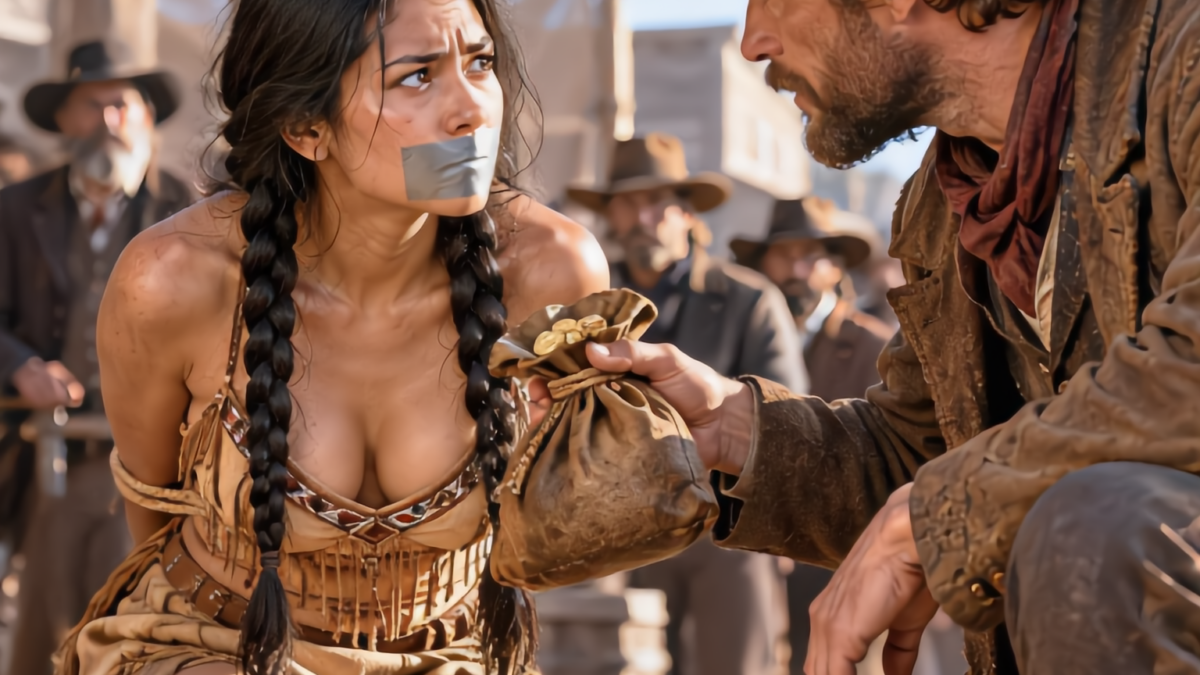
PART 1: Payment Refused
The trading post smelled of dried leather, old tobacco, and something else Caleb couldn’t quite name. Rot, maybe. Or desperation. Out here, it was hard to tell the difference.
He’d ridden six hours through the August sun to collect sixty dollars for a horse-supply order Fletcher Dunn had promised to settle three weeks earlier. He was not in the mood for conversation.
Fletcher stood behind the counter looking like a man waiting for bad news he already knew was coming.
“You got my money?”
The silence that followed was too long. Caleb had played enough poker to know what that kind of silence meant.
“I got something better than money,” Fletcher said.
“Nobody who owes money ever says that and means it.”
Fletcher poured two drinks without asking. Caleb didn’t touch his.
“There’s a woman,” Fletcher began.
“No.”
“You haven’t heard—”
“There’s a woman, Fletcher. That’s already the answer.”
Fletcher pushed the glass closer, as if that might help. It didn’t. “She came through with some traders from down south. They owed me. Said they’d call it even if I took her off their hands. I wasn’t going to do anything with her, I swear it. But I can’t keep her. Men have already come around asking questions. Bad men. The kind that ride in groups.” He swallowed. “I thought you could take her. Call the sixty dollars paid.”
Caleb set the glass down slowly.
“You want to give me a human being in exchange for sixty dollars.”
“It’s not like that.”
“Then what’s it like?”
Fletcher had no answer, because there wasn’t one.
Caleb opened the back door expecting tears, or fear, or someone curled in a corner trying to make herself small.
Instead, he found a young Apache woman sitting on a crate with her back perfectly straight. Her eyes tracked him before he’d even finished opening the door. Her dark hair was pulled back, her jaw set like someone who had recently made a decision and wasn’t changing it. She had already sized him up and was waiting to see if he would disappoint her.
“I’m Caleb Whitmore,” he said.
“I know.” Her voice was level, without a waver. “I heard everything through the wall.”
He respected that. “Then you know what Fletcher suggested. I want you to know I’m not going to do it. No person is payment for anything. That’s not something I’m willing to debate.”
Something in her expression shifted. Not relief. More like recalibration.
“My name is Ayana Red Feather.”
“Are you hurt, Ayana?”
“No.”
“Do you have somewhere you can go?”
She paused just long enough that he had his answer before she gave it. “That is more complicated. The men who delivered me told Fletcher I’d wandered away from my camp and they were returning me.” Her tone made her opinion of that clear. “I did not wander. I was taken. By men working for Silas Crow.”
Caleb knew the name. Everyone in Arizona Territory did. Silas Crow ran mines, owned half the contracts on the southern trade routes, and had a habit of making problems disappear before anyone could discuss them publicly.
“If you involve yourself,” Ayana said, “you’re putting yourself in his path.”
“I know who Silas Crow is.”
“Then you know what that means.”
“I do. I’m asking anyway.”
She studied him in silence. “There are already men searching for me. Four that I counted. They came through yesterday. They’ll be back.”
Caleb picked up his hat. “My ranch is about five miles northeast. It’s not much, but it’s set back from the main road.”
“Why are you offering?”
He answered honestly, because she deserved the honest answer and not the convenient one. “Because leaving you here is wrong. And those men will be back before dark.”
“You understand I won’t stay anywhere I’m not free to leave.”
“I’m not in the business of keeping people against their will. You can go the moment you want to. I just need you somewhere safer than this for now.”
The quiet that followed was different from Fletcher’s stalling silence. This was the silence of a person thinking carefully.
“I’ll come,” she said finally. “For now.”
She rode without complaint, which told him she’d spent most of her life on horseback. Once, she glanced at him sideways. “You’re checking the ridgeline. Counting positions. That’s military.”
“I worked as a guide a while back,” he said. She didn’t push.
When they rode up to his ranch, a plain, solid house and a barn that needed paint, she looked at the three horses grazing in the pasture.
“The gray one is in pain,” she said.
Caleb looked. “She looks fine to me.”
“She’s favoring her left front. Not badly yet. But she will be.”
Ayana slid off her horse before he’d even stopped and walked to the fence. She rested her hand on the top rail and waited, and the gray mare walked straight over to her, slow and easy, as if it already knew her. Ayana spoke to it in a low, rhythmic murmur, and the horse dropped its head.
When Caleb checked the hoof that evening, he found a stone wedged under the shoe exactly where she’d said it would be. He had walked past that animal twice that day without noticing. It shamed him a little.
He cleared out his storage room for her and set up an old cot by the window. She stood in the doorway watching him work. She wasn’t refusing to help. She was watching how he worked.
“There’s water in the bucket outside,” he said. “I’ll heat some if you want to wash the road off.”
She looked at him a moment. “Thank you.”
It was the first time she’d said it, and she said it like she meant it.
Over a supper of cornbread, beans, and salt pork that he knew wasn’t impressive, she told him more.
Silas Crow had been pushing into Apache land for two years, claiming agreements gave him the right. “Some of those agreements were made under conditions that were not honest,” she said. “My father has been fighting those claims. Building support among other leaders, territorial officials, people in the government who’ve actually read the documents.”
“What happened to your father?”
She looked down at the table, just for a second. “He disappeared three months ago.”
“I’m sorry.”
“He may still be alive.” Her expression closed, like a door shut against weather rather than against a person. “Silas told his men to bring him an Apache woman from the north camp as a bargaining chip. I was simply the first one they found. They don’t know who I am. If Silas figures it out, things will get significantly worse.”
“How long before he figures it out?”
“Days,” she said. “Maybe less.”
When she rose, she carried her own plate to the wash basin without being asked. Small things, Caleb thought, told you more than big speeches.
“Caleb.” It was the first time she’d said his name. “I chose to come here. I had choices. I’m not staying because I need to be taken care of.”
“I know that.”
“Good. As long as we understand each other.”
He heard the bolt slide home on her door. He checked his rifle and leaned it against the wall where he could reach it in the dark.
At dawn, four riders appeared on the road. One turned up the drive: young, hard-eyed, with a practiced smile that didn’t reach his eyes.
“We’re looking for an Apache woman. She wandered from her camp. Her family’s worried.”
“Haven’t seen anyone matching that,” Caleb said.
The rider held his gaze a beat too long. Then he touched his hat brim and rode away.
When Caleb walked down to the fence line afterward, he found something carved into his property-line post. A symbol, cut clean and recent. The wood shavings at its base were still fresh.
Ayana crouched beside it later without touching it. “A warning mark. From my people. It means eyes are here. Someone knows I’m in this area and wants me to know I’m not alone.” She looked toward the eastern hills. “It also means I was followed. And Silas’s people can follow the same trail.”
That afternoon, by the creek, Caleb found two sets of boot prints in the soft mud. One small and light. One heavy, its toes pressed deep, as if someone had stood leaning forward, watching his house.
“The smaller one is my people,” Ayana said. “The larger one is someone following them.”
“So Silas has someone watching whoever’s watching you.”
“Silas is careful. He didn’t build what he built by being obvious.”
She refused to stay without working. “I’m not going to take without giving,” she said. “That’s not who I am.”
So she reset the gray mare’s shoe with a patience that was almost uncomfortable to watch, working at the horse’s pace instead of her own. “My uncle said a horse that trusts you will do anything for you. A horse that fears you will do nothing when it matters,” she told him. “He said the same was true of people.”
“Was he right?”
She finally looked up. “You tell me.”
She told him his other two horses were too thin for summer heat. He adjusted their feed. Then, on Thursday morning, the bay went down in the pasture, sweating, eyes rolling white, one foreleg bent wrong.
Caleb’s stomach dropped. A broken leg meant only one thing out here.
Ayana knelt and ran her hands over the animal. “It’s not broken. That leg’s been bent since birth. His gut is working too hard. When did you change his feed?”
He told her. He’d added more grain all at once.
“Too much change, too fast,” she said, without accusation. “He’s bloated. That’s what took him down.”
She worked for three hours with rope, warm water, and dried leaves from a bundle she’d carried in, keeping him calm with a low, continuous voice. Caleb handed her what she asked for and stayed out of her way. By the end of it, the bay was standing.
“He would have died,” Caleb said.
“Probably. Bloat kills horses. You have to move fast and know what you’re doing.”
“I wouldn’t have known.”
“No,” she said. “But you know more now than you did this morning.” She dried her hands. “Everything I know about healing came from someone paying attention.”
That afternoon on the porch, while she wove a gentler hobble for the bay from strips of leather, she said quietly, “My father always said most disasters are just small things nobody looked at closely enough.”
“What’s his name?”
She met his eyes. She’d decided to say it, and she didn’t walk it back.
“Chief Thomas Red Feather.”
Caleb set down the bridle he’d been mending.
He knew the name. Everyone did. The chief who had fought land claims through official channels for years. The man powerful people found extraordinarily inconvenient. The man who’d vanished three months ago, whose disappearance had been reported once and then quietly never discussed again.
“You didn’t tell me.”
“I needed to know if you were the kind of man who would help Ayana,” she said, “not the kind who would help the chief’s daughter. Those are different things.”
He thought about it for a long time. “That’s a fair test.”
“You helped Ayana. So now you know the rest.”
That evening, she laid three sheets of paper on her cot. She’d carried them hidden in her coat lining the whole time.
“My father sent me these two weeks before he disappeared.”
A summary of land agreements with dates that couldn’t possibly be true. A list of territorial officials. A map of contested boundaries, marked C. Cole.
Caleb read the list of names slowly. Then he stopped on one.
“I know this man,” he said. “I did work for him. I guided two survey teams through the northern corridor. I thought they were mapping a trade road.”
Ayana went very still. “That’s my father’s people’s land.”
“I know that now. I didn’t ask enough questions then.”
There was no comfortable way to say it, and no version of the truth that made it easier.
She folded the papers with great care. “I need to think,” she said.
He sat alone in his dark kitchen for a long time without lighting the lamp. He heard her bolt slide shut.
In the morning, she stood at the window with her coffee. “My father says judging a man’s whole life by his worst choice is as unfair as judging it by his best one. The question isn’t what a person did. It’s what they did next.” She turned. “What did you do next, Caleb?”
“I walked away. Refused the next job. Tried twice to report what I suspected, but I didn’t know enough to make anyone listen. And I’ve spent three years on this ranch knowing I probably helped someone take something that wasn’t theirs.”
She studied him a long moment. “What you did next matters more to me than what you did before. And what you’re doing now is what I see.”
“I won’t waste it,” he said.
Then they both heard it: horses on the road. Caleb went to the window. Two riders, heading south, not slowing.
“Not them,” Ayana said.
He let out his breath and turned back toward the table.
A folded sheet of paper lay there. It had not been there when he went to bed.
He picked it up. A single line, in a hand he didn’t recognize. No signature.
She is the chief’s daughter. Crow knows. You have two days.
PART 2: The Exit He Never Took
“He found out,” Ayana said quietly.
“Then we have two days to find Emmett Cole.”
Cole was the careful, white-haired lawyer on Red Hollow’s north side, the C. Cole on her father’s map. Caleb slipped into the back room of the hardware store where Cole took his coffee, and handed him a cloth holding three lines Ayana had written.
Cole read them without his face changing. “Thomas sent word his daughter might need to move quickly. Said she’d find someone trustworthy.” He glanced at Caleb. “I see she has.”
The original documents were secure, Cole said, with copies in two locations. And Chief Red Feather had not been working alone. A federal land inspector named Grayson, out of Santa Fe, had been quietly building his own fraud case against Silas for eight months.
“Thomas also knew about your survey work,” Cole added. “His documentation makes clear the guide left the operation early and tried to report his concerns. Thomas didn’t blame people for the system they operated in. He blamed the men who built it.”
Something in Caleb’s chest loosened that he hadn’t known was tight.
Cole slid two more things across the table: a sealed envelope with Grayson’s contact, and a folded paper. “This came to me two weeks after Thomas vanished. A location where he might be found. Tell her that her father’s work is not undone. It’s unfinished. There’s a difference.”
When Ayana unfolded the paper at the kitchen table, her lips pressed tight. “I know this hand. Someone close to him.”
They rode before dawn into the high country. A violent mountain storm caught them on an exposed ridge, and Ayana led them off the trail from twelve-year-old memory to a wedge of leaning granite her father used to camp beneath. Below them, through the rain, they heard a cry and found a young couple whose horse had thrown them. Caleb carried the injured husband up the slope. Ayana bound the gash on his head and told his frightened wife to keep him awake, the way her grandmother once kept her uncle awake all night.
Afterward, standing at the edge of the overhang watching the storm thin, Caleb said, “Whatever we find up there, I’m not going to disappear when it gets difficult. I know my history in this. I know trust doesn’t come free. But I intend to prove it.”
“I know,” she said.
“You know?”
“I’ve known for a few days.” She looked back at the mountains. “I was being slow about saying it.”
At the top of the second ridge stood an old roofless stone camp. Ash in the fire pit, still crumbling. A strip of cloth tied to a notch at a precise height. And scratched into the stone floor, a series of marks Ayana crouched over for a long time.
“His hand,” she breathed. “He was here six days ago. He went north.” Her voice was steady, but her hands weren’t. “He’s alive. He’s hiding. But he’s alive.”
Further on, another marker told her more: her father had already made contact with Grayson’s people. He was moving toward the end of this.
“Then we need to be close too,” Caleb said.
They saw the smoke on the way home.
Half his barn was scorched. The south pasture fence had been cut. All three of his horses were gone. Ayana read the tracks. “Four riders. They didn’t burn the house. That was deliberate. Silas wants you reachable. He wants to talk before he finishes this.”
Caleb stood in the yard and felt the specific anger that comes when someone reaches into what you’ve built and breaks it just to show you they can.
“The cost of staying is real,” Ayana said. “I want you to see it with your eyes open.”
“My eyes have been open since the day I went to collect sixty dollars.”
“There’s one way out,” she said. “We expose him. Publicly. Before he finds my father.”
In Red Hollow, men looked away from Caleb in the street. Silas’s notices were pinned at the land office, the courier station, and the saloon, warning about individuals interfering with legitimate territorial business.
“He’s building the public story first,” Cole warned. “And Deputy Marshal Lester, who’s had Silas’s money in his pocket for years, has a warrant for you. Fraud. The dates are fabricated, but a warrant is a warrant. Leave now.”
Lester came at dawn anyway, with four riders. Caleb read the warrant on the porch. The survey dates were off by two months, conveniently placed after an agreement that made Silas look legitimate.
“I’ll come,” Caleb said. “I want it on record these dates are fabricated.”
He went inside for his coat and used his thirty seconds at Ayana’s door. “Our contact arrives by midday. Get to Grayson.”
“Don’t say anything in that jail they can use,” she said.
“I know how to stay quiet.”
“I know you do. I’ll find a way to reach you.”
In his cell, Caleb thought about the tin box hidden beneath the storage room floor: every job, every date, every route he’d ever worked, logged out of old habit. Ayana had been sleeping six feet above the proof of his innocence and didn’t know it.
At mid-morning, a man in a neat jacket named Garrett sat outside the bars. “Mr. Crow is a reasonable man. The warrant disappears. Your barn is compensated. You go back to your life.” He folded his hands. “In exchange for the woman’s location. She isn’t your family, Mr. Whitmore. You met her two weeks ago.”
“Get out,” Caleb said.
“Mr. Whitmore—”
“I heard what you said. Get out.”
That afternoon, Ayana appeared for four seconds in the office window and held up two fingers. Two hours.
Forty minutes later, someone else sat in the chair outside his cell: Thomas Vega, who had run the livery in Red Hollow for fifteen years and had worked Silas’s horses for eight of them.
“I’ve known for five of those eight years that what he was doing wasn’t right,” Vega said quietly. “Three weeks ago a frightened girl from the northern camp came through my livery and tried to tell me something, and one of Silas’s men put his hand on her shoulder before she could finish. I’ve got a daughter. She’s twelve.” He looked up. “I know where Silas keeps the real books. Every payment. Every official. Tonight before midnight, he’s sending them north to Prescott. Once they get there, they disappear for good.”
He held up the key Lester kept on an unguarded hook. “I’m not a brave man. I need to know this leads somewhere.”
“Those books would finish a federal case eight months in the making,” Caleb said.
Vega unlocked the cell. “Your horses are at my livery. All three. Go out the back.”
Ayana waited at the end of the alley. “Vega,” she said. Not a question. “Our contact flagged him weeks ago as someone ready to choose a side.”
Caleb told her about the books, about Silas being at his camp that night to oversee the transfer.
“Then we don’t intercept on the road,” she said, already thinking. “We go to the camp.”
He stopped her. “When Garrett came to the jail, he offered to make the warrant go away for your location. I told him to get out.”
“I know,” she said. “Vega heard. But I already knew before Garrett walked through that door.” She stepped closer. “You could have left me with Fletcher. You could have taken Garrett’s deal. You could have let Lester’s warrant convince you I wasn’t worth it. Every time there was an exit, you stayed.” Her voice dropped. “I see you, Caleb Whitmore. I’ve seen you from the beginning.”
He laid his hand over hers for one brief moment. She turned her hand and pressed her fingers against his.
Then voices drifted from the street, and they stepped apart.
At nightfall they lay flat on the ridge above Silas Crow’s mining camp: Caleb, Ayana, and four riders led by a weathered man named Robles, who had worked within Chief Red Feather’s network for two years. Lanterns. Two fires. Two guards at the main office door.
“Silas wants me alive,” Ayana said. “For leverage. So if I walk in, his men will take me to him instead of shooting. While they’re watching me, you get the books.”
“That’s using yourself as bait.”
“It’s using the situation. Robles’s riders come in from the west and north if anything goes wrong.” She held his gaze. “I’m not asking you to hope for the best. I’m asking you to trust the plan.”
He looked at her for a long moment. “Tell me all of it.”
Forty minutes later, he lay at the edge of the main building and watched her walk alone toward the camp gate.
He had spent his whole adult life being the man who chose the route and made the calls. Lying in the dark while someone else walked into the center of the danger was a new experience.
He did not like it.
The first guard straightened when he saw her. A second came around the side of the building. One of them reached out and seized her arm.
And they marched Ayana Red Feather through the door of Silas Crow’s office, and it swung shut behind her.
PART 3: Truth in the Light
Caleb counted to sixty twice. Then he moved.
In the storehouse, three horses stood saddled, heavy saddlebags already loaded. One guard watched the front door. Caleb slipped in through the back window and opened a bag: inside, wrapped in oilcloth, was a ledger. Four years of payments. Two names he recognized at once, both territorial officials.
He tossed a broken buckle into the far corner. The guard spun. Caleb put him down quietly, without lasting harm, and led the horses out the back one by one to the fence where Robles’s men could reach them.
Then he crept to the office’s back window.
Silas Crow stood behind his desk: shorter than his reputation, impeccably dressed, his face the face of a man used to winning through patience and money. Ayana stood in the center of the room, chin level, hands loose at her sides.
Her eyes flicked toward the window for a fraction of a second. She’d seen him. She knew.
“Your father has fed false information to federal contacts for three years,” Silas was saying.
“Accurate information,” Ayana replied. “The accuracy is what concerns you.”
“Your father’s documents will be surrendered this week under court order. His federal inspector has been reassigned. I want your signature confirming those agreements were made in good faith.”
“No. If your case were truly finished, you’d have no reason to want me in this room.”
A man at a side table eased his hand toward something beneath it.
Caleb came through the window and had the man’s arm pinned behind his back before anyone fully understood what was happening. The guards lunged, and Robles and his riders filled the front doorway, rifles leveled. Four armed men against two surprised guards produced a very particular kind of stillness.
“The books are gone,” Caleb said. “They’ve been out of your storehouse ten minutes.”
“Grayson’s been reassigned,” Silas said.
“You told her that,” Caleb answered. “Did anyone tell Grayson?”
“His people have been two miles east since afternoon,” Robles added.
For the first time, a fault line appeared across Silas Crow’s controlled face.
“You knew every agreement was falsified,” Ayana said, stepping closer to his desk. “You knew because you paid people to make it look otherwise. And the books recording those payments are now on their way to someone with the authority to act.”
A man who cares about appearances can be held back by them. Silas could not shoot his way out of a room full of witnesses without destroying the very legitimacy that protected him. He sat down slowly and folded his hands.
“Your story is finished,” Ayana told him. “How it ends for you depends on what you do in the next twenty-four hours.”
Outside, she looked back at the camp. “He’ll try one more thing. A public claim about me and my father, framed as defending himself against a conspiracy.”
“So we get there first.”
“Truth only stops a lie in public,” she said. “My father spent three years proving things in private, and Silas kept operating because no one with power had seen it happen in front of them.”
They rode through the dark and entered Red Hollow as the sun came up.
Cole waited at the edge of the square with a leather satchel. Grayson had received the books and had just arrived himself. Silas had ridden in twenty minutes earlier and was gathering supporters at the land office.
Ayana walked into the center of the square. Caleb stayed two steps behind her. Not in front of her. Not beside her in a way that would make this about him. Present.
People gathered the way townspeople do when something pulls them. Forty. Then sixty.
Silas arrived, already speaking loudly. “This woman has been involved in a coordinated effort to—”
“My name,” she said, clear enough to reach every doorway, “is Ayana Red Feather. I am the daughter of Chief Thomas Red Feather of the northern Apache.”
The square went silent.
“My father spent three years documenting the fraudulent land agreements Silas Crow used to claim land that was never his.”
Cole lifted the documents. “Original agreements. Dates that contradict every claim filed. And financial records delivered last night to Federal Inspector Grayson, showing payments to territorial officials in exchange for falsified authorizations.”
A man stepped out of the courier station, moving with the unhurried certainty of federal authority. He stopped at the edge of the crowd and looked at Silas.
“My father didn’t bring this forward to cause harm,” Ayana continued, her voice never rising. “He brought it forward because those agreements were made in his people’s name, and his people never agreed. Because the law is supposed to apply to everyone. And when it doesn’t, someone has to stand up and say so out loud.”
One of Silas’s men stepped back. Then another.
“Mr. Crow,” said Grayson. Only two words. They carried more weight than anything else said that morning.
“You have no idea what you’ve done,” Silas said to Ayana.
“I know exactly what I’ve done,” she answered. “I finished what my father started.”
Across the emptying square, she turned and found Caleb. He didn’t go to her. He didn’t make it into something public. He simply held her gaze, and she held his.
It was enough.
The hearings ran through autumn. Grayson’s case, built on Cole’s documents, Silas’s own ledgers, and the testimony of Vega and three more of Silas’s former men, moved through the federal courts slowly and solidly, like something built to last. Caleb’s tin box of survey logs proved every date on Lester’s warrant false.
In October, Chief Thomas Red Feather came down from the mountains. Caleb wasn’t there when Ayana saw her father for the first time. That moment belonged only to them. Robles, who was present, said afterward he’d seen many things in his life, but he would never forget watching those two find each other again.
Caleb rebuilt the barn wall stronger than before. Vega rode up personally one Tuesday morning leading all three horses, and said it was the least he could do and probably not enough, but it was a start.
Ayana came back to the ranch in November. Not because she had nowhere else to go. She had her people, her father, a northern camp beginning the long process of having its land rights formally recognized. She came back because she chose to.
“You didn’t tell me when you’d return,” Caleb said from the porch.
“I needed to see my father settled,” she said, sitting down on the step beside him. “I needed to know what we built in that square was holding. And I needed to choose this clearly, without urgency in it.” She looked at him. “If it’s still what you want.”
He looked at the woman who had walked into his life through a trader’s back door and changed the shape of everything in it.
“It’s what I want,” he said.
She gave one small nod, the kind that closes one thing and opens another.
They sat together as the long afternoon light settled over the repaired fence and the new barn wall and the horses grazing slowly below the ridge. And inside, on the wooden table by the window, a silver Apache bracelet lay beside a simple gold ring. Two objects from two different worlds, resting in the same light.
Both chosen freely.
Ayana arrived in Caleb’s life as a debt payment, and nobody asked her name. But from the very first moment, she refused to let her circumstances define her. Dignity is not something another person grants you. It is something you hold on to when everything tries to strip it away.
Caleb was not a perfect man. But when the truth could have made her walk away, he told it anyway. Trust doesn’t come from never making mistakes. It comes from facing what you did and honestly asking, what do I do next?
Every time there was an exit, he stayed. And she saw it, not through his words, but through what he did when no one was watching.
And in the end, home was never a place. It was a choice.








