**He Pulled a Stranger From a Freezing River… By Dawn, She Was Standing in His Kitchen Wearing His Sweater.**
Part 1 — The River
I heard the bridge break before I heard the woman fall.
There was a metallic crack somewhere upstream, sharp enough to cut through the freezing rain, followed by the long scraping shriek of steel tearing loose from concrete.
I knew the sound.
The old footbridge crossed the river at the narrows, a quarter mile above my boathouse. Its galvanized railing had been rusting for years. Everybody in town knew it. Apparently, knowing and fixing were two very different things.
I was standing at the end of my dock at eleven that night, tightening a mooring line around a cleat because the river had risen nearly eighteen inches since sunset.
Then came the second sound.
Not a scream.
People imagine drowning begins with screaming.
It doesn’t.
Water that cold steals the breath before fear has time to give it a voice.
What I heard instead was a small, broken noise somewhere in the darkness.
Then splashing.
I dropped the line.
My name is Wilder Adair. I was thirty-four then, and I’d spent eleven years restoring wooden boats in a converted boathouse along that river. During those eleven years, I’d pulled out two dogs, a canoe, half a dock, and one drunk fisherman who had insisted afterward that he’d been swimming.
So when I ran, there was no courage involved.
My body simply understood the river before my mind caught up.
I grabbed the yellow rescue throw bag hanging from the post beside the dock and sprinted downstream along the bank.
I saw her twenty seconds later.
She was already sixty feet from shore.
The current had her.
One moment her head appeared between black swells, the next it disappeared completely.
“HEY!”
Her face turned toward me.
I don’t know if she actually saw me.
I threw.
The first throw landed behind her.
For the rest of my life, I would remember that.
Three feet.
Maybe four.
The rope slapped the surface of the river and vanished downstream.
She missed it.
I hauled the bag back with hands that suddenly didn’t feel like mine.
She disappeared again.
That was when fear arrived.
Not panic.
Something colder.
The absolute understanding that if I missed one more time, she would pass the bend below the narrows, where the river widened, deepened, and became impossible to reach from shore.
I ran another twenty yards.
She surfaced.
I threw again.
The bag sailed across her body.
“ROPE!”
Her arm came up.
Missed.
Came up again.
Her hand closed.
That was it.
No music.
No heroic leap into the river.
Just a woman with enough strength left to close her fist around a rope.
I wrapped the line around my forearm and pulled.
The current fought for her.
For several seconds, it felt less like rescuing a human being than trying to haul a tree sideways through floodwater.
Then her knees struck the shallows.
I went down the bank, got my arms beneath hers, and dragged her through the mud.
She couldn’t stand.
Couldn’t help me.
Couldn’t even close her fingers properly.
By the time I got her into my truck, her lips were blue.
“Can you hear me?”
Her eyes opened.
“What’s your name?”
Nothing.
I called emergency services.
The dispatcher told me the ambulance was forty to fifty minutes away, maybe longer. Two sections of River Road were underwater. Ice had closed another route.
Then she started giving me instructions.
Get her somewhere warm.
Wet clothes off.
Dry layers.
Blankets.
Cover her head.
No hot shower.
No bath.
No rubbing her arms and legs.
Keep her horizontal.
Watch her breathing.
“If she stops shivering and becomes sleepy, call me immediately.”
I remember stopping beside my front door.
“Stops shivering? Wouldn’t that mean she’s getting warmer?”
“No,” the dispatcher said.
Her voice changed just slightly.
“That can mean she’s getting worse.”
I looked at the woman in my arms.
Then I stopped asking questions.
Inside, everything became practical.
Scissors.
Towels.
Blankets.
The fireplace.
A wool sweater.
Dry socks.
I talked constantly because the dispatcher told me to.
“My name’s Wilder. You’re in my house. You fell from the footbridge. You’re safe. I’m cutting your coat sleeve because I can’t get it over your hand.”
The woman tried to speak.
Her teeth were knocking too violently.
“Don’t worry about talking.”
“S-sorry.”
I looked at her.
“What?”
“S-sorry.”
“For what?”
She couldn’t answer.
A minute later, she apologized again.
That was my first real introduction to Bridey Sullivan.
Her name came somewhere around minute seven.
“Br—”
“What?”
“Br… Bridey.”
“Bridey?”
A nod.
“Good. Bridey, stay with me.”
Her eyes focused on mine.
“I ruined… your floor.”
I looked down at the mud, river water, and leaves spread from my door to the couch.
“That’s what you’re apologizing for?”
“And your… coat.”
“I cut your coat.”
“Exactly.”
Despite everything, I laughed.
She almost did too.
That was the first moment I believed she might actually be all right.
The ambulance never reached us.
Around one in the morning, dispatch called back. River Road was closed completely.
By then Bridey was shaking hard beneath three blankets and speaking in full sentences, both of which apparently counted as improvements.
She was also holding warm tea in two hands and insisting she did not require medical attention.
“You are going to the clinic in the morning,” I said.
“I’m fine.”
The dispatcher heard her through the phone.
“She’s going to the clinic.”
Bridey frowned toward the phone.
“You’re both extremely controlling.”
The dispatcher said, “Good night, Bridey.”
I hung up.
Bridey stared at me.
“You enjoyed that.”
“Immensely.”
I gave her one of my old wool sweaters because everything she’d been wearing was soaked.
It swallowed her.
She looked down at the sleeves hanging past her hands.
“This is ridiculous.”
“It’s warm.”
“I look like a child who’s stolen her father’s clothes.”
“You nearly drowned an hour ago. Fashion isn’t our primary emergency.”
She studied me for a moment.
Then she said softly, “I know.”
Something changed in the room.
The joking disappeared.
She looked toward the window.
Beyond it, the river moved through the darkness.
“I remember the railing giving way,” she said. “After that, almost nothing.”
I didn’t answer.
“I remember thinking I should grab something.”
She swallowed.
“There wasn’t anything.”
I sat across from her.
“You grabbed the rope.”
“Because you threw it.”
Neither of us said anything after that.
Around two, she fell asleep on my couch.
I slept in the chair nearby because the dispatcher had told me to check her breathing every hour.
At dawn, I woke to the sound of my kettle.
For one disoriented second, I forgot there was a woman in my house.
Then I walked into the kitchen.
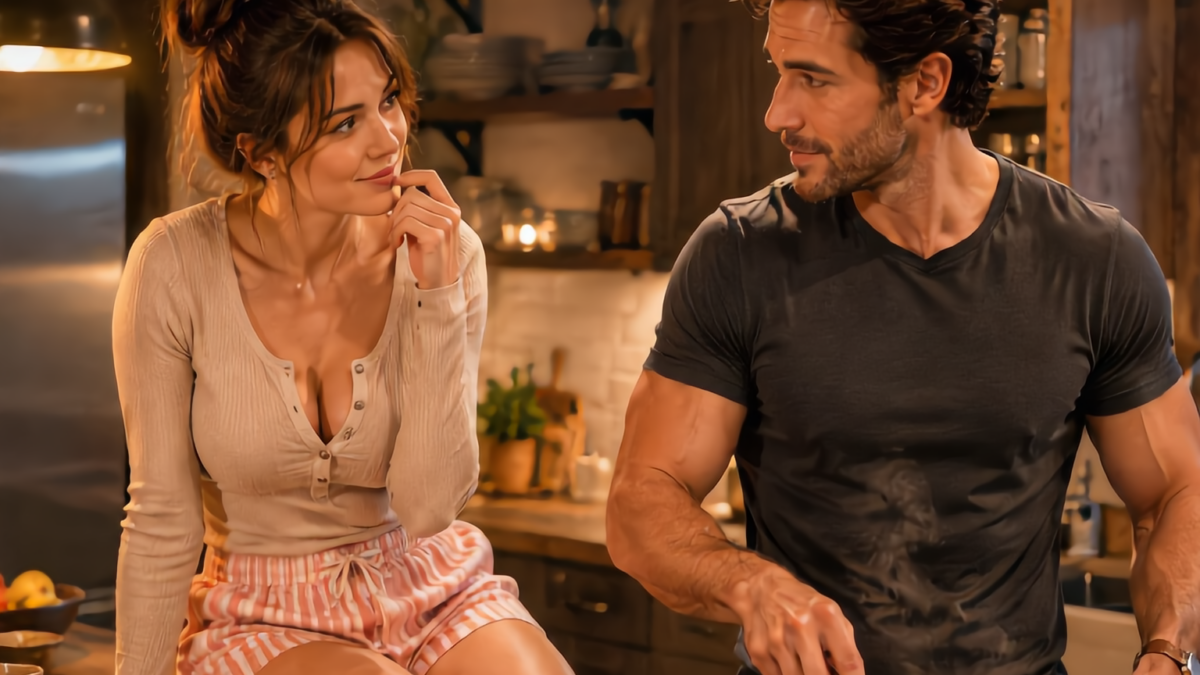
Bridey was standing barefoot at the counter in my oversized gray sweater, her damp hair tangled around her shoulders.
She was opening my cupboards.
“You have four kinds of tea,” she said without turning around, “and no coffee.”
“I don’t drink coffee.”
She looked over her shoulder.
“That’s a moral failure.”
“You’re surprisingly judgmental for someone wearing my socks.”
“I’ve had a difficult night.”
“You’ve got me there.”
She poured hot water into two mugs.
“I used the expensive tea.”
“I assumed you would.”
She slid one mug toward me.
Then the humor left her face.
“I’ve been standing here for twenty minutes trying to figure out how to have this conversation.”
“What conversation?”
“The one where I thank the stranger who pulled me out of a river.”
I leaned against the counter.
“You don’t have to.”
“That’s not helpful.”
“It’s true.”
“No, Wilder. That’s generous. Those are different things.”
It was the first time she’d used my name.
She wrapped her hands around the mug.
“Everything I can think of sounds too small. Thank you sounds ridiculous. A gift sounds worse. Money would be insulting. And anything big enough to match what happened becomes absurd.”
“There doesn’t have to be a matching thing.”
Her expression tightened.
“You say that very easily.”
“Because there isn’t.”
She stared into the tea.
“Can I ask you something?”
“Yes.”
“Will you answer honestly?”
“I’ll try.”
She raised her eyes.
“Was I close?”
I knew exactly what she meant.
For one second, I considered lying.
“No.”
She breathed out.
Then I continued.
“But not by much.”
Her fingers tightened around the mug.
“You were in the water maybe ninety seconds. If you’d missed the second rope, you would’ve gone around the bend. I couldn’t have followed you from the bank fast enough.”
Bridey nodded slowly.
Her face went pale, but she didn’t look away.
“Thank you.”
“For what?”
“For not turning it into a funny story.”
I understood that immediately.
She looked toward the river.
“Everyone else will.”
“Maybe.”
“My mother definitely will. By Thursday, I’ll be the daughter who accidentally went swimming in October.”
“Is that bad?”
“No.”
She thought about it.
“It just means everyone else gets to decide what happened. You’re the only other person who actually knows.”
That morning I learned several things about Bridey Sullivan.
She was thirty-one.
She taught seventh- and eighth-grade science.
She crossed that footbridge twice a day because it saved eleven minutes on her walk to school.
And she had reported the damaged railing twice.
Once in April.
Once in September.
She had even kept the reference number.
Of course she had.
At the clinic, while we waited for the doctor, she called the county.
“I don’t want an apology,” she told someone. “I want the bridge closed.”
Pause.
“Today.”
Another pause.
“There are children who use that crossing before eight every morning. Forty feet of railing are now somewhere on the bottom of the river.”
She listened.
“No. Not inspected. Closed.”
Another pause.
“Reference number 4471. September eleventh. Put that in whatever report you’re writing.”
She ended the call.
I was looking at her.
“What?”
“Nothing.”
“I don’t usually talk to people like that.”
“You’re exactly the kind of person who talks to people like that.”
“You’ve known me nine hours.”
“I’d still put money on it.”
That almost made her smile.
The bridge closed that afternoon.
I assumed that was the end of my involvement with Bridey Sullivan.
A week later, she returned my sweater.
Washed.
Folded.
“I told you to keep it.”
“It’s yours.”
“I have three.”
“Then now you still have three.”
The following week she came back with a casserole.
The week after that, a bottle of whiskey I did not need.
Then a bag of specialty screws I’d once mentioned were difficult to find locally.
That was when I started understanding something.
Bridey wasn’t bringing gifts because she thought I needed them.
She was paying installments.
Every visit was excellent.
Every departure was strange.
She would sit on an overturned crate in my workshop while I worked, telling me stories about thirteen-year-olds with the precise mixture of affection and disbelief required to survive teaching them.
I told her about boats.
She asked real questions.
In November, she brought twenty-two students to the shop.
I showed them steam bending, scarf joints, frames, ribs, planking.
Near the end, a quiet boy in the back raised his hand.
“How do you know when the wood’s ready to bend?”
Bridey, standing by the door, became perfectly still.
I answered.
The boy asked another question.
Then another.
After the class left, Bridey sat down on her crate.
“Nine weeks,” she said.
“What?”
“That boy hasn’t voluntarily spoken in class for nine weeks.”
“You didn’t react.”
“If I’d reacted, he might never have done it again.”
She closed her eyes.
“Half the job is knowing when not to make something important.”
I looked at her then.
Really looked.
And understood that I was in trouble.
Because I liked her.
Not because I’d pulled her from a river.
Not because she kept turning up.
I liked the way her mind worked.
The way she could be severe with systems and endlessly patient with people.
The way she listened.
The way she sat in my workshop as though she’d always had a place there.
But every visit ended the same way.
At some invisible point, something changed behind her eyes.
Then twenty minutes later, she’d leave.
Finally, I asked.
“You always leave in the middle.”
She froze.
“We’ll be talking, and suddenly you’re gone before you’re physically gone. I can’t tell whether I’m doing something wrong.”
For a long time, she said nothing.
Then:
“It’s me.”
“Okay.”
“That’s all?”
“You said it’s you.”
She covered her face briefly with both hands.
“You are extremely irritating.”
“I’ve heard that.”
Her hands dropped.
“I can’t owe people.”
I waited.
“My family keeps accounts.”
“Financial?”
“Emotional.”
She stared at the workshop floor.
“Favors. Gifts. Help. Everything had a number when I was growing up. Maybe nobody actually wrote it down, but we all knew the balance.”
She breathed in.
“And then you pulled me out of a river.”
“That’s not a debt.”
“You can say that because you’re not the person who owes it.”
“Bridey—”
“I brought you a casserole, Wilder.”
“I liked the casserole.”
“I brought you screws.”
“I loved the screws.”
“Stop.”
The word was quiet.
I stopped.
Her eyes finally met mine.
“Here’s the problem.”
Something in her expression made my heartbeat change.
“I like you.”
I didn’t move.
“I’ve liked you since the kettle.”
“The kettle?”
“Don’t interrupt.”
“Sorry.”
“I like you. Too much, probably.”
She folded her arms as if holding herself together.
“But I can’t tell whether it’s real.”
The workshop seemed suddenly too quiet.
“What do you mean?”
“You saved my life.”
“I threw a rope.”
“You were the last face I saw in that water.”
“Bridey—”
“My whole nervous system could have decided you’re safety.”
She gave a short, miserable laugh.
“Animals do it. Imprinting. Ducklings.”
“You’re comparing yourself to a duckling.”
“I’m a science teacher. Let me have the terminology.”
I set the plane in my hand down carefully.
She continued.
“What if everything I feel around you is gratitude wearing better clothes?”
Her voice cracked.
“What if I mistake being safe for being in love?”
That word stayed between us.
Love.
Neither of us touched it.
Finally she whispered, “I don’t know how to find out.”
And somehow, without planning it, I gave the answer that changed everything.
“Then don’t decide yet.”
She stared at me.
“What?”
“Find out.”
“How?”
“I have no idea.”
I stepped closer, but not too close.
“But I’d rather spend a year not knowing with you than have you decide for both of us in my workshop on a Tuesday.”
Something moved across her face.
Fear.
Hope.
Maybe both.
“You’d really do that?”
“Do what?”
“Wait.”
I looked at the woman I’d dragged from a river and somehow, impossibly, come to care about more every time she walked through my door.
“Bridey, I’m not waiting for you to pay me back.”
Her eyes filled.
“I’m waiting to see what happens when you finally believe you don’t have to.”
She stood completely still.
And for the first time since I’d met her, Bridey Sullivan didn’t leave.
Part 2 — The Ledger
After that conversation, nothing happened.
Which turned out to mean everything happened.
Bridey stopped manufacturing reasons to go home.
She came to the workshop on Sundays with science papers and her red pen and sat on the same crate while I worked.
Sometimes we talked for hours.
Sometimes not at all.
I started buying her favorite tea.
I never announced it.
She noticed anyway.
One December afternoon, she fell asleep while grading lab reports.
The workshop was cold despite the wood stove.
I took my coat from the wall and laid it over her.
Then I stood there staring at the coat.
With anyone else, it would have been nothing.
With Bridey, kindness could become currency before it landed.
So I dragged the stove three feet closer to her instead.
An absurd amount of effort.
When she woke forty minutes later, she looked at my coat.
Then the stove.
Then me.
She understood completely.
She said nothing.
Neither did I.
That silence felt more intimate than touching her would have.
Her parents arrived in January.
Bridey gave me forty minutes’ warning.
My phone buzzed.
My parents are here. They want to meet you. I have attempted every available form of prevention. I apologize in advance.
Aiden and Nuala Sullivan were lovely people.
That made the problem worse.
They drove three hours.
Nuala brought fruitcake.
Aiden knew enough about woodworking to ask dangerous amounts of questions.
Nuala cried when she shook my hand.
Then apologized for crying.
Then told me that when Bridey was seven, she’d walked a mile and a half home through heavy rain rather than accept a ride from a neighbor because, according to seven-year-old Bridey, then I’d owe her.
Bridey stood behind her mother looking as if she wished to enter another dimension.
“You were seven?” I asked.
“Don’t.”
Nuala laughed.
“She came home soaked and pleased as anything.”
That story explained more than any psychological theory Bridey had ever offered me.
Then, as they were leaving, Aiden stopped in my doorway.
He reached into his coat.
Pulled out an envelope.
Bridey’s face changed instantly.
“Aiden,” Nuala said quietly.
He ignored her.
“We’d like you to take this.”
I knew what it was without opening it.
“No.”
“Please.”
“I appreciate the thought.”
I kept my hands at my sides.
“But no.”
His jaw tightened.
“You saved our daughter’s life.”
“I was there.”
“That’s not an answer.”
“It’s the only one I’ve got.”
He held the envelope toward me.
“You have a business. There’s always something money can help.”
“Absolutely.”
“So take it.”
Bridey was white behind him.
I shook my head.
“If I take that envelope, what happened becomes something we settled.”
Aiden stared at me.
“And it isn’t.”
Nobody spoke.
“Your daughter fell into a river. I threw her a rope. She’s alive.”
I looked directly at him.
“That’s the whole transaction.”
Nuala started crying again.
Aiden slowly put the envelope back into his coat.
Then he shook my hand.
Longer than necessary.
They left.
Bridey stayed.
She stood in my front room still wearing her coat.
Her hands were shaking.
“Do you know what you just did?”
“I refused a check.”
“No.”
Her voice was thin.
“That was the ledger.”
I didn’t speak.
“My parents love me.”
“I know.”
“They absolutely love me.”
“I know.”
“But that’s how my family survives emotion. We convert it.”
She pressed both palms to her eyes.
“Money. Favors. Gifts. Accounts. Something enormous happens and we find the number that makes it manageable.”
Her hands dropped.
“And you wouldn’t let them.”
“No.”
She was crying now.
Angrily.
“Do you know what I felt when you said no?”
I waited.
“Relief.”
She laughed once, bitterly.
“And disappointment.”
That surprised me.
“Why disappointment?”
“Because if you’d taken it, it would’ve been finished.”
I understood.
“The account would close.”
“Yes.”
She looked at me as though confessing a crime.
“And then I could want you.”
The words hit harder than the river ever had.
She shook her head.
“I wanted you to take my father’s money so I could stop wondering whether every feeling I have belongs to you because of what happened.”
“Bridey.”
“No.”
She wiped her face.
“Let me finish.”
So I did.
“I have spent four months trying to separate gratitude from affection and affection from dependence and dependence from love.”
Her breath trembled.
“And I can’t.”
She looked directly at me.
“I don’t know what belongs to me.”
I wanted to cross the room.
I didn’t.
She noticed.
“Say something.”
“No.”
Her eyes flashed.
“What?”
“Anything I say right now goes onto the scale.”
She stared at me.
“And I know which side I want it to land on.”
Her face changed.
“But if I touch the scale now, you’ll always wonder whether you got there yourself.”
She laughed through tears.
“That may be the most infuriating decent thing anyone has ever done to me.”
“I know.”
“Give me a week.”
I nodded.
She gave herself nine days.
I didn’t call.
Didn’t write.
Didn’t manufacture emergencies.
I also accomplished almost nothing.
On the third day, I ruined a plank I’d spent two weeks shaping.
On day six, my brother-in-law called.
Four minutes into the conversation, he said, “What’s wrong with you?”
“Nothing.”
“You sound dead.”
“There’s a woman.”
He laughed.
“Wilder, the whole town knows there’s a woman.”
“Apparently she’s deciding whether she’s in love with me.”
Silence.
“That’s worse than I expected.”
“Yes.”
“Can you influence the decision?”
“No.”
“Then don’t.”
“I’m not.”
“Good.”
Pause.
“Want me to come over and not discuss it?”
“Please.”
He arrived the next day.
We worked five hours and did not mention Bridey once.
It was exactly what I needed.
On the ninth afternoon, she appeared at the workshop carrying a document folder.
By then, I’d learned that Bridey Sullivan carried document folders when she’d done something irreversible.
“I took my father’s money,” she said.
My stomach dropped.
“What?”
“The check.”
I said nothing.
“I called him. Told him I wanted it.”
She placed the folder on my bench.
“It cleared Wednesday.”
Then she opened it.
Inside were bank receipts, county letters, engineering documents, and a preliminary drawing.
“Yesterday, I donated the entire amount to the footbridge replacement fund.”
I stared at her.
“You did what?”
“The state matches qualifying infrastructure donations two to one.”
She tapped the papers.
“So now it’s worth three times the original amount.”
“You gave your father’s money to a bridge.”
“I gave it somewhere it wasn’t you.”
She gripped the edge of the bench.
“I couldn’t pay you. You wouldn’t let me. And I couldn’t keep carrying it.”
Her voice softened.
“So I put the debt where it belonged.”
“The bridge.”
“The river.”
I stared at the drawing.
A completely new crossing.
Steel supports.
Concrete foundations.
Proper railings.
Construction scheduled for spring.
“What did your father say?”
Her mouth twitched.
“He said, ‘That’s very like you.'”
“Sounds promising.”
“He then sat silently for ten seconds, which for my father is roughly equivalent to collapsing emotionally.”
I laughed.
“And then?”
“He offered another matching donation if the county tried to reduce the project scope.”
“Did they?”
“Tuesday.”
“Did he?”
“Wednesday.”
Of course he had.
Bridey’s expression turned serious.
“It’s gone, Wilder.”
“What is?”
“The number.”
She touched her chest.
“I don’t owe you anymore.”
I almost told her she’d never owed me.
But this wasn’t the time.
She needed her own language.
“I woke up Friday morning and the debt was gone.”
She swallowed.
“And I thought there’d be nothing underneath.”
My pulse began hammering.
“That was the thing I was afraid of.”
She stepped closer.
“That if I removed the rescue, removed the gratitude, removed the obligation… there’d be nothing left.”
“What was left?”
She laughed suddenly, tears appearing.
“It was worse.”
“Worse?”
“So much worse.”
She wiped her cheek.
“I drove here Friday and sat at the end of your lane for forty minutes.”
“You were here?”
“I couldn’t come in.”
“Why?”
“Because apparently ducklings don’t spend four months doing accounting before constructing municipal infrastructure.”
I stared at her.
Then started laughing.
She did too.
But she was still crying.
“It’s not imprinting.”
“No?”
“No.”
She took another step.
“I checked.”
“Thoroughly?”
“I built a bridge.”
“Fair.”
Her face became completely serious.
And I knew what was coming.
Still, I made her say it.
“Say the sentence.”
“Wilder.”
“You made yourself say every difficult thing that came before this.”
I moved closer.
“I want this one spoken aloud.”
She looked furious.
Terrified.
Beautiful.
Then she breathed in.
“I’m in love with you.”
Everything in me stopped.
“It has nothing to do with the river.”
Her voice broke.
“I checked.”
That was when I crossed the workshop.
The first kiss wasn’t careful.
Four months had already taken care of careful.
She caught the front of my shirt in one fist.
My hip hit the bench.
Something metal fell to the floor.
Neither of us looked.
When we finally broke apart, she still had my shirt in her hand.
“I have wanted to do that since the kettle.”
“You’ve mentioned that kettle three times.”
“The kettle was significant.”
“It boiled water.”
“It was an emotional event.”
I laughed.
She kissed me again.
And for the first time since the night I pulled her from the river, neither of us owed the other anything.
Part 3 — The Bridge
We took things slowly after that.
Or at least we called it slowly.
The truth was that four months in the workshop had already taught us things most couples spent their first year discovering.
I knew how Bridey became quiet when angry.
She knew I worked when frightened.
I knew she needed difficult truths stated plainly.
She knew I required silence before I could state them.
We learned the rest.
Her father called me in February.
“I’ve been thinking about what you said when I offered you the money.”
I waited.
“I didn’t like it.”
“I noticed.”
“I’ve come around.”
Another pause.
“Nuala and I ran our family like a ledger for forty years.”
His voice changed.
“I thought that was responsibility.”
I said nothing.
“Bry’s been paying us back for things since she was fourteen.”
He cleared his throat.
“I never asked why.”
That conversation stayed with me.
Not because Aiden apologized.
He didn’t.
Because he understood there are some realizations for which apology is too small and changed behavior is the only useful response.
The new footbridge went up in April and May.
Bridey attended every design meeting she could.
The county originally wanted a commemorative plaque with my name on it.
Bridey killed that proposal in under four minutes.
I have never loved her more.
The final plaque read:
REPLACED 2019
FUNDED IN PART BY A PRIVATE GIFT
IN GRATITUDE FOR THE RIVER
I read it twice.
“In gratitude for the river?”
“Yes.”
“It nearly killed you.”
“It also gave me you.”
“The rope gave you me.”
“The river organized the introduction.”
I looked at her.
She looked unbearably pleased with herself.
“You get the boat shop,” she said. “The river gets the plaque.”
She moved into the boathouse the following spring.
The place wasn’t designed for two people.
We discovered this immediately.
A wall had to come down.
I’d believed for eleven years it was structural.
It wasn’t.
Someone had built it in 1962 for reasons no living person could explain.
Bridey considered this evidence that many things people treated as permanent were simply old decisions nobody had questioned lately.
That sounded suspiciously metaphorical, so I refused to encourage her.
Her students continued visiting the shop.
The quiet boy who’d asked about steam bending came back the summer after graduation and asked for work.
Years later, he became better at scarf joints than I’d been at twenty-five.
Bridey never once said I told you so.
I regard this as one of the great acts of restraint in modern marriage.
I proposed on the bridge.
Not original, I admit.
She knew what I was doing two hundred yards before we arrived.
“You’re walking strangely.”
“I’m walking normally.”
“You’re pinning your right elbow against your coat.”
“No, I’m not.”
“There’s something in your pocket.”
“Can you allow one event in your life to contain mystery?”
“No.”
So I stopped in the middle of the bridge.
The river was low that summer.
Peaceful.
Almost harmless looking.
I took out the ring.
“Bridey Sullivan, you spent four months trying to determine whether you loved me or owed me.”
She was already crying.
“And then you built a bridge to find out.”
“I did not personally build it.”
“Please don’t correct my proposal.”
“Sorry.”
“Nervous?”
“Extremely.”
“Good.”
I took her hand.
“Nobody is ever going to do anything like that for me again.”
Her fingers tightened around mine.
“So will you marry me?”
“Yes.”
Then she looked around through tears.
“And for the record, this is a very good bridge.”
She sat down directly on the deck afterward because her knees had stopped cooperating.
We married that September beside the river.
Forty-three guests.
Most of the science department.
My family.
Her family.
Several former students.
Her parents paid for the marquee and never mentioned paying for it.
I understood how much that cost them emotionally.
Aiden’s wedding toast lasted less than a minute.
“I tried to pay this man,” he began, “and he refused.”
Everyone laughed.
“Then my daughter took the money and spent it on public infrastructure, which is perhaps the most Bridey thing that has ever happened.”
Bridey covered her face.
Aiden waited.
“For most of my life, I believed debts were things decent people settled.”
The room became quiet.
“I’ve learned some things are meant to be carried for a while.”
He looked toward us.
“And if you carry them properly, eventually they become something else.”
He sat down.
Nuala cried.
Bridey squeezed my hand beneath the table.
The gray sweater is still hers.
The one I put on her after the river.
The cuffs are nearly gone.
There’s a hole at one elbow she’s repaired twice with wool that doesn’t match.
I once asked why she didn’t use matching thread.
She looked offended.
“A repair should be visible.”
“Why?”
“Otherwise you’re pretending nothing happened.”
She still wears it in the workshop.
Still grades papers on that same battered crate.
One winter evening, years after the river, I asked her something I’d wondered for a long time.
“Do you still think about that night?”
“Constantly.”
“The water?”
She didn’t look up from her papers.
“No.”
“What, then?”
“The kettle.”
I laughed.
“You almost died and you remember my kettle?”
“The river was ninety seconds, Wilder. I barely remember it.”
She finally set down her pen.
“The kettle was twenty minutes.”
“Twenty minutes of what?”
“Standing in a stranger’s kitchen wearing his enormous sweater, knowing something enormous had happened to me and having absolutely no idea what I was supposed to do with it.”
“And now?”
She looked around the workshop.
At her papers.
At the old boats.
At our coats hanging beside one another.
Beyond the windows, the river moved quietly beneath the bridge.
“Now I know.”
“What do you do with something enormous?”
Bridey smiled.
“Sometimes?”
She reached for my hand.
“You stop trying to pay for it.”
Outside, the river kept moving.
It always would.
But the bridge held.
And so did we.








