He thought fixing things was how a man proved he cared.
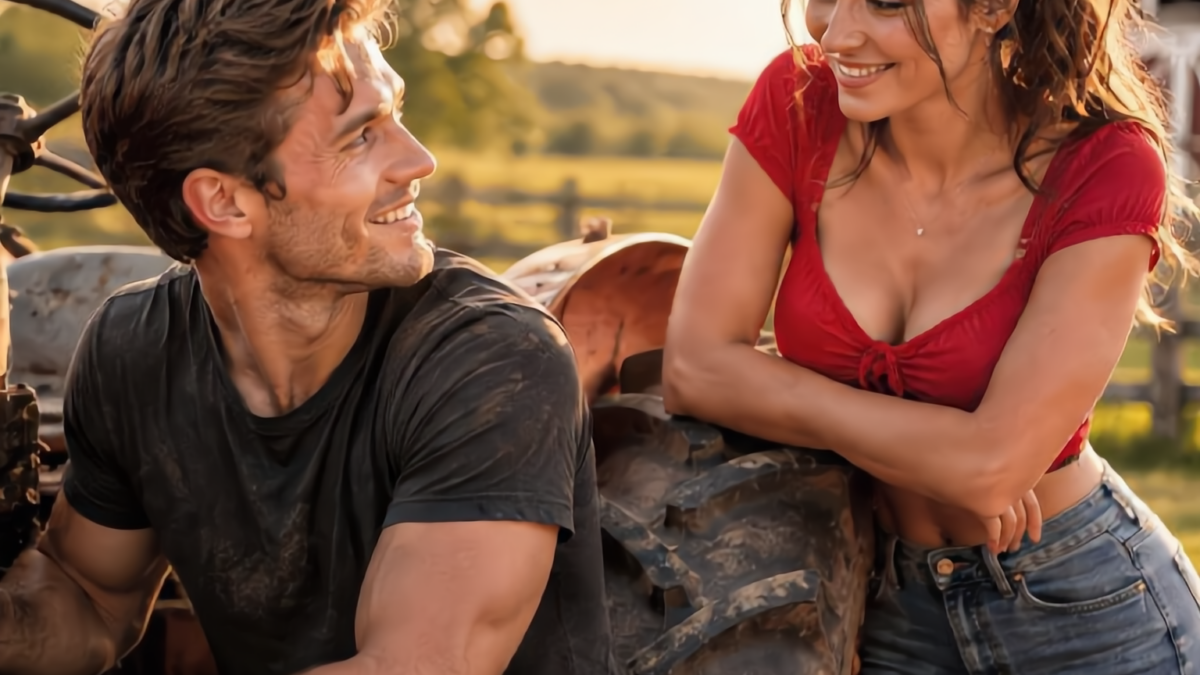
Part 1 — The Things We Think We’re Fixing
I had my head buried under the hood of a 1974 Massey Ferguson when Erin Stroud asked me the question that changed everything.
“Does your future wife know how lucky she is?”
The tractor had been fighting me for forty minutes. The fuel line was corroded, one bolt had rounded off, and whoever had worked on the machine before me had apparently believed electrical tape was a legitimate engineering material.
So I heard Erin before I saw her.
I slid out from beneath the hood more slowly than necessary.
She stood six feet away, holding two mugs of coffee. Thirty-two years old, dark hair tied carelessly behind her head, faded work shirt rolled to the elbows, mud on one knee of her jeans.
She had that expression she wore when she had said something more personal than she intended and was now pretending she hadn’t.
“There isn’t one,” I said.
Her eyebrow lifted.
“That wasn’t what I asked.”
“I know.”
I took the coffee.
“I’m answering the more interesting question.”
For a second she just stared at me.
Then Erin laughed.
Not the polite little exhale she gave customers at the farmers’ market.
A real laugh.
It caught me so badly off guard that I ducked under the tractor again and stayed there for eleven minutes, even though the job I was doing required maybe four.
My name is Hank Holt.
I was thirty-four then, and I had been fixing agricultural machinery since I was nineteen.
In our part of the county, that made me useful.
Very useful.
Old tractors. Milking pumps. Feed conveyors. Hydraulic systems. Electric fencing. Water heaters. Anything mechanical that had been declared dead by someone wearing cleaner clothes than mine eventually found its way to me.
My father used to say there were two kinds of machinery.
Machines that were broken.
And machines that hadn’t broken yet.
I believed something similar about people, though I wouldn’t have admitted it at the time.
Erin had bought the eleven acres beside my mother’s property two years earlier.
Everybody noticed her immediately.
A woman from the city buying a neglected little dairy property in a valley where families measured their history in generations was always going to attract attention.
People expected a hobby farm.
A few goats.
A vegetable patch.
Maybe photographs on social media about “escaping the city.”
Then Erin arrived with notebooks.
Lots of notebooks.
Feed calculations.
Veterinary schedules.
Milk-production projections.
Fencing plans.
A five-year business model.
And a planned herd of forty-one goats.
The valley laughed for approximately six weeks.
Then February arrived.
Gil Ferris lost power during the worst freeze of the year. His generator failed, and without electricity his milking system was useless.
Erin heard about it.
At eleven that night, she arrived wearing an expensive wool coat from a life she no longer seemed to belong to.
She asked Gil three questions.
Then she ran his milking parlor for six hours.
Correct pressures.
Correct sanitation.
Correct sequence.
Gil, who had made at least twelve jokes about “the city girl playing farmer,” never made another one.
Neither did anyone who was there.
Erin could learn almost anything.
What she couldn’t do yet was repair machinery.
That was how I became part of her life.
First came the vacuum pump.
Then an electric fence.
Then a water heater.
Then the Massey Ferguson.
The Massey was older than Erin.
It smoked when it was offended, leaked hydraulic fluid like a wounded animal, and possessed an ignition system with what I can only describe as moods.
Four different people told Erin to scrap it.
My father told her twice.
I disagreed.
“It’s a good tractor,” I told her.
“It doesn’t start.”
“That’s temporary.”
“The steering pulls left.”
“Character.”
“The hydraulics leak.”
“Also temporary.”
She folded her arms.
“How temporary?”
“Depends how attached you are to money.”
She kept the tractor.
And I kept coming back.
At first, I came because things broke.
Eventually, I came on Sundays even when nothing did.
Neither of us officially arranged that.
Sunday simply became ours.
Erin made coffee.
I found something mechanical to pretend needed attention.
She sat on an overturned crate or the tractor wheel and talked.
At first we discussed machines.
Then the farm.
Then the valley.
Eventually, somehow, we discussed ourselves.
That was unusual for me.
I had been in two serious relationships before Erin.
Both women eventually told me some version of the same thing.
I never know what’s going on inside you.
I thought that was unfair.
I worked.
I showed up.
I repaired things.
I changed brake pads before anyone asked.
I replaced leaking faucets.
I put fuel in cars.
How could somebody look at all that and say I wasn’t communicating?
It took Erin to teach me that fixing someone’s door hinge does not necessarily tell them what is happening in your heart.
One Sunday in August, I was lying underneath the Massey fighting a hydraulic fitting while the temperature climbed past ninety degrees.
Erin sat beside me for three hours.
She had plenty to do.
Goats needed checking.
Paperwork waited inside.
A fence line needed clearing.
She ignored all of it.
She handed me tools and talked.
After two hours she asked, “Can I ask you something that’s none of my business?”
“You usually do.”
“Why didn’t you leave?”
I knew exactly what she meant.
When I was twenty-three, I had been offered a job with a large agricultural equipment company four states away.
Better money.
Training.
A real career path.
I had told everyone I stayed because my father had suffered a stroke.
That was the story.
It was even partly true.
But lying underneath that tractor, with Erin unable to see my face, I told the rest.
“Dad had the stroke in March,” I said.
The wrench slipped.
I repositioned it.
“The job offer came in April. Everyone thinks I stayed because of him.”
“Didn’t you?”
“He was mostly recovered by July.”
Silence.
“They kept the job open until September.”
I finally broke the fitting loose.
Metal cracked with a satisfying snap.
“I stayed because leaving meant finding out whether I was any good somewhere people didn’t already know me.”
Erin said nothing.
So I kept going.
“I know what I am here. Everybody within forty miles has my number. Something breaks, they ring me. I show up. I know where I fit.”
I slid the fitting free.
“Somewhere else, maybe I’m just some mechanic.”
A long silence followed.
Then Erin said, “That’s the second most honest thing anyone has ever said to me.”
I looked out from beneath the tractor.
“What’s the first?”
She took a drink of coffee.
“I’ll tell you in about a year.”
She was almost exactly right.
It happened the following November.
I arrived while she was finishing a phone call.
Something in her face was wrong.
“Everything okay?”
“My sister.”
That answer explained nothing, and I almost let it go.
Then Erin said, “I was with someone for six years.”
I put my toolbox down.
She stared toward the barn rather than at me.
“His name was Tate.”
She told me the story without drama.
That somehow made it worse.
There had never been one obvious moment when Tate took control.
At twenty-six, they combined their finances because couples did that.
Then his name went on the lease because his credit was better.
Then he handled the bills.
Then they decided separate accounts were inefficient.
Eventually Erin had a monthly amount transferred into an account Tate controlled.
Her friends disappeared the same way.
Tate never said, Don’t see her.
He simply found something wrong with each friend.
One was disrespectful.
Another was a bad influence.
Another apparently disliked him.
Each argument sounded reasonable by itself.
By twenty-nine, Erin had almost nobody left.
She escaped at thirty with around nine thousand dollars, no lease history in her name for six years, and two friends she had maintained contact with by lying.
“That’s the story,” she said.
I stood there trying to understand it.
“I’m not giving you the long version.”
“Why not?”
“Because the long version is mostly people asking why I didn’t leave earlier.”
“I wasn’t going to ask you that.”
“I know.”
She finally looked at me.
“That’s why I’m telling you.”
Then she explained something I had wondered about since I met her.
Money.
Every job I had ever done for Erin, she paid for immediately.
No tabs.
No favors left hanging.
No “I’ll get you next month.”
Not even with me.
Especially not with me.
“Everything I own is mine,” she said. “The land. The herd. The equipment. There’s one loan, and I know exactly when it ends.”
I nodded.
“And I don’t leave debts undefined.”
“Erin—”
“An unpriced debt is a hand on a lever, Hank.”
Her voice stayed calm.
“I’ve lived with a hand on a lever. I won’t do it again.”
Suddenly every conversation we had ever had about payment rearranged itself in my head.
Every time I told her, Pay me whenever.
Every time I waved away a bill.
Every time I thought I was being generous.
“Oh.”
“Yes.”
“So every time I said don’t worry about it—”
“I knew you were trying to be kind.”
Her jaw tightened.
“But some part of me still had to calculate what you might think I owed you later.”
That sentence hurt.
Not because she meant it to.
Because I heard accusation where none existed.
I heard that after two years she still placed me in the same category as Tate.
And because I was frightened, I said the worst possible thing.
“I’m not him.”
Erin closed her eyes.
The moment she did it, some part of me knew.
But the words were already loose.
“I know you’re not.”
“I would never—”
“Hank.”
She opened her eyes.
“Stop.”
I stopped.
“I have known you for two years. I know exactly who you are. I have never once been frightened of you.”
My shoulders loosened slightly.
Then she continued.
“But I need you to hear something else.”
I waited.
“‘I’m not him’ is a sentence about you.”
I stared at her.
“I just told you the hardest thing about my adult life, and within ten seconds you turned it into a conversation about whether I have been fair to you.”
“I didn’t mean—”
“I know.”
That made it worse.
“Every man I tell does it.”
Her voice remained maddeningly gentle.
“They defend themselves against something I never accused them of.”
I had nothing.
No argument.
No explanation.
No useful sentence.
“I’m not going to manage your feelings about my divorce, Hank.”
She picked up a bucket.
“I’ve got goats to milk.”
Then she walked into the barn.
I didn’t go over the following Sunday.
Or the Sunday after that.
I told myself I was giving her room.
I wasn’t.
I was ashamed.
For four days I replayed the conversation, looking for evidence that Erin had been unfair.
I found plenty.
Or thought I did.
I had said one clumsy sentence after hearing something terrible.
Surely anyone could understand that.
By day five, I remembered something inconvenient.
Erin had never yelled at me.
Had never insulted me.
Had never accused me of anything.
She had simply refused to reassure me.
By day seven, I understood what I had asked her to do.
Within ninety seconds of telling me about the worst six years of her life, I had effectively held out my hand and asked:
Tell me I’m one of the good ones.
And when she declined, I disappeared.
Day nine was worse.
I was sitting in my van outside Halvorson’s farm when I finally understood why her story had frightened me so badly.
For two years I had secretly wondered why a woman like Erin wanted me around.
And I had always had one answer.
Because I was useful.
Then she told me she had been mentally calculating the value of that usefulness from the beginning.
I hadn’t heard her trauma.
I had heard my insecurity.
That wasn’t something Erin had done.
I had carried it into her yard myself.
On the twelfth day, I walked four miles to her farm in the rain.
No van.
No toolbox.
Nothing to hide behind.
She was inside the barn repairing a hinge when I appeared.
“You walked?”
“Yes.”
“It’s four miles.”
“I know.”
Water ran off my coat.
She set the screwdriver down.
“I owe you an apology,” I said. “And I’ve had eleven days to put it in the right order.”
Erin said nothing.
“I’m sorry for taking what you told me and turning it into a question about whether I’m a good man.”
Still nothing.
“You asked me for reassurance about absolutely nothing. I gave you a defense anyway and made you responsible for it.”
Rain hammered the metal roof.
“And the money,” I continued. “You told me exactly what you needed. A number. Every time. I argued because I thought my way of being generous mattered more than your way of feeling safe.”
Her expression changed.
Barely.
But enough.
“You didn’t owe me the reason,” I said. “You had already given me the instruction.”
Four seconds passed.
Maybe five.
Then Erin said, “Okay.”
I swallowed.
“Okay?”
“I accept your apology.”
I breathed again.
“And I want invoices for every job you undercharged me for during the last two years.”
“Erin—”
“Itemized.”
“Some were forty-minute jobs.”
“Itemized, Hank.”
I almost smiled.
Then she wiped her hands down the front of her coat.
A nervous gesture I had seen maybe three times before.
“One more thing.”
“What?”
“Would you come here, please?”
She asked.
That mattered.
I crossed the barn.
And after two years of Sundays and coffee and machinery and things neither of us had said, Erin kissed me.
It wasn’t tentative.
Neither was I.
The old Massey stood behind us, and at some point one of us backed into it hard enough that something metallic fell onto the floor.
I found the piece months later.
Never worked out where it belonged.
Eventually Erin pulled back.
“Hank.”
“Yeah?”
“I need you to understand something now, not three months from now.”
“Okay.”
“I do relationships slowly.”
I nodded.
“I’m not being coy. I’m not testing you. I went fast once, and it cost me six years. This is the first time in my adult life something is moving at a speed I choose.”
I looked down at my soaked clothes.
“I walked four miles through November rain to apologize about invoicing.”
Her mouth twitched.
“I think I can manage slow.”
She laughed against my shoulder.
And for a little while, I believed the hardest part was behind us.
I was wrong.
Because two months later, sitting at Erin’s kitchen table, I would make exactly the same mistake again.
Only this time, I would make it in front of her mother.
And I would take from Erin something she had spent eleven months preparing herself to reclaim.
Her own voice.
Part 2 — The Difference Between Defending Someone and Speaking for Them
Erin’s mother arrived in January.
Colleen Stroud came with Erin’s older sister, Trish, driving two hundred miles from the city for a four-day visit.
They said it was just family time.
It wasn’t.
They wanted Erin to sell the farm.
Not maliciously.
That would have been easier.
Colleen genuinely loved her daughter.
She simply had a particular way of loving people that left very little room for them to disagree with what she believed was best.
“The winters are terrible.”
“You’ve proved you can do it.”
“You don’t need to keep proving anything.”
“You’re thirty-two.”
“You’re alone out here.”
“Coming home wouldn’t mean failure.”
Erin absorbed every sentence without raising her voice.
I was present for two days because she asked me to be.
At the time, I thought she wanted backup.
Years later I understood how vulnerable the invitation actually was.
She was introducing me.
Saturday afternoon, the four of us sat around Erin’s kitchen table.
Coffee.
Cake Colleen had brought.
Polite conversation.
Then Colleen said, “Tate’s been asking about you.”
The room changed.
Erin slowly lowered her mug.
“Has he?”
“I saw him at your father’s birthday.”
“Of course.”
“He always asks.”
Erin’s face revealed nothing.
Then Colleen continued.
“I’m not saying anything, sweetheart. I just think there are always two sides. He has never said one bad word about you.”
I felt anger rise through my chest.
“You were both so young,” Colleen added. “Sometimes things become very complicated and—”
I interrupted her.
“Mrs. Stroud, with respect, I don’t think you understand what happened.”
Silence.
Trish looked at me.
Colleen looked at me.
And Erin looked down at the table.
“I’ll make more coffee,” she said.
I thought I had defended her.
That is important.
I felt good about what I had done.
Colleen dropped the subject.
The weekend continued.
When they left Sunday morning, Colleen hugged Erin.
“We’ll talk when you’re ready.”
I helped clean the kitchen.
Their car disappeared down the lane.
Then Erin said, “You spoke for me.”
I turned.
“With your mother?”
“Yes.”
“I was trying to—”
Her expression stopped me.
“My mother said something about my marriage in my kitchen, and you answered.”
“Erin, she was defending Tate.”
“I know what she was doing.”
She gripped the edge of the counter.
“I’ve known what she’s been doing since 2019.”
“I just didn’t think—”
“No. You didn’t.”
That landed.
“I have had four conversations with my mother about Tate. Every one cost me something. And Saturday would have been number five.”
I stared at her.
“I had it ready, Hank.”
“What?”
“The sentence.”
Her voice broke for the first time.
“I’ve been building it for eleven months.”
My stomach dropped.
“I knew exactly what I wanted to tell her. About the bank account. The lease. My friends. All of it. I had finally reached the point where I could say it without apologizing for saying it.”
She looked at me.
“And then you got there first.”
I felt sick.
“You were right,” she said. “That’s what makes it difficult.”
“I was defending you.”
“You were explaining me.”
No shouting.
No accusation.
Just that.
“You told my mother what happened to me.”
“I didn’t tell her details.”
“You told her she didn’t understand.”
“Because she didn’t.”
“That was mine to say.”
There are moments when you understand that every instinct you possess is wrong.
I wanted to explain.
Wrong.
I wanted to apologize immediately.
Possibly wrong.
I wanted to tell her what I meant.
Definitely wrong.
I wanted to fix it.
Worst of all.
So I forced myself to ask the only question I had left.
“What do you want me to do?”
Erin was quiet.
“I don’t know yet.”
I nodded.
“And I need you to hear ‘I don’t know’ without disappearing for eleven days.”
That one hurt because I had earned it.
“I can.”
“You don’t know that.”
“No.”
I took a breath.
“But I’m going to.”
Nothing resolved quickly.
That was January.
We didn’t fully reach the other side until late April.
We continued seeing each other.
Sunday coffee continued.
We kissed.
We laughed.
She wasn’t cruel.
She didn’t punish me.
Instead, one entire subject disappeared.
Her family.
And I had to live beside the silence without forcing it open.
That was almost unbearable for me.
I had built my identity around arriving when something was broken.
My father had been the same.
So had his father.
Men in our valley didn’t often say, I’m worried about you.
They repaired your brakes.
They cleared your driveway.
They appeared with a chainsaw after a storm.
Usefulness was affection translated into labor.
Now I was being asked to care about Erin without doing anything she hadn’t requested.
I failed repeatedly.
One February afternoon, she came off the phone with Trish and walked into the barn.
I followed her halfway.
Stopped.
Went back.
In March, Colleen sent Erin a birthday card containing a long note.
Erin read it.
Put it into a drawer.
I said nothing.
Every muscle in my body wanted to ask what it said.
I didn’t.
Then, in April, I almost crossed the line completely.
Erin’s phone lay on the kitchen table.
She was showering.
I knew Colleen’s number was in it.
I picked the phone up.
My plan, if you can call it that, was to explain things.
Just once.
Mother to future son-in-law.
Tell Colleen that Erin needed time.
That Tate had done real damage.
That her daughter wasn’t being stubborn.
My thumb hovered over the contacts.
Then I saw my own reflection in the black screen.
A man about to secretly contact a woman’s mother because he believed he could communicate that woman’s life better than she could.
I put the phone down.
My hands were shaking.
That evening I told Erin.
Everything.
Even the shaking.
She listened.
When I finished, she was quiet.
“Thank you for telling me.”
“I nearly did it.”
“I know.”
“I actually picked up your phone.”
“I know.”
“I’m sorry.”
She reached across the table.
“Thank you for putting it down.”
It was the first time I understood that progress sometimes looks humiliating.
Not becoming a person who never has the wrong instinct.
Becoming a person who recognizes it before turning instinct into action.
That winter I learned two sentences.
The first was:
“Do you want help with that, or do you want company while you do it?”
The second was harder.
“I don’t know.”
Erin asked me one night what she should do about a milk contract that was becoming increasingly unprofitable.
I had nine ideas.
Probably ten.
She knew it too.
“What do you think?” she asked.
I almost began listing them.
Then I noticed how carefully she was watching me.
So I said, “I don’t know.”
Her eyebrow rose.
“You absolutely know.”
“I’ve got nine ideas.”
“Nine?”
“Ten now.”
She almost smiled.
“But they’re mine. And I’ve been thinking about this for four minutes. You’ve been thinking about it for a year.”
I put my hands flat on the table.
“So I don’t know. What are you thinking?”
Erin talked for forty minutes.
I barely spoke.
At the end, she stared into her coffee.
“What?”
She shook her head.
“That’s the first time in maybe eight years anyone has let me finish getting to a decision.”
The following winter nearly destroyed the farm.
Milk prices dropped.
Her primary buyer restructured the contract.
Then a small creamery buying her surplus collapsed owing her nearly four thousand dollars.
By March, Erin spent hours at the kitchen table doing arithmetic.
I had savings.
Enough to give her four thousand dollars without changing my life.
For three consecutive evenings, I thought about transferring it to her.
I knew why I shouldn’t.
Knowing didn’t make the urge disappear.
Finally I asked, “What are you thinking?”
She showed me spreadsheets.
Options.
Projected losses.
Alternate markets.
Her mother offered fourteen thousand dollars.
Immediately.
No written conditions.
Which, to Erin, was exactly the problem.
She refused.
After the call she sat on the back step shaking.
“That was harder than leaving Tate,” she said.
“Why?”
“Leaving was one decision.”
She wrapped both hands around her mug.
“That money would have followed me forever.”
“Your mother said there were no conditions.”
“There didn’t need to be.”
She looked toward the barn.
“If I took fourteen thousand dollars, the farm would become theirs in every family conversation. Every Thanksgiving. Every Christmas. Not legally. Emotionally.”
Then she added quietly, “I finally had the fifth conversation.”
I knew immediately.
“With your mother?”
Erin nodded.
“The one I was going to have in January.”
My chest tightened.
“What happened?”
“I told her everything. The account. The lease. My friends. The money Tate controlled.”
“And?”
“She went quiet.”
Erin looked almost surprised.
“Then she said, ‘I didn’t know that.’”
I waited.
“And I told her, ‘I’ve tried to tell you twice.’”
“What did she say?”
“She said, ‘I don’t think I heard it.’”
I let out a breath.
Erin looked at me.
“I got to have that conversation because you weren’t in the room.”
The words hurt.
She saw that.
“I’m not saying it to punish you.”
“I know.”
“You’ve earned the true version.”
I nodded.
She reached for my hand.
The farm survived because Erin had already been designing her way out.
For almost a year she had secretly researched a farmstead creamery license.
She planned to stop selling all her milk as a commodity and convert part of it into cheese.
Higher margins.
Lower volume.
A product she controlled.
“Why didn’t you tell me?” I asked.
She answered without hesitation.
“Because you would have helped.”
I stared at her.
“That’s usually considered a positive quality.”
“You would have been brilliant.”
“That sounds positive too.”
“You would have built equipment. Found suppliers. Redesigned the room. Called people. Solved problems I hadn’t asked you to solve.”
She placed her hand on my arm.
“And it would have become partly yours.”
I didn’t speak.
“Hank, I need one thing in my life that nobody else has fingerprints on.”
Something inside me resisted.
Something older.
The part of me that equated being loved with being necessary.
But I listened.
“One thing,” she continued. “After that, you can help with everything else forever.”
So I did nothing.
Or rather, I did only what she asked.
Which turned out to be much harder.
For fourteen months Erin ran both businesses.
Milking before dawn.
Cheese-making days that lasted nine hours.
Humidity alarms from the aging room in the middle of the night.
Licensing inspections.
Farmers’ markets.
Existing milk contracts she couldn’t cancel until the creamery was stable.
By winter she had lost weight and developed permanent shadows beneath her eyes.
I told her once I was worried.
She said, “I know.”
Then she asked me for something specific.
Thursday evening milking.
That was my contribution.
Thursday evenings.
For fourteen months.
No construction.
No unsolicited improvements.
No heroic rescue.
Just milk the goats on Thursday.
One night at 10:02, my phone rang.
“Hank.”
I was already standing before she finished my name.
“What happened?”
“The chiller.”
“Do you need me?”
“I need you.”
I was in my van in ninety seconds.
Halfway there, I understood something.
Being needed by someone who asks is completely different from being useful to someone who never had the chance to choose.
Same tools.
Same hands.
Different meaning.
By the following August, Erin had produced the first cheese she believed was genuinely good.
She found me in the yard.
“Try this.”
She cut a piece with the knife she kept on her belt.
I tasted it.
“Well?”
“It’s very good.”
She stared at me.
“Hank.”
“What?”
“You’d say that about a shoe.”
“I might.”
“Try again.”
I took another bite.
It was nutty and sharp and complicated, somehow tasting like grass and salt and autumn.
I looked at her.
“That’s the best thing I’ve eaten in this valley in ten years.”
She smiled.
“And I’ve eaten my mother’s cooking for thirty-four.”
Erin turned away.
Walked eleven paces toward the barn.
Stopped with her back to me.
I could see her shoulders moving.
Three years earlier I would have followed her.
I would have put an arm around her because I needed to complete the emotional moment.
I stayed where I was.
When she came back, her eyes were red.
Neither of us mentioned it.
That evening, as the sun fell across the fields and the creamery lights came on for the first time as part of a business that might actually survive, Erin leaned against the old Massey.
“You know,” she said, “I was wrong about something.”
“Only one thing?”
“Careful.”
“What were you wrong about?”
She looked at the tractor.
“I used to think independence meant never needing anybody.”
I waited.
“I don’t think that anymore.”
“What do you think it means?”
She looked at me.
“Getting to choose what you need.”
And I knew then that loving Erin would never mean becoming unnecessary.
It meant letting necessity be hers to define.
Part 3 — The Tractor That Wouldn’t Die
I proposed beside the Massey Ferguson.
There was no sunset.
No restaurant.
No hidden photographer.
We were both filthy.
It was a Sunday in June, nearly four years after Erin bought the farm, and the Massey had been fighting us for most of the morning.
I had rebuilt part of the gearbox that winter.
Replaced hydraulic components.
Rewired half the ignition.
Fabricated two panels from another tractor because original replacements cost more than common sense allowed.
Erin climbed into the seat.
“Ready?”
“No.”
She glared.
“Turn it.”
She turned the key.
The starter caught.
The engine stumbled.
Once.
Twice.
Then it fired.
Not coughing.
Not limping.
Running.
Really running.
The sound filled the yard.
I stood listening to that ancient engine settle into a rhythm it hadn’t held properly in years.
Something about it got to me.
Maybe because everybody had told her to scrap it.
Maybe because everybody had told me repairing it was stupid.
Maybe because we had spent four years learning that damaged things do not become worthless merely because restoring them is inconvenient.
I looked at Erin.
“Marry me.”
She still wore ear defenders.
“What?”
“Marry me.”
“What?”
I pointed at my ears.
She pulled off the defenders.
“The tractor’s too loud.”
“I said marry me.”
She froze.
A dirty rag hung from one hand.
Her mouth opened.
Closed.
Then, incredibly, she looked at the Massey.
“Five people told you to scrap this tractor.”
“Four.”
“Your father counts twice.”
“Fair.”
“And you rebuilt it over four years.”
“Yes.”
“Mostly on Sundays.”
“Yes.”
She looked at me.
“For a woman who wouldn’t let you work for free.”
I smiled.
“You never paid me for the Massey.”
Her eyes narrowed.
“You invoiced me.”
“Not for all of it.”
“I checked every invoice.”
“So did I.”
She stared at me.
Then the tractor.
Then me again.
“No.”
“No?”
“No, you didn’t invoice me.”
I waited.
She suddenly laughed.
“You’ve hidden four years of unpaid labor inside a marriage proposal?”
“That sounds worse when you say it.”
“It sounds terrible.”
“Is that a no?”
She stepped closer.
“No.”
My stomach dropped.
Then she smiled.
“It’s not a no.”
We married the following spring in Erin’s upper field.
She chose the location.
The drainage was terrible.
It rained.
I pointed out afterward that I had predicted both things.
She continues to deny this.
Colleen came.
So did Trish.
Nothing was magically healed.
Life rarely works that way.
Colleen and I remained polite but distant for nearly two years.
Then one Tuesday she visited the creamery.
By then Erin’s cheese was stocked by specialty shops in three counties.
Colleen stood quietly behind the glass while her daughter checked temperatures, inspected wheels aging on wooden boards, negotiated a delivery, corrected an employee’s paperwork, and handled a veterinary call without losing her place in any of it.
That night, from the car, Colleen called Erin.
Erin later told me only the first sentence.
“I got you wrong, and I got Hank wrong, and I’d like to start again.”
She never told me the rest.
And I never asked.
That might be the clearest evidence I can give you that people are capable of changing.
The Massey is still running.
Fifty-one years old now.
Rebuilt gearbox.
New hydraulic pump.
Two mismatched panels.
An ignition system that technically functions, assuming you understand the secret maneuver involving the choke.
Erin drives it more than I do.
Years ago, she asked me to teach her maintenance properly.
Teaching was harder than repairing.
For the first few months I had to sit on my hands while she performed tasks slowly and occasionally incorrectly.
I nearly failed in week two.
Now she services the tractor herself.
I am not allowed near the oil.
About six years into our marriage, we were at a farm auction when a man recognized the Massey.
“You’re Hank Holt, right?”
“That depends who’s asking.”
“Heard about that tractor.”
I nodded.
“Heard it took you four years.”
“About that.”
He laughed.
“Why bother? Four years for an old Massey?”
I looked across the yard.
Erin stood eight feet away pretending to examine a harrow.
“It runs,” I said.
“Yeah, but four years.”
“That’s not a reason not to.”
The man shrugged and walked away.
Erin said nothing.
Not there.
We got into the van.
Drove almost eleven miles.
Then she spoke.
“You know what you said back there?”
“About what?”
“The tractor.”
I looked at her.
She faced the window.
“Yes.”
Neither of us said anything else.
We didn’t need to.
Because somewhere in all those years, I finally understood what I had once gotten wrong.
I used to think loving someone meant protecting them.
Fixing things before they broke completely.
Defending them before anyone could hurt them.
Speaking when they couldn’t find the words.
But sometimes people do have the words.
They have spent eleven months building them.
Sometimes helping means shutting your mouth long enough for them to use those words themselves.
Sometimes love is a wrench.
Sometimes it is money.
Sometimes it is driving four miles through rain.
Sometimes it is coming when someone says, “I need you.”
And sometimes it is standing eight feet away while the person you love does the difficult thing without you.
Erin once asked whether my future wife knew how lucky she was.
She was wrong about one part.
Luck had very little to do with it.
I had to learn how to stay when there was nothing to repair.
How to apologize without demanding forgiveness.
How to offer help without imposing it.
How to hear “I don’t know” and not fill the silence.
How to be useful without making usefulness the price of loving me.
And above all, how to stop defending someone so fiercely that I took the words out of her mouth.
That lesson took longer than rebuilding a fifty-one-year-old tractor.
But like I told that man at the auction—
Taking a long time is not a reason not to do something worth doing.








