Her Father Blindfolded Her at the Altar So She Couldn’t See the Man She Was Sold To. Then the Lakota Warrior Untied It and Said, “Take My Eyes”
PART 1: The Blindfold
The wind came first, low and restless, dragging dust through the broken boards of the old mission chapel at the edge of the Dakota plains. It whistled between the pews like a warning that no one bothered to hear.
At noon, the wedding began.
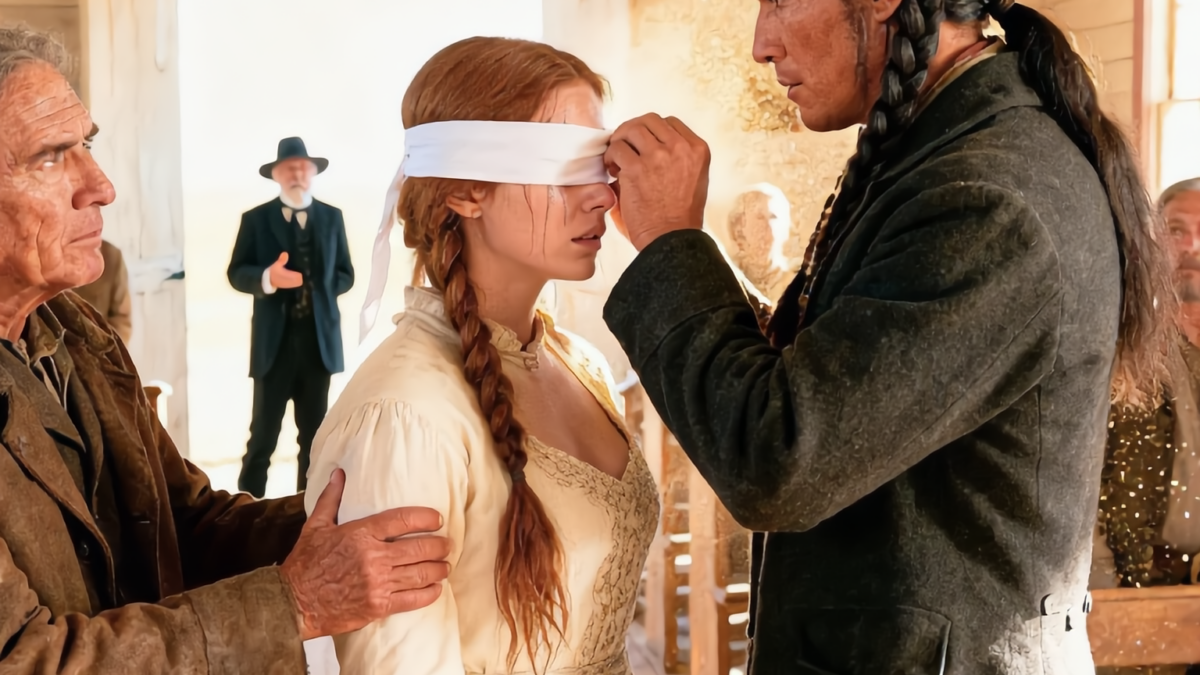
Reverend Collins’s voice trembled more from pity than from piety. His Bible shook in his hands as he looked at the young woman standing before him, her eyes covered by a strip of white cloth knotted far too tight to be called a veil.
Her name was Anna Lee. She was nineteen years old, pale as the frost that sometimes struck the prairie too early, though it was spring now and the frost had no business here. Her father’s hand pressed hard against the small of her back, steering her forward the way a man steers a horse toward an auction ring.
The cloth over her eyes was meant to hide her shame, Silas Lee had told the gathered crowd. To spare her from seeing what she did not deserve.
But the truth was simpler and uglier. The blindfold kept her from seeing the man she had been promised to.
He stood in silence before the altar: a Lakota warrior called Talon of the Red Hills. He was tall and broad-shouldered in a dark wool coat, his black hair braided, a single hawk feather tied at the end. He had not asked for a wife. She had been offered to him as part of a truce that no one in that chapel believed would last, a treaty between a town and a band of the Lakota who had been bleeding each other for years over water, grazing land, and broken promises. The girl was meant to be a symbol. Her body was meant to seal an agreement that men had written without ever asking her name.
She stood there trembling, her wrists loosely bound in front of her with a length of pale ribbon.
When the reverend asked, “Do you take this man?” her father hissed through his teeth.
“Answer.”
Her voice cracked against the wind. “I… I do.”
Talon’s gaze drifted down to her. He took in the tremor of her lower lip. The way her chin quivered beneath the knot of white cloth. The red marks the ribbon had already rubbed into her thin wrists.
When his turn came, he did not answer.
The silence stretched. And stretched. Long enough for the settlers in the pews to begin shifting uneasily. Long enough for the Lakota men watching from the doorway to glance at one another. Long enough for even the reverend to falter, his finger sliding uncertainly down the page.
Then Talon spoke, his voice low and steady. It was not a loud voice. It didn’t need to be. It carried weight the way deep water carries weight.
“She will not take me,” he said, in English that was careful and unhurried, “before she sees who I am.”
Murmurs rippled through the small congregation, half settlers in their Sunday wool, half Lakota men standing still and watchful at the threshold.
Silas Lee stepped forward, fury already rising in his face. “She doesn’t need to see anything. It’s done.”
But Talon lifted his hand, slowly, deliberately, and untied the blindfold.
The strip of cloth fell to the dusty floor like a feather drifting down from the sky.
Anna blinked against the sudden light. Her lashes were wet. And for the first time, her eyes met the eyes of the man standing in front of her.
He looked nothing like the monster she had been told to fear.
For three weeks, her father had painted him for her in the dark: a killer, a brute, a man who would beat her before the wedding night was over. She had lain awake in her narrow bed imagining scars and cruelty and a face like a storm.
Instead, she saw dark, deep eyes that held a gentleness that startled her. There was sorrow in them, too, old and quiet. It looked almost like her own.
He spoke again, more softly now, only to her.
“If she cannot see her life,” he said, “I will give her mine.”
The reverend hesitated, uncertain whether to continue. Silas Lee spat on the chapel floor.
“You’ll regret this, savage.”
But Talon did not look away from Anna.
“If it is sight she needs,” he said calmly, “then take my eyes.”
To him, the words were neither a boast nor a metaphor. They were an oath.
Anna’s lips parted. The air between them seemed to hum. And for the first time in her life, someone was speaking to her as though her worth were not a debt waiting to be paid.
The wind softened. It slipped through the open door like a promise that something sacred had just begun.
By the time the vows were finished, the sun had begun its long descent over the plains, painting the sky in streaks of pale gold and dust.
Reverend Collins closed his Bible without a blessing. The guests, if they could be called that, scattered as though they feared lingering too long in whatever had just happened. Anna stood motionless near the altar, her fingertips tracing the pink crease the blindfold had pressed into her skin.
Her father was already gone. She could hear his boots crunching up the hill toward town, and with every step came the faint, cheerful jingle of silver coins: the bride price, heavy in his coat pocket.
He did not look back. Not once.
Only Talon remained beside her, silent as the wind tugging at his coat. He did not touch her, not even when she swayed on her feet. Instead, he walked to the threshold and turned back.
“Will you come?” he asked quietly.
It was not an order. It sounded more like a question they were both asking themselves.
She hesitated, still dazzled by the light, her heart pounding against ribs that had learned too well how to stay still.
“Where?” she whispered.
“Home,” he said simply.
And for the first time in her life, the word did not sound cruel.
Outside, a paint pony waited, its reins looped around the chapel rail, its patched coat glowing in the evening light. Talon took a small bundle from the wagon bed: a blanket, a loaf of bread wrapped in cloth, a battered canteen. He held them out to her.
“You ride,” he said. “I walk.”
Anna shook her head weakly. “No. I can walk.”
He studied her for a long moment. Then he nodded once and untied the horse.
They walked in silence along the narrow trail leading away from the chapel, the tall grass brushing against their boots. The world around them was vast and empty, marked only by the slow breath of the wind and the soft creak of the saddle leather.
At the top of the low ridge, Anna turned to look back. The chapel was already only a speck, a ghost on the horizon.
“Was it true?” she asked suddenly. “What you said in there?”
Talon kept his eyes on the trail ahead. “I say nothing I do not mean.”
She swallowed. “Then why say that about your eyes?”
He slowed, picked up a small stick from the grass, and snapped it absently in two.
“Your people see what they want,” he said at last. “Eyes lie easily. The heart does not.”
The words hung between them, heavy but true, like something older than either of them.
They walked until the sun slipped behind the distant hills and the world turned the deep blue of dusk. A hawk circled high overhead, its cry slicing through the silence. Anna’s feet ached in her thin wedding shoes, but she did not complain. When she stumbled on a stone, Talon caught her by the elbow, steadying her with startling gentleness. His hand was warm and calloused, and though he let go almost immediately, the memory of his touch stayed on her skin like a heartbeat.
Over the next two days, they climbed higher.
On the second morning, they reached a high plateau where the land opened like a sea of grass beneath an endless sky. The wind tore through Anna’s hair, pulling it loose from its pins, and for the first time in weeks, she did not reach up to tie it back.
Talon stopped beside a flat rock and rested his palm on it, the way someone greets an old friend.
“This is Red Dawn,” he said. “My mother’s land. My father built a cabin here before the soldiers came.”
Anna followed his gaze. On the far side of the plateau, a small log cabin stood with a single crooked chimney leaning against the light. A thin thread of smoke rose from it, as if the house had been waiting years for someone to come home.
“You built it?” she asked.
“No,” he said. “I rebuilt what was left.”
She could hear the weight of the past in his voice. Unspoken, but heavy as the mountain itself.
When he stepped toward her, she flinched out of habit. She hated herself for it. But he only reached out and took the pale ribbon still clutched in her fist, the same ribbon that had bound her wrists at the altar.
For one heartbeat, she froze.
But he lifted it carefully, gathered her wind-tangled hair in his hands, and tied the ribbon around it instead, to keep it from the wind.
“You should not wear the past like a chain,” he said softly. “Let it hold your hair. Not your heart.”
She wanted to answer. She couldn’t find the words.
For four days, Anna learned the rhythms of Red Dawn.
She learned to tend the small iron stove. She learned to grind coffee beans with the heel of her palm. She learned to tell the hawk’s cry from the warning moan of the wind. Talon taught her without many words, through gestures and patience, showing her where the drifts hid dry wood and how to mend a fence so the boards wouldn’t warp in the rain.
At night, she slept by the fire. He slept across the room, near the door, his rifle within reach. He never once came closer.
“You think too loudly,” he told her on the third night, a faint trace of a smile in his voice.
Her cheeks burned. “I’m not used to quiet,” she admitted. “Where I come from, silence meant danger. If the house got quiet, it meant someone was about to start shouting.”
Talon nodded slowly, his eyes on the flames. “Here, silence means peace. When the land stops speaking, it means it trusts you.”
On the fourth morning, the snow on the shaded slopes began to melt. The sound of dripping water filled the air like the ticking of a clock. Anna sat on the porch in the thin sunlight, brushing dust from her skirt.
That was when she saw it.
A dark shape moving fast along the lower ridge. A horse, ridden hard.
She stood. Her heart clenched as the rider drew closer. He wore a hat pulled low over his face and a long brown duster flapping behind him like a flag. And she recognized the way he sat in the saddle: heavy, careless, cruel with the reins.
No mountain man rode like that. Her father’s hired men did.
“Talon,” she whispered, backing toward the door.
He was in the doorway almost instantly, reading the fear on her face before she said another word. “Stay inside,” he said calmly, reaching for the rifle leaning against the wall.
She shook her head. “He won’t stop. Not if he thinks I’m here.”
“Then he will learn to stop.”
The rider slowed as he reached the clearing, his horse blowing clouds of steam into the cold air. Anna recognized him now: Jeb Harlan, who drank at her father’s table and laughed too loudly at his jokes.
“You’ve got something that don’t belong to you,” Harlan called, his voice hard and arrogant. “The girl.”
Talon said nothing. The rifle rested loosely in his hands, barrel lowered.
“She is not a thing to be returned,” he said at last. “She is where she is safe.”
Harlan spat into the snow. “Safe? You call that safe? Hiding in a shack with a savage? Her pa says she ran off.”
Anna stepped out onto the porch before Talon could stop her. Her voice shook, but it held.
“I didn’t run,” she said. “I was sold.”
Harlan laughed, dry and cruel. “Call it whatever you want, miss. He sent me to fetch you.”
“Then tell him I’m not for sale.”
His smile faltered for a moment. Then the arrogance came flooding back. He swung down from his saddle, his boots sinking into the wet earth, and his hand drifted toward the revolver on his hip.
“You’re coming,” he said, taking a step toward her. “Willing or not.”
He took another step.
And the crack of a rifle shot split the valley in two.
PART 2: The Storm Comes for Them All
Anna screamed.
The echo rolled across the plateau and back again, bouncing off the red rock until it seemed that a dozen rifles had fired at once. Harlan’s horse reared, shrieking in terror, and for a single terrible heartbeat, Anna was certain she would see a man fall dead in the snow at her feet.
But Harlan was still standing.
Splinters of frozen bark rained down beside his boot. The bullet had buried itself in the trunk of a pine tree not six inches from his leg.
It had not been fired to kill. It had been fired to warn.
“Next time,” Talon said calmly, already working the lever of his rifle, his eyes steady and his voice as even as a prayer, “there is no warning.”
Harlan swore, scrambling backward, grabbing for his horse’s trailing reins. He hauled himself into the saddle with none of his earlier swagger.
“This ain’t over,” he snarled. He wheeled the horse around and galloped back toward the trail, mud flying from its hooves.
The echo died. Only the wind remained, and the dull, frantic pounding of Anna’s heart.
She stood frozen, her hands clenched in the hem of her shawl. Talon lowered the rifle. His breath fogged in the cold air.
“He’ll tell the others,” she whispered. “They’ll come.”
“Let them come,” he said. “This land knows me better than it knows them.”
She wanted to protest. She wanted to tell him she couldn’t bear to be the reason danger came climbing up his mountain. But the words died at the look in his eyes. It wasn’t anger. It wasn’t fear. It was something deeper: a silent promise, made to no one but himself.
“You don’t owe me anything,” she finally said.
“That is true,” he agreed softly. “But I chose it.”
And Anna realized that for the first time in her life, someone’s protection came without a price.
It came with peace.
The storm broke two days later, without warning, sweeping across the plateau like a punishment handed down from something ancient and restless.
The sky turned the color of iron. The first crack of thunder rolled through the valley before the wind even reached them. By dusk, the cabin was shuddering under the weight of the rain. Talon nailed the shutters closed, and Anna worked beside him, steady despite her numb fingers, holding the boards while he hammered. The sound was fierce and rhythmic, like a heart refusing to stop.
When the last window was covered, they stood in the dim orange glow of the hearth, soaked to the bone and out of breath.
“How long will it last?” she asked.
“Long enough to test what was built,” he said, nodding toward the walls. “Storms always test.”
She managed a faint smile. “And people?”
His eyes met hers. “Them too. People most of all.”
Lightning ripped through the cracks in the shutters, throwing their shadows huge against the far wall. For an instant, it looked as though two giants stood in that small cabin, defying the sky itself.
When the wind drove a gust of smoke and sparks back down the chimney, Talon moved without thinking, pulling her against his chest to shield her from the embers. She froze. She could feel the warmth of him, the slow, steady rhythm of his breathing.
“You are shaking,” he said softly.
“It’s the cold,” she lied.
He let her go. But his hand lingered on her shoulder one heartbeat too long.
The hours passed that way: silence, thunder, the storm beating against the walls. At some point, Anna fell asleep in the chair by the fire, her head tilted toward the window, the folded blindfold resting in her lap. She had kept it all this time. She couldn’t bring herself to burn it. Part of her still believed that destroying it would erase more than the pain. It would erase the proof that she had survived.
Talon watched her from across the room, the firelight tracing the thin scar along his jaw, a mark from another life he never spoke of. He remembered how she had looked on the trail that first evening: eyes wide with fear, hands shaking. And he looked at her now, calm in the middle of chaos, with a softness he hadn’t seen in anyone since before the wars.
He realized, with a quiet kind of wonder, that the storm outside no longer frightened him.
It was the stillness that did. The stillness that came over him when he looked at her and felt something he had no word for, in either of his languages. Something between grace and belonging.
Near midnight, a branch struck the roof with a sound like a gunshot. Anna jerked awake.
Talon was already at the door, opening it a crack. “A tree came down near the ridge,” he said. “We will deal with it at dawn.”
She nodded, rubbing her eyes. “You should rest.”
The corners of his mouth lifted. “Now you give orders to warriors?”
“Only the tired ones,” she said, smiling in the shadows.
He laughed, a sound so rare it felt like a gift.
When the thunder finally rolled away into the distance, Anna looked down at the white cloth in her lap.
“This was supposed to keep me from seeing my shame,” she murmured. “But I think it was keeping me from seeing grace.”
Talon looked at her steadily. “Then do not keep it anymore.”
She hesitated. Then she leaned forward and dropped the blindfold into the fire.
The cloth curled and blackened, a single thread catching flame before vanishing into light. And the storm outside died with it, sinking into a silence so complete it felt like an answered prayer.
Three days after the storm, a rider left a letter by the creek.
Talon found it at dawn and brought it to her without a word. Folded paper, worn at the edges, a broken seal of red wax.
The handwriting was jagged, carved into the page the way a man carves wood: with force and no delicacy. There was only one line.
You belong to no savage. The preacher will mend what was broken. We come Sunday.
Beneath it was a signature she hadn’t seen in months. Her father’s.
The paper trembled in her hands. But she did not cry. Not this time.
“He means to take me back,” she whispered.
Talon’s jaw tightened as he looked toward the valley below. “He comes with men who talk too much and listen too little.”
She folded the letter and tucked it into her apron, as though hiding it might change what it meant. “You should let me go,” she said finally, her voice low and steady. “If they come, they’ll bring guns. And I won’t be the reason this place burns.”
Talon turned to her then. The lines in his face looked deeper than before.
“You think you are the reason for what men do?” he asked. “You think cruelty waits for permission?”
His tone was gentle, but it broke something in her anyway. She lowered her eyes. “I just don’t want you hurt.”
He drew a slow breath. “When I said you would see through my eyes, I meant more than sight. I meant you would learn to stop closing them when the world makes you small.”
“And if I can’t?” she whispered.
“Then I will see for both of us.”
Those words should have sounded like pity. Instead, they sounded like faith.
They came on Sunday at noon.
The valley shimmered in the warmth of the thaw, a haze that made the riders look like ghosts until they were nearly at the ridge. There were four of them. Her father rode in front, his coat far too fine for the land he trampled, his face set into something harder than she remembered. Reverend Collins rode beside him, his Bible tucked under his arm like a weapon. Behind them came Jeb Harlan and another hired gun, men paid for obedience rather than conviction.
Talon stood a few paces in front of the cabin, his shadow stretching across the dry grass.
His hands were empty. He had left his rifle inside.
Anna’s heart hammered as the riders reined in, their horses blowing clouds of steam into the still air.
“That’s far enough,” Talon said, calm as the mountain.
Silas Lee swung down from his horse with a heavy thud. “You think you can keep what ain’t yours?”
“I keep only what came to me by choice.”
“She’s a child,” her father spat. “And you’re nothing but a savage hiding behind her shame.” He turned to Anna, his voice rising. “Get over here. You made a fool of me once. You won’t do it twice.”
The sound of those words broke something open inside her. Something that had been dying slowly for years.
She took a step. But not toward him.
Her feet carried her to Talon’s side, her skirt brushing against his coat.
“I don’t belong to you,” she said. “Not now. Not ever.”
Her father’s face flushed crimson with rage. “You were bought.”
“No,” she said softly, her voice trembling but sure. “I was given away. He gave me back to myself.”
Harlan raised his revolver, hesitant but eager.
Talon lifted his open palm in the sign of peace. “There is no war here,” he said. “Only the one you carry with you.”
Reverend Collins shifted uncomfortably in his saddle. “The girl’s father has rights under the law.”
“Then your law is blind,” Talon answered. “Perhaps it needs my eyes.”
The words hung in the air like prophecy.
“Take her!” Silas Lee roared.
Harlan moved first, lunging forward, and the world split open with a thunder that did not come from the sky. The shot went wide, shattering a boulder into a spray of red dust. In the same breath, Talon moved faster than Anna would have believed possible. He seized Harlan’s wrist, twisted the revolver from his grip, and hurled it into the grass.
“Enough,” Talon said. His voice shook with a fury he had denied himself until that moment. “You have taken enough.”
Silas Lee stumbled backward. His face went pale, the rage draining into fear. “You’ll hang for this,” he hissed.
“Perhaps,” said Talon. “But not before I teach you what it means to truly see.”
He stepped forward. Not as a threat. As the weight of truth.
And for the first time in his life, the man who had sold his daughter could not hold another person’s gaze.
Reverend Collins raised a trembling hand. “Let it end here,” he said hoarsely. Then, quieter, almost ashamed: “I married them before God, Silas. I’ll not undo it with blood.”
Silas Lee looked from the reverend to his daughter to the warrior standing between them. Then he turned abruptly, hauled himself onto his horse, and rode away. The others followed, silent and shamed, until their shapes faded into the bright haze of the valley.
When the last hoofbeat died away, the silence returned. Deep, trembling, alive.
“They will not come again,” Talon said.
Anna wanted to thank him, but the words felt far too small. So instead, she took his hand.
PART 3: The River of Light
That evening, the valley was calm again, the air washed clean by the storm of men and pride that had passed through it.
Anna stood beside the river below the cabin, watching the water glitter where it ran shallow over the stones. She knelt to touch it. Cold and alive. And for the first time since she had left the chapel, she felt the trembling in her hands slow.
Talon came down the slope with a bucket, his steps so light the earth barely seemed to notice. He set it down beside her.
“I needed to see something that moves without fear,” she said, letting her fingers trail through the current. “The river doesn’t care what it’s seen. It just keeps going.”
He crouched beside her. “The river remembers,” he said. “It carries every storm, every fallen leaf. But it does not hold them. It lets them pass.”
“I want to be like that,” she said. “I want to let things pass.”
“Then begin here.”
He reached into the water and drew out a small stone, smooth and pale from years of current, and placed it in her palm.
“Throw it. Give it back to the water.”
She weighed it in her hand. “And if it sinks?”
“Then it learns peace.”
She drew back her arm and threw. The stone flashed once in the light, then vanished beneath the surface, leaving only rings spreading outward.
For a long time, neither of them spoke.
“You’ve given me more than I can ever repay,” she said at last.
“You owe me no thanks.”
“Then what can I give you?”
“The truth,” he said simply. “The kind that does not hide.”
She looked down at her own reflection, trembling on the water. “The truth is that I used to wish I’d never been born.” Her voice broke on the last word. “I thought God had forgotten me.”
Talon’s eyes softened. His hand closed gently around her wrist, right where the ribbon had once bound her.
“Then perhaps He sent someone who did not.”
The river seemed to grow louder, as though the whole world had been holding its breath. Tears filled her eyes, but not from pain. From something larger, like light breaking through a door that had been shut too long.
“When I was blindfolded,” she whispered, “I prayed that if I ever saw again, it would be something worth looking at.”
She looked at him.
“I think it was.”
Talon smiled faintly. “Then your prayer was answered.”
As the last of the sun faded, the river turned to silver, then to fire, a ribbon of light woven through the dark land.
“The river of light,” she murmured. “Your eyes saw it first.”
Talon shook his head, looking at her instead of the water.
“No,” he said softly. “Now they are yours.”
Morning came gentle and silver, the kind that gives the world back its innocence.
Anna had not slept. She stood on the porch wrapped in Talon’s old wool blanket, watching the first light touch the peaks beyond Red Dawn. When he stepped outside, the rising sun struck his face, and for a moment he looked almost unreal: half shadow, half light, like something the mountain had decided to keep.
“You did not sleep,” he said.
“I was afraid that if I closed my eyes, I’d wake up in that chapel again.”
“That place does not exist anymore.”
She looked down at her wrists, where faint marks still lingered. “I thought blindness was the worst prison,” she said. “But it wasn’t. The worst prison was believing what they told me I was.”
He nodded slowly. “They took your sight for their comfort. You found your own vision for yourself.”
A faint smile touched her lips. “Then maybe I don’t need your eyes after all.”
“No,” he said gently. “But you have them anyway.”
She laughed, a soft, trembling sound that surprised them both.
“What will you do now?” he asked.
She turned to him, her face glowing in the dawn. “Live,” she said. “And see everything.”
He studied her a moment longer. Then he held something out to her: a small strip of blackened cloth, its edges frayed by flame.
“You kept it,” she whispered. “You pulled it from the fire.”
“It was part of your story,” he said. “Now it can rest.”
She held it in her palm, the faint smell of smoke still clinging to it. Then she opened her hand and let the wind take it. It rose, spun once, caught the light, and vanished into the sky.
“You told me once that eyes lie easily,” she said.
“They do.”
“Then tell me what you see now.”
He looked at her, and at the light behind her, and at the land that had once been red with loss and was now golden with promise.
“I see peace,” he said. “And I see that it is looking back at me.”
She reached for his hand. And this time, there was no preacher, no father, no treaty, no coins jingling in anyone’s pocket. Only two people choosing each other in the open morning light.
“I take you,” she said quietly. “With my eyes open.”
His fingers tightened around hers. “And I take you,” he answered, “with all of mine.”
The wind moved through the grass in long waves, carrying away the last trace of smoke, the last shadow of the blindfold, until nothing remained but the morning, clear and open and free.
And as the first bird broke the silence, the world began again.
No vows of bargain. No bonds of ribbon. No fear.
Only sight.








