I Took the Wrong Suitcase in Paris. Inside Was a Wedding Dress, and the Bride Begged Me, “Please Don’t Give It Back Yet”
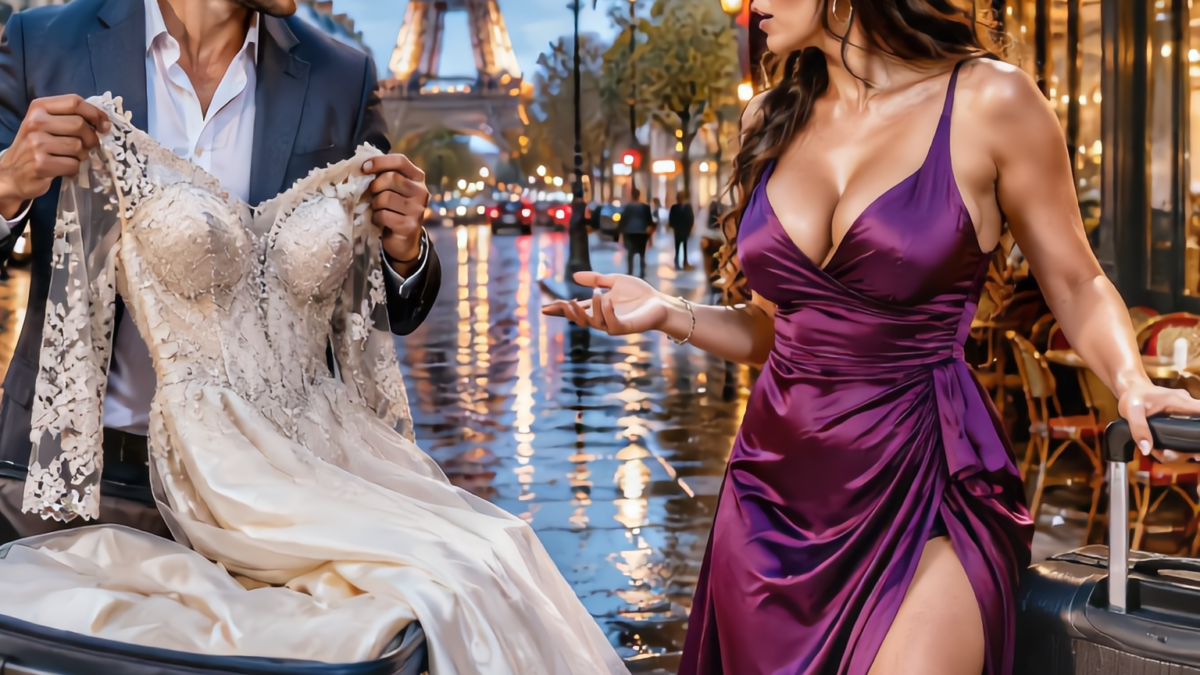
PART 1: The Wrong Suitcase
The bride was crying when she found me in the middle of a Paris train station holding her wedding dress.
But it wasn’t the suitcase that was making her cry.
She looked me straight in the eye and whispered, “Please. Don’t give it back to me yet.”
My name is Caleb Mercer. Three hours earlier, I had never heard of the woman standing in front of me. I was in Paris on a two-day business trip, consulting for a logistics firm that wanted to modernize its warehouse software, and I had packed exactly what I needed: one small black suitcase, two suits, a laptop, and a firm intention to be asleep in my hotel bed before midnight.
Instead, one careless moment at a baggage carousel dropped me into the center of a stranger’s wedding. And somehow, into the center of her heartbreak.
My flight from Chicago had landed at Charles de Gaulle nearly three hours late. A storm over the Atlantic had kept us circling, then a broken jet bridge had kept us trapped on the tarmac for another forty minutes while a toddler two rows behind me screamed with the righteous fury of someone whose entire world had become a seatbelt. By the time I reached baggage claim, I was exhausted, hungry, and scrolling through a mountain of emails I had no business answering at that hour.
The carousel groaned to life. Bags tumbled down the chute one after another. Black, black, gray, black. Every suitcase in Europe, it seemed, was black.
Then one rolled toward me with a small silver luggage tag clipped to the handle. I’d bought a silver tag at the airport in Chicago precisely so I wouldn’t make this mistake. I barely looked up from my phone. I grabbed it, swung it off the belt, and walked straight toward the train.
I didn’t realize what I’d done until I reached my hotel near Gare du Nord.
The room was small and smelled faintly of lavender and old radiators. I set the suitcase on the bed, unzipped it, and froze.
On top lay neatly folded clothes, but they weren’t mine. A cream-colored silk blouse. A soft gray cashmere cardigan. A pair of white satin heels wrapped carefully in tissue paper. Tucked into a corner was a small velvet box, deep blue and worn at the edges, the kind that held something old and treasured rather than something newly bought.
And beneath it all lay a long white garment bag.
I knew I shouldn’t. I knew it with absolute certainty. But my fingers moved anyway, sliding the zipper down just a few inches, just enough to understand what I was holding.
White lace. Delicate, intricate, impossibly fine. A wedding dress.
I zipped it back up as if I’d touched something sacred. For a long moment, I just stood there in that cramped hotel room with my heart pounding, feeling like a thief who had accidentally stolen someone’s entire future.
Then I noticed the envelope.
It was tucked against the side of the garment bag, slightly bent, made of heavy ivory paper. On the front, in careful, slanting handwriting, were five words:
For tomorrow. Please, please, please.
I didn’t open it. I didn’t even touch it. Because at that exact moment, my phone rang.
“Monsieur Mercer?” The voice was crisp, professional, and unmistakably exhausted. “This is the baggage service at Charles de Gaulle. Another passenger from your flight has reported a missing suitcase. We believe you may have taken hers by mistake. Your bag, it seems, was collected by her.”
I closed my eyes. “Yes. I’m so sorry. I have it right here.”
“She has asked whether you could meet her tonight,” the agent continued. “She said it is extremely urgent. She is waiting at Gare du Nord.”
Twenty minutes later, I was back at the station, walking through the rain with a stranger’s wedding dress slung carefully over my arm.
Gare du Nord at night is a strange, restless place. Trains sigh and shriek beneath the great iron canopy. Travelers drift past like ghosts, dragging luggage, clutching tickets, shouting into phones in a dozen languages. The air smells of diesel and wet stone and burned coffee.
That’s where I saw her.
She was standing near the main entrance in a long beige coat, her dark hair damp and slightly tangled from the rain. One hand was clenched around the handle of my black suitcase, my own silver tag glinting beneath her fingers. She looked like someone who had spent the last hour trying with every ounce of strength not to fall apart, and was losing.
When she saw the garment bag over my arm, her whole body went still.
“You have my suitcase,” she said.
“I think I do,” I said. “And you have mine.”
She nodded. But she didn’t reach for her bag. She didn’t move at all. Her eyes stayed locked on the white garment bag as though it were a live animal that might bite.
“Did you open it?” she asked.
“Only enough to realize what it was.” I felt my face grow warm. “I’m so sorry. I swear I didn’t mean to.”
She lowered her eyes. “My wedding dress.”
“I’m sorry,” I said again, because I couldn’t think of anything else. I held it out toward her. “Here. It’s all there. I didn’t touch anything else.”
She didn’t take it.
Instead, she stepped closer and lowered her voice until I could barely hear her over the roar of an arriving train.
“Please,” she whispered. “Don’t give it back to me yet.”
I was certain I had misheard. “What?”
“Please don’t give me the dress. Not tonight. Not until tomorrow morning.”
I stared at her. “Why?”
She glanced around the crowded station, as though someone might be watching. When she looked back at me, her lips were trembling.
“Because if I take it back tonight,” she said, “I’ll wear it tomorrow. And I’ll walk down that aisle. And that would be the worst mistake of my life.” She drew a ragged breath. “I don’t know if I’m going to marry him.”
That single sentence changed everything.
Her name was Maren Ellis. She was thirty-two years old, a pediatric nurse from Chicago, and she had flown to Paris with her fiancé, Grant, for a wedding they’d spent nearly a year planning. The ceremony was set for the following afternoon in a small historic chapel in a village outside the city. Seventy guests had flown in from across the United States. Her parents had spent most of their savings on it. Every chair, every candle, every white rose had been chosen with care.
Grant had flown in a day earlier to meet with the wedding planner. They had been supposed to travel together, but a scheduling conflict at Maren’s hospital had pushed her flight back. At the last minute, Grant had changed his own ticket to fly with her. “So we can arrive together,” he’d said. “Like it’s meant to be.”
On the flight, somewhere over the dark Atlantic, he had fallen asleep beside her with his head against the window.
And his phone, resting face-up on his tray table, wouldn’t stop lighting up.
“I didn’t mean to look,” Maren said, her voice breaking. “I swear I didn’t. But it just kept glowing, over and over, and finally I glanced down.”
A message had appeared on the screen. It was from a woman named Elise.
Maren knew Elise. Everyone did. She was Grant’s ex-girlfriend, the one he had sworn was completely in the past, the one he rolled his eyes about at dinner parties.
The message said: You promised me you’d tell her before the wedding.
Maren had sat frozen in her seat for the remaining three hours of the flight, staring at the back of the seat in front of her while Grant slept peacefully beside her. When they landed, she confronted him in the terminal. He denied everything. He laughed it off, said Elise was unstable, said she was trying to sabotage them, that it was nothing.
But then, while he was in the restroom, Maren had picked up his phone, the code was still her birthday, and found the messages he thought he’d deleted.
It wasn’t one affair. It wasn’t one drunken mistake.
It was months of secret conversations. Hotel bookings. Meetings during “business trips.” Promises. And one message, sent only three weeks earlier, that Maren said she would remember for the rest of her life.
I’m only marrying her because my family expects it. Give me a year. I’ll figure it out.
“I should have walked away the second I found out,” Maren said softly. “But I’d spent so long planning tomorrow. So many people are here. My mother cried when she saw the chapel. And I just stood there in that airport, and I couldn’t make myself admit it was over.”
She had fled the terminal in a daze, grabbed what she thought was her suitcase, and taken the train into the city alone, leaving Grant searching for her at the arrivals gate. Only when she reached a friend’s apartment did she discover the suitcase wasn’t hers.
“When I realized you had my dress,” she said, “my first feeling wasn’t panic.” She laughed, and it was a terrible, hollow sound. “It was relief.”
I held the garment bag out to her one more time, gently. She shook her head.
“I know what you’re thinking,” she said.
“I probably don’t think what you think I’m thinking.”
A faint, sad smile touched her face. “You think I’m crazy.”
“No,” I said. “I think you’re in Paris with a wedding dress you don’t want to wear.”
She stared at me for several long seconds. Then her eyes filled.
“That’s the first honest thing anyone has said to me all day.”
We found a quiet café a block from the station, a narrow place with fogged windows, mismatched chairs, and an elderly waiter who looked at the soaked American couple and the wedding dress and wisely decided not to ask questions. Maren ordered tea and barely touched it. I ordered coffee I didn’t need. The garment bag lay across the empty chair between us like a third person at the table.
For the next hour, I mostly listened.
She talked about how she and Grant had met at a charity gala five years earlier. How charming he’d been, how certain, how his family had embraced her immediately. She talked about the small doubts she’d brushed aside over the years: the late nights at the office, the phone always turned face-down, the way he sometimes looked through her as though she were furniture. She talked about how she’d told herself every couple had problems, that wedding nerves were normal, that love was a choice you made every day even when you didn’t feel it.
Then her phone buzzed on the table.
Grant.
She stared at the screen. “He knows I found out.”
“Are you going to answer?”
“No.”
Another message appeared. Then another. Then another, stacking up on the screen in rapid succession.
She finally turned the phone so I could see.
Please come back.
We can fix this.
Don’t throw everything away over one mistake.
Maren laughed bitterly. “One mistake?” She locked the phone and set it face-down. “I think I kept calling it a mistake because admitting it was a habit hurts too much.”
The phone buzzed again. This time, she didn’t even look.
But I did.
The message preview glowed against the dark tabletop.
I can see where you are, Maren. You still share your location with me.
My blood went cold. Maren must have seen my face change, because she snatched up the phone, read it, and every trace of color drained from her cheeks.
“Oh God,” she whispered. “I forgot. I forgot to turn it off.”
Her hands were shaking so badly she couldn’t unlock the screen. I reached over to help, but before either of us could do anything, the little bell above the café door jangled.
A gust of cold, wet air swept across the room.
A tall man in a dark, rain-soaked overcoat stood in the doorway. He was handsome in the polished, expensive way of men who have never been told no, his jaw clenched, his chest rising and falling as though he’d been running. His eyes swept the café once and landed on Maren.
Then they moved to me.
Then, slowly, to the white garment bag lying across the chair between us.
The entire café fell silent. Even the elderly waiter stopped wiping the counter.
The man took one step forward, water dripping from his coat onto the black-and-white tiles.
“Maren,” he said, his voice low and dangerously calm. “Who the hell is this?”
And then he held out his hand toward me.
“Give me the dress.”
PART 2: One Honest Thing
For a few seconds, nobody moved.
I could feel Maren beside me, rigid as a statue. I could feel the eyes of every person in that tiny café: an old man with a newspaper, two students sharing a croissant, the waiter frozen mid-wipe. I could hear rain drumming against the fogged glass and the low hum of the espresso machine.
Grant took another step toward our table, his hand still outstretched.
“I’m not going to ask again,” he said. “That dress cost more than your car. It belongs to my fiancée. Hand it over.”
I didn’t stand up. I didn’t reach for the garment bag. Every instinct in my body was urging me to tell this man exactly where he could put his outstretched hand, but some calmer part of me knew that this moment didn’t belong to me. If I turned this into a contest between two men, I would just be one more person deciding Maren’s life for her.
So I looked at her instead.
“It’s your dress,” I said quietly. “It’s your call.”
Grant laughed, a short, contemptuous bark. “Oh, that’s good. That’s very noble.” He turned to Maren, and his face transformed instantly, softening into an expression of wounded tenderness so practiced that it made my skin crawl. “Babe. Come on. You’re exhausted. You haven’t slept. You’re not thinking clearly. Let’s go back to the hotel, and we’ll talk about everything. I’ll explain all of it.”
Maren stared at him. Her voice, when it came, was barely a whisper. “Explain it, then.”
He blinked. “Here?”
“Here,” she said. “Right now. In front of him. In front of all of them.” She gestured around the café, her hand trembling. “Explain Elise. Explain the hotel in Denver. Explain the message from three weeks ago.” Her voice cracked but didn’t break. “Explain why you’re only marrying me because your family expects it.”
The silence that followed was crushing.
Grant’s jaw worked. I watched him calculate, weighing which version of the truth might still save him.
“It was a mistake,” he finally said. “One stupid mistake. It’s over. I ended it. Those messages were just me trying to let her down gently. You know how she is. She’s obsessive. She won’t let go.”
“Then why did you promise to tell me before the wedding?” Maren asked. “Tell me what, Grant?”
He opened his mouth. Nothing came out.
“Months,” she said, her voice growing stronger with every word. “Months of it. That’s not a mistake. That’s a choice. You made it over and over and over again, and every single time, you came home and kissed me and helped me pick out napkins.” She stood up slowly. “I’m not going to the hotel with you. I’m not going anywhere with you tonight.”
Grant’s face hardened. The tenderness vanished like a mask dropped on the floor.
“You’re humiliating yourself,” he said coldly. “You’re humiliating both of us. Seventy people flew across an ocean for tomorrow. My parents paid for half of this. Your parents emptied their retirement account. Do you have any idea what you’re about to throw away? Over what? A few text messages?” He leaned closer. “You’ll be at that chapel tomorrow at two o’clock, Maren. Because deep down, you know you don’t have anything else.”
That last sentence hung in the air like smoke.
I saw it hit her. I saw the old reflex flicker across her face, the instinct to shrink, to apologize, to make herself smaller so he wouldn’t be angry. For one terrible moment, I thought she might actually reach for the dress.
Then something in her expression changed. Her shoulders straightened. Her chin lifted.
“Get out,” she said quietly.
“Maren—”
“Get out,” she repeated, louder now. “Or I’ll ask him”—she nodded toward the elderly waiter, who had silently picked up the café telephone—“to call someone who will make you.”
Grant looked at the waiter. At the students. At the old man with his newspaper, who had folded it neatly in his lap and was watching with an expression of ancient, unimpressed disapproval.
He turned back to Maren, and for a moment I thought he might say something unforgivable. Instead, he simply shook his head, as though she were a hopeless case, and walked out into the rain without another word.
The bell above the door jangled.
Maren sank back into her chair and covered her face with her hands. Her whole body was shaking.
The elderly waiter set down the phone, walked over, and placed a small glass of brandy in front of her without saying a word. Then he patted her shoulder twice, gently, the way a grandfather might, and went back behind the counter.
“Turn off your location,” I said softly.
She laughed through her fingers, a wet, broken sound, and did it immediately.
For a long time, she didn’t speak. When she finally lowered her hands, her eyes were red, but her voice was steady.
“Can I ask you something?”
“Of course.”
“Why didn’t you just give him the dress? It would have been so much easier. You don’t know me. You don’t owe me anything.”
I thought about it for a moment. Then I decided to tell her the truth.
“Four years ago,” I said, “I was engaged too. Her name was Hannah. Three weeks before the wedding, she sat me down at our kitchen table and told me she couldn’t do it. She said she loved me, but not the way you’re supposed to love someone you’re going to spend fifty years with. And she said she’d rather break my heart once than spend the rest of her life slowly breaking both of ours.”
Maren stared at me. “What did you do?”
“I hated her,” I admitted. “For about a year. Everyone told me she was cruel, that she’d humiliated me, that she should have figured it out sooner.” I turned my coffee cup slowly on its saucer. “But eventually, I realized she’d been the bravest person I’d ever known. She saw what neither of us wanted to see, and she said it out loud. She saved both of us from a life of pretending.”
Maren was silent.
“So when you told me you didn’t want the dress back tonight,” I said, “I recognized it. That wasn’t you being crazy. That was the bravest part of you trying to buy itself one more night.”
Tears slid down her cheeks. She didn’t wipe them away.
“What would you do?” she asked. “If you were me?”
I didn’t hesitate. “I’d rather disappoint a room full of people for one day than disappoint myself for the rest of my life.”
She was quiet for a very long time.
Then she reached across the table, toward the garment bag, and I thought for a moment she’d changed her mind. Instead, she pulled out the ivory envelope that had been tucked beside the dress. For tomorrow. Please, please, please.
“I wrote this,” she said softly. “Four months ago. These are my vows. I wrote ‘please, please, please’ on the front because I was so terrified of losing them. I made myself promise I’d read them for the first time at the altar.”
She opened the envelope, unfolded the single page inside, and began to read silently. I watched her face as she read, line by line. Watched it tighten, then soften, then crumble.
When she finished, she set the page down on the table between us.
“I promised to love a man who sees me,” she said. “Who tells me the truth even when it’s hard. Who makes me feel safe being exactly who I am.” She looked up at me, her eyes shining. “I wrote these vows for a man who doesn’t exist. I wasn’t describing Grant. I was describing what I wanted, and I was trying to convince myself he could become it.”
I walked her back to her friend’s apartment around one in the morning. The rain had softened into mist, and the streets glowed gold under the lamps. At her door, she turned to me, and for a moment, I thought she was going to ask for the dress after all.
Instead she said, “Keep it tonight. Please. I don’t trust myself with it yet.”
“Okay,” I said.
“Thank you, Caleb.”
“I didn’t do anything.”
She smiled faintly. “You listened.”
The next morning, I woke to a message on my phone.
Thank you for last night. I’m going to the chapel.
My heart dropped like a stone. For one awful moment, I thought she’d decided to marry him after all.
Then another message appeared.
I’m going to cancel the wedding. I want to tell everyone myself. In person. Could you bring me the dress?
I smiled so wide my face hurt.
I brought the garment bag to her hotel that morning. She met me in the lobby wearing jeans and an old sweater, her hair pulled back, her eyes swollen but clear. She unzipped the bag and stared at the white lace for a long moment.
“I thought I’d feel relieved,” she said.
“Maybe you will,” I said. “Eventually.”
She brushed her fingers along the lace sleeve. “This dress cost more than my first car.”
“Then it deserves a better story.”
She laughed, really laughed, for the first time since I’d met her.
But before she turned toward the elevator, she paused and looked back at me.
“There’s something I never told you.”
“What?”
“I asked you not to give back the dress because I was scared that once it was in my hands, I’d talk myself into letting everything happen. I’d convince myself to just get through the day and figure it out later.”
“And did it work?” I asked.
She smiled. “No. You did.”
That afternoon, Maren stood at the front of a small stone chapel outside Paris, surrounded by seventy guests and hundreds of white roses, and told them the truth. Grant tried to stop her. Then he tried to persuade her. Then, when that failed, he blamed her in front of everyone. And finally, when his own father asked him directly, he admitted that he’d been seeing Elise for months.
Maren’s parents were furious at first. Her father paced the chapel steps, muttering about deposits and plane tickets. But when her mother saw her daughter’s face, she said nothing about the guests or the money. She simply crossed the aisle and pulled Maren into her arms and held her while she cried.
The wedding never happened.
PART 3: A Better Story
I flew back to Chicago two days later. The business meeting went fine. I don’t remember a single thing about it.
Life resumed its ordinary shape. Work. Gym. Takeout eaten standing over the kitchen counter. But something had changed in me, too, though it took me weeks to understand what. For four years after Hannah left, I’d quietly believed that the safest life was a small one, that if you never let yourself want anything too badly, nothing could be taken from you.
Watching Maren stand up in that café and say “Get out” to the man who had told her she had nothing else, I’d realized I’d been hiding from my own life in a different way. She had walked away from a future that was wrong for her. I had simply stopped walking at all.
I started saying yes to things. Dinner invitations. A pottery class my sister had been nagging me about for two years. A weekend trip to Michigan with old college friends I’d been avoiding. Small, ordinary yeses. But each one felt like opening a window in a house I’d kept shut for too long.
Three months after Paris, an envelope arrived at my apartment.
No return address. Just my name, written in careful, slanting handwriting I recognized instantly.
Inside was a single photograph.
Maren stood on a windswept beach somewhere, the ocean a deep blue-gray behind her, her dark hair whipping across her face as she laughed at the camera. And she was wearing the wedding dress.
Except it wasn’t the same dress anymore.
Someone, probably a talented seamstress, had completely transformed it. The heavy train was gone. The long lace sleeves had been removed. It was shorter now, simpler, falling just below the knee, light enough to move in the wind. She was barefoot in the sand, her arms thrown wide, and she looked more alive than any bride I had ever seen.
I turned the photo over. On the back, she had written:
I didn’t wear it to marry someone else. I wore it to celebrate coming back to my real life.
And beneath it, one more line:
P.S. I still owe you a coffee.
I stood in my kitchen holding that photograph for a long time. Then I pinned it to my refrigerator with a magnet shaped like the Eiffel Tower, and I left it there.
Six months after the suitcase mix-up, I went back to Paris.
This time, the trip wasn’t for business. This time, I packed my suitcase slowly and carefully, and I bought a new luggage tag at the airport, bright red, impossible to confuse with anything.
Maren was waiting outside the café near Gare du Nord where we’d first talked. The same fogged windows. The same mismatched chairs. It was spring now, and the chestnut trees along the boulevard were heavy with pale pink blossoms. She was wearing a yellow coat, and when she saw me crossing the street, she waved with her whole arm, like a child, and something in my chest gave way completely.
No wedding. No fiancé. No panic. No suitcase between us.
Just two people who had met by mistake and stayed because they didn’t want to let something that real slip away.
The elderly waiter was still there. When he saw us walk in together, he paused for exactly one second, then gave a small, dignified nod, as though this outcome had been obvious to him all along. Without being asked, he brought Maren a tea and me a coffee, and then a small glass of brandy for each of us, “pour la suite,” he said. For what comes next.
We sat at the same table. The empty chair beside us held nothing but our coats.
Maren wrapped her hands around her tea and smiled at me across the table.
“You know,” she said, “I still can’t believe you took my suitcase.”
I laughed. “And I still can’t believe you asked me not to give it back.”
She looked out the window for a moment, at the blossoms drifting across the wet pavement, at the travelers hurrying toward their trains with their black suitcases and their tired faces and their entire lives packed inside.
Then she looked back at me, and her eyes were soft and certain.
“Maybe it was the best mistake either of us ever made.”
I reached across the table and took her hand. She didn’t pull away.
Outside, a train whistled, long and low, the sound of something leaving and something arriving all at once. And I thought about how close I’d come to never looking up from my phone that night. How close she’d come to wearing that dress for the wrong man. How easily two lives can pass each other on a baggage carousel without ever knowing what they might have meant to each other.
Sometimes the wrong suitcase carries exactly what you were supposed to find.








