She Came West to Teach. Her Stagecoach Was Ambushed Before She Arrived. The Navajo Scout Who Pulled Her From the Wreckage Asked Only One Thing: “Do I Have Your Permission?”
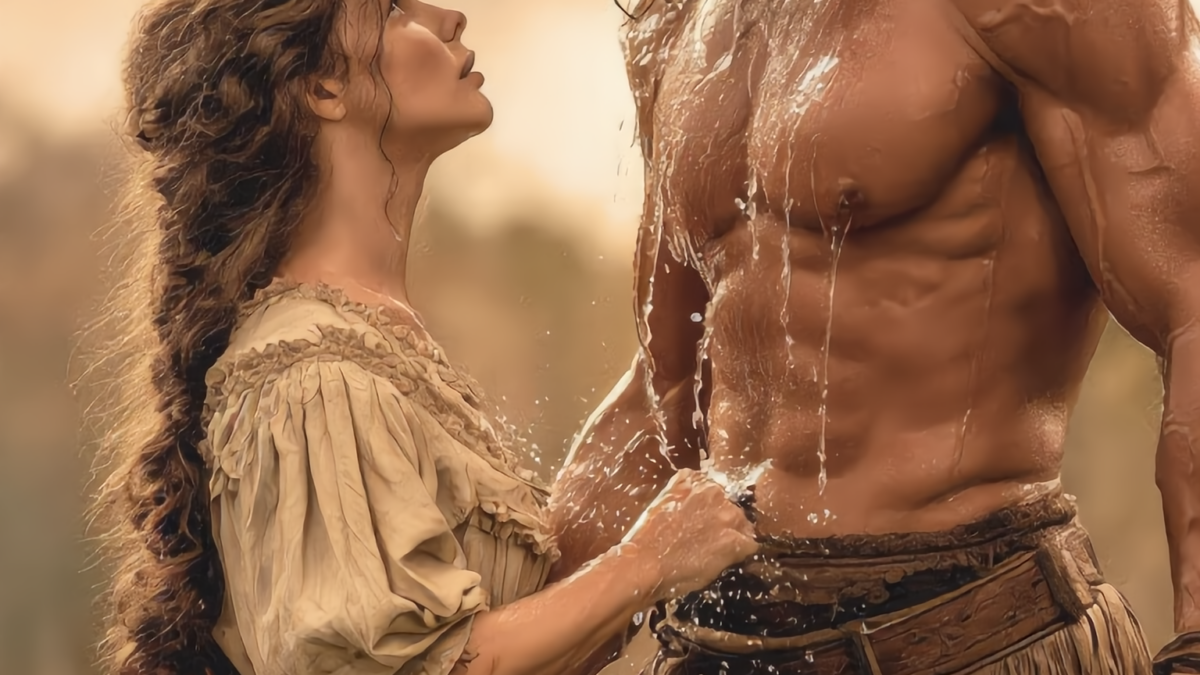
PART 1: Dead Man’s Cut
The dust was the first thing.
It was not the dust she had known: the gray soot of Boston streets. This was a fine red powder that coated every surface, worked its way through the seams of the stagecoach, and settled on her damp skin. It tasted of iron and of ages.
Eliza Hart sat very still, her hands clasped tightly in her lap. The heat was a physical weight, pressing the dark wool of her traveling suit against her ribs. It was the late 1870s, and the Arizona and New Mexico territories lay in the grip of a drought so fierce it felt biblical. Beyond the window, the land was baked red and cracked, the skeletal remains of mesquite and cholla clinging to a thorny, desperate life.
At twenty, Eliza was, by the standards of the East, a confirmed spinster. She had never been courted. She had been raised to become a quiet, gray companion to a wealthy aunt, reading aloud in a parlor that smelled of camphor until one of them died.
This journey was her one act of defiance.
In her reticule, beneath a linen handkerchief, lay a letter from her father. He had been gone five years, but his words were her compass: Choose your own way, Eliza. Do not let them build your fences.
And so she had chosen. A clipped advertisement in a church newspaper for a schoolteacher. A formal reply. A letter of invitation bearing the surprisingly elegant signature of Mayor Horace Crowley of San Miguel Wash, a town she could not find on any proper map.
Her trunk was filled with books: Shakespeare, Virgil, primers on grammar and arithmetic. Beside her on the seat, taking up the space of a person, sat her camera. A heavy box of polished mahogany and brass that used glass plates and volatile chemicals. Slow and cumbersome, but hers. It was the only way she truly knew how to see the world. To capture it. To prove it was real.
The other passengers, two weary prospectors and a silent woman in black, spoke in low tones of the railroad. The Atchison, Topeka and Santa Fe was coming, a line of iron and fire cutting across the territory. And it needed water.
Everything here needed water.
“Sorry, miss!” the driver bawled as the coach lurched over a rut. “Road ain’t been kept. Not since Silas Wren’s freight wagons started tearing it to hell.”
Silas Wren. She had heard that name at the last way station, spoken with fear dressed up as respect. The largest cattle baron in the basin. A man who, it was whispered, had the ear of the railroad and the hand of the territorial legislature.
Several miles south, hidden by a ridge of sandstone shaped like a sleeping lizard, Atsa Nez watched the plume of dust rising from the stagecoach.
He was twenty-seven. He had been a scout for wagon trains and, once, for the cavalry, guiding them through passes he had known since childhood. He had seen enough of the white man’s world to want no part of its hunger. He moved with a quiet economy, his moccasins making no sound on the hot rock. Settlers often mistook his stillness for menace. It was simply a way of being. He did not waste movement. He did not waste words.
His left shoulder ached, an old, puckered scar from a skirmish he no longer spoke of. He had seen too much blood. He hated its waste. All he wanted now was a life that belonged to him. A place to build, not to break.
He was not watching the coach. He was gathering snakeweed for Doña Marisol, the old Mexican healer who had tended his wounds when no one else would. In exchange, he had a mat by her fire and a quiet respect that felt more like home than anywhere he had ever known.
Her adobe sat near a spring called El Ojo del Río, the Eye of the River. It was the heart of the basin. The only reliable water for fifty miles.
And the spring was the trouble.
A month ago, Atsa’s uncle had gone there to fish, as their people had for a thousand years. Men had been waiting. Men in long dusters with repeating rifles, their horses bearing a fresh brand: a horseshoe with a W at its center. They hadn’t asked him to leave. They had beaten him, broken his arm and two ribs, and left him lying in the shallows as a message.
Silas Wren. The name was a dry sickness in Atsa’s throat. The railroad needed water for its engines. Wren’s cattle needed water. And Wren intended to own it all, using the American law of prior appropriation: whoever claimed the water first and put it to use owned the rights. Wren had a dozen hired guns whose job was to make sure he was always first, even when he arrived last.
Atsa’s fingers brushed the sandstone as he turned to go and found a familiar carving: a small handprint, etched by an ancestor long dead. It meant the people had been here. It meant the water was life, a gift for all.
Silas Wren would never understand such a thing.
The crash came without warning.
A sharp metallic crack. The scream of splintering wood. The driver’s oath cut off by a sickening thud. The world tilted, and Eliza was hurled against the roof as the coach overturned and dragged on its side before grinding to a halt in a choking red cloud.
Silence followed, thick and absolute.
Pain lanced bright and sharp up her left arm. She clawed her way over the groaning prospector and the woman in black, who was now terribly still, and tumbled out onto the hot rock of the pass.
The scene was devastation. One horse down, its leg at an impossible angle. The driver lying twenty feet away, unmoving. And scattered across the narrowest part of the road: small, wicked iron jacks. Caltrops.
This was not an accident. It was an ambush.
A shadow moved on the ridge above. Someone was watching.
Instinctively, Eliza reached for her camera. It had been thrown clear, its mahogany scarred but intact. She dragged it close, shielding it with her body, and then another shadow detached itself from the boulders, much closer.
A tall man in buckskins and a loose cotton shirt, his black hair tied back, his face stark and still. A Navajo, she guessed. Every penny dreadful she had ever read rose in her throat like bile. She scrambled backward until her spine struck hot metal.
He did not approach. He stopped thirty feet away and raised one hand, palm out.
Then he walked to the struggling lead horse, spoke to it in a low, soft language she did not know, and, with a few quick motions of his knife, cut it free of the tangled harness. It bolted down the pass. He knelt beside the driver for a long moment, then stood and shook his head once.
Only then did he walk toward her. He stopped ten feet away, his eyes not on her face but on the arm she clutched to her chest.
“Your arm is broken,” he said. His voice was quiet, almost without accent. “I will not harm you. Others will. We must leave.”
“The others…” she whispered, glancing at the coach.
“The man inside lives. The woman is gone. The driver is gone.” He said it not with cruelty but as fact. His eyes flicked to the ridge, where sunlight glinted on a rifle barrel. “They are waiting to see who survived.”
“Who are you?”
“Atsa Nez.” He took one slow step forward. “I must look at your arm. I will not touch you otherwise. Do I have your permission?”
Permission. The word was so startling, so civilized, that it broke through her panic. She looked at him. Truly looked. His dark eyes were watchful and intelligent, but not unkind. He was nothing like the savages of the cheap novels. He was just a man. A very calm man in a very terrible place.
She nodded.
He knelt, careful not to crowd her. His fingers barely touched her swelling wrist. “It is not a bad break. But it must be set.” He fashioned splints from the shattered coach frame and drew a strip of cured leather from his pouch. “This will hurt.”
He pulled. Steady, sharp traction. Eliza cried out as the bone slid home, and then the bright pain dulled to a deep throb. He bound the splints with clean, firm knots, his body angled away from her the entire time, never looming.
It was the most profound courtesy any man had ever shown her.
She caught movement on the ridge again: a man walking down toward the wreck, gathering the caltrops. Eliza heaved the camera onto her hip with her good arm, aimed the brass lens, and released the shutter.
Click.
Atsa stared at her. “What did you do?”
“I took his picture.”
“Quickly,” he said, and half-pushed her toward a hidden cleft in the rock. “Do not look back.”
By dusk, they reached Doña Marisol’s adobe, tucked against the rock beside a thread of green. The old woman looked at Atsa, then at Eliza, her black eyes missing nothing.
“Ah,” she said, her voice like dry leaves. “So it has begun.”
Inside, over a cup of cool mineral water, Marisol told her the truth.
“The school, mija, is a lie. Sugar to make the poison go down. Mayor Crowley promises the settlers a school, a future for their children, to keep them quiet while he signs their water over to Wren.” She shook her head. “A dead teacher is a tragedy, and a tragedy is a delay. But a teacher who asks questions is a problem. They hoped you would be the tragedy.”
Eliza looked at her splinted arm and her ruined dress. She had come west to be free, and she had walked straight into a war.
Three days later, Atsa led her by a long, hidden route into San Miguel Wash.
It wasn’t a town so much as a scar: a single wide street flanked by flat-roofed adobes, a blacksmith’s forge, a whitewashed church with a crooked cross, and a two-story saloon with a faded sign: The Copper Lily. People stopped and stared as they passed. Not at Eliza. At the Navajo man guiding her.
At the church, a nun in a gray habit, Sister Agnes, examined Atsa’s splint and gave him a look of open respect. “Better than our doctor,” she said, “when he bothers to show up.” The town’s sheriff, a tired man named Dulan with a tarnished star, listened to Eliza’s account of the ambush and muttered that this was a hard country, where accidents happened. The blacksmith, a giant named Miguel Ortega, clasped Atsa’s good shoulder and called him hermano.
Then Mayor Crowley swept in, wide-smiling, dry-handed, with eyes as cold and flat as gray stone. “A miracle, Miss Hart! You must come to the town meeting this very afternoon. Let the town see their new teacher is safe!”
The Copper Lily was hot, crowded, and reeked of stale whiskey and anxious sweat.
Silas Wren stood at the front, flanked by four men in long dusters. He was not what Eliza expected: tall, severely handsome, in the fine suit of a businessman, his voice smooth and educated.
“Progress requires fuel,” he told the room. “And in this land, fuel is water. My proposal is simple. A temporary diversion of El Ojo, just to see the railroad built.”
“The spring belongs to everyone,” Miguel called from the back.
Wren’s gaze swept past him and landed on Eliza, his face softening into warm concern. “And we are blessed today with a new face of that future. Miss Eliza Hart, who survived a terrible ordeal to teach our children. To welcome her, I am personally pledging the funds for a new schoolhouse.”
The settlers applauded. Eliza felt sick. She looked past Wren at the men behind him, and her breath stopped.
One of them had a long scar down his right cheek. He wasn’t smiling. He was the man from the ridge. The man in her photograph.
He realized she had recognized him. Slowly, without expression, he looked away.
Silas Wren was welcoming her. His man had tried to kill her.
When Crowley passed around the contract, Eliza took a copy before she could stop herself. She had read contracts with her father for years. It was all buried there, in tiny legal script: temporary and exclusive diversion rights, to be reviewed upon completion of the rail line.
“Mayor,” she said, her voice cutting through the stifling air. “This contract has no end date for this temporary diversion. It gives Mr. Wren permanent control of the spring.”
Silence. Wren’s smile tightened like a wire.
Outside afterward, Sheriff Dulan caught her arm and leaned close, his breath sour. “Miss Hart, as a friend, you should not have done that.” He nodded toward the mouth of the valley, where two riders sat motionless on the ridge. “Wren’s men are guarding the pass. Nobody goes in or out without his say. Leaving now would be very unwise.”
The trap had snapped shut. She was a prisoner.
She had barely reached the church when a boy came sprinting down the street, his voice shrill with terror.
“Fire! Fire at Doña Marisol’s!”
PART 2: The River and the Light
It wasn’t the house that burned. It was the small shed beside it, where Marisol dried her herbs and kept a winter’s worth of medicine. Someone had barred the door and set it to smolder slowly, so nothing could be saved. The air reeked of burning sage.
Marisol stood watching with her hands clenched at her sides. She did not cry. Her face was cold fury.
This was the answer to Eliza’s accusation.
Atsa stood rigid beside the old woman. He had wanted no war. But this was an attack on healing itself.
Eliza came to stand with them, her fear burned away into something cold and clear. “I have his picture,” she said. “The man with the scar.”
“One photograph is not enough proof,” Atsa said.
“Then we will get more. Proof of all of it. With my camera. With your eyes.”
He looked from the smoking ruin to her face. He saw no fear. He saw a resolve that matched his own.
He gave a single sharp nod.
They left before moonset, with a plan: if they weren’t back by noon, Miguel would hammer his anvil in a broken, unnatural rhythm loud enough to echo down the canyons.
Atsa led her along a newly dug ditch, a raw scar wide enough for a wagon, climbing toward the Little Colorado. Wren will not dam the spring where the town can see, he’d said. He will go to the source. He will cut the head from the snake.
At the river, he left her hidden among the willows to watch the ridge while he went down to the water.
She watched for a long time. Then her gaze drifted to the riverbank.
He was standing waist-deep in the cold, fast current, his shirt on the rocks, washing the dust from his face and neck. The sun broke through the clouds and lit the pale scar on his shoulder. Eliza’s breath caught. She had never in her life seen a man like this, unguarded, unbound by stiff collars and Boston wool. A bewildering heat rose to her face. Every rule of her upbringing told her to look away.
He looked up and saw her.
She froze, mortified. But he didn’t shout or turn away. He only lifted his open hand toward the linen cloth on the rocks beside her, then inclined his head: May I approach?
He was asking. Even now.
She brought him the cloth, keeping her eyes on his face. Their fingers brushed. The touch went through her like lightning.
“Thank you,” he said quietly.
“You’re welcome,” she whispered, and fled back to the willows, trembling.
Fifty yards downstream, they found it all. Fresh surveyor stakes. And beneath a sandstone ledge, a canvas sack stenciled PROPERTY OF A.T. & S.F.R.R., full of dynamite and coiled fuse.
“He’s using the railroad’s explosives,” Eliza breathed. “He means to blast the river.”
“To turn it into his ditch,” Atsa said grimly. “The spring will be dry in a month.”
Working one-handed through the pain, she photographed the stakes. The sack, with its letters sharp and clear. And a piece of driftwood Atsa found caught in the reeds, a crude charcoal map of river, ditch, and spring, with Wren’s horseshoe-and-W brand burned into it.
Afterward, sitting together in the silence, she asked him why. This was a settler’s quarrel. Why risk himself?
“My mother brought me to the spring when I was a boy,” he said, watching the red water. “She taught me the herbs on its banks. The water is for the Diné. For the Mexican families. For the land itself. One man cannot own it.” He turned to her. “I have been a warrior. I want to be a healer. Wren only knows how to break. Someone must stop the breaking.”
“I don’t know what I feel,” she confessed, her face burning. “For you.”
He was quiet a long time. “I feel it also. But this is a dangerous time. I will not rush you. I will not push you. We will go as slow as you need.”
It was a promise of safety, of choice. It felt more intimate than any touch she had ever imagined.
Then a horse nickered, sharp and close.
Atsa pulled her flat behind the tamarisks. Three riders appeared on the far bank. One was the scarred man. Jed Lowe, Atsa breathed.
“We blast Friday night,” Lowe told the others, “when the town’s asleep. After this rain, the flood’ll look like nature. By morning the river’s in his ditch.”
Then, faint and far, came a sound. Clang. Clang-clang. Clang. Broken. Wrong.
Miguel. Noon.
“Something’s off in town,” Lowe muttered. “Mount up.”
They had two days.
That night, in the windowless cellar beneath the church, Eliza developed the plates one-handed by the glow of a ruby lantern, the developer’s poisonous fumes stinging her eyes, while Atsa and Miguel guarded the trapdoor above. If a single shard of light touched the glass, everything was lost.
One by one, ghosts rose from the dark glass. The stakes. The stenciled sack. The driftwood map with the burned W.
She had it all.
Sister Agnes, it turned out, had been reading more than her Bible. She produced the territorial statutes and tapped a federal clause: willfully impeding or destroying a public waterway for private gain was a federal crime. They laid it all on Sheriff Dulan’s desk. Pale and trapped, he locked the plates in his iron safe and promised to “look into it.”
The next day, Wren stopped Eliza in the street and, in front of half the town, invited her to be his guest at a dance that evening, a celebration of the railroad and the new school. To refuse publicly would be an insult. To accept would make her the face of his theft.
That evening, she slipped away to Marisol’s porch. Atsa was already there. Benny, a young Navajo cousin who worked off a debt at the saloon, had passed him a note: Wren owned a second, smaller spring two miles south. If El Ojo died, Wren’s would be the only water left. He would own the entire valley.
The weight of it was too much. Eliza laid her hand over his on the rough bench.
He went completely still. Then he turned his palm to meet hers.
“Eliza,” he breathed. “Is this all right?”
“Yes.”
He leaned in slowly, giving her every chance to turn away. She didn’t. The kiss was brief, warm, and certain. A question and an answer.
An hour later, she walked into the Copper Lily, where Wren waited in the center of the floor with a whiskey in one hand and the other held out to her in triumph.
“I will not dance with you, Mr. Wren,” she said, and the fiddle squealed into silence. “Not tonight. Not ever. I won’t be the sugar for your poison. And the blast you’ve planned for Friday will not happen.”
She walked out, leaving a stunned, deathly silence behind her.
Friday night came with a high, dry wind.
The tunnel had been blasted into the canyon wall and shored with dead cottonwood. Inside, in a small chamber, crates of railroad dynamite were wired to a plunger and a ticking clock. One hour left.
Miguel raised his iron cutters.
“I wouldn’t, blacksmith.”
Jed Lowe stepped from the shadows with a lantern and a cocked revolver. “Boss said you’d come.”
Atsa shifted in front of Eliza, his rifle still pointed at the floor. Too late to raise it.
Then footsteps behind them. Benny, with a rifle. Lowe sneered with relief. “Good, kid. Watch me clean up.”
Benny looked at Atsa, his cousin. His voice shook.
“He is my mother’s family.”
And he fired.
The bullet shattered the lantern in Lowe’s hand. Darkness swallowed the chamber.
“Now, Miguel!”
Snip. Snip. The wires parted. Eliza uncapped her bullseye lantern and pressed the shutter, and the magnesium flash froze everything: Lowe lunging in rage, Miguel holding the cut wires, Atsa shoving Lowe away from the detonator.
Lowe crashed into the shoring timbers. A rotten beam broke loose and slammed down onto Atsa’s left shoulder, right on the old scar. He fell to one knee with a choked cry.
Eliza ripped her petticoat with her teeth and pressed the cloth hard against the fresh blood soaking through his shirt, while Miguel bound Lowe with rope. Then, hands slick with Atsa’s blood, she changed the plate and photographed Lowe bound beside the dynamite.
Benny was weeping. “Wren has my mother. He holds her at the line shack by his south spring. For my father’s debt. He said he’d let her go if I spied.”
“Then you’ll testify,” Eliza said. “It is the only way to free her.”
Outside, the church bell was ringing. Sheriff Dulan and a dozen townsmen came with lanterns.
But Silas Wren arrived too, on a tall black horse, his lawyer beside him with a briefcase full of contracts signed by Crowley and invoices for “legally leased” explosives.
“These fanatics assaulted my foreman,” Wren said smoothly. “Arrest them, Sheriff.”
Dulan wavered.
“No.”
Atsa pushed himself upright, bleeding, and turned not to Wren but to the crowd. “He speaks of paper. I speak of water. This water feeds your cattle, Mr. Estes. Your children, Mrs. Gable. It has fed all of us for all time. The water does not know his name. It knows the people.”
The crowd saw him for the first time. Not an Indian. A defender.
Wren saw them slipping away and smiled. “Such passion. Then let the people decide. A vote, nine o’clock tomorrow.”
And everyone heard how fair it sounded. And Eliza knew he already owned the votes.
At nine the next morning, four regulators stood on the saloon porch beside Mayor Crowley and a whiskey-crate ballot box. To vote, you had to walk past their guns.
Sister Agnes walked into the middle of the square, read the federal statute aloud, and pressed the book into Dulan’s hands.
Then Eliza and Miguel strung a rope between the posts of the sheriff’s office and clipped the glass negatives to it. The morning sun poured through them and projected every image onto the whitewashed wall for the whole town to see.
The stenciled railroad sack. The burned W. The severed wires. Jed Lowe, bound beside the dynamite.
Benny broke free and shouted the truth about his mother.
Kidnapping. The word ripped through the crowd. Men stepped forward with rifles. Dulan slowly unpinned his tin star, looked at it, then pinned it back on, straighter this time.
“This vote is over,” he announced. “I’m forming a posse. You’re all deputized.” He pinned a second badge onto Atsa’s chest.
Silas Wren’s mask burned away.
“No Navajo will ever put me in chains!” he roared, ripping his rifle from its scabbard and leveling it straight at Atsa’s heart.
Eliza had been watching him through her viewfinder. She saw the barrel rise.
“Atsa!”
PART 3: Every Day
He reacted to her voice, not the threat. He dove sideways.
The shot cracked across the square and punched through the brim of his hat, exactly where his heart had been.
Before Wren could lever another round, Miguel Ortega seized his leg and tore him from the saddle. Wren crashed into the hitching rail and lay sputtering in the dust. His regulators looked at the posse’s dozen rifles, at their fallen leader, and fled the town in a cloud of shameful dust.
“Silas Wren,” Dulan said, snapping on the cuffs, “you’re under arrest for conspiracy, kidnapping, and the attempted murder of an officer of this territory.”
Atsa got to his feet and looked for Eliza. She stood frozen, ashen, the camera hanging forgotten from her hand. He saw her terror. He saw it was for him.
He crossed the space between them in two strides and, in front of the entire town, in the bright, unforgiving sun, pulled her into his arms.
There was no more hiding.
That night, after Benny’s mother was found and freed from the line shack, Eliza walked to El Ojo del Río. Atsa was already there, sitting by the moonlit water, his shoulder freshly stitched.
“I thought he had killed you,” she whispered.
“In the tunnel, when the beam fell,” he said, “I was not afraid of dying. I was afraid I would never see you again.” He looked at the spring. “I want to build a house, Eliza. Thick adobe walls. A garden: corn, beans, squash. The three sisters. They grow together. They help each other. And a school where Navajo, Mexican, and Anglo children can all learn their own languages and the new ones.” His voice caught. “But I cannot build it alone.”
“Then we’ll build it,” she said. “Slow. And right.”
She laid her hand on his chest. This time, he didn’t need to ask. The kiss was deep and slow, tasting of mineral water and dust and relief.
“The town will have names for me,” she whispered. “For a woman who chooses you.”
“I know.”
“Then let them. I won’t have a love that must hide in the shadows. If love must be hidden, it isn’t freedom.”
He knelt and rinsed the bloodstained bandage in the spring until it ran white, then let the current carry it away. A small flag of surrender.
A twig snapped. Doña Marisol stood behind them with a spool of red thread. “The water takes what is bad,” she said. “Now you must bind what is good.” She wound it seven times around their joined wrists, whispering a blessing in Spanish and older words. “It is thread. It is weak. You must make it strong. Every day, you must choose not to break it.”
Sheriff Dulan, Miguel, and Sister Agnes delivered Wren and Lowe to the federal marshal in Santa Fe, fighting off an ambush at Gila Pass along the way. Sister Agnes, it was later reported, fired a single perfect warning shot that ended it.
Atsa went north for two weeks, to his mother’s grave and to the uncle Wren’s men had beaten, to ask their blessing. Eliza began teaching on the church porch: five children the first day, seven the next. Miguel built her pine bookshelves from Wren’s confiscated timber.
When Atsa returned, thinner and weary but at peace, he poured seeds into her palm: blue corn, speckled red beans, pale squash. “My uncle said it is time to plant.” Then he placed in her hand his mother’s small curved knife, its handle worn smooth. “She used it to cut roots. To heal, not to harm.”
And Eliza understood something at last. He had not rescued her. He had met her. Every brave thing since the wreck, the saloon, the tunnel, she had chosen herself.
The whole town helped raise their house beside the spring. There was no preacher. Atsa and Eliza stood on their new porch before everyone, and Miguel handed them a wooden cup filled with water from El Ojo.
“I was a man of stone and dust,” Atsa said. “You gave me water.”
“I was a person of rules and pages,” Eliza answered. “You gave me the earth.”
“We will build,” he said.
“Every day.”
He drank half. She drank the rest.
Silas Wren was convicted in under an hour and sentenced to thirty years in Yuma. His assets were auctioned into a community trust, which built a stone schoolhouse with real glass windows on the hill above the spring. Eliza painted the sign herself: School by the River.
One morning, she led her fifteen students to the ancient handprint hidden among the wild roses and had each child place a hand over it. “This was our first teacher,” she told them. “It marks this water. It means it belongs to all of us.”
In the evenings, Eliza and Atsa sat on their porch with a ledger left behind by the federal investigator. They didn’t use it for money. They recorded the rainfall, the height of the corn, and the level of the spring on the measuring stick they had driven into its heart. It was their promise to the water, to the land, and to each other.
Eliza thought of her father’s letter. She had come west believing freedom was escape. She’d been wrong. Freedom was the hard, brave, daily choice to stay, to build, and to care for the life you had chosen.
Atsa held out his hand, palm up, across the space between their chairs. The same hand that had asked her permission in the river. The same hand that had pulled her from the wreckage.
She placed hers in it.
From the town drifted the faint song of Miguel’s violin. And from the spring came the steady, living music of water that belonged to everyone.








