She Fired the Entire Boardroom in One Breath. Then She Walked Past Every Executive, Stopped at the Quiet Single Dad in the Back, and Said, “You Stay.”
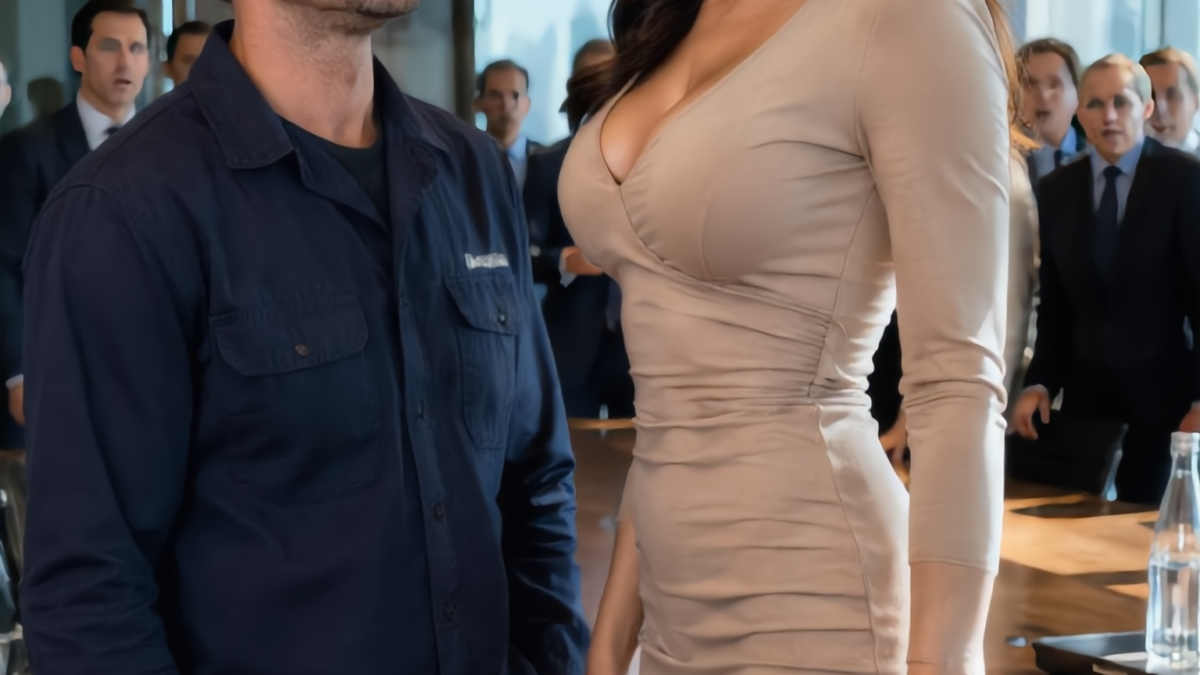
PART 1: The Only Name She Kept
The folder hit the conference table like a gunshot.
“Everyone in this room is fired.”
Nobody moved.
On the fourteenth floor of Halston Medical Systems, the air conditioning hummed above thirty faces that had stopped working all at once. Someone dropped a pen. It rolled across the polished walnut, clicked against a water glass, and stopped, and the small sound was unbearable. At the center of the table, the Vice President of Finance slowly removed his glasses, as if mishearing the words might make them disappear.
They did not disappear.
Claire Morgan stood.
She was thirty-eight years old, the youngest chief executive in Halston’s forty-year history, and in four years she had earned three reputations: brilliant, controlled, and feared. She did not raise her voice. She never had to. As she walked the length of the room, the silence followed her like a second shadow.
She passed the head of compliance, who had gone gray. She passed the director of procurement, whose hands were flat on the table as though bracing for an earthquake. She passed Martin Kessler, Vice President of Operations, the man who had spent eighteen months selling the board on the company’s ambitious expansion plan. He kept his eyes fixed on the window.
She did not slow for any of them.
She walked until she reached the very last chair at the far end of the table, where a man in a gray work shirt sat with his cap folded in his lap. Above his breast pocket, his first name was stitched in red thread: DANIEL.
She stopped beside him.
“You stay.”
The silence changed texture. Before, it had been shock. Now it was something sharper. Thirty heads turned toward the end of the table, toward the one person in the room who had not spoken a single word all morning, and every face asked the same question.
Him?
Daniel Brooks didn’t understand it either.
For eleven years, Daniel had perfected the art of not being noticed.
At thirty-nine, he wasn’t an executive. Technically, he wasn’t even an employee. He was a contract maintenance technician, hired through Brightline Facilities Services and assigned to Halston’s downtown headquarters. People noticed him only when something broke. He fixed elevators that stalled between floors. He coaxed fifty-year-old boilers through Midwestern winters. He replaced faulty wiring, reset tripped breakers, and stayed late more nights than he could count because someone had forgotten to mention that the server room was running hot.
He was also raising his eight-year-old daughter, Lily, alone.
His wife, Sarah, had died three years earlier. A fever that wouldn’t break turned into an infection the doctors had a long name for, and eleven days later Daniel was standing in a hospital parking lot at four in the morning, holding a plastic bag of her belongings and trying to remember how to breathe.
He never talked about it at work. He wasn’t ashamed. He had simply learned, very quickly, that grief didn’t pay the mortgage. Grief didn’t buy groceries or sign permission slips or know which brand of cereal Lily would actually eat. So he folded it up small and carried it where no one could see, the way he carried everything.
That morning, he had been summoned to the executive floor because the CEO wanted “someone who understands the building’s security and power systems.” He’d assumed it was a routine question about the backup generators. He expected to stand in the corner for ten minutes, answer something technical, and go back down to the basement where he belonged.
Instead, he’d been handed a chair at the end of the table because the corners were full of easels, and he had watched an entire leadership team get dismantled in less time than it took to change a lightbulb.
The room emptied slowly, the way rooms do after a funeral.
Executives gathered their leather portfolios with trembling fingers. Some glared at Daniel as they passed, the resentment of men who needed someone to blame and had found the nearest target. Others studied him with naked curiosity, as if trying to decode what a maintenance man could possibly know that they didn’t.
Martin Kessler was the last to leave. He paused in the doorway and looked at Daniel for a long, unreadable moment. Then he was gone.
The heavy door sighed shut.
Claire remained standing at the window with her back to him. Daniel waited. He had learned long ago that the people with the most power usually spoke first, and the people with the least power usually spoke last.
That was when he noticed it.
Her hands were shaking.
Only slightly. She had pressed them against the window ledge to hide it. But Daniel had spent his whole career watching things that were about to fail: a pipe beginning to sweat, a cable starting to fray, a motor humming a half-note too high. He knew what strain looked like when it was trying very hard not to show.
Claire Morgan, the most feared woman in the building, was holding herself together by force.
She turned around.
“Do you know what happened here this morning, Mr. Brooks?”
“No, ma’am.”
“Good.”
Daniel frowned. She walked back to the table and slid the thick folder toward him. Inside were maintenance reports from the previous eighteen months, inspection logs for the emergency generators, fire suppression systems, and electrical transfer switches. Daniel recognized the forms immediately. He had filled out hundreds of them.
At the bottom of each one was his digital signature.
He turned one page. Then another. Then another. His chest went tight.
“These aren’t mine.”
“I know.”
“I never inspected these generators. This one—” he tapped a page, “—this is the old Eastfield warehouse. I’ve never even been inside that building’s generator room. It says here I certified it fully operational.”
“Fourteen reports,” Claire said quietly. “Fourteen safety certifications with your name on them. Every one of them false.”
Daniel looked up slowly. The full weight of it was settling onto him now, the way water settles into a basement: silently, then all at once. Falsified safety documents were not a clerical error. People went to prison for this. And if anyone ever got hurt because of these papers, his name would be the first one a prosecutor read.
“If someone used my name—”
“Then they did it because they assumed no one would ever believe a contractor over a vice president.” Claire sat down across from him. “That was their mistake.”
“I don’t understand. Why keep me? If my name is on all of this, I’m the obvious suspect.”
“I kept you because you’re the only person in this company whose real reports were never manipulated.”
He stared at her. “Why?”
Her answer was barely above a whisper.
“Because you wrote what you actually found.”
She pulled a second, thinner folder from beneath the first. These were his genuine reports, the handwritten ones he scanned into the system every week. They were blunt, sometimes misspelled, occasionally underlined twice in frustration. Panel B corroded. Recommend full replacement. Do NOT defer. Boiler 3 relief valve failing. Told supervisor again.
“Every report that crossed my desk for two years told me everything was fine,” Claire said. “Every department. Every quarter. Fine, fine, fine. Yours were the only ones that ever told me something I didn’t want to hear.” She paused. “That’s how I knew the others were lying.”
That was the first surprise. Daniel hadn’t been kept because she trusted him. He had been kept because, without knowing it, he had become the one piece of evidence she could believe.
“An outside investigation firm arrives tomorrow,” she continued. “Until they finish, you need to understand something, Mr. Brooks. You are either my witness or my suspect.” She held his gaze. “I would very much prefer the first.”
That evening, Daniel nearly quit.
He sat in his rust-spotted pickup outside Lincoln Elementary, engine idling, staring at the steering wheel as though it might offer an answer. The bills were stacked in a rubber band on the passenger seat: mortgage, electric, the dentist. Lily’s sneakers had a split in the left sole that he’d patched with shoe glue twice. His contract with Brightline could be terminated with twenty-four hours’ notice and no reason given.
His phone buzzed. A voicemail from his Brightline manager.
“Daniel, call me back. Halston’s asking questions about you. Don’t talk to anyone over there until you talk to me. I mean it.”
He deleted it without calling back.
The school doors opened, and a river of backpacks and noise spilled out. Lily climbed into the truck with her braids half-undone and her coat zipped wrong, holding something carefully in both hands.
“Dad, I made this for you.”
It was a butterfly, folded from construction paper, its wings colored in purple and orange marker that had bled past the lines.
Daniel smiled. “It’s beautiful, bug.”
She studied his face the way only children and old dogs can, seeing straight through everything. “You look tired.”
“I am.”
“Then don’t be brave tonight.”
Daniel turned to look at her.
Lily shrugged and buckled her seatbelt. “Mom used to say you don’t have to be brave every day. Sometimes you can just be tired.”
For the first time all day, Daniel’s eyes filled. He looked away, out the windshield, until the blur passed. Then he took the paper butterfly, folded its wings gently, and set it on the dashboard where he could see it.
He didn’t sleep.
At 11:40 p.m., he was sitting at the kitchen table, beneath the grocery list Sarah had written on the refrigerator three years ago that he had never been able to take down, when his phone lit up.
A text. Unknown number.
Whatever she asked you, you don’t remember anything. Think about your girl.
Daniel read it four times. Then he got up, walked down the hallway, and checked the lock on the front door. Then the back door. Then the windows. He stood in Lily’s doorway for a long time, watching the small rise and fall of her blanket in the glow of her nightlight.
He could quit tomorrow. He could walk away from Halston, take whatever contract Brightline offered next, and hope the whole thing passed over him like a storm.
But he knew how this would go. If he ran, someone else would write the story. And in that story, the man who forged fourteen safety reports would be the contractor who disappeared the moment an investigation began.
So the next morning, he went back.
Not because he trusted Claire Morgan, but because quitting would mean letting someone else’s lie decide his future, and his daughter’s.
His badge didn’t work at the service entrance.
The reader blinked red three times. A security guard Daniel had known for six years, a man whose truck battery Daniel had once jump-started in a snowstorm, wouldn’t quite meet his eyes as he escorted him to the elevator.
“Fourteenth floor,” the guard said. “They’re waiting.”
The conference room looked different without the thirty executives. Colder. Claire sat at the head of the table beside two strangers in dark suits, a man and a woman with laptops open and expressions that gave away nothing. There was no coffee this time. No folder slid across the table like an offering.
“Sit down, Mr. Brooks.”
He sat.
The woman spoke first. “Mr. Brooks, our firm has completed a preliminary audit of Halston’s document management system. Fourteen falsified inspection reports were uploaded over an eighteen-month period.” She turned her laptop around to face him. “Every single one was submitted using one set of login credentials.”
On the screen, in plain black letters:
USER: DBROOKS_FAC
Below it, a column of dates and timestamps. One of them, highlighted in yellow, read March 9 — 2:14 A.M.
Daniel felt the floor tilt beneath him.
He looked at Claire. She was perfectly still. Her voice, when it came, was steel. But beneath the table, where only he could see it, her hands had begun to shake again.
“Yesterday, you told me these reports weren’t yours.”
“They’re not.”
“Then tell me, Daniel.” She leaned forward. “Why did every single one of them come from your account?”
Daniel opened his mouth.
Nothing came out.
(To be continued in Part 2…)
PART 2: The Night the Lights Went Out
Daniel stared at the yellow line on the screen.
March 9 — 2:14 A.M.
At first, the numbers meant nothing. They were just digits, accusing him in a language he didn’t speak. Then something cold and certain moved through his chest, because he knew that night. He would know it for the rest of his life.
“I wasn’t anywhere near a computer,” he said slowly.
The male investigator’s expression didn’t change. “Can you prove that?”
“March ninth. That was a Tuesday.” Daniel’s voice steadied as the memory sharpened. “My daughter woke up screaming a little after midnight. Her stomach. I thought it was the flu. By one o’clock she couldn’t stand up straight. I drove her to St. Agnes. Her appendix was about to burst.” He swallowed. “At 2:14 in the morning, I was sitting in the pediatric emergency room holding her hand while they prepped her for surgery.”
He pulled out his phone with fingers that didn’t feel like his own, scrolled back seven months, and turned the screen around. A photo, blurry and badly lit: a small hand in a hospital bracelet, gripping a much larger one. The timestamp in the corner read 2:09 A.M., March 9. Then another photo, a visitor’s badge from St. Agnes, the check-in time printed in smudged ink.
The room was silent.
The female investigator leaned closer to the screen. “The hospital will be able to verify that.”
“They will,” Daniel said.
Claire hadn’t moved, but something in her face had shifted, a crack running through ice.
“Then who used your account?” the male investigator asked.
Daniel had already worked it out. He had worked it out the moment he saw the timestamp, because only one other person in the building had ever known his password.
“There’s a shared terminal in the facilities office downstairs,” he said. “About two years ago, our supervisor, Greg Pruitt, made every technician write their login credentials on a laminated card. Said it was for emergencies, in case someone was out sick and he needed to close a work order. I told him it was a bad idea. He told me to stop being difficult.” Daniel exhaled. “The card’s in his desk drawer. Top left.”
Within the hour, the investigators had pulled the building’s badge access logs. On March 9, at 2:06 a.m., eight minutes before the first falsified report was uploaded, someone had swiped into the basement service entrance.
The badge belonged to Greg Pruitt.
When the investigators left, Claire remained at the table for a long time without speaking.
“I’m sorry,” she finally said.
Daniel shook his head. “You were doing your job.”
“No.” She looked down at her hands, which had finally gone still. “I was doing what everyone in this company has been doing for years. I looked for the easiest name to blame.”
She was quiet for a moment.
“You noticed my hands yesterday,” she said. “Didn’t you?”
“Yes, ma’am.”
She almost smiled. “You’re the only one who ever has.” She turned toward the window, toward the gray sprawl of the city beyond the glass. “When I was twelve, my father fell four stories from a scaffold on a construction site. It had been signed off as inspected and safe that same morning. Nobody had actually checked it.” Her voice didn’t waver, but it thinned. “He lived. He never walked again. And the man who signed that form kept his job for another twenty years.”
Daniel said nothing. There was nothing to say that would be big enough.
“When I saw those reports,” Claire continued, “fourteen forms, all saying safe, all lies, I wasn’t sitting in a boardroom anymore. I was twelve years old in a hospital hallway.” She turned back to him. “So yes. My hands shake. Now you know why.”
The investigation uncovered something stranger than anyone expected.
The falsified reports hadn’t been created to steal money. No accounts had been drained. No kickbacks had been hidden. The reports had been forged to bury a dangerous shortcut.
For two years, Halston had been preparing to move one of its largest manufacturing operations, the medical device assembly line from its aging Ridgeway plant, into an old warehouse on the eastern edge of town. The Eastfield building was cheap, enormous, and available immediately.
It was also electrically unsound.
Its main distribution panel was decades past its service life. Its automatic transfer switch, the device that was supposed to shift the building to backup power during an outage, was corroded and unreliable. The emergency generators had never been properly load-tested. Someone had signed off on repairs that were never completed.
Daniel knew exactly why.
Three months earlier, during a one-day assignment at Eastfield, he had opened the main panel and felt the heat coming off it before he even touched it. He’d written a report that night at his kitchen table: Main distribution panel severely corroded. Transfer switch failing. Risk of overload and arc fault during electrical storm. Building NOT safe for occupancy until replaced. He’d underlined NOT twice.
Greg Pruitt had called him into the office the next morning.
“You need to stop making everything sound so dramatic, Brooks. This isn’t a disaster movie.”
Daniel had quietly filed the report anyway.
Somewhere in the system, it had been marked “duplicate — closed” and buried in an archive no one ever opened. But Daniel had a habit Sarah had teased him about for years: he kept a carbon copy of every report in a battered spiral notebook in his truck’s glove compartment.
Claire found the digital version buried in the archives. Daniel brought her the notebook. The handwriting, the date, and the double underline all matched.
When investigators confronted Greg Pruitt, he broke in under ten minutes.
“I did what I was told,” he said, sweating through his shirt. “Kessler needed the paperwork clean. He said the repairs were coming. He said it was temporary.”
Martin Kessler did not look like a villain.
That was the second surprise. When he walked into Claire’s office that afternoon, he looked like a man who hadn’t slept in months, because he hadn’t. He didn’t call a lawyer. He didn’t deny anything. He sat down heavily across from Claire and Daniel and put his face in his hands.
“The Ridgeway lease ends in December,” he said. “The landlord sold the land to a developer. If we didn’t have Eastfield running by October, the board was going to close the entire assembly line and move production overseas.” He lifted his head. “Four hundred and twelve jobs, Claire. I grew up in Ridgeway. Half of those people went to my high school. I’ve been to their weddings. Their parents’ funerals.”
“So you faked safety inspections,” Claire said, her voice dangerously calm.
“I scheduled the repairs. I had an electrical contractor lined up. The financing came through six weeks late, and then the contractor’s crew got pulled onto a hospital job, and every week I told myself one more week, just one more week, and nobody will ever know.” His voice cracked. “I thought I could fix it before anyone got hurt.”
“Is anyone working in that building right now?”
Kessler hesitated.
It was only a second, but it was the longest second Daniel had ever lived through.
“A trial night shift,” Kessler admitted. “Sixty workers. We started three weeks ago to stay on schedule.”
Claire stood up so fast her chair rolled into the wall.
“You put sixty people inside a building you knew could burn.”
“I know what I did.”
“I want him arrested,” Claire said, turning to Daniel as though he were the only other person in the room. “Today.”
Daniel looked at Kessler, at the gray stubble, the shaking hands, the eyes of a man who had been drowning by inches for months.
“He was wrong,” Daniel said quietly. “But he wasn’t trying to hurt anyone.”
Claire stared at him. “You’re asking me to forgive him?”
“No.” Daniel shook his head. “I’m asking you not to confuse a bad decision with a bad person.”
“Tell that to the sixty people standing under that panel.”
“I am,” Daniel said. “That’s exactly why I want him helping fix it instead of sitting in a cell while it burns. He knows every shortcut that was taken in that building. Nobody else does.”
For a long moment, nobody spoke.
Finally, Claire picked up her phone. “Eastfield shuts down at six o’clock tomorrow morning. Every shift. No exceptions.” She looked at Kessler. “And you will be standing in that parking lot when it does.”
They had less than eighteen hours.
They didn’t get them.
The storm arrived without warning, the way the worst ones always do.
By nine o’clock that night, a violent summer squall line had rolled across the city. The sky turned the color of a bruise, and wind ripped branches from trees and sent trash cans tumbling down empty streets. Daniel had just finished reading Lily a chapter of her library book when the power at his house flickered twice and came back.
He stood at the kitchen window, watching the lightning stalk the eastern horizon, and a terrible stillness settled over him.
East. Toward Eastfield.
His phone rang at 9:17 p.m.
“Lightning hit a transformer near the warehouse,” Claire said. Her voice was tight and fast. “There’s smoke in the building. The fire department is on the way, but it’s chaos out here—”
“The transfer switch,” Daniel said. He was already moving, already grabbing his keys. “The surge will overload the main panel. If the backup generators don’t kick in, the electronic door locks fail closed. Some of those workers won’t be able to get out.”
“How do you know that?”
“Because I wrote it down three months ago.”
His neighbor, Mrs. Alvarez, came over in her bathrobe without asking a single question. Daniel kissed Lily’s forehead while she slept. On the way out, he grabbed the paper butterfly from the dashboard without quite knowing why, and shoved it into his shirt pocket.
The Eastfield warehouse was a nightmare of strobing red lights and sheeting rain.
Claire was already in the parking lot, soaked through, her expensive coat plastered to her shoulders. Martin Kessler was beside her. He’d heard about the call and driven straight there. Workers were streaming out through the loading dock, coughing, some carrying others.
“Twelve people are still inside,” a shift lead shouted over the wind. “The packing area. The doors won’t open!”
“The locks are on the main circuit,” Daniel said. “If I kill the main feed manually, the fail-safe should release them.”
“Should?” Claire grabbed his arm.
Daniel looked at her. “I replaced the emergency battery units in that building myself last spring. On my own time. Nobody asked me to.” He pulled free. “They’ll hold.”
He ran inside.
The smoke was thicker in the east corridor, acrid and chemical, stinging his eyes. The air tasted like burned copper. He kept one hand on the wall and counted doorways in the dark, the way he’d memorized them three months ago, because memorizing a building’s exits was simply what he did.
The electrical room door was hot to the touch.
Inside, the main distribution panel was arcing, a vicious blue-white crackle, the sound of something tearing itself apart from the inside. The manual disconnect lever was mounted beside it, and when Daniel grabbed it, the metal seared his palm like a stovetop.
He didn’t let go.
He threw his whole weight against the lever. It resisted, grinding, decades of corrosion fighting him, and then it gave with a deep metallic CLUNK.
Every light in the building died.
For several seconds, Eastfield disappeared into absolute darkness. No hum. No crackle. Just the storm hammering the roof and Daniel’s own ragged breathing.
Then, one by one, the emergency lights flickered on, dim and amber and steady. The battery units he had installed himself.
Somewhere down the corridor came a sound he would remember for the rest of his life: the heavy thunk of a dozen magnetic locks releasing at once, followed by voices, running footsteps, and someone sobbing with relief.
By the time the firefighters reached the packing area, it was empty. All sixty workers were standing in the rain in the parking lot. Martin Kessler was carrying the last of them, a young woman with a twisted ankle, across the threshold in his arms.
Everyone was safe.
Except Daniel.
Claire found him sitting on the wet concrete floor of the loading dock, his back against a steel column, wrapping his blistered hand in the torn sleeve of his work shirt. His face was smeared with soot. The paper butterfly had slipped halfway out of his pocket, its wings damp and crumpled.
She knelt beside him in her ruined coat, heedless of the puddles.
“You could have walked away,” she whispered.
Daniel looked past her, toward the open loading doors, toward the sixty silhouettes standing in the rain under the flashing lights, alive.
“So could they,” he said.
(To be continued in Part 3…)
PART 3: What the Butterfly Remembered
Six weeks later, Claire Morgan called another meeting.
It was the same room on the fourteenth floor, with the same polished walnut table and the same humming air conditioning. But almost nothing else was the same.
This time, the chairs were filled with engineers and electricians, line supervisors from Ridgeway, a nurse from the occupational health office, and a forklift operator named Rosa who had been one of the twelve workers trapped in the packing area that night. There were hard hats on the table beside leather portfolios. There were people in the room who had never been invited to the fourteenth floor in their lives.
And this time, Daniel Brooks sat at the table, not at the far end, but halfway down, with a white bandage still wrapped around his right hand.
Nobody was fired.
Claire stood at the head of the room and laid out the changes plainly, the way Daniel wrote his reports. Safety inspections could no longer be signed off by a single supervisor. Any employee or contractor, from the newest janitor to the most senior engineer, could now report a hazard directly to an independent safety review board that answered to no one in management. Retaliation against anyone who filed a report would mean immediate termination.
Greg Pruitt had been dismissed and referred to the district attorney for forgery. Some debts are owed to the law, and Claire did not pretend otherwise.
Martin Kessler had resigned his position as Vice President. He was cooperating fully with state regulators and would answer for what he had done. But at Daniel’s quiet urging, and over the objections of her own lawyers, Claire had made one unusual decision. Kessler would spend the next year working without a title, under independent oversight, helping rebuild Eastfield properly. Every wire, every panel, and every switch would be inspected and inspected again.
The Ridgeway workers would get their new building. It would open four months late.
It would also be the safest manufacturing facility Halston had ever owned.
“Four hundred and twelve jobs,” Kessler had said, standing alone in Claire’s office the day before he resigned. “And I nearly got sixty of those people killed trying to save them.” He’d looked at Daniel. “Why did you speak up for me?”
Daniel had thought about it for a long time before he answered.
“Because three years ago, when my wife died, I made a hundred bad decisions,” he said. “I yelled at people who didn’t deserve it. I stopped answering the phone. I forgot to pay the electric bill and my daughter did her homework by flashlight for two nights.” He shrugged. “Somebody gave me room to become better instead of just punishing me for being worse. I figured I owed that forward.”
After the meeting ended, Claire asked Daniel to stay.
It had become something of a joke between them.
She slid a single sheet of paper across the table. It was a formal offer of employment. No more contracts through Brightline, no more twenty-four-hour termination clauses. Halston wanted to hire him directly as Director of Facilities Safety, with a salary that made Daniel read the number three times to be sure he wasn’t misreading it.
He pushed the paper back toward her.
“I fix things,” he said. “I don’t give speeches. I don’t wear ties. I’ve never managed anybody in my life.”
“I know.”
“Then why me?”
Claire was quiet for a moment.
“Because every person I’ve ever promoted learned to tell me what I wanted to hear,” she said. “You’re the only one who’s ever told me the truth, even when it cost you. Especially when it cost you.” She slid the paper back across the table. “You don’t need to become someone else to lead people, Daniel. You just need to keep being exactly who you were in that warehouse.”
Daniel looked down at the offer for a long time.
Then he picked up a pen.
“One condition,” he said.
Claire raised an eyebrow.
“Flexible hours. I need to leave by 2:45 every afternoon. At three o’clock, I pick up my daughter from school.” He met her eyes. “That’s not negotiable.”
For the first time since he had known her, Claire Morgan laughed. It was a real laugh, startled and warm, the laugh of someone who had forgotten she was capable of it.
“Done,” she said.
The leaves had turned gold by the time Claire finally met Lily.
It was a Thursday in late October. Claire had driven to Lincoln Elementary to drop off a signed set of documents Daniel had forgotten at the office, or that was the excuse she gave herself. She found him leaning against his pickup in the pickup line, exactly where he said he’d be, holding something small and fragile between his thumb and forefinger.
The paper butterfly.
Its edges were worn soft. The purple marker had faded to lavender and the orange to a pale peach. A brown water stain ran across one wing from the night of the storm, and one corner was singed where it had pressed against his shirt while he gripped a burning lever.
But he had kept it.
“Why do you still carry that thing?” Claire asked.
Daniel turned it gently in the autumn light.
“Because it reminds me that going home matters more than getting ahead.”
Claire looked at the butterfly. Then she looked at him. Then she looked away, toward the school doors, toward the bright stream of children pouring out into the afternoon.
“I think I forgot that,” she said softly. “Somewhere along the way.”
Daniel didn’t answer. He didn’t need to.
A small figure in a crooked coat came barreling across the schoolyard and collided with his legs at full speed. Lily looked up at the tall woman in the expensive coat with frank, unembarrassed curiosity.
“Are you Dad’s boss?”
“Something like that,” Claire said.
Lily considered this. Then she dug into her backpack, pulled out a sheet of crumpled green construction paper, and began folding with fierce concentration. Thirty seconds later, she held out a lopsided butterfly with one wing slightly larger than the other.
“Here,” she said. “For when you’re tired.”
Claire took it as though it were made of glass. For a moment, the most feared CEO in the city couldn’t speak at all.
“Thank you,” she managed.
“Mom used to say you don’t have to be brave every day,” Lily informed her, already climbing into the truck. “Dad says you’re really brave. So you probably need a day off.”
That evening, for the first time in eleven years, Claire Morgan left the office before six o’clock. She drove two hours north to the small house where her father still lived, in the wheelchair he had sat in for twenty-six years, and she sat with him on the porch until the stars came out. She didn’t talk about work once.
Some lessons aren’t taught in boardrooms.
They’re learned in empty parking lots at four in the morning. At kitchen tables beneath grocery lists no one can bear to take down. In hospital waiting rooms, in burning electrical rooms, and in all the small, invisible moments when someone decides, against every reason not to, to keep going.
Claire Morgan fired an entire room that morning because she needed one person she could trust.
But Daniel Brooks didn’t stay for the job. He didn’t stay for the title, or the salary, or the corner of a conference table he’d never asked for.
He stayed to protect the kind of man he wanted his daughter to believe he was.
And sometimes the most powerful thing a person can do isn’t to climb higher. It’s simply to refuse to become bitter on the way up.
Integrity may never make you the richest person in the room.
But one day, when the lights go out and the smoke rolls in and everyone is looking for someone to follow, it may make you the only person everyone trusts.
— THE END —








