She Kept the Ring I Gave Her at 12 for Sixteen Years. Then We Found the Letters Our Parents Hid From Us
PART 1: The Ring and the Locked Drawer
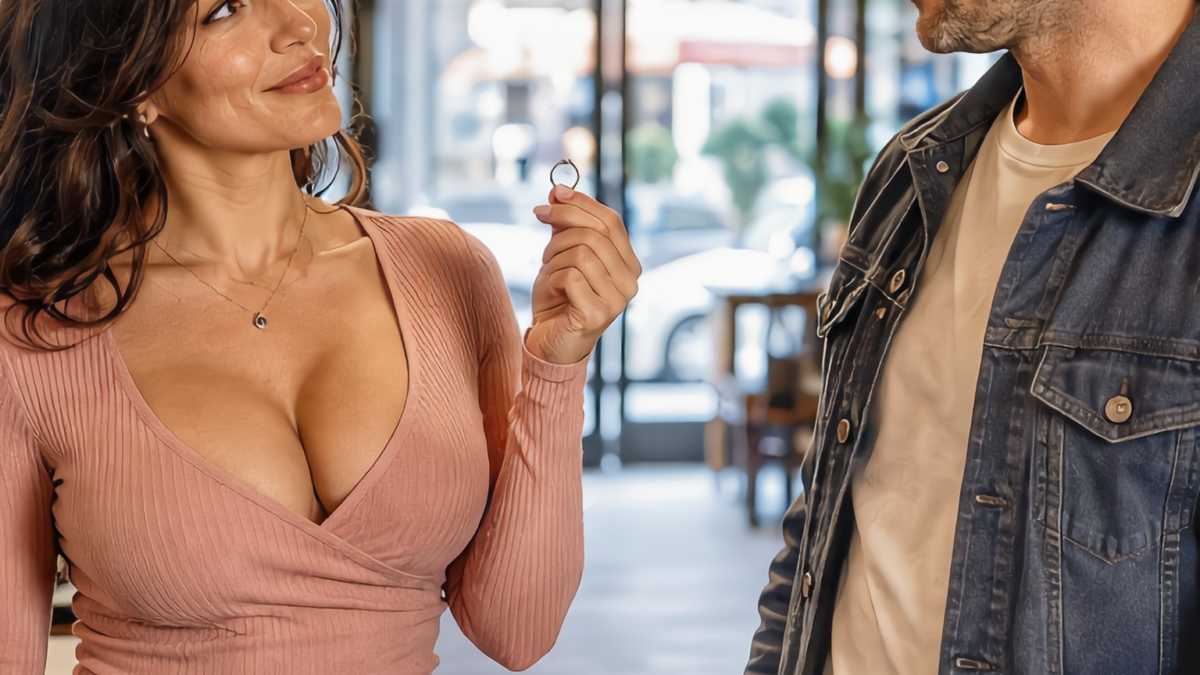
The first thing Nora did when she saw me after sixteen years was reach into her coat pocket and pull out a tiny silver ring.
Then she looked straight into my eyes and asked, “Do you remember what you promised me when we were twelve?”
I had spent half my life trying not to think about that summer. And suddenly I was standing in the middle of Main Street in Bellwood, the town I had sworn never to come back to, facing the one person on earth who could remember every single detail I had worked so hard to forget.
My name is Ethan Cole. I was thirty-five years old that autumn, and I had built a quiet, orderly life four states away: an engineering job in Denver, an apartment with clean white walls and nothing on them, and a calendar so full that I never had to sit still long enough to feel anything. I was good at that. I’d learned it from the best.
My father.
He died on a Tuesday in late September. A heart attack in his garden, the hospice nurse told me over the phone, with a trowel still in his hand. We hadn’t spoken in almost two years. Before that, our conversations had been brief, polite, and carefully empty, like two men passing each other on a narrow bridge, each of us pretending the river below didn’t exist.
He left me his small gray house on Maple Street. Everything in it. And a lawyer’s letter informing me that, as his only child, I would need to come in person to settle the estate.
So I came. I told myself I’d stay ten days. Clear out the house, sign the papers, list it with a realtor, and drive west without looking back. I wasn’t coming home for memories. I certainly wasn’t coming home for Nora Whitaker.
But there she was.
She was standing outside Pemberton’s Books, the same narrow, ivy-covered shop where we’d spent half our childhood sitting cross-legged in the aisles, reading comics we couldn’t afford. She was holding a paper bag against her chest. Her dark hair was pulled loosely over one shoulder, and the October wind was tugging strands of it across her face.
She was older, of course. So was I. There were faint lines at the corners of her eyes now, and she carried herself with a quiet, settled steadiness the twelve-year-old girl I’d known never had.
But the way she smiled at me was exactly the same.
“Ethan.”
I stopped walking. My voice came out rougher than I meant it to. “Nora.”
For a few seconds, neither of us moved. Leaves skittered across the sidewalk between us. Somewhere down the street, a church bell was ringing the hour.
Then she laughed softly, almost in disbelief. “You really came back.”
“I guess I did.”
“I heard about your dad.” Her smile faded into something gentler. “I’m so sorry.”
“Thank you.”
There were a hundred things I wanted to ask her. Where she’d gone. Who she’d become. Whether she was married, happy, still afraid of thunderstorms, still putting too much sugar in her tea. But none of those questions seemed right to ask on a sidewalk after sixteen years of silence.
Instead, she reached into her pocket and opened her hand.
The ring was small and silver, worn thin in places, scratched along the band. A tiny blue stone sat in the center, no bigger than a grain of rice, catching the pale autumn light.
I stared at it. “You kept that.”
She looked down at it, too. “I told you I would.”
The memory came back so clearly it almost hurt.
We were twelve years old, sitting beneath the enormous oak tree behind her grandmother’s farmhouse at the edge of town. It was the last week of June, hot and heavy and humming with cicadas. Nora was leaving the next morning to spend the summer with her aunt in Vermont, and I had spent the entire week quietly convinced that when she came back, she would have outgrown me. She’d find new friends. Cooler ones. Kids who didn’t stammer when they got nervous and whose fathers didn’t shout through the walls at night.
So I had done something desperate. I’d taken my lawn-mowing money, every crumpled dollar I’d saved since April, and walked into Halloway’s Antiques on Second Street. The ring had been sitting in a velvet tray near the register, and the old woman behind the counter sold it to me for nineteen dollars and a pack of gum.
Beneath that oak tree, I’d pressed it into Nora’s palm, my face burning.
“So you don’t forget me,” I’d mumbled.
She’d laughed, that bright, startled laugh of hers, and slipped it onto her finger. It was too big. She’d had to wrap the back of it with a strip of tape.
“I’m not going to forget you, stupid.”
“Promise?”
“Promise.”
And then I’d said something I hadn’t let myself think about in nearly two decades.
“If we ever lose each other,” I’d said, very seriously, “whoever comes back first has to find the other one. No matter what. No matter how long it takes.”
She’d held out her pinky finger. I hooked mine around it. At twelve, it felt like the most important promise anyone had ever made.
She did come back that August. And for four more years, we were inseparable. Bike rides to the reservoir. Shared headphones on the school bus. Long, rambling phone calls that drove both our parents crazy.
And then, the summer we turned sixteen, everything just stopped.
Not with a fight. Not with a betrayal. It simply faded. She stopped calling. My letters, I’d written her letters that summer when her family moved across the county to Ashford, went unanswered. Then my father sat me down at the kitchen table one night and told me, in that flat, final voice of his, that he’d run into Mrs. Whitaker at the hardware store, and that Nora had asked her mother to tell me to stop writing.
She’s moved on, son. She’s just being polite. Don’t embarrass yourself.
I believed him. Why wouldn’t I? It was the most reasonable explanation in the world. Of course she’d moved on.
At nineteen, I left Bellwood for college and never came back. Different schools. Different friends. Different lives. That was the story I told myself, and over the years it had calcified into a kind of truth.
And now here she was, holding that same ring in the palm of her hand.
“You actually kept it all these years,” I said.
Nora nodded slowly. “Every single one.”
“Why?”
She hesitated. Something passed across her face, a shadow, a decision being weighed. She glanced back at the bookstore, then at me.
“Come by tomorrow,” she said finally. “Around two. I’m on Juniper Lane now. Number fourteen.” She closed her fingers around the ring. “There’s something I need to show you.”
Before I could ask what, she squeezed my arm once, briefly, and walked away up the street, the paper bag held tight against her chest.
That night, I couldn’t sleep.
My father’s house was exactly as I remembered it, and somehow that made it worse. The same faded floral wallpaper in the hallway that my mother had chosen before she left us when I was ten. The same ticking clock above the stove. The same creak on the third stair. The same faint smell of pipe tobacco and machine oil that had soaked so deeply into the walls that no amount of time could scrub it out.
He hadn’t changed anything. Not one thing in twenty-five years. It was as though the house had stopped the day my mother walked out, and he had simply gone on living inside the moment.
Around midnight, I gave up on sleep and went into his study to start sorting papers.
I hadn’t been allowed in that room as a child. It was his sanctuary: a scarred oak desk, a green-shaded lamp, shelves of engineering manuals and fishing magazines, and the heavy silence of a man who preferred machines to people because machines did what you expected. I sat in his cracked leather chair and began working through the drawers. Tax returns. Warranty cards for appliances that no longer existed. A neat stack of birthday cards I’d mailed him over the years, each one stamped and dated, each one apparently kept. I stared at those for a long time.
The bottom right drawer was locked.
I searched the desk for a key and found nothing. I searched the kitchen, the junk drawer, the hooks by the back door. Nothing. Finally, half out of frustration and half out of something I didn’t want to name, I went out to the garage, found a flathead screwdriver, came back, and pried the drawer open. The old lock gave way with a sharp crack that echoed through the empty house like a gunshot.
Inside was a shoebox.
And inside the shoebox were letters.
Dozens of them. Envelopes of every color, pale blue, lavender, plain white, some decorated with hand-drawn stars and doodled flowers in the corners. They were held together with brittle rubber bands that snapped the moment I touched them.
Every single one was addressed to me.
In Nora’s handwriting.
My hands began to shake. I picked up the first one. Postmarked July, nineteen years ago. Unopened. The next one, August. Unopened. September. October. Christmas. A birthday card, my sixteenth, with a drawing of a lopsided cake on the front. Unopened.
I sat on the floor of my father’s study surrounded by a blizzard of envelopes, unable to breathe.
She had written. All that time, she had written to me. Week after week. Month after month. And my father had taken every single letter out of our mailbox before I came home from school and locked it away in this drawer.
She’s moved on, son. Don’t embarrass yourself.
At the very bottom of the box, there were only two envelopes left.
The first was from Nora. It was the only one that had been opened. The flap had been slit cleanly with a letter knife. It was dated the last week of August, three summers later, the week I’d left for college.
I unfolded the single sheet of notebook paper inside with trembling fingers.
Ethan,
This is the last one. I promise. I’ve written you forty-one letters and you’ve never written back, so I guess I finally understand. But I’m sixteen and stupid and braver than I’ll ever be again tonight, so I’m going to say it once, out loud, on paper, where I can’t take it back:
I think I’ve been in love with you since the day under the oak tree.
If you don’t answer this one, I’ll know. I won’t write again. I won’t call. I’ll leave you alone, like you want.
But I’m keeping the ring. You can’t make me give that back.
— Nora
I read it three times. The words blurred. My chest felt like it had been cracked open with that same screwdriver.
He had read it. My father had opened this one. He had read a sixteen-year-old girl pour out her whole heart onto a page, and then he had folded it back up, put it in a box, locked it in a drawer, and let me walk out of this house believing that no one in Bellwood had ever cared whether I lived or died.
And then I saw the last envelope.
It was long, plain, and white. Sealed. My father’s blocky, careful handwriting ran across the front, the letters slightly shaky, as though they’d been written by an old man’s hand.
Ethan.
If you’ve found these, I’m already gone. I’m sorry. Please read this before you see her.
PART 2: Forty-One Letters
I didn’t open my father’s letter that night.
I sat on the floor of his study until dawn turned the windows gray, holding that sealed white envelope in my hands, too angry to read it and too afraid not to. Every few minutes, I’d look over at the scattered pile of Nora’s letters, forty-one of them, her handwriting changing as the years went on, from round and bubbly to tighter and more careful, and a fresh wave of rage would rise up in my throat.
When the sun finally came up, I made coffee in my father’s kitchen, sat down at his table, and broke the seal.
The letter was four pages long. His handwriting deteriorated as it went, the lines slanting downward, as though writing it had cost him something physical.
He told me about the summer my mother left. How he’d come home from the plant to find a note on this very table, and how something in him had quietly frozen solid that day and never thawed. He told me he’d watched me grow up shy and soft-hearted, so much like her, and that it had terrified him.
When you started spending every waking hour with that Whitaker girl, he wrote, I saw myself at nineteen. I gave up an engineering scholarship in Chicago to stay in Bellwood for your mother. I thought love was worth more than any future. And then she left anyway, and I was stuck in this town for the rest of my life with nothing to show for it but a job I hated and a boy I didn’t know how to talk to.
I swore I wouldn’t let that happen to you.
He told me how Nora’s mother had come to him the summer we turned sixteen. Helen Whitaker had plans for her daughter: a scholarship, a prestigious university, a life far away from Bellwood and far away from the son of the angry man on Maple Street. She’d found my letters and was hiding them. She asked my father to do the same.
And he agreed.
I told myself I was protecting you. That’s the lie I told myself every single day for three years while I took those envelopes out of the mailbox. And when that last letter came, the one with the stars on it, I opened it. I don’t know why. I think part of me wanted to see what kind of girl would keep writing to a boy who never wrote back.
I read it, Ethan. And I knew then what I’d done. I knew I’d taken something from you that I could never give back. And I was too much of a coward to tell you.
Three years after you left, I wrote to Helen Whitaker and told her I was done lying. I don’t know if she ever told Nora. I hope she did.
I’m not asking you to forgive me. I don’t think I’d forgive me. But I kept every birthday card you ever sent. I want you to know that. I read them all. More than once.
You were always better than me, son. Go find her. Don’t wait as long as I did to say what needs saying.
— Dad
I folded the letter and put my head down on my father’s kitchen table, and for the first time since the hospice nurse had called, I cried.
Not the clean, quiet grief people expect at funerals. Something uglier and older than that. I cried for the boy who’d sat at this same table hearing she’s moved on, son. I cried for the girl who’d written forty-one letters into silence. I cried for the man who had locked them all in a drawer and then spent nineteen years too proud and too ashamed to unlock it. I cried because he was dead, and I could never shout at him, and I could never tell him I understood, and both of those things were true at once.
At two o’clock that afternoon, I knocked on the door of number fourteen, Juniper Lane, with a shoebox under my arm.
Nora opened the door in an old gray sweatshirt and jeans, her hair twisted up in a messy knot. She looked less like the polished, successful woman I’d imagined for sixteen years and more like the girl I remembered.
Then she saw my face, and the shoebox, and her expression went very still.
“You found them,” she said quietly.
“You knew?”
“Not until three years ago.” She stepped aside. “Come in.”
Her house was small and warm and cluttered in the best possible way, crowded with books stacked on every surface, trailing green plants in the windows, mismatched mugs on hooks above the sink. On the mantel above the fireplace sat a framed photograph. I recognized it instantly: two scrawny twelve-year-olds sitting beneath an enormous oak tree, squinting into the sun. Nora’s grandmother had taken it the afternoon I gave her the ring. You could just see a tiny glint of silver on Nora’s taped-up finger.
Beside the photograph sat an old wooden box with brass corners.
Nora picked it up and carried it to the kitchen table. I set my shoebox down beside it. For a moment, we just looked at the two boxes sitting side by side, like evidence at a trial neither of us had known was happening.
“When my grandmother passed and we sold her house,” Nora said, “I found this in her attic. Behind the old Christmas decorations.” She opened the lid.
Inside were letters. Dozens of them. White envelopes, every one addressed to Nora Whitaker, every one postmarked Bellwood.
In my handwriting.
I picked one up. It was dated the summer I turned sixteen. I knew without opening it exactly what it said, because I remembered writing it: sitting on my bedroom floor at midnight, telling her about my father’s temper, about my plans to leave town, about how lonely everything felt without her.
“My mother hid them at my grandmother’s,” Nora said. “Every single one. And she told me you’d stopped writing. She said she’d run into your father, and he’d told her you’d found a girlfriend in town and wanted me to leave you alone.” Her voice cracked. “I didn’t believe her at first. So I kept writing. And writing. And you never answered.”
“Because I never got them.”
“I know that now.” Tears were sliding down her cheeks. “For sixteen years, Ethan, I thought you chose to leave me. I thought you read every one of my letters and just decided I wasn’t worth answering. I thought you laughed at that last one.”
“I never saw it,” I said hoarsely. “Not until last night.”
She went pale. “You read it?”
I nodded. I reached into the shoebox and found it, the only opened envelope, and laid it on the table between us.
Nora stared at it as though it were a ghost. She covered her mouth with her hand.
“I was sixteen,” she whispered. “I wrote that on my bedroom floor at two in the morning. I cried for a week when you didn’t answer.”
“And I left for college believing nobody in this town would notice if I disappeared.”
For a long time, neither of us said anything. The kitchen clock ticked. Outside, a dog barked twice and went quiet.
Then I slid my father’s letter across the table to her.
She read it slowly. When she reached the last page, she set it down very carefully, the way you set down something that might break.
“Three years ago,” she said, “my mother was dying. Near the end, she gave me a letter from your father. She’d kept it all that time. She said she was sorry. She said she’d been so afraid I’d end up stuck in Bellwood like she had, that she couldn’t see anything else.” Nora wiped her eyes with the sleeve of her sweatshirt. “That’s how I found out. That’s when I went up to Grandma’s attic and found this box.”
“Why didn’t you reach out?” I asked. “When you knew?”
She laughed, a small, broken sound. “I tried. I found your firm’s website. I wrote you an email four different times. I never sent any of them.” She looked down at her hands. “I kept thinking, it’s been thirteen years. He has a whole life. He’s probably married. He probably doesn’t even remember my name. And honestly?” Her voice dropped. “I was angry. For a long time. Not even at you. At them. At us. At how easy it was for two adults to just erase something that mattered so much.”
“Are you still angry?”
She was quiet for a long moment. “No,” she said finally. “Mostly I’m just tired of losing things.”
We sat at her kitchen table until the light outside turned orange, then purple, then dark. We read each other’s letters, the ones we’d written at sixteen, seventeen, eighteen, and that was the strangest thing of all, meeting our younger selves on the page. I read about her first job at the drugstore, her fight with her best friend over a boy named Kyle, the night she drove to the reservoir alone and sat on the hood of her mother’s car looking at the stars and wondering if I was looking at them too.
She read about my father’s silences, my acceptance letter to the University of Colorado, the night I almost drove to Ashford to see her and turned around at the county line because I was too afraid she’d shut the door in my face.
“You were going to come,” she said softly.
“I made it to the Ashford exit. I sat on the shoulder for an hour.”
“I would have opened the door,” she said. “I would have opened it so fast.”
There were awkward moments. Painful ones. Long silences where neither of us knew what to say. And, unexpectedly, there was laughter. Real, helpless laughter over her terrible sixteen-year-old poetry and my even worse attempts to sound mature.
Somewhere around nine o’clock, I asked the question that had been sitting in my chest all day.
“Nora. Why did you really keep the ring?”
She slid it off her finger and set it on the table between us, beside the two boxes of letters.
“Not because I was waiting for a fairy tale,” she said. “I want you to know that. I’ve had a life, Ethan. I was engaged once, at twenty-eight. A good man. I broke it off two months before the wedding, and I never fully understood why until I found that box in my grandmother’s attic.” She touched the little blue stone with one fingertip. “I kept it because it reminded me that once, somebody believed I was worth remembering. Worth spending every dollar he had. Even when I thought you’d forgotten me, the ring didn’t.”
I swallowed hard. “You were. Worth remembering.”
She looked up at me, and her eyes were shining.
“Then maybe,” she said, “we should stop losing each other.”
I laughed, and my eyes filled. “That sounds a lot like a promise I made under an oak tree.”
“Whoever comes back first has to find the other one,” she said softly. “You came back first, Ethan.”
“No,” I said. “You found me. You were standing outside that bookstore.”
She smiled through her tears. “Maybe we both kept our promise.”
Before I left that night, she slipped the ring back onto her finger. It fit perfectly now, no tape required. At the door, she hesitated.
“How long are you staying?” she asked.
I thought about my calendar in Denver. My white apartment with nothing on the walls. The ten days I’d promised myself.
“I don’t know yet,” I said.
And for the first time since I’d come home, I wasn’t thinking about leaving at all.
PART 3: The Place Where People Belong
I didn’t sell my father’s house.
Not at first, anyway. I called my firm in Denver and arranged to work remotely through the winter. Then I spent November slowly going through the house room by room, deciding what to keep. I kept the green-shaded lamp from his study. I kept his garden trowel. And I kept the shoebox of birthday cards, every one I’d ever sent him, worn soft at the edges from being read more than once.
On a cold, bright Saturday in December, Nora drove me out to the cemetery on the hill. I stood in front of my father’s grave for a long time without saying anything. She waited by the car and let me have the silence.
“I’m still angry at you,” I finally told the headstone. “I think I will be for a while.” I set something down at the base of the stone: my sixteen-year-old letter to Nora, the one about the night I almost drove to Ashford. “But I read your letter. And I understand more than you think. You were scared. So was I. And it turns out, being scared just makes you lose things.”
I put my hand flat on the cold granite. “I’m not going to lose this one, Dad. I promise.”
When I walked back to the car, Nora took my hand without a word and held it the whole drive home.
Pemberton’s Books had been on Main Street since before either of us was born. Nora had worked there for six years, ever since she’d moved back to Bellwood to care for her mother. Old Mr. Pemberton was eighty-three and ready to retire to Florida, and the only offer he’d received was from a developer who wanted to turn the building into a vape shop.
“It’s ridiculous,” Nora said one night in January, curled up on her couch with a mug of tea that had far too much sugar in it. “It’s the only place in town where kids can sit on the floor and read for free. Where old Mr. Daley comes every Tuesday just so somebody will talk to him about Civil War history.” She sighed. “I always thought, someday, I’d have a place like that. Where people could come in, sit down, read, and feel like they belonged somewhere.”
I didn’t say anything that night.
But in March, I sold my father’s house to a young couple with twin toddlers and a golden retriever. And with that money and everything I’d saved in eleven years of empty, overscheduled Denver life, I bought Pemberton’s Books.
When I put the keys in Nora’s hand, she stared at them for so long I thought she might hand them back.
“Ethan. You can’t—”
“I already did.”
“Why?”
“Because a twelve-year-old girl once told me she wasn’t going to forget me,” I said. “And she didn’t. Not for sixteen years. I figure I owe her at least one bookstore.”
She laughed and cried and threw her arms around my neck so hard we both nearly fell into a display of discounted cookbooks.
We reopened in May. We painted the walls a warm, buttery yellow, filled the corners with secondhand armchairs, and built a little reading nook in the back with pillows and a rug where kids could sprawl out on the floor and read comics they couldn’t afford, exactly like we used to. Mr. Daley still comes every Tuesday. Now he leads a history club for teenagers.
Above the front door, we hung the old photograph from Nora’s mantel: two scrawny twelve-year-olds beneath an enormous oak tree, squinting into a June sun that had no idea what was coming.
And beneath it, on a small brass plaque, Nora had engraved six words:
Whoever comes back first, find them.
Nora still wears the ring every day. Sometimes, when she’s shelving books near the front window, the afternoon light catches that tiny blue stone and throws a speck of color across the floor. And I stop whatever I’m doing and think about how close we came to remaining strangers forever. Two kids who loved each other. Two frightened parents who thought they were protecting them. Forty-one letters locked in a drawer. Dozens more hidden in an attic. Sixteen years of silence that neither of us chose.
How easily it could all have ended there.
But some promises are stronger than the people who make them realize. They survive lies, distance, grief, and the long, slow erosion of time. They wait patiently in coat pockets and locked drawers and dusty attics, for the day someone is finally brave enough to open them.
Last week, on the anniversary of the day I came home, I took Nora out to the edge of town, to the old farmhouse that had once belonged to her grandmother. The new owners had kindly said we could visit. The oak tree was still there, enormous and gnarled and green, its branches spreading over the grass exactly as they had twenty-four years ago.
I sat down beneath it. She sat beside me.
And I pulled a small velvet box out of my coat pocket.
This one hadn’t cost nineteen dollars and a pack of gum. But when I opened it, Nora’s hand flew to her mouth, and her eyes filled with the same tears I’d seen on the sidewalk outside Pemberton’s Books the day I came home.
“Do you remember what you promised me when we were twelve?” I asked her.
She laughed through her tears and held out her pinky finger.
“I promised I’d never forget you,” she whispered.
“Promise again?”
“Promise.”
Coming home, it turns out, isn’t always about returning to a place. Sometimes, it’s about finally finding the person you never truly stopped looking for.








