She Pulled a Ruined Dress From the Farm’s Burn Pile and Mended It in Secret, Never Knowing It Belonged to the Farmer’s Dead Mother. When He Saw It, the Most Feared Man in the Mountains Fell to His Knees
PART 1: The Dress in the Mud
Just one more little stitch. Slowly.
The needle rose and fell by candlelight, and Augusto could not take his eyes off it.
It was nearly midnight. Unable to sleep, he had wandered into the yard, and now he stood in the deep shadow of the old mango tree, looking through the small window of the last back room. Inside, bent over a narrow bed, the young woman who did the farm chores was mending a pale piece of fabric, stitch by stitch, the way someone prays. Every so often she stopped, wiped her eyes with her sleeve, and went back to sewing.
She didn’t know she was being watched.
And neither of them knew the truth: that the cloth in her lap had been pulled from the mud only minutes before it would have turned to ash. That it was the very thing he had searched for with his own blackened hands. The last piece of his mother that still existed in the world.
On the Santa Luzia farm, deep in the coffee mountains of southern Minas Gerais, the day began before the sun.
At half past four, while fog still lay over the coffee plantations like a wet sheet, Inês was already in the corral. She pulled up her stool, rested her forehead against a cow’s warm flank, and began milking in the dark beneath a single swinging yellow bulb.
She was twenty-four, slender, quiet. Her hands were long-fingered and delicate, hands that didn’t match the heavy labor. Anyone paying attention would have noticed that she held everything with unusual care, as if the world might fall apart. And they’d have noticed the habit: in her apron pocket she always kept a worn metal thimble, which she squeezed between her fingers when she was nervous.
The thimble had belonged to her grandmother, Conceição.
Seven months earlier, Grandmother Conceição had died. She had been a seamstress in the little town below the mountains, raising Inês alone in a small house with a blue wall. She’d taught her granddaughter to thread a needle before she taught her to read. She sewed wedding gowns, christening clothes, school uniforms, and charged almost nothing, because, she said, poor girls have the right to marry beautifully too.
When she fell ill, there had been a bank loan for medicine and tests and long bus rides to the hospital in Pouso Alegre. She died on a rainy Sunday. The debt stayed behind. And with it came the threat of losing the little blue-walled house, the only place in the world Inês could call her own.
So Inês climbed the mountain and knocked on the gate of Santa Luzia, asking for any work at all. Nobody there needed a seamstress. But there was always a shortage of hands for chores.
In the big house kitchen, coffee was strained through cloth on a wood-burning stove, and every dawn Dona Nena, the tiny white-haired cook, greeted Inês with a steaming mug and a warm cheese bread.
“Eat, girl. You’re as thin as a broomstick.”
“I’m fine, Dona Nena.”
“Fine, my foot. Sit.”
Seu Valdomiro, the foreman with the thick mustache and the crooked hat, had grown fond of her too. One day he tore his Sunday shirt on barbed wire, the last gift from his late wife. That night, Inês quietly asked to borrow it. The next morning she returned it folded and ironed, and the tear had vanished. He couldn’t find the spot even holding it up to the light.
“Girl, where did you learn that?”
“From my grandmother, Seu Valdomiro. She used to say everything can be fixed, except a lack of care.”
From that day on, whenever anyone raised a voice to Inês in the corral, the foreman would appear with a stern face, and the matter would end there.
At night, in her little back room, she would open a small green notebook and write down the numbers. What she’d earned. What she’d sent to the bank. What remained. R$9,800. The balance went down like water dripping from a badly closed faucet. She would stare at it for a long time. But she didn’t cry. Grandma used to say crying mends nothing. What mends things is thread, needle, and patience.
The boss, Inês almost never saw.
Augusto, the owner of Santa Luzia, was forty-four. Everyone respected him, and nearly everyone feared him. Not because he was cruel. He was fair. He paid on time and never shouted. But his eyes were empty, and he carried himself like a locked door.
Every morning at five, he came down the stairs alone and sat at the end of a twelve-seat jacaranda table built for a large family. He drank his coffee in silence. The clink of his spoon against the cup was the only sound in the room. Eleven chairs sat empty around him.
After coffee, he would pass a door at the end of the hallway. He never went in. He would only stop, rest his palm on the wood for a moment, and keep walking.
It was the room of Dona Celeste, his mother. The key lived in his vest pocket. No one was ever permitted to open that door.
On the farm, Dona Celeste’s name was still spoken softly, like a saint’s. She had been the soul of those lands. She filled the chapel with flowers. She taught the young women of the farm colony to embroider. No sick neighbor ever went unvisited. Two years before, on an August dawn, her heart simply stopped, while her son was away on business. Augusto came home too late. He carried that unspoken goodbye in his chest like a stone.
Since then, the chapel had no flowers, and the big house had no voice.
The farmhands whispered that the boss was going to marry a city girl, daughter of the owner of the region’s largest dairy. No one saw love in it. It was a matter of contracts and cooperatives, father to father.
On a cold July afternoon, a shiny black imported car came crawling up the dirt road through the coffee fields. It got stuck twice. Seu Valdomiro had to pull it out with the tractor. When it finally stopped in front of the big house, out stepped a woman in dark glasses and a fur coat, whose thin heels sank into the mud on her very first step.
She looked at the mud with disgust. Then she looked up at the house the way someone looks at a renovation project.
At the kitchen window, Dona Nena crossed herself. “There,” she whispered. “The peace of this house is over.”
Her name was Lorena. It took only three days for everyone at Santa Luzia to learn to lower their heads at the sound of her heels on the floorboards.
She complained about the cold, about the cloth-strained coffee, about the smell of the corral. She walked through the house with a little notebook, pointing her pen at everything. Crochet curtains, out. Prayer altar, out.
On her second morning, she found Inês sitting on a stool by the stove, warming her hands on a mug beside Dona Nena. Lorena looked her up and down: the patched apron, the muddy boots, the hair tied with a rubber band.
“Do the employees drink coffee in the big house kitchen now?”
Inês stood instantly. “Sorry, ma’am. I was just leaving.”
“Then go. And next time, use the back entrance. This kitchen is not a corral.”
Inês left with her head down. Dona Nena gripped her dish towel until her knuckles went white. But she said nothing. In that house, nobody said anything anymore. When Augusto heard about such things, he only murmured, “Let it be.”
On Wednesday, Augusto had to ride out to the winter pasture, three days away over rough roads. Before leaving, he stopped at his mother’s door, as always, and placed his hand on the wood. Then he turned to Lorena.
“No one touches this room.”
“Of course, darling. Go in peace.”
His truck’s engine hadn’t faded down the road when Lorena called for Seu Valdomiro. “I want that door opened. Today.”
The foreman took off his hat and twisted the brim. “Miss Lorena, with respect, the boss doesn’t allow it.”
“The boss is marrying me in three months. This house will be mine. In two weeks, I’m hosting the most important families in southern Minas, and I will not have a musty room in the middle of my hallway smelling like a funeral parlor. Call a locksmith or break it down. Your choice.”
An hour later, the old lock gave way with a sharp click.
Dona Celeste’s room was exactly as she had left it. A patchwork quilt on the bed. A rocking chair by the window with a blanket folded over its arm. A little wooden oratory holding Our Lady of Aparecida and a string of white rosary beads. Photographs: a small boy in short pants on a horse, a black-and-white wedding, a woman laughing among flowering coffee trees. The air smelled of lavender and stopped time.
Dona Nena, who had cleaned that room for over forty years, pressed her hand to her mouth.
Lorena fanned her nose. “Ugh. Open that window. Take it all out. What can be sold goes to storage. Burn the rest.”
“Burn, Miss Lorena? These are Dona Celeste’s things.”
“These are a dead woman’s things, Dona Nena. And the dead don’t need anything.”
At the back of the closet, beneath pressed linen sheets, sat a small dark wooden chest. Inside, wrapped in yellowed tissue paper, lay a dress.
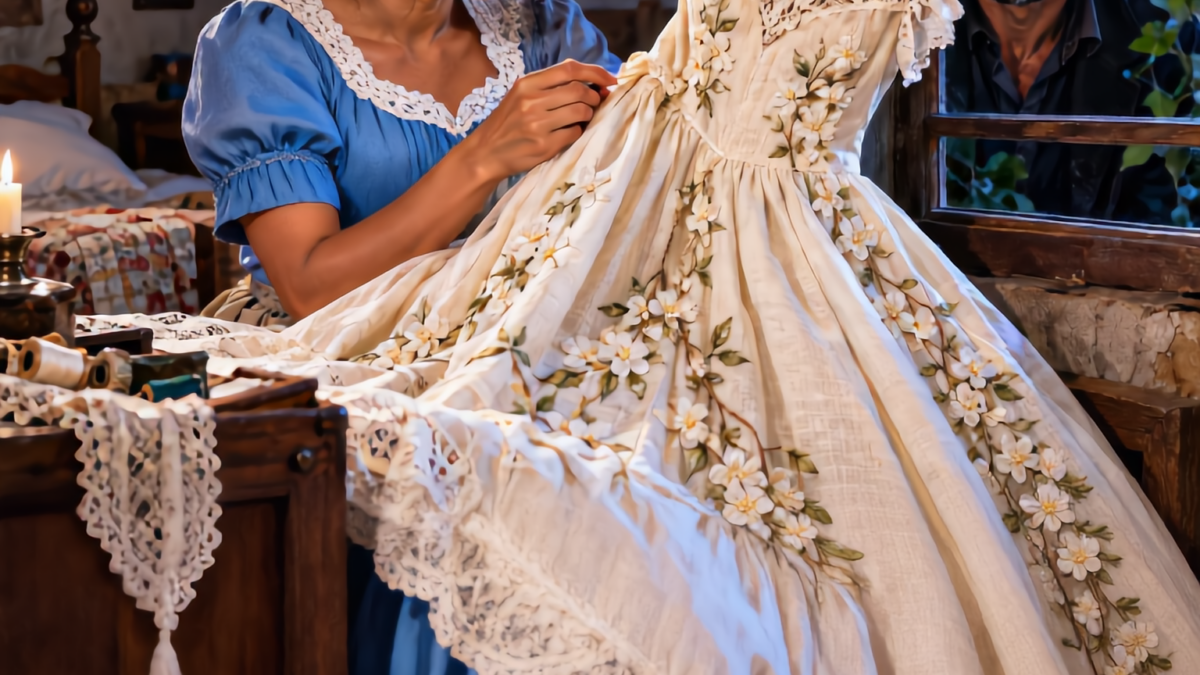
It was ivory linen with delicate lace at the neckline. From the knee down to the hem, branches of coffee blossoms climbed the skirt, embroidered in white thread. Even folded, even yellowed by time, you could see that someone had poured many nights of patience into that fabric.
Lorena lifted it by her fingertips like a dead animal. She saw the frayed hem and a small tear along the side, and she laughed.
“Look at this. It looks like a shroud.”
She carried it downstairs and out behind the corral, where the farmhands had heaped everything from the attic and storeroom beside the bamboo fence: old mattresses, moth-eaten curtains, broken chairs. She stopped in front of the pile, where everyone could hear.
“A modern woman’s home doesn’t keep dead people’s rags.”
She opened her hand.
The dress fell slowly, turned once in the cold wind, and landed in the mud beside the pile. The lace sank into the red clay. The coffee blossoms darkened.
“Valdomiro, pour the kerosene. I want this all burned before dark.”
Seu Valdomiro poured slowly, like a man doing penance. The sharp smell spread across the yard. The sun slid behind the ridge and painted the sky orange.
Three steps away, leaning against a fence post with a heavy bucket of milk, stood Inês. She had spent the day in the lowland pasture and had just come back. She didn’t know what room those things had come from, or whose they’d been. To her, those “dead people’s rags” could have belonged to anyone who’d ever passed through the farm.
But she had watched the lace sink into the mud. And she felt the same ache in her chest she felt whenever she saw someone throw bread on the ground.
Things made by hand carry a piece of the person who made them, her grandmother used to say. Throwing them away is like throwing away a person.
She knew the risk. If anyone saw her, she would be called a thief. She would lose her job, her wages, this month’s payment to the bank. Maybe the little blue house. She squeezed the thimble in her pocket until it hurt.
Seu Valdomiro patted his pockets. No matches. He muttered and went off to the shed.
Inês looked around. No one at the windows. No one in the corral.
She set down her bucket, took three steps, knelt, and pulled the dress from the mud. It was heavy and cold and soaked through. She folded it quickly, hid it beneath her apron against her chest, picked up her bucket, and walked away. Not running. Not looking back.
Minutes later, flames roared into the dusk and lit the coffee fields red.
No one missed a thing. Or almost no one.
At the top of the kitchen steps, a dish towel in her hand, Dona Nena had watched the girl bend down. She said nothing. She only crossed herself again, this time with her eyes wet for an entirely different reason.
That first night, Inês didn’t sew. She only washed.
While everyone slept, she heated water in the kitchen kettle and filled her metal basin. With a bar of coconut soap and only her fingertips, she washed the dress the way you bathe a baby. She didn’t scrub. She squeezed slowly and let the water carry the mud away. The water turned brown. She changed it. It turned gray with soot. She changed it again. In the fourth basin, the water ran clear, and Inês sat down on the floor, exhausted, with the wet fabric in her lap.
That was when she truly looked at it for the first time.
Old linen, tightly woven, the kind no one makes anymore. Bobbin lace so fine it looked like a spiderweb strung with dew. And the coffee blossoms…
She traced one with her fingertip, and her heart stopped.
That stitch. The satin stitch that spiraled into the center of each blossom like a snail’s shell. Inês knew it from exactly one place in the whole world: her grandmother. Conceição had called it the snail stitch, and laughed that she’d invented it as a girl on a rainy afternoon. She had taught it to seven-year-old Inês, guiding her small hand over the embroidery hoop.
This one is ours, Inês. It’s our signature.
Inês stared at that flower for a long time. She tried to tell herself it was coincidence. But hands know. Hands always know.
On the lining of the inside pocket, two tiny initials were embroidered in pale blue thread: C.A. They meant nothing to her. She had never heard anyone’s surname spoken in that house.
And inside the pocket, folded in four, softened by dampness but still whole, was a piece of paper. The handwriting was round and neat, a woman’s.
She read the first line before she could stop herself.
My son, if one day you forget how to smile…
She stopped. Her cheeks burned. Those words were not hers to read. She folded the paper along its old creases and hid it inside a clean handkerchief at the bottom of her trunk.
“I’m sorry, ma’am,” she whispered to the empty room. “Whoever you were. I won’t read it. This belongs to your boy.”
On Friday, Augusto returned from the pasture, climbed the stairs in his boots, and felt it before he understood it. Fresh paint. Gray curtains where the crochet had hung. And at the end of the hallway, his mother’s door standing open, its lock broken.
The room was empty. White walls. On the floor, only a pale rectangle where a rug had lain for forty years.
Lorena explained, a wine glass in her hand, that she’d done him a favor. The good furniture was in storage. The rest had gone to the fire. Papers, curtains, old clothes. Nothing of value.
Augusto swallowed his anger. There was the cooperative. The contract. Her father. And above all, a weariness so heavy it wouldn’t let him fight.
He said nothing. He walked out through the kitchen to the circle of scorched earth behind the corral. He crouched down and sifted the ashes with his fingers, slowly, searching for the only thing that mattered: the ivory dress his mother used to wrap him in when, as a little boy, he woke up crying at thunder. The last thing in the world that still carried her scent.
He found nothing.
He stayed there crouching, his hands black with ash, until it was dark.
That night, unable to sleep, he walked the yard and saw, through the last back window, a candle burning and the young chore girl bent over a pale fabric. He thought the care in it was beautiful. And he walked on, never imagining what lay in her lap.
For eleven nights, Inês sewed after her shifts, when her body was begging for sleep. She slipped her grandmother’s thimble onto her finger. She rebuilt the side tear thread by thread with invisible stitches. She re-embroidered the three frayed blossoms at the hem with the same turn, the same pressure, the same patience. Sometimes she’d stare into the flame, remembering her grandmother at her old pedal machine humming hymns, and she’d cry a little. Then she’d wipe her eyes on her sleeve and pick up the needle again.
One dawn, Augusto appeared at the corral gate, hat in hand, something he never did at milking time.
“Good morning, miss.”
“Good morning, Seu Augusto.”
His eyes fell to her hands. Her fingertips were red and covered in tiny needle pricks. “Did you hurt your hand?”
She hid her fingers under her apron too quickly. “It’s nothing, sir. Just a trifle.”
He seemed to want to ask something more. He didn’t. He nodded and walked away. But for the first time in two years, Augusto left the corral thinking about someone other than his mother.
Later, over her morning coffee, Dona Nena took Inês’s face in her warm, flour-dusted hands. “I saw you that day by the fire.”
Inês froze. “Please don’t tell anyone, Dona Nena. I didn’t take it for myself. I just couldn’t bear to watch it burn.”
“My child,” the old cook whispered, “you have no idea what you saved.”
“Do you know whose it was?”
Dona Nena looked toward the big house and pressed her lips together. “I do. But it’s not my place to say. God will reveal it in His own time.”
But the danger had not passed.
On the ninth night, a gold ring vanished from Lorena’s vanity. She came down the stairs screaming, accusing the whole household, and ordered Seu Valdomiro to search every employee’s room.
“Start in the back,” she snapped. “New people are always the first suspects.”
Inês heard it from the corral, and her blood ran cold. The dress lay spread across her bed, the needle still stuck in its hem. If Lorena saw it, she wouldn’t see a missing ring. She would see the dress she had ordered burned. And she would call Inês a thief in front of everyone.
Inês ran. She burst into her room, folded the dress with shaking hands, and shoved it between the thin mattress and the wooden slats.
She had barely turned around when someone knocked.
Seu Valdomiro stood in the doorway. Behind him, arms crossed, stood Lorena.
The foreman opened the trunk. Looked under the bed. Ran his hands through the clothes hanging on the nail. Inês pressed herself against the wall, not breathing.
Then Seu Valdomiro slid his palm slowly across the mattress.
His hand stopped.
He had felt something soft beneath it. Something folded. Something that was not a ring.
Slowly, very slowly, the old foreman raised his eyes and looked straight at her.
Behind him, Lorena stepped forward, her heels clicking on the floorboards.
“Well?” she demanded. “What is it, Valdomiro? What did you find?”
PART 2: The Night of the Storm
Inês didn’t speak. She only looked back at him.
The old foreman held her gaze for a single second that felt like an eternity. Then he lifted his hand from the mattress, turned to Lorena, and said firmly:
“There’s nothing here, Miss Lorena.”
Lorena huffed and moved on to the next room. Hours later, her own maid found the ring where it had fallen behind the vanity. Lorena apologized to no one.
That night, when Inês went to fetch water, Seu Valdomiro was sitting on the back bench cutting rope tobacco. He didn’t look up.
“Finish that work soon, girl,” he said quietly. “And be careful.”
On the eleventh night, just before the rooster crowed, Inês sewed the last stitch and bit off the thread, the way her grandmother always had. She hung the dress on the nail behind her door.
By candlelight, it seemed to glow on its own. The coffee blossoms climbed the skirt as if they were alive. It looked as though its owner had only just taken it off to wear again on Sunday.
And standing before it, Inês made a vow: she would never wear it. It wasn’t hers. It belonged to a mother. She didn’t know how to return it, or to whom. So she decided to wait. God would show her the right moment.
The very next morning, Lorena swept into the kitchen with the guest list for Saturday’s banquet. The biggest coffee growers in southern Minas. The mayor. The cooperative president. Her own father.
“And no employee,” she said, looking Inês up and down, “will appear in that hall looking like a country bumpkin.”
She had no idea that her own order would force the girl to put on the very dress she had sworn never to wear.
Saturday came with rain.
By six o’clock, the mountain sky had gone the color of lead and the storm broke open: water drumming on the roof, rivers of runoff gushing down the dirt road, lightning flashing across the coffee fields. Still the cars kept arriving, headlights glaring, delivering men in suits and women in long gowns.
Lorena had transformed the house. Rented crystal chandeliers. Satin tablecloths. White orchids flown in from São Paulo. A string quartet hired from Belo Horizonte played music no one on the farm had ever heard. She descended the staircase in a red Italian gown, mentioning its origin three times in ten minutes.
At the head of the table sat Augusto in a dark suit, his tie squeezing his neck like a noose. His old felt hat, which he refused to give up even on feast days, hung on the back of his chair. Around him, the talk was of commodity prices, land deals, and who had bought whose farm. A grower laughed loudly about firing half his sharecroppers to buy a machine.
Augusto stared at the crystal and thought of his mother. She would have hated this. She’d have set a straw basket of cheese bread in the middle of the table, called a local guitarist, and made everyone kick off their shoes to dance.
Thunder cracked directly overhead. The lights flickered. Some guests laughed nervously.
Augusto closed his eyes. It had been just like this on stormy nights when he was small. The rumble. The fear. Then his mother’s footsteps in the hall, the scent of lavender, the soft fabric of her dress against his cheek. Hush, my son. Thunder is just the sky rearranging its furniture.
He opened his eyes. There were no footsteps in the hallway. Only the clink of crystal.
“Smile, darling,” Lorena hissed, gripping his arm. “My father is watching.”
In the kitchen, it was war. Dona Nena and her two helpers rushed between steaming pots of roast suckling pig, black bean purée, and sautéed collard greens. Lorena had vetoed half the menu. Cheese bread at a dinner like this? That’s truck-stop food. Dona Nena hadn’t had the heart to throw it away. She’d hidden the trays inside the wood-fired oven.
At eight o’clock, Rosinha, the youngest helper, went pale and slumped against the sink. She’d been feverish since the day before but said nothing, terrified of losing a day’s pay. Dona Nena touched her forehead and gasped. “Child, you’re burning up. Go lie down.”
Sixty guests. Fifteen minutes until the main course.
Dona Nena threw open the window and shouted into the rain. “Valdomiro! Get Inês! Run!”
Inês had spent half an hour in the downpour pulling a calf out of the flooded lowland, and she arrived in the kitchen soaked from head to foot, mud to her knees, hair dripping.
“I need you in the dining hall now.”
Inês looked down at herself. “Like this? Dona Lorena will kill me.”
“Don’t you have anything else?”
Her other two outfits were hanging on the clothesline, soaked. The only clean, dry, decent garment in her little room was hanging on a nail behind the door.
Her stomach turned over. “I have something, Dona Nena. But it isn’t mine.”
The two women looked at each other in silence. And Dona Nena understood at once. Her eyes filled with tears, and she nodded slowly.
“Wear it, my dear. The woman who owned that dress would want you to. I knew her for more than forty years. She would want it.”
Inês ran through the rain to her room. She dried herself, washed her face in the basin, and took the dress from its nail. She was trembling, not from cold, but from respect. Before putting it on, she held it to her chest and closed her eyes.
“Whoever you were, forgive me. Grandma, help me. It’s only for tonight. I swear it’s only for tonight.”
She put it on slowly, the way you walk into a church. The linen fell over her body as if it had been made for her. She tied her hair in a simple bun, fastened a crisp white serving apron over the dress, and returned to the kitchen.
When Dona Nena saw her, she dropped her ladle into the pot.
There was no time for anything else. The old cook pressed a silver tray with the suckling pig into her hands and pushed her toward the swinging door. “Go. Head high. Nobody will look at you. People never look at the help.”
The hallway was long, its floors gleaming beneath the chandeliers. Inês walked slowly, watching every step. She heard the laughter, the clatter of silverware, the singing violin.
Then she stepped through the ballroom door.
First, one violinist missed a note. Then he stopped altogether. The cello followed. One by one, the musicians lowered their bows, all staring in the same direction. The conversations died table by table, like candles being snuffed. In less than ten seconds, sixty people sat in total silence, staring at the girl in the ivory dress standing in the doorway with a silver tray.
At the head of the table, Augusto had been lifting his glass to his lips.
He froze with it in midair.
Lorena shot to her feet so fast her chair crashed over backward. Her smiling face turned as red as her Italian gown.
“What is this? What is this woman doing in that outfit?”
She stormed across the room, heels cracking against the floor, and stabbed a finger at Inês. “This is an outrage! This maid is a thief! She dug an old rag out of the trash and came to parade in front of my guests to humiliate me! Someone get her out of here!”
Whispers rippled across the tables. Someone laughed softly. A lady in pearls shook her head with contempt.
Inês felt her face burn and her eyes sting. But she didn’t lower her head. Grandma used to say people who owe nothing don’t bow their heads.
At the head of the table, Augusto rose. Slowly. Both hands pressed against the satin tablecloth. Out of pure habit, he reached back and took his old hat from the chair.
Every eye turned toward him. The silence grew heavier. Everyone knew the master of Santa Luzia: a man of few words and firm decisions. Everyone expected to see the maid thrown out into the rain.
Augusto began walking toward her. One step. Two. Three.
And with every step, something in his face began to soften.
Because he wasn’t seeing a maid. He wasn’t seeing a white apron or a silver tray or hair pinned up in a hurry. He was seeing branches of coffee blossoms climbing an ivory linen skirt. He was seeing the lace at the neckline his little boy’s fingers used to touch while his mother sang to him softly. He was smelling, even from across the room, a scent that existed now only in his memory: lavender and warmth.
His hands began to shake. And in a flash, he remembered the back window. The candle. The young woman bent over pale fabric, night after night. The needle-pricked fingertips hidden under her apron.
That was what she’d been doing.
He stopped a few feet from Inês. He looked at the dress. At her face. At the dress again. He opened his mouth, but no sound came out.
And then, before the richest growers in southern Minas, before the mayor, the cooperative president, and his future father-in-law, the most feared man in those mountains sank to his knees on the ballroom floor, covered his face with his hat, and wept.
It was not a quiet cry. It was the cry of two whole years. The cry of a goodbye that never happened. The cry of a forty-four-year-old boy who still woke afraid of thunder and had no lap left to run to. His shoulders shook. The sound filled the hall and mingled with the rain on the roof.
No one moved. No one breathed.
And in that instant, Inês understood everything. The dress belonged to his mother. Dona Celeste. The woman everyone on the farm called a saint. That was why Dona Nena had wept. That was what C.A. meant. That was who my son was.
She could have defended herself. Explained. Apologized. That’s what everyone expected.
She did none of it.
Very carefully, she set the silver tray on the nearest table. Then she knelt down in front of him in the middle of the hall, reached into her apron pocket, and drew out a folded white handkerchief. Inside it was the paper.
“This was in the pocket of the dress, Seu Augusto,” she said quietly, but steadily. “It’s yours. I didn’t read it. Only the first line, by accident. The rest belongs to you.”
He lowered his hat. His eyes were red and lost. He saw his mother’s round handwriting, and a sob tore out of him that seemed to come from deep in the earth. He took the note in both hands, the way you receive communion.
“Where…” His voice failed. “Where did you find this?”
“Behind the corral, sir. It was going into the fire with a pile of old things. I saw it fall. I swear I didn’t know whose it was. I just couldn’t bear to let it burn. I washed it and mended it at night. Eleven nights. No one was supposed to see. Tonight Rosinha got sick, and I was covered in mud, and it was the only clean thing I owned.” Her voice trembled. “Forgive me. But I wore it with respect.”
Augusto closed his eyes and pressed the note against his chest. He stayed there on his knees, breathing deeply, like a man trying not to break apart a second time.
When he opened his eyes, they were no longer the eyes of a lost boy.
He rose and helped Inês to her feet with a gentleness no one in that room knew he possessed. Then he turned toward Lorena, who stood in the middle of the floor, white as a sheet.
“Tell them, Lorena.” His voice was low, but everyone heard it. “Tell them who ordered my mother’s things to be burned.”
PART 3: Changing Hands
Lorena tried to smile. It came out crooked.
“Darling, it was just an old rag. It had no value. I was doing you a favor. You can’t live in the past forever.”
“No value,” Augusto repeated, as if tasting the bitterness of the words.
An elderly grower from Lambari stood up, his voice choked. “Young lady, I knew Celeste for fifty years. That is the dress she wore to this boy’s christening. I was there. It is no rag.”
Murmurs of agreement rose around the room. The lady in pearls, who had sneered at Inês moments before, now stared at Lorena in disbelief. Lorena’s own father looked down at the tablecloth, unable to raise his eyes.
Augusto did not shout. He spoke with the calm of a man who had already decided.
“Lorena, I agreed to this engagement because I was too tired to choose anything else. That was my mistake, and I apologize for it. But someone who tramples the memory of the dead cannot live under the roof where that person lived. The engagement ends here. In front of everyone.”
Lorena opened her mouth, but no words came.
“Your father’s driver will take you to the city tonight. Seu Valdomiro will light your way to the gate. The road is bad in the rain. I’ll send your things in the morning.”
She looked around for support and found none. At the door, she turned to say something. But nobody was looking at her. Every eye was on the girl in the ivory dress.
When the car’s engine had faded into the storm, Augusto looked down at the skirt and frowned. “The hem. It was frayed my whole childhood. My mother never wanted it fixed.”
“I remade the blossoms, Seu Augusto. Three of them.”
He shook his head slowly. “No one can make that flower. My mother said it was a special stitch she’d learned as a poor farmer’s daughter, from a seamstress in town who taught her for free every afternoon on a porch. She said everything she knew about embroidery, and patience, and kindness, she learned on that porch.” He paused. “That seamstress was Dona Conceição.”
Inês’s legs gave way. Her hands flew to her mouth, and tears spilled over before she could stop them.
“Dona Conceição was my grandmother,” she whispered. “She raised me. She taught me that stitch when I was seven. She called it the snail stitch.”
From the kitchen doorway, Dona Nena let out a loud sob and crossed the hall, not caring who saw. “It’s true, sir. I remember! Dona Conceição came up the mountain to help your mother sew her wedding trousseau. A short lady with spectacles. I was just a girl, serving coffee to the two of them on the porch.”
She wrapped Inês in her arms.
Seu Valdomiro returned soaked from the gate, took off his hat, and stood in the doorway with brimming eyes. The farmhands who’d been peering through the kitchen windows slipped in one by one, muddy boots and all, and nobody told them to leave. For the first time that night, the hall felt like a family home.
A gray-haired ranch wife, Dona Amélia from São Lourenço, took Inês’s hands. “My dear, I’ve never seen such work in my entire life. My granddaughter marries in March. Will you sew her trousseau? I’ll pay whatever is fair.”
“And I want an altar cloth for the chapel on my farm,” called a woman farther back.
“And a christening gown for my grandson!”
Inês thought of her little green notebook. Of the numbers and the sleepless nights. Of the blue-walled house. And for the first time in seven months, she felt that the sums might balance. Not by anyone’s charity. By the work of her own hands.
Augusto held out his large, calloused hand, trembling just slightly, and waited. She took it. He didn’t lead her to the kitchen or the door. He walked her the full length of the hall, between the tables, beneath everyone’s gaze, to the head of the table. He pulled out his own chair. The master’s chair.
“Seu Augusto, I can’t.”
“Yes, you can. This seat belonged to my mother for forty years. Tonight it’s yours.”
She sat with her hands in her lap. Augusto turned to his guests, his voice clear and strong, as it hadn’t been heard in that house for two years.
“I want every one of you to know this young woman. Her name is Inês. She’s milked my cows at dawn through cold and rain since the beginning of the year, and I, the owner, never truly looked at her. That says more about me than about her.” He paused. “When everything in this house was thrown into the fire, when I wasn’t here to protect it, when no one else had the courage, she was the one who reached into the mud. She preserved the dignity of this house when no one else did. Not even me.”
Then Dona Nena pulled the hidden trays of cheese bread from the oven and set them in a straw basket in the center of the table, just the way Dona Celeste liked. A farmhand fetched his guitar. The quartet from Belo Horizonte, a little awkward, joined in on an old folk song.
And that night, for the first time in two years, the big house of Santa Luzia sounded like a home.
The next morning, with the sky washed clean and the coffee leaves glittering with dew, Augusto called Inês to the porch. He had read his mother’s note alone in the chapel at dawn. Now he understood why she’d hidden it in the pocket of her favorite dress. She’d known that one day, longing would make her son open that chest.
“My mother left so many things unfinished,” he said. “The chapel. Help for the colony families. A memorial for the farm’s history. I never had the heart to carry any of it on. I want you to lead it. With a fair salary, paid studies, and a house of your own here. Not as an employee. As family of this land.”
Inês was quiet for a long time, looking out at the chapel.
“I accept, Seu Augusto. On one condition. Your mother taught the young women here to embroider, didn’t she? I want to open a little sewing school. Free. For the colony women, the girls from town, anyone who wants to learn. The way my grandmother taught your mother on that porch.”
Augusto had to look away toward the pasture, because his eyes had filled again.
Over the following months, Inês paid off the bank with her own work: the bridal trousseau, the altar cloth, the christening gown, and a flood of orders passed from farm to farm by word of mouth. On the day she delivered the last payment, she sat in the town square, opened her green notebook, and beneath the final number wrote a single word.
Paid.
Then she climbed the hill to the little blue-walled house, opened the door that creaked exactly as it always had, and pulled the dish towel off her grandmother’s old pedal sewing machine.
“Grandma, the house is ours,” she said aloud to no one. “And you’ll never believe whose dress that was.”
She sat there until dusk, laughing and crying at the same time, her grandmother’s thimble clutched in her hand.
The sewing school opened in September in a room beside the chapel with four students. By December there were nineteen: young women from the colony, widows from town, and a nine-year-old girl named Teresa who walked three kilometers each way to get there.
In her first week, Teresa botched every stitch and cried with frustration. One rainy afternoon, Inês took the worn metal thimble from her pocket and slipped it onto the girl’s finger. It was far too big. Teresa laughed.
“It belonged to my grandmother,” Inês said. “She lent it to me when I was your age. Now I’m lending it to you. Someday, you’ll lend it to another girl.”
That afternoon, Teresa finished her first complete snail blossom, crooked and perfect. And Inês understood that her grandmother had never really left. She had only changed hands.
The chapel had flowers again. Every evening at six, someone led the rosary. Dona Celeste’s memorial was set up in the old sewing room with the rescued photographs and the rocking chair. And in its center, beneath a glass dome, stood the ivory dress with its climbing coffee blossoms. Beneath it, a small wooden plaque read:
Embroidered by Conceição and Celeste. Saved by Inês.
The twelve-seat jacaranda table was never empty again. On Sundays it filled with Dona Nena, Seu Valdomiro, Rosinha, the students, the farmhands and their families. And at its head, side by side, sat Augusto and Inês. Between them grew something quiet and respectful that no one needed to name. He brought her coffee in the late afternoons while she bent over her hoop. She taught him to thread a needle, and he laughed at himself for the first time in years. Sometimes they walked to the chapel together in silence, and the silence between them wasn’t heavy anymore. It was warm.
The farmhands said the boss had become human again.
Dona Nena said no. He had simply become Dona Celeste’s son again.
Almost a year after that July afternoon, there was another pile in the yard behind the corral: clothes, blankets, shoes, pots, toys. But no one was holding kerosene. It was the sewing school’s winter drive for families up in the mountains.
Augusto came up behind Inês with two mugs of coffee. “Where is all this going?”
“To people who need it,” she said, folding a small wool cardigan. “On this farm, Seu Augusto, nothing goes into the fire anymore.”
That night before bed, Augusto read his mother’s note once more. He knew it by heart, but he loved to see her round handwriting.
My son, if one day you forget how to smile, find someone who knows how to mend things with patience. That is how I learned to live.
The world is full of people who trample what they think is worthless, blinded by their own vanity. But life has mysterious ways of teaching us that the hands that pull others from the mud, with love and respect, are the very hands chosen to sit in the place of highest honor.








