“That Scarred Cowboy Doesn’t Know How to Love Anyone,” the Whole Village Warned Her. Then, on the Darkest Night of Her Life, the New Teacher Knocked on His Gate and Begged for His Protection
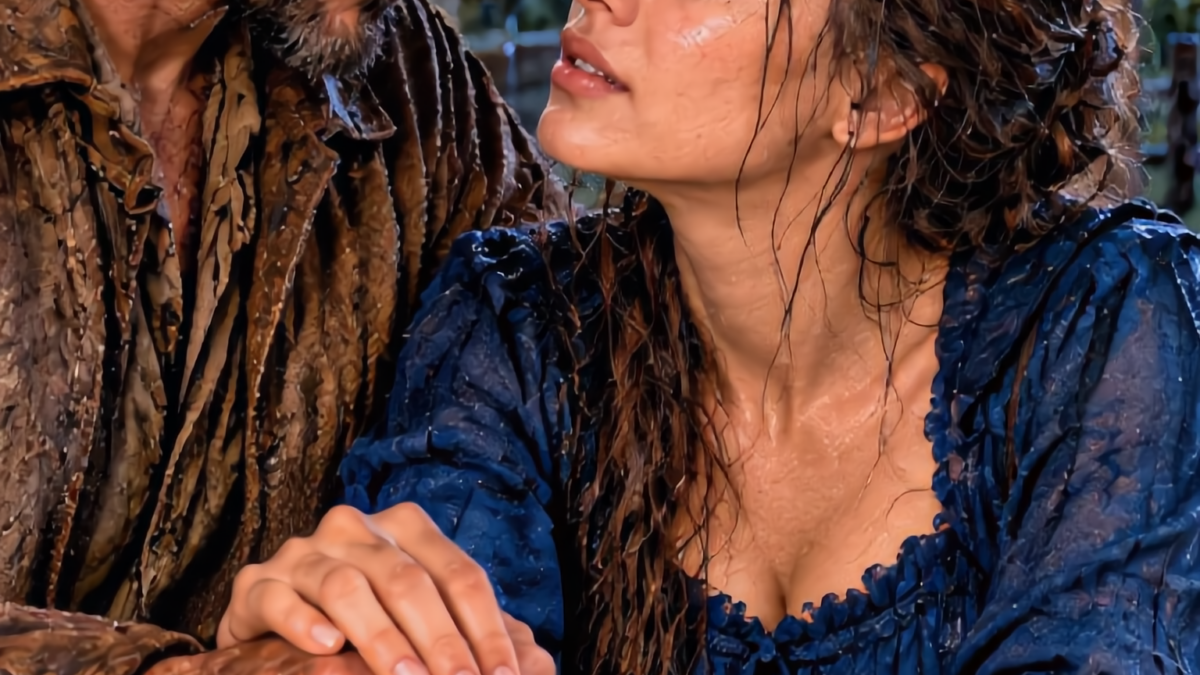
PART 1: The Ghost Cowboy
“That man doesn’t know how to love anyone, teacher. The fire burned his heart right along with his face.”
Dona Lourdes said it softly, leaning across the shop counter with one hand cupped beside her mouth, the way people whisper a secret the whole village already knows by heart.
Helena had only asked for a kilo of sugar, a box of matches, and two candles. It was her first day in Vila das Acácias, deep in the backlands of Bahia near the Sergipe border, and the red dust of the road still clung to the hem of her dress.
Outside, a tall cowboy was crossing the square on a brown horse with a short-cropped mane.
He wore a leather hat and a vest gone thin at the elbows, his shirtsleeves rolled up. His forearms were covered in scars that looked like dry riverbeds drawn on a map. On the left side of his face, the skin ran tight and shiny from temple to jaw, and the eye on that side always seemed a little tired.
Helena watched the whole square change as he passed.
A woman hanging laundry on a wall went inside and shut her window. Two men on the bench beneath the tamarind tree fell silent, and one of them spat on the ground. Even the shop’s skinny dog pricked up its ears. Silence followed the horse like a long shadow, and only when he rounded the corner of the little church did the voices return.
That was when it happened.
A tiny, white-haired woman in a flowered dress and headscarf was coming down the stone hill with a market basket on her arm. Her slipper caught on a loose paving stone, and she fell hard to her knees on the midday-hot rocks. Oranges went rolling down the hill. Her moan was low, more shock and embarrassment than pain.
No one else was near.
The cowboy pulled up his horse, swung down in a single motion, and knelt on the stones beside her.
Helena stood frozen in the shop doorway, the bag of sugar pressed to her chest. She watched those burned hands, thick as tree roots, lift the old woman with a tenderness that matched nothing she’d just been told. She watched him pull the kerchief from his own neck, wet it from his gourd, and clean the scraped knee slowly, carefully, the way someone tends their own mother.
“It was nothing, ma’am,” she heard him say in a low, rasping voice. “It was only the stone that got frightened.”
The old woman let out a shaky little laugh. He gathered the oranges one by one and set them back in her basket.
Then her daughter came running around the corner, seized her mother by the arm without once looking at him, and hauled her up the hill, muttering something Helena couldn’t hear.
She didn’t say thank you.
The cowboy stayed kneeling a moment longer, the dust-stained kerchief in his hand. Then he stood, mounted, and rode away in silence.
No one in the square had seen what Helena saw.
His name was Mateus.
That night, after penning the cattle and scattering corn for the hens, he sat on the porch of his small ranch at the far edge of the region, past the dry creek, where the road became a trail and the trail became thornbush. The kerosene lamp hissed low, its smoke mixing with the smell of earth still warm from the day.
In his hands, he turned an old bronze cowbell with a dented rim, its metal darkened in a way no sandpaper would ever clean.
Fifteen years ago, that bell had hung around the neck of Estrela, the gentlest cow on the great Boa Vista ranch, the cow the whole herd followed. On the night the corral caught fire, it was the sound of her bell that led the animals out, while Mateus threw open gate after gate through the smoke and the heat. He saved the entire herd. He came out with his face and arms marked forever.
Instead of gratitude, he earned a nickname.
First they said he’d been drunk that night. Then they said the fire was his fault. And as his scars hardened and he grew quieter, they began calling him the ghost cowboy. They said he felt nothing. That he never married because no woman could bear to look at him. That he talked to cattle because people wouldn’t talk to him.
That last part was true. Just not the way they meant.
His life ran as steady as sunrise. Up at four. Coffee from the thermos, corn couscous with milk from that morning’s milking. Mending fences, pulling cactus thorns from a calf’s hoof, patching his leather jacket with waxed thread. No one ever saw him sit still. Stillness left room for thinking, and thinking hurt.
But late afternoons belonged to him. When the backlands sky turned the color of embers, then ash, Mateus climbed the great stone slab behind the ranch and sang his aboio, the ancient cattle call of the sertão. It rose from deep in his chest, long and sad and beautiful, rolling across the scrubland until the horizon swallowed it. And the cattle lifted their heads and came.
It was the only voice that ever answered him.
On Saturdays, he rode into town for kerosene, salt, tobacco, and bread. When drought cut the milk and money ran short, Dona Lourdes wrote his debts in her ledger, turned it toward him, and he signed with an X.
Always an X.
No one knew Mateus had never learned to read. Or maybe they knew and thought it fit the rest of him. A man without words, without a face, without a heart.
Only one man at the market never turned away: old Zé do Bode, a goat drover past eighty with trembling hands and a torn straw hat. He always lifted a hand in greeting. But he could never hold Mateus’s gaze, always dropping his eyes like a man carrying a weight he couldn’t name.
Mateus never understood why.
That night, it wasn’t the old rumors that troubled him. He’d grown calluses over those. It was the eyes of the young woman in the shop doorway. She hadn’t looked away. She had looked at all of him, scars and all, the way you look at a person.
Across the dark, on the little hill where the school stood, a single window was still lit.
For the first time in fifteen years, Mateus sat very still, looking at a light that wasn’t his own.
Helena was thirty-one and had never lived far from Salvador.
She grew up in the Liberdade neighborhood in a two-room house, raised by her grandmother Firmina, a washerwoman with cracked hands who sang samba de roda over the washboard. Helena’s mother had left when she was small. She left a note on the kitchen table and never came back.
It was Grandma Firmina who held everything together, and it was money from strangers’ laundry that paid for Helena’s schooling. Firmina never learned to read. All her life, she signed documents with an ink-stained thumb, until Helena, already a teacher, sat with her at the kitchen table and taught her to write her own name, letter by letter, at eighty years old.
Firmina wept the first time she managed it. It was because of those tears that Helena chose to teach adults.
When she passed the civil service exam and saw the posting for a night literacy class deep in the backlands, everyone said she was crazy. Her grandmother only held her face in both hands. “Go, my girl. Wherever there are people wanting to learn, there is a place for you.”
Firmina died six months later.
Helena arrived with three dresses, a box of books, and a photograph of her grandmother smiling in their front doorway, which she set on the nightstand of the only house for rent in the village. Only later did she learn who owned it.
The school was a single room on a little hill: a roof leaking in three places, a cracked blackboard, twelve desks for nineteen students. Class began at 6:30, when people came in from the fields. Farmers with soil still under their nails. Washerwomen with fingers puckered from soap. Cowboys who smelled of cattle. Many walked six or seven kilometers in the dark with a flashlight just to learn to put letters together.
Dona Rita, seventy, knew every bird of the caatinga by its song but couldn’t write a single name. Seu Bené, a laborer with enormous hands, wanted to read the Bible on his own before he died. And in the second week, Dona Bastiana arrived, the little woman who had fallen on the hill, with her headscarf and a notebook wrapped in a plastic bag. Her daughter, Dona Cícera, allowed it only because her mother insisted.
Helena fell in love with all of them in the first week. When she realized the school snack was the only evening meal many of them got, she began buying cornmeal, milk, and eggs from her own salary, and the smell of cinnamon porridge filled the little room.
Afonso Teixeira appeared in that very first week.
About forty, well-dressed, with a felt hat and a gold ring on his little finger, he was the son of the late Colonel Teodoro, who had owned the Boa Vista ranch and half the land around the village. He arrived with a basket of cheese, dulce de leche, and a bottle of genipap liqueur.
“Welcome, teacher. If you need anything at all, just send for me. Around here, I’m the one who handles things.”
Helena thanked him and shared the cheese and sweets with her students. She returned the liqueur. He came back with a dinner invitation. She declined. He came back with a dress bought in Aracaju.
“Seu Afonso, I appreciate the attention,” she said, firm but never rude. “But I came here to work. That’s all I want to do.”
He smiled. It didn’t reach his eyes.
Three days later, the first note appeared under her door, on brown wrapping paper in cramped block letters:
TEACHERS FROM THE CAPITAL DON’T LAST HERE.
After that, things changed the way bad things always change in a small town. The school snacks stopped arriving. At city hall, the clerk muttered about “a route problem” and couldn’t meet her eyes. Helena wrote down his name and the date in a little notebook. Grandma always said paper keeps what memory forgets.
The local councilman dropped by one evening and observed, as if it were nothing, that a class so small might have to be shut down.
The second note said: A WOMAN ALONE SHOULD KNOW WHO HER FRIENDS ARE.
She kept the third one only because her hands were shaking too hard to tear it.
One night, walking home along the dark road, she heard horses behind her at a slow walk, and low laughter. She ran home and bolted the door, and listened to the hooves stop outside her window. Someone tapped on the glass. Three times. Then rode away.
The next morning, she reported it to the village’s only policeman, a sleepy, heavyset man named Bertolino. He scratched his chin. “Must be kids fooling around, teacher. Good people here.”
On his wall, as she left, she noticed a calendar with a photograph of the Boa Vista ranch.
She tried Dona Lourdes. Dona Cícera. The women at church. Every one of them was kind, sympathetic, and quick to change the subject. In Vila das Acácias, no one wanted to be on the wrong side of Afonso Teixeira.
At night, Helena talked softly to her grandmother’s photograph. “You always said people brave enough to be good take a beating, but they don’t rot. I’m taking the beating, Grandma. And I’m so afraid of doing what Mama did. Of packing my bags and disappearing.”
On a Thursday in October, the backlands sky did something rare.
It closed.
Heavy clouds rolled in by late afternoon and class was canceled. By eight, a thunderstorm broke, the kind that brings whole families to their doorways to watch water pour from the sky.
Helena shut the windows and lit a candle.
That was when she heard the horses again.
This time, there was no laughter. Only the slow, careful sound of someone working at the latch of her back door. Testing it. Then a man’s voice, thick with liquor, saying her name softly through the wood, the way a man calls an animal.
Helena pressed herself against the kitchen wall, the candle in both hands, her heart hammering so hard she thought the whole village must hear it.
The latch held.
The horses rode away. But a cold certainty rose from her stomach to her throat: next time, it wouldn’t.
She thought of Bertolino and his calendar. Of Dona Lourdes changing the subject. And then, without quite knowing why, she thought of a pair of burned hands cleaning an old woman’s knee on the hill, and a hoarse voice saying it was only the stone that got frightened.
Helena grabbed her lantern, threw her raincoat over her nightgown, and stepped out into the storm.
Three kilometers. Pitch dark. Rain like gravel. The creek that had been dry all year now ran shin-deep and fast, and she waded it with her lantern held high, her nightgown dragging, the flame shrinking to a trembling blue bead.
Halfway along the trail, she heard it behind her.
Hooves. Slow. Following.
She ran.
She stumbled through the thornbush and reached the rough wooden gate of the ranch at the end of the world, and pounded on it with her fist. Again. Again.
“Is anyone there? Please!”
Behind her, out on the black trail, the hoofbeats stopped.
The lantern flame guttered and died.
And in the darkness on the other side of the gate, another light appeared, swinging closer, until it lit the scarred face of the man the whole village was afraid of.
PART 2: The Man From the Frightened Stone
Mateus raised his lantern past her, toward the trail.
A long moment. Then, out in the dark, the sound of a horse being turned, and hoofbeats fading back the way they’d come.
Only then did he look at her: soaked from head to foot, her coat plastered to her body, her dead lantern still clutched in a trembling hand. In fifteen years, the only visitors at his gate had been the wind, a stray ox, and once, a lost anteater.
“Good evening,” she said, and her voice came out steadier than she expected. “Forgive me for coming at this hour. My name is Helena. I’m the schoolteacher.”
“I know who you are,” he said, and waited.
She told him everything at once, with no embellishment. The notes. The horses on the road. The vanished school meals. The councilman. The policeman’s calendar. The latch, that very night. That her landlord was the same man she was sure had sent the notes.
“I didn’t come to ask for money,” she said. “Or to stay here. I need just one thing. Someone to walk me to school in the evening and home again at night. Someone they respect, or someone they fear.” She paused. “You’re the only man here Afonso can’t buy.”
The rain fell between them.
“Why me?” he finally asked, lower than he meant to.
Helena looked straight at him. At his face, his scars, his eyes. She didn’t look away for a single second.
“Because I saw you lift Dona Bastiana on that hill,” she said. “And a man who cleans an old woman’s knee like that isn’t the man they say you are.”
Something stirred in Mateus’s chest. Something old and rusted, like a gate no one had opened in years.
“You’re shivering,” he said. “Wait here.”
He came back with his horse saddled and laid his own leather coat over her shoulders. It still held his warmth and smelled of lamp smoke and wet grass.
“Tomorrow at five-thirty, I’ll be at your door,” he said, reaching down a hand to help her up behind him. “And every day after that you need me.”
When they reached the village, he waited until she was inside with the door locked. Then he led his horse beneath the umbu tree across the road and sat down among its roots, hat low, rain dripping from the leaves.
Through the crack in her shutters, Helena watched him stay there all night.
She slept for the first time in weeks.
At dawn, as Mateus rose stiff with cold, the door of the house two down creaked open. Dona Joana, the old village healer, crossed the muddy road in her shawl and pressed a steaming mug of coffee into his hands without a word. Then she went back inside.
Mateus stood in the middle of the street holding it with both hands.
In fifteen years, no one in that village had offered him so much as a glass of water.
Riding home, he stopped beside a puddle and looked at his own reflection for a long time. The same scarred face as always.
But for the first time in fifteen years, he didn’t want to look away.
From then on, at five-thirty every evening, Mateus knocked on her door. She rode behind him to the school as the sky went purple over the ridge, and at nine, he was waiting outside, leaning on his horse.
At first, they barely spoke. “All right?” “All right.” The rest was hoofbeats and crickets.
The village watched, and whispered, and didn’t know what to think. And the horses that had prowled around Helena’s house at night stopped coming.
But Afonso was not a man to give up quietly.
One evening, at the bend by the reservoir, three riders blocked the road: two Boa Vista foremen, and Afonso himself, his ring catching the last of the light.
“Well, well. The teacher’s hired herself a bodyguard. And that one, of all people.” He looked Mateus up and down. “Go back to your hole, ghost.”
Helena felt Mateus’s body go still in front of her. He didn’t raise his voice. He didn’t reach for anything. He simply stopped his horse, looked Afonso in the eye, and waited, solid as a fence post, until the silence grew heavy.
One foreman looked away first. Then the other.
“The road belongs to everyone, Seu Afonso,” Mateus said calmly. “And the teacher has a class to teach.”
He rode forward slowly between their horses. Looking back, Helena saw Afonso’s face, and knew it wasn’t over.
That week, the old wooden bridge over the creek cracked under the floodwater. Half her students lived on the other side, and Dona Rita was terrified to cross in the dark.
The next evening, the bridge was new. Thick aroeira planks, nailed and wired, solid as a house floor.
Mateus said nothing. Helena only understood when she saw his hands full of splinters and a fresh gash on his arm.
“Was it you who fixed the bridge?”
He shrugged. “A broken bridge is no use to anyone.”
She laughed, a short, bright laugh that escaped before she could stop it. He turned toward the road, but she saw him linger, one second longer than necessary.
She began noticing everything he did without saying. A thermos of coffee every evening, with couscous wrapped in a dishtowel. A sack of beans left anonymously at the school door. Students from out his way began arriving less exhausted, because Mateus gave them rides in his cart.
Dona Bastiana was the first to accept. She climbed down at the school and announced to the whole class: “This is the young man from the frightened stone.”
One Saturday, Helena asked to see his ranch.
In the corral, a tiny dun calf lay weak on the straw. Mateus knelt, lifted her head in his palm, and fed her warm milk from a bottle with a cloth nipple, murmuring in a voice Helena had never heard. “Drink, little flower. Drink, my child. There’s still so much beautiful pasture for you to see.”
Helena stood at the gate and found she wanted to cry. Maybe because she was watching a man no one had allowed to be tender with people pour all the tenderness he had into a sick calf.
That same afternoon, she saw the X.
The milkman had left a receipt to sign. Mateus held the pencil a second too long, then drew an X. He saw her see it. His face reddened beneath his scars, and he shoved the paper into his pocket.
She said nothing that day. But on Monday, after class, she asked him to step inside.
“Seu Mateus, why do you never come into the classroom?”
He looked at the empty desks as if at a snake. “A man like me doesn’t belong in there, teacher.”
“This is exactly where a man who can’t read belongs,” she said gently. “But if you’re not ready to sit with the others, I can teach you myself. On my porch, after class. No one needs to know.”
The silence lasted so long she thought he’d walk out.
Instead, he took off his hat and held out his big, scarred hand for the pencil.
“Where do I start?”
“With the first letter of your name.”
That first night, he gripped the pencil like a castrating knife. Helena laughed, laid her hand over his, and adjusted his fingers one by one.
They both went perfectly still.
For a moment, neither remembered what they were doing there. Then she withdrew her hand slowly, cleared her throat, and said, “Now. The M.”
It came out crooked. Then less crooked. Then firm.
Night after night, after the last student’s lantern faded down the road, they sat in the lamplight with the notebook between them. He made mistakes, erased, tried again, sometimes pressing so hard in frustration that the lead snapped, and she’d smile and sharpen another. And Mateus discovered he was sometimes making mistakes on purpose, just to hear her laugh.
At market, Dona Joana nudged Dona Lourdes. “Have you noticed, Lourdes? That man’s been whistling lately.”
But inside, he was torn. Some nights, he rode home light-hearted and his aboio on the rocks sounded new. Other nights, he lay in his hammock and thought: This isn’t for me. A woman like that, looking at a face like this. She’ll leave for the capital, or listen to what people say, and I’ll be left with an open gate and no one on the other side.
One night, without lifting his eyes from the notebook, he asked: “Aren’t you afraid of me?”
Helena took a long time to answer. “I’ve been afraid of a lot of things this month, Seu Mateus. The dark road. That man. But never of you.” She paused. “My grandmother learned to write her name at eighty. She used to say people brave enough to be good take a beating, but they don’t rot. I think she’d have liked you.”
He didn’t answer. But when the lesson ended, he wrote slowly by himself at the bottom of the page.
M-A-T-E-U-S.
He stared at those six letters for a long time, like a man looking at a portrait of someone he’d forgotten existed.
Across the square, Afonso Teixeira sat on his horse watching the lit porch of the house he owned. There was no smile on his face at all.
The blow came on a Monday, from three sides at once.
First, the gossip. After Sunday mass, someone at the church door began saying the teacher from the capital was “carrying on with the ghost.” What decent husband would let his wife study at night with a woman like that?
Then, the eviction. A typed notice on her door: fifteen days to vacate.
And finally, a letter from city hall. Due to low attendance and community complaints, the night class will be evaluated for closure at the end of the month. Students may enroll in the city, 40 km away.
Everyone knew what that meant. No farmer would travel forty kilometers at night to study. It was the end.
That night, Mateus took her to school as always. She lit the lantern, wrote the date on the board, and waited.
Six-thirty. Seven. Seven-thirty.
No lanterns appeared on the road.
For the first time since she’d arrived, not a single student came.
At eight, Helena blew out the lantern and sat on the schoolhouse steps with the crumpled letter in her fist. She had cried it all out while she waited.
“I’m leaving, Seu Mateus,” she said, without looking at him. “If I stay, they’ll close the class anyway. If I go, at least they’ll leave the students in peace. And you. You never should have had to hear what they’ve been saying about you because of me.”
Mateus sat beside her and watched the moon rise silver over the scrubland. Then he took the darkened bronze cowbell from his pocket.
“Have you ever wondered how I ended up like this?” he asked, with a brief gesture at his face.
And for the first time in fifteen years, he told someone.
He had come to Boa Vista as an orphan boy, and Colonel Teodoro had given him a roof, food, and a trade. Harsh, but fair in his way. Mateus owed him everything. Afonso, then barely twenty, was always fighting his father. One night, after a vicious argument, he stumbled drunk into the barn with a lit cigarette and came running out, leaving the fire behind him.
“I saw him come out,” Mateus said. “I was in the corral. The flames jumped to the fence, and from the fence to the corral. A hundred head trapped inside. I just did what had to be done.”
“Then why does everyone say it was your fault?”
He turned the cowbell between his fingers. “Because the colonel came to see me in the hospital in Aracaju while I was still in bandages. He said if the truth came out, his son would go to prison. He asked me to keep quiet.” A long pause. “I did it out of gratitude. Then people started inventing things. Afonso helped. And I just stayed silent. Who’d have believed a man with this face who couldn’t even write his own name? Then the colonel died, and the lie kept living.”
Helena placed her hand over his, over the bell, and left it there.
The silence between them wasn’t empty. It was the place where important things fit.
“I have something to tell you too,” she said at last. “You know my mother left when I was small. What I never said is that I’ve spent my whole life afraid of becoming her. Of being someone who leaves when things get hard.” She drew a shaky breath. “And here I am with my suitcase practically packed.”
Mateus looked at the dark schoolhouse behind them: the cracked blackboard, the twelve desks, and taped to the wall, Dona Rita’s drawing of a red-crested cardinal with the bird’s name written beneath it in shaky letters, the first word she’d ever written in her life.
He closed his hand around the bell.
“For fifteen years, I let other people tell my story,” he said slowly. “Hidden away in that corner, thinking that’s what I deserved.” He looked at her. “Enough, Dona Helena. You’re not leaving. And I’m not staying silent anymore.”
Helena wiped her face. Then she remembered, and pulled the little notebook from her bag: every date, every name, the meal “route problem,” the councilman’s visit.
“Seu Mateus,” she said slowly. “The school meals didn’t vanish on their own. Someone’s stealing them. And I have it all written down.”
He smiled then, really smiled, crooked where the scar pulled at it, but whole.
“Then teach me two new words tonight,” he said. “Petition. And report.”
By lantern light, they wrote a letter to the Department of Education and another to the prosecutor’s office. Helena drafted the hard words. And Mateus slowly copied out the opening line of a petition he’d composed himself:
We, the people of Vila das Acácias, ask that our school stay open for those who never had the chance to learn.
“But who will sign it?” Helena asked. “No one here will cross Afonso.”
Mateus folded the paper carefully and tucked it inside his jacket, beside the cowbell.
“Then I’ll knock on every door.”
For six days, he rode from ranch to ranch, house to house, knocking on gates he’d never knocked on in fifteen years. Many never opened. Some opened a crack and slammed shut. One man set his dog on him.
At every next door, he took off his hat again. “Good afternoon. I’ve come to talk about the school.”
The first signature was Dona Joana’s. She read every word through glasses perched on the tip of her nose, then looked at him over them. “I set your crooked back once, years ago. You don’t even remember.” And she signed in neat, careful script.
The second was Zé do Bode’s, in his shack by the reservoir. The old drover signed with a trembling hand, and as Mateus mounted to leave, he caught the bridle.
“For fifteen years I couldn’t look you in the face, Mateus. You never knew why.” His eyes were wet. “I was there that night. I saw who came out of that barn. And I took the colonel’s money to keep quiet. I’m old, and I was a coward. Forgive me.”
Mateus climbed down and stood before him. Then he hugged him, an awkward embrace between two men who had never learned how, and the old man sobbed quietly into the shoulder of his leather jacket, his straw hat fallen in the dust.
On Thursday, he knocked on Dona Cícera’s door. She went pale at the sight of him. But Dona Bastiana appeared behind her, beaming. “Come in, my son! Cícera, it’s the young man from the frightened stone.”
Dona Cícera read the petition with trembling hands, looked at her mother, looked at Mateus, and signed. Beneath it, slowly, tongue between her teeth in fierce concentration, Dona Bastiana wrote her own full name. The first signature of her life.
“That day on the hill,” Cícera murmured, eyes lowered, “I never even thanked you.”
“It’s all right, ma’am. Your mother was fine. That’s all that mattered.”
By Saturday night, the petition held 143 names.
Sunday was the Vaqueiros’ Mass, the biggest festival of the year. Cowboys from across the region rode in wearing full leather, their horses braided with ribbons. The square smelled of sun-dried beef on the coals, coconut candy, and coffee, and an accordion played baião beneath the tamarind tree. Helena stood with her students holding a sign they’d lettered together, each person drawing a little piece of it:
OUR SCHOOL STAYS.
After mass, with the whole crowd still gathered, Afonso Teixeira climbed the church steps and spread his arms wide.
“Since everyone’s here, let’s clear a few things up. This girl from the capital calls herself a teacher. What kind of example is she, riding around behind a man we all know? A man who set fire to my father’s corral and nearly burned a hundred head of cattle alive!”
A murmur rolled through the square. Helena’s face burned. But she didn’t lower her sign.
And then the crowd began, slowly, to part.
Mateus was walking through it. Not running. Not shouting. Hat in his hand, his scarred face bare to the whole region, every eye in Vila das Acácias on him as he stopped at the foot of the church steps and looked up at the man who had stolen fifteen years of his life.
PART 3: An Open Gate
“Seu Afonso,” Mateus said, in the steady voice of a man calling cattle home at dusk, “I kept quiet for fifteen years out of respect for your father. He taught me a trade, and I owed him a great deal. But he’s dead. And the respect I owed him, I don’t owe you.”
He paused.
“The man who ran out of that barn with a lit cigarette was you. And everyone who was there knows it.”
“Lies!” Afonso shouted. “Who’s going to believe the word of someone like him?”
“I believe him.”
The voice came from the middle of the crowd. Old Zé do Bode made his way forward on his walking stick until he stood beside Mateus.
“I was there. I saw it. And the colonel paid me to keep my mouth shut. I did. It was the worst thing I’ve ever done.” He turned to face the whole square. “This man walked into that fire to save his father’s animals. And we spent fifteen years calling him a ghost.”
The silence was so deep you could hear the wind in the tamarind leaves.
Afonso opened his mouth. Closed it. Looked around and found no one on his side. He went down the far side of the steps, mounted his horse, and rode out without another word.
Then Mateus took the folded petition from his jacket. There on the church steps, before the entire region, he began to read aloud. Slowly. Syllable by syllable. Stumbling over the long words.
But reading.
“We… the people… of Vila… das Acácias… ask that our school… stay open… for those who never had the chance… to learn.”
No one clapped at first. People were crying. Dona Lourdes had both hands over her face. Seu Bené took off his hat.
It was Dona Bastiana who began to clap with her small, wrinkled hands. Then Dona Rita. Then the whole square.
The next Saturday, more than twenty men climbed onto the school roof with tiles each had brought from home, while the women cooked chicken stew for everyone under the umbu tree. Dona Cícera offered Helena her back room for as long as she wanted it. Dona Lourdes tried to tear Mateus’s page of debts out of her ledger in front of him; he wouldn’t let her. He paid every cent with milk money and signed the receipt with his own name.
They delivered the petition and the letters in town, and reported the threats with Zé do Bode and Dona Cícera as witnesses. Three weeks later, the answer came. The class would stay open. The school meals arrived in full that same week.
The prosecutor’s investigation found the stolen food had been going to the Boa Vista warehouse with the councilman’s help. The councilman was removed from office, and Afonso Teixeira, who had spent his life believing he could buy anything, was made to answer for the threats and the theft. Months later, he sold his house in the village and moved to Aracaju.
Not everything turned to flowers. There were still people who whispered in shop doorways. But now, when they whispered, someone answered back.
On the night of the roof-raising, at the students’ request, Mateus sang his aboio not alone on the rocks but in the village square. The long, beautiful call rolled through the dirt streets and in through the open windows, and the village that had spent fifteen years running from that voice fell silent to listen.
“Thank you for not letting me leave,” Helena whispered beside him, her eyes wet.
Something enormous rose in him, and he had no words for it yet, written or spoken. So he only tipped his hat. “Good night, Dona Helena.”
He led his horse home on foot. Smiling the whole way.
A year later, on an October dawn, the dun calf, now a strong heifer with a shining coat, lifted her head as Mateus came into the corral. Around her neck, on a new leather strap, hung the old darkened bronze bell. Its sound would never again stay hidden in his pocket.
On the porch, he wrote slowly on a single sheet of paper, his letters still large and a little crooked, but firm. It had taken him three nights to choose every word.
On his way, he passed Zé do Bode’s shack. The old man lifted his hand and, this time, held his gaze, grinning with a nearly toothless mouth. For a year now, they’d had coffee together every Friday.
The school had a new roof and thirty-one students. Seu Bené read his Bible alone now, following the lines with his finger. And at a desk in the back sat a tall, scarred cowboy who had finally found the courage to walk into the classroom, and now helped the newcomers write the first letters of their names.
During the break, while the students ate porridge under the umbu tree, Mateus handed Helena the letter and stood beside her, hat in hand, staring at the ground.
Dona Helena,
It’s been a year since you knocked on my gate asking for protection. But it was me who was protected.
You taught me to write my own name. But before that, you taught me I still had one.
They said I’d never love anyone. They were wrong. I just didn’t know it yet.
If you’ll have me, I’d like to spend the rest of my life walking this road at sunset beside you.
Mateus.
Helena read it twice. Then she folded it carefully, the way you fold something sacred.
She thought of her mother’s note on the kitchen table: a goodbye. She thought of her grandmother crying over her own name at eighty. And she thought that life sometimes brings us back to the same place just so we can write a different ending.
This note wasn’t from someone leaving. It was from someone staying.
She looked up at him, at all of him, scars and all, just as she had that first day in the square.
“My grandmother would have loved you, Mateus,” she said, dropping the formal Seu for the very first time. “And I love you too. I have for a long time.”
She took his thick, fire-marked hand, and she didn’t let go.
They married six months later in the village church, under a clear sky. Dona Joana blessed the rings. Zé do Bode stood as best man in the new straw hat Mateus had given him. Dona Lourdes baked the cake, and Dona Bastiana wept in the front pew from beginning to end.
And in the parish register, beneath Helena’s graceful signature, Mateus wrote his full name, letter by letter, unhurried, with the same hand that once knew only how to make an X.
Nobody in Vila das Acácias calls him a ghost anymore. They call him Seu Mateus do Aboio. And sometimes, when the backlands sky turns the color of embers, travelers on the road can still hear an old bronze bell leading the cattle home, and the voice of a man they once believed had no heart.
Because fire may mark a man’s skin forever. But only the absence of kindness can erase him.
And all it takes is one person who refuses to look away for someone to exist again.








