The first thing I noticed was **my shirt**.
PART 1
The first thing I noticed was my shirt.
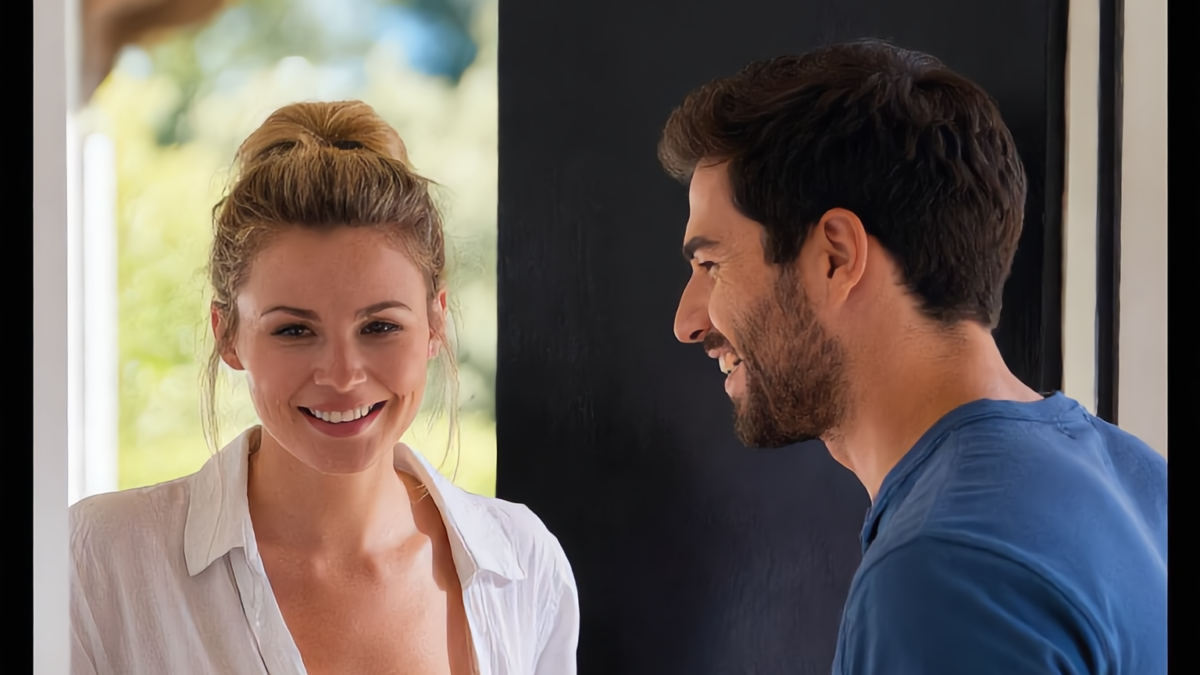
It was hanging loosely from the shoulders of a woman standing barefoot in my kitchen, morning sunlight pouring through the windows behind her.
For several seconds, I simply stood in the doorway.
The shirt was an old blue button-down I usually wore when fixing things around the house. On me, it was ordinary. On her, it reached nearly to her knees, the sleeves rolled several times because they were far too long.
Her damp clothes were tumbling in the dryer down the hall.
And as far as I could tell, she wasn’t wearing anything else beneath the shirt.
I immediately looked away.
“Coffee?” I asked.
There are moments in a man’s life when eloquence fails him.
That was one of mine.
The woman glanced down at herself and then back at me.
A faint blush appeared across her cheeks.
“You’re very committed to pretending this isn’t awkward.”
“I’m trying to survive it with dignity.”
For the first time since I had met her, Serafina Vale laughed.
Not loudly.
Not for long.
But genuinely.
And somehow, that quiet laugh affected me more than the sight of her standing in my kitchen ever could.
Because Serafina did not laugh often.
In fact, until that morning, I wasn’t entirely sure she remembered how.
My name is Callum Reed.
I was thirty-four years old then, and I had become extremely good at living a life nobody would describe as exciting.
I worked as the maintenance supervisor at the Hartwell Community Center, where my days consisted of repairing leaking faucets, replacing broken door hinges, keeping ancient boilers alive, and occasionally rescuing basketballs from the roof.
I lived in a small two-bedroom house on Ashbury Lane.
The paint was peeling around the porch.
The fence leaned slightly to the left.
The kitchen cabinets had been installed sometime during an era when people apparently believed brown laminate would remain fashionable forever.
But the mortgage was manageable.
The neighborhood was quiet.
And after the previous few years, quiet felt valuable.
My younger brother Milo lived with me.
He was twenty-seven and had been recovering from a serious motorcycle accident that had left him with extensive injuries to his left leg.
Doctors said he would walk normally again.
Eventually.
That word had become the enemy.
Eventually.
Eventually he’d stop using crutches.
Eventually the pain would lessen.
Eventually he’d return to work.
Eventually life would become normal.
Recovery taught both of us that eventually could be a brutal distance from today.
So our life became simple.
Work.
Physical therapy.
Dinner.
Bad television.
Sleep.
Repeat.
Then Serafina Vale moved into the abandoned yellow house three streets away.
People noticed immediately.
People in small neighborhoods always do.
The house had been empty for almost two years. Its previous owner had died, and nobody had bothered renovating it.
Then one afternoon, a dark sedan pulled into the driveway.
Serafina stepped out with a single suitcase.
That was almost everything she brought.
No moving truck.
No furniture delivery.
No smiling relatives carrying boxes.
Just one suitcase.
A week later, I saw her sitting alone on the front steps.
She was beautiful.
That was obvious.
Dark hair falling across one shoulder. Sharp, intelligent eyes. The kind of face that probably looked stunning in expensive restaurants and strangely out of place on the steps of an empty house.
But beauty wasn’t what I remembered.
It was the way she stared at the street.
Not watching anything.
Not waiting for anyone.
Just staring.
Like she’d traveled a thousand miles only to discover there was nowhere left she wanted to go.
I asked Milo about her one evening.
He looked through the window.
“The mysterious woman?”
“She’s not mysterious.”
“She moved into a condemned-looking house carrying one suitcase and hasn’t spoken to anybody.”
“That doesn’t make someone mysterious.”
“It literally does.”
I rolled my eyes.
Milo grinned.
“You think she’s pretty.”
“I think her gutter is falling off.”
“Romantic.”
“Go do your exercises.”
“I hate you.”
“Do fifteen more.”
Then came the storm.
It rolled through town late Friday evening.
Heavy rain.
Hard wind.
Temperatures dropping fast enough to make May feel like November.
Around eight Saturday morning, somebody knocked on my door.
When I opened it, Serafina stood on the porch.
She looked exhausted.
Her hair was damp. Her sweatshirt was soaked across the shoulders. Mud stained the hem of her jeans.
“Callum?”
That surprised me.
“You know my name?”
She gave me the smallest smile.
“Mrs. Patterson knows everybody’s name.”
That made sense.
Mrs. Patterson considered neighborhood privacy a personal insult.
“What can I do for you?”
Serafina hesitated.
“I heard you know heating systems.”
“Depends how much the heating system hates me.”
Another almost-smile.
“The heater at my house stopped working last night.”
“Completely?”
“I woke up freezing.”
I grabbed my jacket and toolbox.
“Show me.”
Her furnace was older than Milo.
That was the first problem.
The second was a damaged ignition system.
The third was evidence that several previous repairs had been performed by someone whose technical philosophy appeared to be tape fixes everything.
“This might take a while,” I told her.
“How long?”
“Couple hours if the part I need is at the community center.”
She nodded.
Only then did I notice she was shivering.
“You’re soaked.”
“I’ll dry.”
“That’s not how hypothermia works.”
“I’m fine.”
People who are actually fine rarely say I’m fine with that much determination.
“Come to my place.”
Her expression changed instantly.
“I’m not asking you to stay.”
“I know.”
“Then I’m okay.”
“Serafina, your house is approximately fifty degrees.”
“I’ve survived worse.”
There was something behind the sentence.
Something I didn’t understand yet.
I didn’t push.
“At least take a hot shower and wait somewhere warm while I get the furnace working.”
She looked toward the empty rooms behind her.
Finally she nodded.
“Okay.”
That was how Serafina Vale entered my house for the first time.
Milo was in the living room with his leg elevated.
He looked from Serafina to me.
Then back to Serafina.
His eyebrows rose.
I gave him a warning look.
“Serafina, this is Milo.”
“The unfortunate younger brother.”
“He’s dramatic.”
“I nearly died.”
“You broke a leg.”
“And several other things.”
Serafina smiled.
“I’m Serafina.”
“I know.”
I stared at him.
He quickly added, “Small neighborhood.”
She laughed softly.
I found towels.
Then clean clothes.
Unfortunately, my wardrobe offered limited options.
There was one pair of sweatpants that would probably fall straight off her waist.
Three T-shirts with community center logos.
And one oversized blue button-down.
I handed her the shirt.
“Your clothes can go in the dryer.”
She looked at it.
“This is yours?”
“Unless somebody broke into my house to donate extremely boring shirts.”
She smiled.
“Thank you.”
I left to finish repairing the furnace.
It took nearly two hours.
When I returned, I came through the back door carrying my toolbox, expecting to find Serafina sitting on the couch.
Instead, she was standing in my kitchen.
Barefoot.
Wearing my shirt.
And apparently nothing else.
She held a mug of tea in both hands.
Sunlight illuminated the loose strands of hair around her face.
My brain stopped functioning for approximately three seconds.
Then I noticed something else.
She looked peaceful.
Not seductive.
Not flirtatious.
Just comfortable.
Like for the first time in a long time she had stopped preparing herself for something bad to happen.
“Coffee?” I asked.
She glanced down.
“You’re very committed to pretending this isn’t awkward.”
“I’m trying to survive it with dignity.”
She laughed.
That laugh changed the room.
Then Milo’s voice came from behind me.
“Oh, this is fantastic.”
I closed my eyes.
“Milo.”
“What? I’m just getting water.”
“Go away.”
“I live here.”
“Today you don’t.”
Serafina covered her face, laughing harder.
It was the first time I’d seen her look truly alive.
And that should have been all the moment meant.
A borrowed shirt.
A warm kitchen.
A woman laughing.
But life sometimes marks important beginnings without telling you.
Years later, I would remember exactly how the sunlight looked on that floor.
Because that morning was the first crack in the wall Serafina had built around herself.
Over the next several weeks, she began appearing more often.
Never intrusively.
Sometimes she brought back tools I had left at her house.
Sometimes she brought food.
Once she arrived carrying an absurdly expensive coffee machine.
“What’s this?”
“Payment.”
“For fixing a furnace?”
“And the gutters.”
“I didn’t fix the gutters.”
“You stared at them judgmentally. It motivated them.”
I refused the coffee machine.
She left it anyway.
Then something unexpected happened.
She and Milo became friends.
Milo had reached the stage of recovery where frustration had become more difficult than pain.
One afternoon I came home and found his crutch lying across the room.
He was sitting on the couch, furious.
Serafina sat opposite him.
“I can’t do it,” he said.
“You did six steps yesterday.”
“Seven.”
“Then you’re already contradicting yourself.”
“It’s getting worse.”
“No. Today is worse.”
“Same thing.”
“No.”
Her tone was calm.
“One bad day isn’t the same as a bad future.”
Milo stared at her.
“Easy for you to say.”
Silence.
I expected Serafina to get offended.
Instead, she looked down at her hands.
“No,” she said quietly. “It isn’t.”
Something passed across her face.
Milo saw it.
So did I.
He lowered his voice.
“Sorry.”
“Don’t be.”
Then she helped him stand.
A month after we met, I finally learned who Serafina had been before Ashbury Lane.
We were sitting beneath the maple tree behind my house.
She had brought architectural sketches for Milo to look at.
I picked one up.
“This is yours?”
She nodded.
It showed a cultural arts center.
Glass walls.
Gardens built into terraces.
Curving walkways connecting different levels.
It was extraordinary.
“You’re an architect?”
“Was.”
I looked at her.
“Buildings stop needing architects?”
“I stopped being one.”
“Why?”
Her expression closed.
Immediately.
I almost apologized.
Then she surprised me.
“My fiancé.”
I waited.
“Former fiancé.”
“Okay.”
“His name was Alaric Voss.”
The name meant nothing to me then.
Later, it would.
“He ran a development company.”
She folded one sketch carefully.
“We met through work.”
At first, she’d told me, Alaric seemed like everything she had wanted.
Ambitious.
Charming.
Well-connected.
He introduced her to investors and clients she’d spent years trying to reach.
Together, they began working on major commercial projects.
Then something shifted.
Serafina created the early designs for a massive waterfront redevelopment.
Alaric’s company handled financing.
When the project began struggling financially, documents appeared carrying Serafina’s approval on expenses she said she had never authorized.
Design files she created appeared under another architect’s name.
Payments disappeared.
And when investors demanded explanations, Alaric had one prepared.
Serafina had mismanaged the project.
Serafina had authorized changes.
Serafina had become unstable under pressure.
“Didn’t you fight it?”
“I tried.”
“What happened?”
“He had lawyers.”
“So could you.”
“He had money.”
“You were successful.”
She looked at me.
“Successful isn’t the same as wealthy.”
That silenced me.
“He also had people.”
“People?”
“Partners. Clients. Friends.”
Her voice hardened.
“People who wanted to keep doing business with him.”
The professional dispute destroyed her reputation.
The legal fight consumed most of her savings.
Then came the personal betrayal.
“Three days after I moved out,” she said, “I discovered he had been seeing someone else.”
“While you were engaged?”
She nodded.
“For almost a year.”
I felt anger despite barely knowing the man.
“That’s why you came here?”
“My grandmother owned the house.”
“The yellow one?”
“She left it to my mother. My mother never wanted it.”
Serafina stared toward the street.
“So when I needed somewhere cheap enough to disappear, I remembered it.”
Disappear.
Not recover.
Not rebuild.
Disappear.
That word stayed with me.
A few days later, an opportunity arrived.
An old colleague contacted Serafina about helping design a public library renovation.
Nothing enormous.
Nothing prestigious.
But real architecture.
She turned it down.
Then they called again.
And again.
Finally, she told me.
“They want me to lead the preliminary design.”
“That’s good.”
“No.”
“Why?”
“Because they haven’t found anybody else.”
“You don’t know that.”
“They know what happened.”
“So?”
She stared at me as though the answer were obvious.
“So they’ll watch everything I do.”
“People watch everybody who matters.”
She frowned.
“That’s terrible advice.”
“I repair toilets professionally. Keep expectations reasonable.”
She laughed despite herself.
Then she became serious.
“What if I can’t do it anymore?”
“You can.”
“How do you know?”
“I don’t.”
She looked almost offended.
I continued.
“But fear isn’t evidence.”
She said nothing.
“You think being afraid means you’re not ready.”
“Doesn’t it?”
“No. Sometimes it means the thing matters.”
She looked down at her hands.
“What if I fail?”
“Then you fail.”
She stared at me.
“You really are terrible at encouragement.”
“And then you try again.”
The silence between us softened.
I pointed toward the sketches she still carried everywhere.
“You’re already an architect, Serafina.”
“I haven’t worked professionally in almost a year.”
“Doesn’t matter.”
“It does to me.”
“Then prove yourself wrong.”
The following morning she accepted the project.
For two weeks, something changed.
She woke early.
Bought drafting supplies.
Converted one room in the yellow house into a workspace.
She asked my opinion about things I knew absolutely nothing about.
“Which façade feels more welcoming?”
“They’re both walls.”
“Callum.”
“I’m a maintenance supervisor.”
“Look at them.”
I studied the drawings.
“That one.”
“Why?”
“Less glass.”
“That’s your architectural insight?”
“Glass breaks.”
She stared at me.
Then wrote something in the margin.
“You’re impossible.”
“You asked.”
Slowly, confidence returned to her.
Then, one Thursday afternoon, I found her standing in my driveway.
White-faced.
A black sedan was parked across the street.
She stared at it.
I followed her gaze.
“Do you know that car?”
Her lips parted.
No sound came out.
The driver’s door opened.
A man stepped onto the street.
Tall.
Expensive charcoal suit.
Dark hair.
Calm expression.
Everything about him seemed polished.
Controlled.
He looked at Serafina.
Then at me.
And smiled.
The kind of smile that never reached the eyes.
“Serafina.”
She didn’t move.
The man crossed the street.
“You’re difficult to find.”
I stepped slightly in front of her without thinking.
His gaze shifted to me.
“And you are?”
“Callum Reed.”
“Ah.”
Something about the way he said it bothered me.
“You’ve heard of me?”
He smiled again.
“Recently.”
Behind me, Serafina whispered one name.
“Alaric.”
So this was him.
The man who had helped destroy her career.
Her reputation.
Her life.
Alaric looked past me.
“We need to talk.”
“No.”
Serafina’s voice was quiet but clear.
His smile tightened.
“This isn’t optional.”
“Yes, it is.”
He reached inside his jacket.
My body tensed.
He removed an envelope.
Then held it toward her.
Serafina didn’t take it.
“What is that?”
“The reason I drove six hours to find you.”
Her eyes narrowed.
“Leave.”
Alaric sighed.
“I was hoping you’d grown out of the dramatics.”
I saw her flinch.
Tiny.
Almost invisible.
But I saw it.
And suddenly I understood how someone like him operated.
He didn’t need to shout.
He knew exactly where to place the knife.
“Get off my property,” I said.
His eyes moved to me.
“You seem protective.”
“I’m asking you to leave.”
“Interesting.”
He slipped the envelope beneath the windshield wiper of Serafina’s car.
Then looked at her.
“You have forty-eight hours.”
“For what?”
“Open the envelope.”
He returned to the sedan.
Before getting inside, he looked toward me.
“You should be careful, Callum.”
“About what?”
“Believing stories when you’ve only heard one side.”
Then he drove away.
For nearly a minute, Serafina didn’t move.
Finally, she crossed the driveway.
Her fingers shook as she removed the envelope.
“Don’t open it here,” I said.
She looked at me.
“Why?”
“I don’t know.”
That was the truth.
But suddenly the ordinary afternoon didn’t feel ordinary anymore.
We went inside.
Milo was at therapy.
Serafina placed the envelope on my kitchen table.
The same table where we had shared breakfast the morning she’d worn my shirt.
She stared at it.
“You don’t have to open it.”
“Yes, I do.”
She tore the seal.
Inside were several pages.
She read the first one.
Color drained from her face.
“What?”
She handed it to me.
It was a legal notice.
I didn’t understand every detail.
But one sentence was clear.
Alaric’s company was accusing Serafina of stealing confidential architectural material.
The project she had just accepted contained design elements they claimed belonged to his firm.
If they pursued the allegation successfully, she could lose the opportunity before it even began.
Possibly more.
“You designed those concepts,” I said.
“I know.”
“Then prove it.”
Her silence told me the problem was worse.
“Serafina?”
“The original files.”
“What about them?”
“They were stored on the company server.”
My stomach tightened.
“Do you have copies?”
She shook her head.
“I left everything when I moved.”
Then she saw something at the bottom of the final page.
Her breathing stopped.
“What?”
She pointed.
Attached was a photograph.
Not of architecture.
Not of legal documents.
A photograph of my house.
Taken from across the street.
Serafina standing on my porch.
Milo visible through the living room window.
And beneath it, handwritten in black ink, were seven words.
Walk away, and none of them matter.
Serafina stared at the photograph.
Then at me.
The fear I had watched disappear from her over the previous weeks returned all at once.
And I realized Alaric hadn’t come merely to threaten her career.
He had come to remind her that anyone she loved could become leverage.
PART 2
“Call the police.”
Those were the first words out of my mouth.
Serafina shook her head.
“For what?”
“He photographed my house.”
“From a public street.”
“And wrote a threat underneath it.”
“He’ll say it wasn’t a threat.”
“It’s obviously a threat.”
“To us.”
She lowered herself into a kitchen chair.
“That’s how he works.”
I hated how calmly she said it.
Like this wasn’t new.
Like she had spent years learning exactly how close Alaric could walk to a line without technically crossing it.
I called anyway.
An officer came.
He examined the photograph, documented the situation, and advised us to preserve everything.
The officer was professional.
He took Serafina seriously.
But there was no dramatic arrest.
No handcuffs.
No instant protection.
Just paperwork.
Evidence.
Documentation.
Steps.
Real life rarely moves as quickly as fear.
Afterward, Serafina sat on my porch.
“I’m leaving.”
I leaned against the railing.
“Where?”
“I don’t know.”
“That’s not a destination.”
“Somewhere else.”
“Why?”
She looked at me as though I’d asked something stupid.
“Because he knows where you live.”
“So?”
“So Milo lives here.”
Milo, returning from therapy at that exact moment, heard his name.
He climbed slowly from the car with his crutch.
“What did I do?”
“Nothing.”
“Good. That’s usually when Callum gets angry.”
Serafina didn’t smile.
Milo noticed.
Within ten minutes, he knew everything.
His reaction was predictable.
“I’m not leaving.”
Serafina stared at him.
“I didn’t ask you to.”
“No, you’re planning to leave.”
“That’s different.”
“No, it isn’t.”
“Milo—”
He lowered himself into a porch chair.
“I spent eight months learning how to walk again.”
“What’s that got to do with anything?”
“A lot.”
He adjusted the brace on his leg.
“When I first came home from the hospital, I couldn’t get from my bed to the bathroom without Callum helping me.”
Serafina glanced at me.
“I hated it.”
Milo continued.
“I hated needing anybody. So I kept trying to do things alone and making everything worse.”
“Milo—”
“I’m talking.”
That was my brother.
He looked at Serafina.
“Eventually my therapist told me something.”
“What?”
“Accepting help isn’t surrendering control.”
Serafina became quiet.
“It means you’re choosing who gets to stand beside you while you fight.”
She stared at him.
Then slowly smiled.
“Since when did you become wise?”
“Near-death experiences.”
“You broke a leg.”
“Several bones, Callum.”
Despite everything, Serafina laughed.
That evening, the three of us made a plan.
Not a heroic one.
A practical one.
We installed cameras.
Changed locks.
Documented every message.
Serafina contacted the lawyer who had represented her during the earlier dispute.
Then came the bigger problem.
The architecture.
Alaric’s company claimed ownership over design elements Serafina had created years earlier.
Her lawyer explained that authorship could potentially be demonstrated through drafts, timestamps, correspondence, notebooks, and earlier versions.
“Do you have anything?” I asked.
Serafina shook her head.
“Most of my notebooks are gone.”
“Gone where?”
Her expression answered before she spoke.
“Alaric’s house.”
“Your old house?”
“His house.”
The correction mattered.
“What about email?”
“Company account.”
“Cloud storage?”
“Locked when I left.”
“Printed drafts?”
“Maybe.”
“Where?”
She looked toward the window.
“My mother.”
The next morning, we drove two hours to see her.
I learned more about Serafina during that drive than I had in months.
Her mother, Evelyn Vale, lived in a large colonial house surrounded by perfectly trimmed hedges.
Everything about the property communicated order.
The windows were spotless.
The driveway immaculate.
Even the flowers seemed disciplined.
Evelyn opened the door.
She looked like an older version of Serafina with less warmth.
Her gaze shifted from her daughter to me.
“Who is this?”
“Callum.”
Evelyn waited.
“My friend.”
Something about that word affected me more than it should have.
Evelyn stepped aside.
Inside, family photographs covered the walls.
Serafina graduating.
Serafina receiving an award.
Serafina beside Alaric at charity dinners.
Almost all the recent pictures included him.
“Why are you here?” Evelyn asked.
Serafina sat upright.
“I need the boxes I stored here.”
“What boxes?”
“My architecture files.”
Her mother frowned.
“Why?”
“Alaric is threatening legal action.”
Something changed in Evelyn’s expression.
Not surprise.
Fatigue.
“Oh, Serafina.”
My jaw tightened.
“What?”
“I thought we were finished with this.”
“With what?”
“Fighting him.”
Serafina stared at her.
“He destroyed my career.”
“Your career isn’t destroyed.”
“He blamed me for financial misconduct.”
“Charges were never filed.”
“Because there wasn’t evidence.”
Her mother sighed.
“You both made mistakes.”
There it was.
The sentence that can erase years of harm in five words.
You both made mistakes.
Serafina’s hands clenched.
“What mistake did I make?”
“You’re not here to argue.”
“No.”
Her voice sharpened.
“I want to know.”
“Your engagement became toxic.”
“That’s not an answer.”
“You should have walked away earlier.”
Silence.
I saw the words hit.
Serafina looked down.
I wanted to say something.
But this wasn’t my fight.
Not unless she asked me to enter it.
Her mother continued.
“You knew Alaric was difficult.”
“Difficult?”
“You knew how ambitious he was.”
“So that excuses what he did?”
“No.”
“Then why do you always make his behavior something I failed to prevent?”
Evelyn’s expression changed.
Serafina had finally asked the question she’d probably swallowed a hundred times.
Her mother sat opposite her.
“I don’t.”
“You did five seconds ago.”
“Serafina—”
“When everything collapsed, you asked why I hadn’t been more careful.”
Evelyn remained quiet.
“You asked why I signed documents without checking.”
“He said—”
“He lied.”
Her mother’s mouth closed.
“He lied to you, Mom.”
Serafina’s voice cracked.
“And you believed him because his story was easier.”
I watched Evelyn absorb that.
“I didn’t know what to believe.”
“You could have believed me.”
The sentence was devastating because Serafina didn’t shout it.
She whispered it.
Evelyn looked toward me as though hoping a stranger would rescue the conversation.
I didn’t.
Eventually, she stood.
“The boxes are in the basement.”
There were nine of them.
Old drawings.
University notebooks.
Project folders.
Receipts.
Photographs.
And buried in the seventh box was something Serafina had forgotten.
A sketchbook.
She opened it.
Then sat down on the basement floor.
“What?”
She flipped pages rapidly.
Concept drawings.
Dates.
Notes.
Early versions of the disputed design.
Months before Alaric’s company claimed the concept had been created.
“Is that enough?”
“No.”
She looked up.
“But it’s a beginning.”
Back home, Serafina worked obsessively.
Too obsessively.
She barely slept.
She compared dates.
Found old text messages.
Contacted former colleagues.
Some refused to speak.
Some said they didn’t remember.
One hung up.
Every rejection chipped away at her confidence.
Then came Lydia Chen.
A structural engineer who had worked on the original waterfront project.
Serafina called her one evening while sitting in my kitchen.
“Lydia?”
Pause.
“It’s Serafina.”
Another pause.
“I know it’s been a long time.”
I watched her face.
Whatever Lydia said made her shoulders tense.
“No, I’m not calling about money.”
Silence.
“I need to ask you something about the waterfront project.”
Serafina listened.
Then her eyes widened.
“What emails?”
I moved closer.
She raised one finger.
“When?”
Another silence.
“Do you still have them?”
Her hand began trembling.
“Can you send everything?”
After the call ended, she remained frozen.
“What happened?”
“Lydia kept emails.”
“What kind?”
“Alaric asked her to remove my name from drawings.”
I stared at her.
“Why didn’t she say something?”
“She was afraid.”
Serafina’s expression wasn’t angry.
Just tired.
“Everyone was afraid.”
That night, Lydia sent forty-three emails.
They changed everything.
Not enough to magically fix the past.
But enough to challenge Alaric’s version of it.
Enough to prove Serafina had authored key concepts.
Enough for her lawyer to respond aggressively to his legal threat.
Three days later, Alaric called me.
I almost didn’t answer.
“Callum.”
“What do you want?”
“You’ve encouraged her.”
“Good.”
He laughed quietly.
“You think you understand her.”
“I understand enough.”
“No. You understand the version she’s presenting because you’re useful to her right now.”
I gripped the phone.
“Why are you calling?”
“To save you trouble.”
“How generous.”
“Serafina has a pattern.”
I said nothing.
“She needs people intensely. Then she blames them when things go wrong.”
I knew what he was doing.
Planting doubt.
But knowing a tactic doesn’t always make you immune to it.
“Ask yourself why she had no friends left when she came to you.”
I didn’t answer.
“Why didn’t her own family take her in?”
Still nothing.
“Why was everybody against her?”
That question bothered me.
Not because I believed him.
Because it was designed to exploit the easiest human weakness.
The belief that numbers equal truth.
If ten people say one thing and one person says another, we naturally look toward the ten.
Even when the ten learned the story from the same liar.
“Stay away from her,” I said.
“Or what?”
“I’ll continue documenting every contact.”
His silence told me he hadn’t expected that.
“Goodbye, Alaric.”
I hung up.
That evening, I told Serafina about the call.
Every word.
I didn’t hide the ugly parts.
When I finished, she stared at the floor.
“Do you believe him?”
“No.”
“You hesitated.”
“Because I was thinking.”
“About whether he’s right?”
“About how effectively he does this.”
She looked at me.
“He almost convinced you.”
“For about three seconds.”
“That’s enough.”
She stood.
“Serafina.”
“No.”
She grabbed her bag.
“Don’t do this.”
“Do what?”
“Decide what I’m thinking because you’re afraid of what I might think.”
Her eyes flashed.
“That’s unfair.”
“So is leaving before I can answer.”
She stopped.
I lowered my voice.
“He tried to make me doubt you.”
Her face tightened.
“And for three seconds, it worked?”
“For three seconds, I wondered why everybody had abandoned you.”
She looked devastated.
I continued before she could leave.
“Then I remembered that half of them had only heard his story.”
Silence.
“And the ones who didn’t?”
“Lydia was afraid.”
“What about my mother?”
“Your mother made the wrong choice.”
“What about everyone else?”
“I don’t know.”
She looked at me.
“That’s what scares me.”
“What?”
“That someday you’ll get tired of not knowing.”
I stepped closer.
“Then tell me what I need to know.”
“I can’t prove everything.”
“I didn’t ask you to.”
“Then why are you still here?”
The question escaped her before she could stop it.
I think she regretted it immediately.
But it deserved an answer.
“Because I know what loneliness looks like.”
Her expression softened.
I glanced toward the living room where Milo’s crutches rested against the wall.
“When our parents died, I became Milo’s guardian overnight.”
Serafina knew they’d died.
She didn’t know the rest.
“I was twenty-four. Milo was seventeen.”
I swallowed.
“Everybody called me strong.”
“I can imagine.”
“I wasn’t.”
I looked at her.
“I was terrified every single day.”
Money.
Bills.
School.
Grief.
My own life disappearing beneath responsibilities I wasn’t ready for.
“But when people call you strong enough times, eventually you become afraid to tell them you’re not.”
Serafina listened.
“I spent years pretending I didn’t need anything.”
“Callum…”
“So when you ask why I’m still here…”
I stepped closer.
“It’s because I recognize someone who’s tired of pretending.”
We were standing perhaps two feet apart.
The kitchen felt suddenly smaller.
Serafina looked at me.
Not frightened.
Not broken.
Just open.
“That morning,” she said quietly.
“What morning?”
“The shirt.”
I almost smiled.
“Hard to forget.”
“I woke up on your couch and didn’t know where I was.”
Her eyes lowered.
“For three seconds, I panicked.”
“Why?”
“Because I had fallen asleep somewhere I didn’t completely know.”
Then she looked back at me.
“And then I heard you outside arguing with your lawn mower.”
“I wasn’t arguing.”
“You threatened it.”
“It knows what it did.”
She smiled.
“I remember thinking…”
She hesitated.
“What?”
“Nothing bad is going to happen here.”
The smile disappeared.
“That was the first time I’d felt that in almost a year.”
Something inside me shifted.
I reached for her hand.
Slowly.
Giving her every opportunity to move away.
She didn’t.
Her fingers closed around mine.
Neither of us said anything.
Then Serafina leaned forward.
Our foreheads touched.
It wasn’t a kiss.
Not yet.
And somehow, it felt more intimate than one.
“Callum.”
“Yeah?”
“I’m scared.”
“I know.”
“What if I ruin this?”
“You don’t have enough power to ruin my life.”
She laughed softly.
“Terrible romantic line.”
“I’m new at this.”
“This?”
I looked at her.
“Whatever we’re doing.”
Her eyes met mine.
Then she kissed me.
Softly.
Briefly.
Like a question.
I answered by kissing her back.
Nothing hurried.
Nothing demanded.
When we separated, she was smiling.
And for one foolish second, I thought maybe the worst was behind us.
Then my phone rang.
Milo.
I answered.
“What’s up?”
At first, all I heard was breathing.
Then:
“Callum.”
His voice sounded wrong.
“What happened?”
“I’m at the community center.”
“Okay?”
“There are police here.”
My stomach dropped.
“Why?”
“Because somebody broke into your office.”
Serafina froze.
I switched to speaker.
“What did they take?”
Milo hesitated.
“Nothing.”
“Then why—”
“They left something.”
“What?”
His next words erased the warmth from the room.
“A box.”
Silence.
“And inside it…”
His voice cracked.
“…is Serafina’s engagement ring.”
PART 3
The ring had been missing for nearly a year.
Serafina told me later that she’d left it behind the night she walked away from Alaric.
Not dramatically.
She hadn’t thrown it.
Hadn’t mailed it back.
She simply placed it on the bathroom counter and left.
Now it had appeared inside my locked office at work.
Alongside a note.
You always come back to what belongs to you.
The police treated the break-in far more seriously than the photograph.
There were security cameras.
Access logs.
Physical evidence.
And Alaric had made one mistake.
He had hired somebody careless.
A man entered through a service door using an access code that belonged to a cleaning contractor.
The contractor denied involvement.
Then investigators found payment records connecting the intruder to one of Alaric’s subsidiary companies.
The story Alaric had built so carefully began to crack.
Meanwhile, Lydia’s emails gave Serafina’s attorney leverage to reopen questions surrounding the old project.
Another former employee came forward.
Then another.
What had once looked like Serafina’s word against Alaric’s became something different.
A pattern.
The legal process took months.
There was no overnight triumph.
There were interviews.
Documents.
Delays.
Expensive meetings.
Days when Serafina came home furious.
Days when she wanted to stop.
Days when old accusations reappeared online and strangers confidently discussed events they knew nothing about.
But this time, she wasn’t alone.
Not because I fought her battles.
Because she finally had people who stood nearby while she fought them herself.
Eventually, Alaric’s company withdrew its claim against her designs.
More importantly, Serafina’s professional record began to recover.
The library project went forward.
When the city unveiled the final plans, Serafina stood beside a massive rendering while reporters photographed her.
I watched from the back of the room.
Milo stood beside me without crutches.
“You’re staring,” he whispered.
“I know.”
“You love her.”
“I know.”
“You should tell her.”
“I have.”
“Good.”
He paused.
“Tell her again.”
A year after the morning she stood barefoot in my kitchen wearing my shirt, Serafina opened her own architecture studio.
Vale Design.
Small office.
Four employees.
One ridiculously expensive coffee machine.
I gave her grief about that.
She claimed good architecture required good coffee.
Milo completed rehabilitation and accepted a job coaching adaptive athletics at the community center.
As for me, I remained exactly what I’d always been.
Maintenance supervisor.
Brother.
Owner of a badly leaning fence.
Except my quiet life didn’t feel empty anymore.
One Saturday morning, I walked into the kitchen and stopped.
Serafina stood at the counter.
Barefoot.
Wearing the same blue shirt.
I stared.
She glanced over her shoulder.
“What?”
“You kept that?”
“Obviously.”
“I thought I lost it.”
“You did.”
She held out a mug.
“Coffee?”
I smiled.
“You’re very committed to pretending this isn’t familiar.”
She laughed.
Then she crossed the kitchen and wrapped her arms around my neck.
The first time she’d worn that shirt, she had been a woman trying to disappear.
Now she had clients waiting for her.
Friends who called too often.
A brother-like relationship with Milo that mostly consisted of the two of them making fun of me.
A life.
Not the life she’d had before Alaric.
Something new.
Something she had chosen.
I kissed her forehead.
“You know what I thought the first morning I saw you wearing this?”
She raised an eyebrow.
“I can imagine.”
“No.”
I smiled.
“I thought you looked safe.”
Her expression changed.
“Safe?”
“Like you’d finally stopped running for five minutes.”
She touched my face.
“I had.”
“Because of me?”
She shook her head.
“Because you gave me somewhere I didn’t have to perform.”
That answer was better.
Because love didn’t rescue Serafina.
Love wasn’t some magical reward she received after surviving something difficult.
She rescued herself.
What love did was give her somewhere to rest between battles.
And maybe that is what the right person does.
Not save you.
Not repair you.
Not carry you forever.
They simply create enough safety for you to remember that you still know how to stand.
Sometimes love doesn’t arrive with fireworks.
Sometimes it walks through your front door soaked from the rain.
Sometimes it falls asleep on your couch.
Sometimes it steals your favorite shirt.
And sometimes, when that person finally stands barefoot in your kitchen holding a cup of coffee, you realize the thing that changed your life wasn’t how beautiful she looked wearing your clothes.
It was that she finally felt safe enough to stay.
And somehow…
so did you.








