The Mail-Order Bride Stepped Off the Stagecoach Bruised, With 12 Cents and Nowhere to Go. The Rancher Looked at Her and Said, “You’re Coming With Me”
PART 1: Damaged Goods
The noon sun beat down hard on the dusty main street of Cedar Ridge, Arizona Territory.
Heat shimmered up from the packed earth in waves, making the crooked wooden buildings look as if they were melting in the light. It was the kind of day when sensible people hid indoors, leaving only the desperate and the foolish out in the open.
The stagecoach from Tucson rattled to a stop in front of the depot. The horses were spent, their flanks dark with sweat. The driver, a weathered old man named Jake Pruitt, spat into the dirt and hollered for everyone to climb down.
A few passengers stumbled into the glare. But one woman turned every head on the street the moment her feet touched the ground.
Not because she was beautiful, though once, perhaps, she might have been.
It was the bruises.
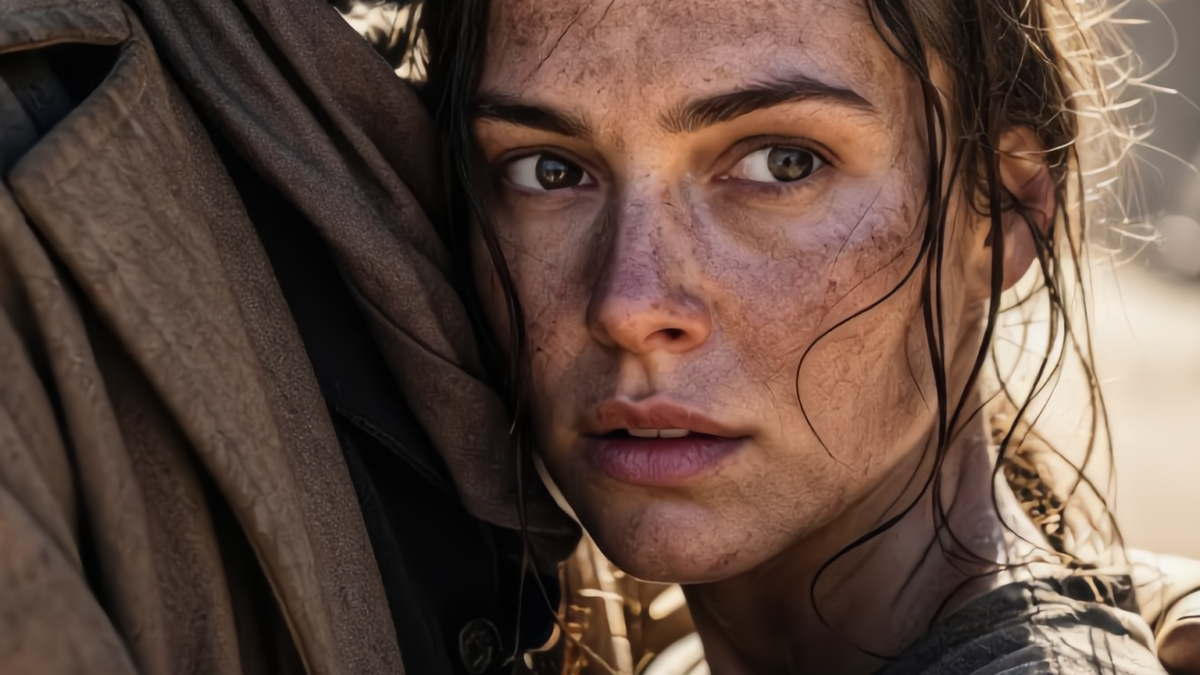
Her traveling dress was torn and stained. One sleeve hung loose where it had been ripped from the shoulder. Purple and black marks bloomed across her arms, her throat, and the left side of her face, where one eye was swollen nearly shut. She moved slowly, every step deliberate, as though her ribs hurt too much to let her breathe all the way in.
Her name was Sarah Mallister. She was twenty-four years old, and she clutched a small carpetbag so tightly her knuckles had gone white. Her hazel eyes darted from face to face, flinching at everything and everyone.
Two months earlier, she had been standing in her late aunt’s parlor in Harrisburg, Pennsylvania, reading a letter for the hundredth time. She had answered an advertisement in a matrimonial newspaper: Respectable merchant of Tucson seeks a gentle, God-fearing wife. The man who placed it, William Thornton, had written back in a beautiful, careful hand. He wrote of a fine adobe house with blue shutters. He wrote of a thriving dry-goods store, of evening walks, of a garden she could plant however she pleased. He wrote that he was lonely, and kind, and that he would cherish her.
None of it was true.
William Thornton turned out to be a drunk, a gambler, and a liar. He had lost his store at a card table months before she ever boarded the train. The adobe house with blue shutters belonged to someone else. When he met her at the Tucson station, swaying and sour with whiskey, he looked her up and down and flew into a rage, shouting that she was plainer than her photograph, that he’d been cheated, that she’d lied to him.
The beating was fast and brutal, in a rented room above a saloon, while the piano downstairs played louder to drown out her screams.
This morning, he had shoved her onto the first stagecoach leaving town and told her to get far away before he changed his mind about letting her live.
Now she stood in Cedar Ridge with twelve cents in her pocket. No home. No family. Nowhere to go.
“Well, now,” drawled a voice from the shade of the depot porch. “Look what the stage dragged in.”
Three men stepped out into the sun, their eyes bright with an interest that turned Sarah’s stomach.
The first was tall and thin, with yellow teeth and a stained hat. He looked her over slowly, from her dusty boots to her bruised face, the way a man inspects a horse at auction. The second, heavy-set with a red beard, chuckled darkly.
“Damaged goods,” he said. “But still useful.”
Sarah backed away until her shoulders struck the hot wood of the stagecoach. Up on his seat, Jake Pruitt looked away and gathered his reins. Along the boardwalk, townsfolk had stopped to watch. A woman with a market basket. A clerk in the doorway of the bank. Two old men on a bench outside the barbershop.
None of them stepped forward.
“Please,” Sarah whispered. Her voice was hoarse from days of crying. “I don’t want any trouble.”
“Trouble?” The thin man came close enough that she could smell the whiskey on his breath. “Nobody’s offering trouble, honey. We’re offering work. Town like this, a woman alone with no money and no man? There’s ways to earn a living.”
His meaning was perfectly clear.
Sarah’s knees began to tremble. She had heard stories back East about women forced into such lives. Whispered stories, told behind hands at church socials, about girls who went West and were never heard from again. She had never imagined she would have to face it herself.
She looked down the long, blinding street and understood, with a terrible calm, that there was nowhere to run.
Then another voice cut through the heat.
Deep. Steady. Unhurried.
“The lady said she doesn’t want any trouble.”
The three men turned. Sarah looked too, and saw him.
He stood in the middle of the dusty street, broad-shouldered, tanned and weathered by sun and wind. His age was hard to guess, somewhere past thirty-five, perhaps. His clothes were clean but worn: canvas trousers, a faded blue shirt, boots with the heels ground down from years of work. A rancher, she guessed.
But it was his eyes that held her. Gray as a winter sky. Calm. Steady. Watching everything, judging nothing.
“Ain’t none of your business, Coleman,” the thin man said.
“Maybe not,” the rancher replied. “But I’m making it my business now.”
“You looking to buy yourself a woman?” The red-bearded man sneered.
Coleman didn’t take the bait. His right hand rested near the revolver on his hip, relaxed but ready.
“I’m looking to finish my business in town,” he said. “This woman’s coming with me.”
He said it like a simple fact. Not a threat. Not a claim. Just the truth.
The men shifted uneasily. Coleman’s eyes went cold.
“Tom,” he said to the red-bearded man. “You’ve got a wife and three little girls at home. You want to be the kind of man who stands in the street haggling over a beaten woman like she’s a heifer? You want your daughters to hear about that?”
Tom Briggs flinched as though he’d been slapped.
“And you, Pete.” Coleman turned to the thin man. “Your mother takes in washing to keep a roof over your head. How do you suppose she’d feel, knowing her boy was out here acting like a buzzard over carrion?”
Pete’s face went red. He opened his mouth, then shut it.
Nobody wanted to be shamed in a town that small, where every word spoken on Main Street reached every kitchen by suppertime. The men muttered among themselves and drifted off toward the saloon, spitting and cursing under their breath.
When they were gone, Coleman turned to Sarah.
Up close, she could see the lines carved around his eyes by years of squinting into the sun. He studied her injuries in silence. There was no pity in his face, and no hunger, either. Only a kind of understanding, as if he knew exactly what it meant to be wounded and alone.
“You’re coming with me,” he repeated quietly. Then, more gently: “That’s not an order, ma’am. It’s an offer.”
Her voice broke as she answered. “I can’t pay you. I don’t have anything.”
“Didn’t ask for anything.” He bent and lifted her carpetbag from the dust. “My ranch is thirty miles out. You’ll have a bed, food, and time to heal. That’s all.”
He took a few steps toward a buckboard wagon hitched outside the general store, then stopped when he realized she wasn’t following.
“Ma’am,” he said softly, without turning around. “You’re safe with me. That’s the only promise I’ll make.”
Something shifted inside her. Something small and fragile and unfamiliar, like the first green shoot pushing through cracked earth.
It felt like hope.
She took one step. Then another. And she followed him down that dusty street toward a life she had never expected.
The ride to Joe Coleman’s ranch took hours, across open land toward distant purple mountains.
Sarah sat beside him on the wagon seat, holding her carpetbag on her lap like a shield. Every jolt of the wheels sent a bright knife of pain through her ribs, but she stayed silent. She didn’t know this man. She didn’t know whether she could trust him. But she knew one thing: he had stepped between her and danger without a moment’s hesitation, when no one else on that street would.
That had to mean something.
Joe drove with calm focus. He spoke only when necessary, and when he did, his voice stayed low and even. Once, he stopped the wagon at a creek, filled a tin cup, and handed it to her without a word. Once, when a hawk dropped out of the sky after a rabbit, he said, “Red-tail,” and nothing more.
The sun was sinking when they crested a low hill, and the ranch came into view.
It wasn’t grand. But it looked honest. Real. A small adobe house sat on the land, built thick to withstand the merciless desert wind. A barn stood nearby, its doors straight, its roof sound. Corrals held a handful of horses, and cattle dotted the long, golden flats beyond. Everything was clean and cared for, the work of a man who took quiet pride in what was his.
“Isn’t much,” Joe said as he guided the wagon down the slope. “But it’s quiet.”
Quiet.
After days of shouting and fear, that single word settled over Sarah’s shoulders like a warm blanket.
When the wagon stopped, Joe climbed down and came around to help her. His hands were careful and respectful. He didn’t stare at her bruises. He didn’t hurry her. He offered his arm only when she swayed on her feet.
Inside, the house was clean and simple. A wide stone fireplace. A kitchen table with two chairs. A rocking chair by the window. Shelves lined with preserve jars and a handful of worn books. Through one doorway, she glimpsed his bedroom. Through another, a second, smaller room.
Joe set down her bag and began heating water on the stove without a word, his movements practiced and efficient.
“You’ll want to wash up,” he said. “There’s salve in that cupboard. Good for bruises.” He hesitated, then added: “That room’s yours as long as you need it.”
Sarah looked around her, overwhelmed by how ordinary everything was. How safe.
“Mr. Coleman…”
“Joe.”
“Joe.” She didn’t know how to ask the question gnawing at her. “Why are you doing this for me? You don’t know me.”
He paused, his back to her. His shoulders rose and fell with a slow breath.
“Long time ago,” he said, “I found a mare out on the flats. Half dead. Beaten, starved, ready to quit. I brought her home. Couldn’t leave her there. I figured she’d die anyway.” He turned around, and his gray eyes were calm. “But she didn’t. She healed. Took a long while. But she healed.”
He set clean cloths and a basin of warm water on the table.
“Some things deserve a chance to heal,” he said. “That’s all.”
Sarah didn’t know how to answer. No one had ever spoken to her like that. As if she were worth saving.
“I’ll see to the animals,” he said. “Take your time.”
When the door closed behind him, she stood alone in the silent house and fought back tears. Not from pain, but from the shock of kindness. Real kindness, with no conditions and no expectations. It was strange. New. Almost frightening.
She washed slowly, wincing. Some of the bruises were old, yellowed and fading. Others were fresh, purple and swollen. Her ribs screamed when she bent. She found the salve and spread it carefully, and the smell of herbs filled the room.
In a cedar chest at the foot of the bed, she found dresses and underthings. Women’s clothes, clean and carefully folded, as if waiting for someone who had never come.
She chose a simple brown calico dress. It was a little loose, but it was whole, warm, and protective. She felt as though she had stepped into someone else’s life.
When Joe came back in, she was sitting at the table with her hands folded. He noticed the dress, and something flickered across his face, then disappeared.
“It suits you,” he said.
He warmed yesterday’s stew for supper. Simple food. But after days of terror and hunger, it tasted like a feast. Halfway through, tears began rolling down her cheeks, and she couldn’t stop them. Joe didn’t ask why. He simply passed her a clean handkerchief across the table and let her cry.
“Why was the room ready?” she finally asked, her voice small. “The clothes?”
Joe’s jaw tightened. He looked down at his hands.
“I was supposed to have a wife,” he said. “Mail-order bride. From St. Louis, eight years ago. Her name was Margaret.” He was quiet a moment. “Fever took her on the journey. She never reached Arizona.”
Sarah’s breath caught. Suddenly the silence of the house made sense. The careful arrangement of the furniture. The clothes kept in cedar. The second bedroom left untouched.
“Never had the heart to pack her things away,” Joe said. “Told myself maybe someday. Someday never came.”
He stood and stretched, his joints creaking. “Everybody needs a place to land when they fall,” he said simply. He stopped in the doorway of his room. “You’re safe here, Sarah. Whatever else you’re afraid of, you can let it go. Nobody comes onto this land without my say-so.”
She fell asleep that night in the rocking chair by the dying fire, wrapped in a quilt, her breathing slow and easy for the first time in weeks.
She woke to the sound of hoofbeats.
It was the dead of night. The fire had burned down to red embers. Outside, the desert lay black and silent except for the pounding of a horse coming hard up the ranch road.
Joe was already at the window, a rifle in his hands. She hadn’t even heard him cross the room.
“Stay back from the glass,” he whispered.
Sarah pressed herself against the wall, her heart slamming against her bruised ribs. A lantern swung in the darkness beyond the corral, bobbing closer.
Then a man’s voice rang out across the yard, rough and urgent.
“Coleman! I know you got her in there! You send that woman out here, right now, before somebody ends up dead!”
PART 2: The Man Who Wasn’t Finished
Joe didn’t move for a long moment.
Then his shoulders loosened, just slightly. “I know that voice,” he murmured.
He opened the door a crack, rifle still ready. “Jake Pruitt, you old fool. You near got yourself shot.”
The stagecoach driver swung down from a lathered horse, breathing hard, his lantern trembling in his hand. He looked past Joe and found Sarah’s frightened face in the shadows.
“I ain’t here to take her, Joe,” he said hoarsely. “I’m here to warn her.”
Inside, by the light of the stoked fire, Jake sat at the kitchen table with his hat crushed in his hands, refusing the coffee Joe poured him.
“I watched what happened on that street today, miss,” he said, unable to meet Sarah’s eyes. “I sat up on my seat and I looked away. Same as I looked away in Tucson this morning, when Thornton threw you into my coach like a sack of meal and I seen the blood on your sleeve.” His voice cracked. “I been driving thirty years. I never been more ashamed of myself than I was today.”
Sarah’s throat tightened. “Why did you come?”
“Because I went back through Tucson on my evening run.” Jake finally looked up. “Thornton’s been telling anybody who’ll listen that you robbed him. Says you stole his money and run off. He’s half out of his mind, drinking and swearing he’ll find you.” He swallowed. “And somebody in Cedar Ridge already sent word down the line that a bruised woman got off my coach and went home with Joe Coleman.”
The fire popped. No one spoke.
“I didn’t steal anything,” Sarah whispered. “I have twelve cents. I’ve had twelve cents since Pennsylvania.”
“I know it, miss.” Jake turned his hat around and around. “But men like Thornton don’t need the truth. They just need somebody to blame.”
After he left, riding back into the dark, Sarah sat shaking by the fire. Joe put another log on and sat down across from her.
“He’ll come,” she said. “Joe, he’ll come here.”
“Maybe.” He looked at her steadily. “And if he does, he’ll find you’re not alone anymore.”
He didn’t come. Not that week. Not that month.
And slowly, the weeks on the ranch settled into a gentle rhythm that felt almost like healing.
Every morning, Sarah woke to the sound of Joe moving around the kitchen, trying to be quiet and never quite managing it. Coffee waited on the stove. Biscuits wrapped in a cloth sat on the table. Sometimes she found a handwritten note telling her where he was working: North pasture. Back by noon. —J. Written as though she mattered. As though someone cared where she was.
For the first week, she did little but rest. Her bruises faded from deep purple to sickly yellow. Her ribs still ached, but she no longer gasped with every breath. She spent long hours in the rocking chair, bathed in sunlight and peace, letting her body relearn how to live without bracing for a blow.
Joe came home every evening dusty and tired, but never short-tempered, never impatient. He washed at the pump outside and cooked supper with steady hands. They ate in a silence that felt safe rather than awkward.
By the second week, she found small things to do. Mending a curtain. Rearranging the shelves. Sweeping a floor that was already clean. Joe noticed everything, but he never tried to stop her.
“You don’t have to do all that,” he said once.
“I know,” she answered. “But I want to.”
He nodded. Later that evening, a jar of wildflowers appeared on the table. No explanation. No note. That was simply how Joe Coleman spoke.
By the third week, she was rising early to make breakfast. Joe always looked startled when he opened the door to find a hot meal waiting, as if part of him still expected to walk into an empty house someday.
“You’re spoiling me,” he said.
“Call it rent.”
He shook his head. “You don’t owe me anything.”
“I know. But I like feeling useful.”
Something passed through his gray eyes then: understanding. He knew what it meant to need a purpose.
She began tending the small garden behind the house, pulling weeds, turning over the hard dry earth, coaxing life where nothing had wanted to grow. Sometimes she’d look up and catch Joe watching her from the corral, his hat brim low, his face unreadable.
One evening, they sat together on the porch beneath a golden sky. A warm wind moved across the desert. Sarah looked toward the hills and asked the question she’d been holding.
“Joe, what was Margaret like?”
He went still. Not with anger. With memory.
“Never really got to know her,” he said softly. “Just her letters. She wrote about the river back home. She liked to sing. Said she was bringing seeds for a garden.” He paused. “Guess that’s why I never dug up that patch behind the house.”
Sarah’s heart ached. She understood now the quiet sadness that lived behind his steady gaze.
“Do you have regrets?”
“Just one,” he said. “That I didn’t go fetch her myself. That I let her travel alone.” He looked at Sarah. “Never regretted trying, though. Never once.”
The months passed. She learned small things about Joe. That he hid peppermint sticks in his coat pocket like a boy. That he played the harmonica in the barn when he thought she couldn’t hear. That he slept lightly, like a man long used to danger.
And Joe learned things about her. That she hummed when she was nervous. That she jumped at sudden noises. That she checked every window and door twice before bed.
He never said a word about any of it. One night, she noticed he’d fitted a heavy new bolt to her bedroom door, on the inside. He’d done it while she was in the garden. He never mentioned it.
She cried for an hour that night. Not from fear. From being understood.
By late summer, they had to go into town for supplies.
Sarah’s stomach knotted at the thought of returning to Cedar Ridge. But she would not hide forever. She put on her best dress and bonnet, held her head high, and climbed into the wagon.
The general store was dim and cool. Mrs. Garrett, behind the counter, looked at her with a surprise that softened into something kinder. Sarah chose fabric, thread, and seeds for the garden. Soon, a cheerful young woman named Kate Morrison came in with two small children tugging at her skirts. She greeted Joe warmly and scolded him for missing Sunday supper three months running.
Then she turned to Sarah with genuine warmth.
“Welcome to Cedar Ridge,” Kate said. “My husband Ben’s the town marshal. If you ever need anything, anything at all, you come find me.”
Those simple words meant more than Sarah could say.
But trouble was waiting outside.
Tom Briggs stood near the saloon with two men at his side. The same men from that terrible day.
“Well, look at that,” Tom sneered, loud enough for the whole street to hear. “Coleman’s charity case cleaned up real nice.”
Sarah’s heart began to pound.
“Tom,” Joe said evenly. “Move along.”
Tom ignored him. He sauntered closer, wearing a grin that made Sarah’s skin crawl.
“Heard she came West through a newspaper,” he said. “Bought and shipped back like busted merchandise. Makes a man wonder what kind of damage she’s carrying.”
Before Sarah could react, Joe moved.
One moment, he was standing by the wagon. The next, Tom Briggs was pinned against the saloon wall with Joe’s forearm across his throat. The other two men froze, hands hovering near their guns, not daring to draw.
“You’re going to apologize to the lady,” Joe said, in a voice so low and calm it seemed to chill the air.
Tom choked, red-faced. “I didn’t mean nothing by it.”
“Apologize.”
“Sorry, ma’am,” Tom gasped.
Sarah lifted her chin. “Your apology is accepted.”
Joe stepped back. Tom stumbled away, rubbing his throat, and his friends hauled him off down the street.
They rode in silence for a mile before Sarah spoke. “I’m sorry,” she said softly. “I caused you trouble.”
Joe looked at her, genuinely surprised. “That wasn’t trouble. That was Tom Briggs being Tom Briggs. Somebody needed to remind him of his manners.”
“You scared them.”
“Good. They needed scaring.”
“You scared me, too,” she admitted quietly.
Joe’s grip on the reins loosened. “Sarah. I’d never hurt you. Not ever.”
“I know,” she said. And she meant it. She trusted him in a way she had never trusted anyone in her life.
They reached the ranch as the sun was going down. The sky turned orange, then soft rose. Sarah looked at the house, the barn, the land stretching out quiet and endless.
Home. The word rose in her like a breath.
“Joe,” she said as they unloaded the supplies. “I don’t want to leave.”
He went still, a sack of flour in his arms. Then something in his weathered face softened.
“Good,” he said quietly. “Garden’s finally starting to come in. Be a shame to waste all that work.”
She smiled, understanding the truth hidden beneath his simple words.
But three days later, while she was kneeling in that garden with dirt on her hands, she heard horses on the ranch road.
Two riders.
The first was Tom Briggs. The second rode slumped and swaying in the saddle, a bottle tucked in his coat, and even from a hundred yards away, Sarah would have known that shape anywhere. She had seen it standing over her in a rented room above a saloon while the piano played louder.
William Thornton swung down from his horse in the yard, unsteady, grinning. He pulled a folded paper from his coat and held it up so it caught the sun.
“There she is,” he called. “There’s my wife.”
PART 3: Where She Belongs
The trowel fell from Sarah’s hand.
“I’m not your wife,” she whispered.
“Says otherwise right here.” Thornton waved the paper. “Married by proxy, Philadelphia, May the third. Your signature, my signature, a preacher’s stamp. You’re my lawful wedded wife, Sarah, and I’ve come to take you home. And I’ll take back what you stole while I’m at it.”
Sarah’s blood ran cold. She remembered the paper. A man at the matrimonial agency in Philadelphia had pushed it across a desk and called it a betrothal agreement, a formality for the railroad ticket. She had signed it without reading the fine print, because she’d been so desperate to believe in blue shutters and evening walks.
Joe came out of the barn slowly. He didn’t hurry. He didn’t reach for his gun. He simply walked across the yard and stopped between Sarah and the two men, the way he had stopped in the middle of Main Street months ago.
“You’ve got about one minute to get off my land,” he said.
“Can’t trespass a man coming for his own property,” Thornton slurred. “Tom here says you been keeping her. Says she’s real comfortable.” He leered past Joe’s shoulder. “Law’s on my side, rancher.”
“Then let’s ask the law.”
The voice came from the ranch road. A third rider was coming at a hard gallop, a silver star catching the light on his vest. Behind him rattled a buckboard driven by Kate Morrison, her bonnet blown back, and beside her, clinging to the seat, sat old Jake Pruitt.
Marshal Ben Morrison reined in and looked down at Thornton with open disgust.
“Kate saw you ride through town with Tom,” he said. “Jake here recognized you. Told us everything.” He held out his hand. “I’ll see that paper.”
Thornton hesitated, then thrust it at him. The marshal read it carefully. Then he read it again.
“This is a betrothal contract,” he said flatly. “Says so right at the top. There’s no officiant’s signature, no witness, and it was never filed with any court. A matrimonial agency can’t marry anybody, Thornton. This isn’t worth the ink.”
Thornton’s face went purple. “She stole from me!”
“She arrived in my town with twelve cents,” Jake Pruitt said from the buckboard, his old voice shaking with anger. “And she arrived with your fist marks on her face. I drove that coach. I saw the blood. I’ll swear to it before any judge in the Territory.”
“So will I,” Kate said fiercely.
Thornton swung toward the only man left on his side. “Tom. Tell ’em.”
Every eye turned to Tom Briggs.
He sat in his saddle, his red beard bristling, staring at the ground. For a long moment, he said nothing. Then he looked at Sarah, standing in the garden with dirt on her hands and her chin raised, and something in his face crumpled.
“He bought me whiskey,” Tom said quietly. “Three nights running. Asked me about her. I told him where she was.” He swallowed hard. “My oldest girl asked me last week why folks were whispering about the lady out at Coleman’s. I couldn’t answer her.” He looked at Joe. “You were right about me. I don’t want to be that man.”
He turned his horse and rode away without another word.
Marshal Morrison swung down from his saddle and pulled a pair of iron cuffs from his belt.
“William Thornton,” he said, “you’re under arrest for assault and battery on Miss Sarah Mallister. And for filing a false complaint of theft. You’ll answer to the circuit judge in Prescott.”
Thornton lunged, swinging wildly. He was too drunk and too slow. The marshal had him face-down in the dirt in three seconds flat.
As he was hauled toward the horses, Thornton twisted around and spat toward Sarah. “You’re nothing. You hear me? Nothing. Nobody’s ever gonna want you.”
Sarah stepped out from behind Joe.
She walked toward the man who had beaten her, and she did not tremble. She stopped just out of reach and looked straight into his bloodshot eyes.
“You wrote me letters about a home,” she said, quietly enough that only he could hear. “You lied about every word. But I found one anyway. And you’ll never be welcome in it.”
Then she turned her back on him. And she never looked at William Thornton again.
That night, Sarah and Joe sat on the porch beneath a sky so thick with stars it seemed to sag under their weight. A coyote sang somewhere far off. The garden rustled in the warm wind.
“I signed that paper,” Sarah said softly. “I was so desperate to be wanted that I would have signed anything.”
“You were desperate to be safe,” Joe said. “That’s not the same thing.”
She was quiet for a while. “He said nobody would ever want me.”
Joe didn’t answer right away. He never did when something mattered. He reached into his coat pocket, and she expected a peppermint stick. Instead, he drew out a folded square of paper, old and creased.
“Wrote this in June,” he said. “Never had the nerve to give it to you.”
She unfolded it by the light from the window. His handwriting was blunt and uneven, the hand of a man more used to rope than pen.
Sarah,
I’m no good with words. But I figured a woman who came West for a letter deserves at least one that tells the truth.
Here’s the truth. The house was quiet for eight years, and I told myself I liked it that way. Then you started humming in my kitchen, and I found out I’d only been lonely.
I don’t want a mail-order bride. I don’t want anybody shipped or bought or sent for. I just want you to stay because you choose to. And if someday you want more than that, I’d be proud to ask you proper.
—Joe
Sarah pressed the letter to her chest. Tears ran freely down her face, and she didn’t wipe them away.
“Joe,” she whispered.
“You don’t have to answer. Not now. Not ever.”
“Ask me,” she said.
He looked at her, the gray of his eyes soft as dawn.
“Not tonight,” he said gently. “Not the same day that man came here. When I ask, I want it to be on a day that belongs only to us.”
He asked her the following spring.
It was the morning Margaret’s garden bloomed for the first time: sunflowers along the fence, morning glories climbing the post, a riot of marigolds Sarah had grown from the seeds she’d bought that day in town. Joe found her kneeling among them, and he knelt down beside her in the dirt, and he didn’t make a speech.
“Sarah Mallister,” he said. “Will you marry me?”
“Yes,” she said, laughing through her tears. “Yes. A thousand times, yes.”
They were married in June in the little church in Cedar Ridge. Kate Morrison stood beside Sarah. Jake Pruitt drove them to the church in his stagecoach, freshly painted, with wildflowers tied to the lamps. And in the third pew sat Tom Briggs with his wife and his three little girls, his hat in his hands, his eyes wet.
After the ceremony, Joe finally packed Margaret’s things away in the cedar chest. Gently. With Sarah beside him. They kept her letters, and they kept the garden, and on Sundays Sarah sang while she worked there, because Margaret had liked to sing.
Sometimes, in the evenings, Sarah would stand on the porch and look out over the land, the house, the barn, the cattle drifting across the golden flats, and remember the woman who stood bruised in the burning dust of Main Street with twelve cents and nowhere to go.
She had come West for a man who wrote beautiful lies.
She found a man who could barely write at all, and every word he ever gave her was true.
And for the first time in her life, Sarah Coleman knew exactly where she belonged.








