They Sent the Fort’s Young Teacher Into a Comanche Warrior’s Lodge as Bait. He Pulled Her Close and Swore She Was His Forever
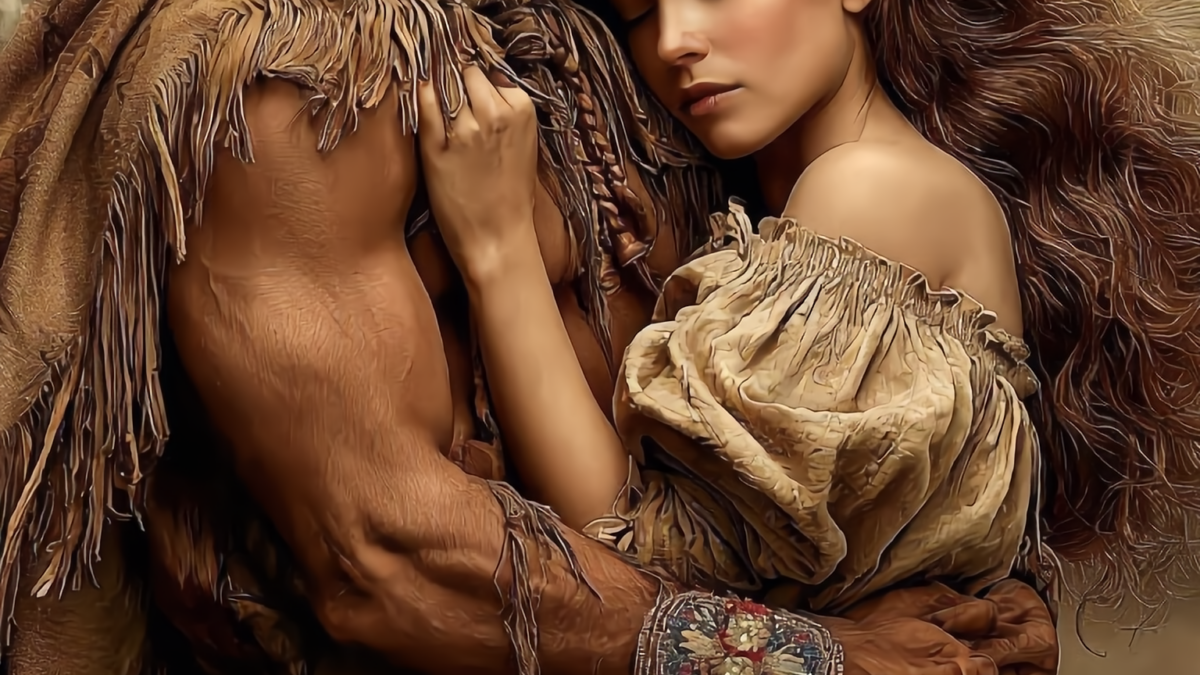
PART 1: The Bride of Peace
The year was 1877, and the sunbaked earth of the Texas plains breathed out a fine red dust that settled on everything.
It coated the rough pine stockade of Fort Redemption. It filmed the water in the horse troughs. It found its way into the lungs of the people who lived there, and, some said, into their souls.
Fort Redemption sat alone in a vast sea of grassland and red stone mesas, more than a hundred miles from the nearest true town. The railroad had pushed west like a raw iron scar across the land, but it had stopped forty miles shy of the fort. For now, the outpost was an island, tied to the world only by horseback and a single humming telegraph wire.
And the air there was thick with more than dust. It was thick with tension.
The long, bloody wars with the tribes were said to be cooling. Washington wanted treaties now, reservations, a final settlement. But greed was stronger than any treaty. Greed for land. Greed for the gold rumored to lie in the hills. Greed for the clear, straight path the railroad barons wanted across Comanche country.
Into this place had come Elena Whitfield.
She was twenty-one, the daughter of a poor, stern Boston pastor, and she had come west not for gold or land but to teach reading and arithmetic in a one-room schoolhouse that smelled of fresh pine and chalk dust. By the standards of the fort, she was a lady of the highest quality.
In the cruel whispers of the soldiers’ saloon, she was something else. They called her the bride who never was.
Elena had been promised to Lieutenant Charles Avery, a young officer of good family she’d known back home. But his letters had grown colder with every mile she traveled west, and in the last one, he’d postponed the wedding indefinitely. The unrest on the frontier makes it imprudent to take a wife, he’d written. So she remained bound to a man who wasn’t there, neither wife nor free, trapped in a promise that felt more like a cage with every passing month.
She held fast to her faith and the strict lessons her father had drilled into her. But the West frightened her: the casual cruelty, the gunfights over cards, the sheer crushing size of the sky. And deep down, in a part of herself she barely dared acknowledge, it also called to her. A wild, unformed longing for a freedom she had never been allowed to want.
Then, one blistering afternoon, he arrived.
His name was Greywolf. He came riding at the head of a small Comanche delegation sent to prepare for treaty talks, his hands unbound, but his freedom plainly a matter of the commander’s permission. He was tall in the saddle, lean and powerful beneath worn buckskins, his long black hair braided with strips of fur. A pale scar ran from his left temple to his jaw.
But it was his eyes that held Elena where she stood. Dark, watchful, and cold. And beneath the cold, she saw something that startled her: a deep, hollowed-out exhaustion. Not peace. Grief.
Everyone at the fort knew his story. Three summers before, bluecoated soldiers had raided his sleeping village at dawn. His wife, Morning Dove, had been killed. So had his son, Little Hawk, five years old. Since then, Greywolf had lived like a ghost. He fought when he had to. But the fire in him had burned down to cold embers. He was a warrior tired of killing, tired of hate, tired of a war that had already taken everything.
Watching the delegation ride in, his boots polished to mirrors even in the dust, was Colonel Nathan Bowmont.
Bowmont was in his late forties, handsome, his graying hair perfectly combed, his eastern accent smooth as cream. He was unfailingly gracious to Elena, bowing and praising her “civilizing influence” on the fort’s children as if they stood in a Boston drawing room.
But beneath the polish, Nathan Bowmont was cold iron and ambition. He wanted a general’s star, and the fastest road to that star ran straight through a war. A peace treaty would end the war, shrink the army’s role, and bury his career on the frontier. Bowmont needed this treaty to fail.
And if Bowmont was ambition’s polished face, Sam Kincaid was its filthy hand.
A former Confederate officer turned bounty hunter and hired gun, Kincaid wore no uniform. He and his band of hard men rode out in secret, burning settlers’ cabins and stealing cattle, always leaving a painted feather or a Comanche arrow behind. Bowmont paid him in gold to manufacture the “unprovoked attacks” he needed for his reports to Washington.
“We need a reason, Sam,” Bowmont said one night in his office, cigar smoke curling toward the ceiling. “Something undeniable. Something filthy. Something the sentimental fools back east can’t ignore.” He turned from the window, where he’d been watching the Comanche campfires. “We need to test the wolf.”
“Test him how?”
Bowmont smiled thinly. “We’ll send a lamb into his den. A pure, Christian, white schoolteacher. And when something terrible happens to her out there, and I promise you, something will, we’ll have our holy war.”
Kincaid’s slow grin spread across his beard. “You got a lamb in mind?”
“The teacher,” said Bowmont. “Miss Whitfield.”
A few days later, crossing the parade ground at dusk, Elena heard a sound that stopped her cold: the dull, sickening thud of a boot striking flesh.
Behind the jail shed, two young soldiers, boys she’d seen at Sunday services, had an old Kiowa man on the ground. He was drunk and helpless, and they were kicking him for sport. Soldiers across the yard looked away.
Elena didn’t think. She walked straight into the alley.
“Stop,” she said. Her voice came out thin as a bird’s cry. Then louder: “Stop it.”
The soldiers turned, startled and ashamed, then angry. “Ma’am, this ain’t your concern.”
“He’s hurt. You cannot do this.”
She knelt in the dust, ruining her clean gray dress, and held her own canteen to the old man’s cracked lips until he’d drunk every drop. When she stood up, shaking, her eyes went past the shuffling soldiers to the stables thirty feet away.
Greywolf was standing there. Watching.
His face was carved stone. But his eyes held a weary, profound contempt for the uniformed men in that alley, and something else as they turned to her. A question. Curiosity. He had seen her, truly seen her, in a place where small acts of kindness simply didn’t exist.
Elena hurried toward the chapel, her face burning. All her life, she’d been taught the Indian was a godless savage. But tonight, she’d watched two Christian soldiers kick a helpless old man for fun. And she’d watched the so-called savage observe it with nothing but mournful dignity.
A terrible question formed in her mind, one she could not unthink.
Who is the savage here?
The next morning, the post chaplain, Reverend Hobbes, escorted her to the colonel’s office.
“We are on the cusp of a historic peace, child,” Bowmont said, his voice heavy with paternal concern. “But trust is fragile. We need a gesture of absolute faith.” He steepled his fingers. “We are asking you to be our dove. A bride of peace. You would live in the Comanche camp for one month, as a guest under the protection of Greywolf himself.”
The room went silent except for a fly buzzing against the windowpane.
“Live with him,” Elena whispered. “In his lodge?”
“Only as a symbol,” Reverend Hobbes said quickly. “It is not a true marriage. It is an act of Christian faith. You would be the sermon itself, carrying the light into darkness.”
“And if I refuse?”
Bowmont’s smile faded for just one second. “Then I fear the peace will fail. And the blood that follows will be on our hands.” He didn’t say your hands. He didn’t need to.
Within hours, the whole fort knew. In the Longhorn Saloon, soldiers laid bets. Ten dollars says he has her before the week’s out. Elena locked herself in her room, her face burning with humiliation. She was no longer a person. She was bait.
At the treaty council three days later, under a white-hot sun, Bowmont announced his “gift” before both peoples. The Comanche warriors stirred with disbelief and anger. Old Chief Ten Bears answered through a translator: “A woman is not a sign of peace. She is a prize of war. If you want to show trust, send your son.”
“A soldier is a symbol of death,” Bowmont replied smoothly. “A woman is a symbol of life.”
Every eye turned to Greywolf. He stepped forward and looked at Elena for a long, unbearable moment. He saw her terror. He also saw that she wasn’t looking at him with hatred or disgust.
He understood the game instantly. If he refused, Bowmont would claim the Comanche had no honor. If he accepted, he’d be forced to guard a living reminder of the people who had murdered his wife and son.
He would accept their bait, he decided. And he would return it to them untouched, and prove whose honor was the lie.
“We accept this symbol,” he said.
The “giving” was held at sunset at the main gate, a grotesque parody of a wedding. Elena wore her best white day dress and a light veil to hide her face from the dust and the leering. Soldiers lined the walls, catcalling.
Greywolf waited on his war pony, holding the reins of a second horse. He didn’t dismount. He didn’t offer his hand. He simply nodded at the saddle, expecting her to mount it herself.
She gathered her skirts and every scrap of her dignity, and she did.
As he turned to lead her through the gate, he spoke so low that only she could hear.
“I will not do what you do not want,” he said. “But now, I must protect you from your own people.”
Before she could understand, three drunken soldiers stumbled forward to block the gate. One grabbed Greywolf’s bridle. A burly corporal reached up, seized Elena’s veil, and yanked it so hard it ripped from her bonnet.
“Let’s see the pretty bride!”
Elena cried out.
It happened faster than a blink. Greywolf was off his horse. One brutal blow dropped the first soldier unconscious. Two fast strikes folded the second. Then he caught the corporal’s wrist and twisted. There was a wet, sickening snap, and the man screamed and fell to his knees.
The entire fort went silent.
Greywolf hadn’t drawn his knife or his gun. He bent, retrieved the torn scrap of Elena’s veil from the dust, and remounted in one fluid motion. He looked at her, and his eyes held no triumph. Only that same deep, weary exhaustion. He nodded toward the open gate.
And Elena Whitfield rode out of Fort Redemption beside the man she’d been raised to fear.
They rode two hours with a nervous cavalry escort under Lieutenant Harris. Then the sky turned a sickly yellow-gray, and a dust storm hit them like a wall.
Elena’s horse reared and threw her. She landed hard, blind, choking, certain she would be trampled. Then a hand closed on her arm like iron. Greywolf hauled her up, tied the remains of her veil over her mouth, and pushed her against his horse’s flank, shielding her body with his own while the sand screamed past. She pressed her face against his buckskin shirt. It smelled of smoke and wind. His heartbeat beneath her cheek was steady as a drum.
That night by a small fire, he squatted across from her and finally spoke.
“I had a son. Five years old. He did not understand your lines on paper either.” His voice was flat. “The soldiers came while we slept. Now he is gone. My wife is gone.”
“I’m so sorry,” she whispered. Then, quietly, she told him about Charles. The cold letters. The promise that felt like a cell.
Greywolf studied her for a long time.
“We are both,” he said slowly, “in prisons we did not build.”
A mile away on a dark ridge, Sam Kincaid lowered his spyglass and grinned at the lonely fire burning halfway between the two camps.
An hour later, the night exploded.
Rifle volleys crashed out of the darkness. Horses screamed. Men shrieked in the cavalry camp. A high, ululating war cry rose from every direction. “Indians! We’re under attack!”
Elena scrambled toward the opening of her tent, her heart slamming against her ribs, just as the flap was torn open from outside.
A man filled the entrance. His face was smeared with crude war paint. A long knife gleamed in his fist.
But in the light of the flames, his eyes were pale blue. And when he spoke, it was in the slow drawl of a Georgia farm boy.
“Evenin’, Miss Whitfield,” he said, reaching for her. “The colonel sends his regards.”
PART 2: The Woman Who Speaks
His hand never reached her.
A shadow slammed into the painted man from the side and drove him to the ground. There was a short, savage struggle in the dirt, then stillness. Greywolf rose, breathing hard, and dragged Elena out of the tent.
“It is a lie,” he hissed. “The cries are wrong. They fight like white men.”
He shoved her into a shallow ditch and covered her body with his own as bullets ripped the air above them. “Stay down. Do not move.” Then he was gone, running not toward his own warriors but straight into the fight.
Elena dared to raise her head. In the chaos of moonlight and muzzle flashes, she saw a young soldier, Corporal Elias Cole, a boy from her Sunday reading class, struggling with a jammed rifle as a painted attacker lunged at him with a knife. Greywolf hit the attacker like a battering ram, slammed him against a wagon wheel, and pressed the boy’s rifle back into his hands.
“They are not Comanche!” he roared over the gunfire. “Fight them!”
When three of the attackers broke away and ran for her empty tent, the abduction team, Greywolf met them in the open with nothing but a knife. Elena saw a blur of motion. Then all three were on the ground, and the rest of the raiders fled into the dark.
The fight had lasted less than five minutes.
Afterward, Greywolf knelt beside one of the dead and wiped the paint from his face with his sleeve. Beneath it lay a pale, bearded white man. The old cavalry sergeant crouched beside him and lifted the dead man’s foot. Under the moccasins, he was wearing standard-issue army boots. Beside him lay a brand-new Spencer repeating rifle.
Lieutenant Harris went gray. “My God.”
Greywolf stood and stared north, toward Fort Redemption, his face cold with understanding.
And Elena understood too. The men who had tried to take her weren’t Comanche. They were her own people. The lie wasn’t out here in the wilderness.
The lie was back at the fort.
At the fork of the Red River, Harris and his shaken troopers turned back to report. Elena chose to ride on.
The winter camp lay hidden in a valley of red cliffs, and it stole her breath. Not the filthy cluster of tents from Boston newspapers, but hundreds of painted tipis in a great circle, thousands of horses grazing, children laughing, women working hides, the air sweet with sage and woodsmoke.
It was a home. A living, breathing home.
Their arrival stopped everything. Greywolf’s aunt, Stone Woman, a fierce, wrinkled elder with eyes as sharp as his, looked Elena over like a horse being judged. A young, arrogant warrior named Black Coyote strode forward with a new repeating rifle and spat in the dust at Elena’s feet.
“He called you a white snake,” Greywolf said quietly. “He says I have brought poison into our home.”
Inside his lodge, a small fire burned in the center. A thick bed of buffalo robes lay on one side. A smaller pallet of furs lay on the other.
“Your colonel wanted a marriage,” Greywolf said. “If you sleep in another lodge, my people will say I reject the peace, or that you are a woman of no honor. So you sleep there.” He pointed to the pallet, then to his own robes. “That is your place. This is mine.” His voice hardened. “I will not cross the fire. I will not touch you. This is not a marriage of the body. It is duty. I must protect you from my people, from your people, and my honor from your colonel’s lies.”
Elena sank onto the pallet, dizzy with relief. Charles had always spoken of her as a possession to collect someday. The soldiers saw her as meat.
The man she’d been sent to test saw her as a human being.
The days that followed were the strangest of her life. Stone Woman woke her at dawn, laughed at her high-buttoned boots, and tossed her a pair of beaded moccasins. Elena ground corn until her soft Boston hands blistered. She ruined a deer hide and got scolded in a language that needed no translation. The children giggled at her clumsiness, then slowly began following her around, and she taught them a hymn her mother used to sing.
In the evenings, she listened to Stone Woman’s stories of the Creator, of Coyote the trickster, and understood she was witnessing an entire ancient world that her own people were trying to erase.
Greywolf kept away. But he watched. And one night, a violent thunderstorm cracked the sky open. Elena had been terrified of lightning since childhood. She sat shaking on her pallet, biting back cries.
He crossed the fire.
He draped his own heavy buffalo robe around her shoulders and laid one hand on her back, over the fur. Not an embrace. A steadying weight.
“It is only the sky,” he said. “It will pass.”
He sat beside her until the thunder faded.
Two days later, a delegation rode in: Lieutenant Harris, several officers, and a government agent from Santa Fe in a black suit, a man named Thorne. They brought news that “Comanche” raiders had murdered three prospectors at Miller Creek. The treaty was declared broken. Colonel Bowmont, deeply concerned, demanded Miss Whitfield’s immediate return.
It was her escape. Her way back to safety.
Elena stepped into the council circle, shaking from head to foot.
“That is a lie.”
Gasps rose from soldiers and warriors alike.
“We were attacked on the trail by white men dressed in paint,” she said, her voice gaining strength. “They wore United States Army boots. I saw them. The sergeant saw them. You are lying about the silver mine because you lied about the ambush.”
The sergeant stared at the ground. Then, miserably: “Sir… the lady’s not wrong.”
Agent Thorne’s eyes narrowed. The delegation rode away without her.
Elena turned and found Greywolf standing directly behind her. The cold mask was gone. In its place blazed respect, and a fierce, possessive pride that took her breath away.
He had been sent a lamb to judge. He had been given a lion.
The cost came quickly. A letter from Charles Avery arrived, cold as steel. He did not ask whether she was safe. He wrote of his embarrassment, of gossip in the officers’ mess, of her reputation as “the bedrock of her value.” If her virtue appeared compromised, their engagement would be void.
Days later, a drunken trader named Silas let slip, not knowing Elena could hear behind the drying hides, that Kincaid’s gold didn’t come from Bowmont at all. It came from railroad men back east who wanted the Comanche wiped out and the land cleared. Bowmont was only the trigger. The money came from very far away.
That night, Elena sat hollow-eyed in the lodge. “I was sent to test you,” she whispered. “But I’m only an excuse. A game piece. I bring the soldiers. I divide your people. I’m nothing.”
Greywolf crossed the fire and knelt before her. He took her blistered hand and pressed it flat against his chest. She felt his heart beating, steady and strong.
“They sent you to test me,” he said. “But you are wrong. It is I who am tested by you. You test my anger. You test the cold, dead place inside me.” His voice went raw. “And I am not the same.”
Then a scout galloped in. Bowmont was moving soldiers and cannons to blockade the north pass, forcing the war before Washington could stop him.
“We have the truth,” Elena said. “The boots. The sergeant. Silas’s words. We ride to the fort and tell Thorne.”
“You ride into the wolf’s mouth,” Ten Bears warned. But he let them go.
Their last stop was Last Chance Crossing, a filthy railroad way station. The men on the boardwalk saw a white woman in a Comanche buckskin dress and laughed. Looks like he tamed her good. Greywolf paid an outrageous price for a tiny canvas room and stood guard at the door.
Inside, Elena broke. She wept for the first time in weeks, ugly and ragged. When Greywolf came in, she poured it all out.
“When they told me I was to be your bride, I thought you were a beast. I thought I’d been sent to tame you.” She laughed brokenly. “I was a puppet. Now I’m a traitor to everyone. And tomorrow they’ll hang you as a savage and me as a traitor, and I’m so afraid of losing… of failing…”
He pulled her to her feet and into his arms. Not crushing. Simply holding, one hand on her back, the other cradling her head against his chest while drunken laughter roared outside.
“I swore when I lost my family that my heart was dead,” he whispered into her hair. “Then you came. Whatever happens tomorrow, you will not be a sacrifice again. Not for them. Not for me.” He drew back, his eyes blazing. “To me, you are already mine. My honor. My woman. You are mine until the day you look at me and say you are not.”
It was not ownership. It was a vow that placed all the power in her hands.
Elena rose on her toes and kissed him.
For one heartbeat, he went still as stone. Then the stone broke, and he kissed her back with the starved, pent-up longing of a man who’d believed his life was over. And then, just as suddenly, he stopped. He rested his forehead against hers, breathing hard, and did not cross the line.
That restraint undid her more completely than the kiss.
They spent the night side by side on the narrow cot beneath one thin blanket. He told her about Little Hawk chasing grasshoppers and Morning Dove teaching him to laugh. She told him about her mother pressing flowers in books, and her dream of a school that didn’t feel like a punishment.
It was the true wedding night of their hearts.
At Fort Redemption, Bowmont tried one final trick in front of Agent Thorne. He produced Charles Avery’s letter and read it aloud.
“Even her own fiancé doubts her stability. She’s hysterical. Compromised. Bewitched by her captor. Whose testimony do you believe, sir? A decorated officer’s? Or hers?”
The officers nodded. Elena felt the floor give way. Then something in her broke, not her spirit, but her chains.
“You’re right, Colonel. I’m not the woman who left this fort. That woman was a puppet.” She turned to Thorne. “My people include a man who paints his face to murder miners for gold.” She pointed at Kincaid. “And a colonel who sent a woman he calls child to be bait in a trap, paid with railroad money to keep a war alive.” She faced Bowmont. “You are the worst savage I have ever met.”
“Arrest her!” Bowmont roared, drawing his pistol. “Arrest them all!”
Greywolf stepped in front of her. His two warriors raised their rifles. Every soldier drew. Ten guns faced ten guns.
“Fire!” Bowmont screamed. No one moved.
Then the watchtower shouted. “Colonel! The ridge!”
Lining the north ridge in a long, silent row sat sixty Comanche warriors. At their head, on a black-and-white pinto, sat Black Coyote. He had followed them. A rider with a white flag called down: if one hair on the warrior or the truth-speaking woman was harmed, the fort would become a grave.
Agent Thorne rose. “Colonel Bowmont, you are relieved of command.”
PART 3: The Ridge Between Worlds
Thorne confined Bowmont to his quarters under guard. It was a fatal mistake.
That evening, Corporal Elias Cole burst into the infirmary, white as chalk. “He’s gone, ma’am! Out the back window with Kincaid! They’re riding for the north canyon to kill Ten Bears and the elders, blame it on Black Coyote, and start the war tonight!”
Greywolf was already running for the horses. Elena saddled her own mare.
“Stay. It is not your fight.”
“The hell it isn’t,” she snapped. “I’m not a lady to be protected, Greywolf. I’m your partner.”
He looked at her for one hard second. Then nodded. “Ride.”
Black Coyote’s warriors thundered down from the ridge to join them. No words were needed. This was betrayal aimed at their own people, and old rivalries burned away in an instant.
Bowmont and Kincaid had set an ambush at the Needle’s Eye, a narrow pass between sheer rock walls. But Greywolf knew this land. He led twenty warriors, and Elena, up a hidden goat path in the dark, and they fell on Kincaid’s hired guns from above like ghosts.
When gunfire exploded, Greywolf tackled Kincaid by a pinnacle of rock. They rolled, rifles lost, knives drawn.
“I remember you,” Kincaid spat. “That village. Bowmont paid good for that one. Just a job.”
Greywolf’s roar was not a human sound. It was a soul tearing open. He fought not for a treaty but for his son, and the fight was short. But as Kincaid fell, his pistol fired one last dying shot into Greywolf’s side.
Below, Elena stumbled onto Bowmont, uniform torn, face black with powder and hate.
“It’s over, Colonel!”
“You,” he hissed, raising his pistol at her heart.
A rifle cracked from the opposite ridge. Bowmont screamed as his pistol flew from his shattered hand. Black Coyote lowered his smoking rifle. He hadn’t killed him. He’d taken his fangs.
Lieutenant Harris galloped in with a dozen troopers, too late for the battle but not for judgment. He kicked the colonel’s pistol away. “Nathan Bowmont, you are under arrest for treason and murder.”
Elena was already scrambling up the rocks. She found Greywolf slumped at the base of the pinnacle, his hand pressed to his side, the stone beneath him black with blood.
“No,” she sobbed, pulling his head into her lap. “No.”
His eyes opened. A faint smile. “The test,” he whispered. “Did I pass?”
“You swore I was yours,” she wept fiercely. “Now I swear it too. You are my husband. My heart. You don’t have permission to leave me.”
His bloody fingers brushed her cheek. Then his eyes closed.
He was not dead.
For six days and nights, he burned with fever in Stone Woman’s smoke-filled lodge while she packed the wound with yarrow and bitter herbs. Elena never left his side. She bathed his face, held his hand, and talked to him through every hour of darkness, refusing to let the spirits have him.
On the seventh morning, he squeezed her hand. She woke to find his eyes open and clear.
“Elena,” he croaked.
She pressed her lips to his scarred knuckles and wept with gratitude.
The new treaty was signed on the banks of the Red River. A hard, gray major general named Croft had arrived from the east, examined the army boots on the exhumed bodies, heard the testimony, read the railroad payments, and declared that no more people would be used as symbols. The valley and north canyon became permanent Comanche land. The railroad would curve south around it. Comanche scouts under their own command would be paid to guard it, and Black Coyote, of all men, became their fiercest leader.
At the signing, Corporal Cole stood up before both peoples and told them how Greywolf had saved his life in the ambush. “He didn’t fight with them. He fought for us. He’s a better man than some of us.”
Bowmont and the disgraced Reverend Hobbes were sent east in chains to face federal trial. The fort’s cannons were dismantled. Its gates were thrown open as a trading depot.
They married twice, because they were two people from two worlds. Once beneath the open sky, where Greywolf drew a painted buffalo robe over both their shoulders while sixty warriors raised their rifles in salute. And once in the little pine chapel, before Harris, Cole, and Stone Woman in the back pew. When the young chaplain said, “You may kiss the bride,” Greywolf simply took her hand. It was enough.
Stone Woman gave Elena a new name, Heart of the Wolf. She reopened the schoolhouse, and on its benches the freckled children of soldiers sat beside the dark-haired children of the Comanche, learning their letters together. In the afternoons, Elena learned the people’s language from Stone Woman. She had stopped being a missionary. She had become a bridge.
Stone Woman returned her torn wedding veil one day, mended with sinew, bordered in tiny blue beads, a single red-tailed hawk feather tied at its center. Not a symbol of fragile purity anymore. A map of her new, scarred strength.
A month after the weddings, a last letter came from Charles Avery. He had heard the whole story now. He called her a heroine. He’d secured a discharge, he wrote. He was coming to rescue her from her ordeal and bring her back to civilization where she belonged.
Elena read it twice by the fire in the tipi. Across from her, Greywolf mended a bridle. He didn’t ask what it said. He simply waited, trusting her.
She smiled, a small private smile meant only for him. Then she leaned forward and fed the paper into the flames, watching the words rescue and civilization curl into black ash and drift up through the smoke hole into the night.
She was free.
They sent a young woman as a pawn, to test whether a lonely man was a beast. But she was never the one being tested. The civilization of high collars, cold letters, and polished, murderous ambition was tested. And it was found wanting.
And a warrior who believed his heart had turned to stone found his life again, not in killing his enemies, but in defending, and then loving, one of them.
If you had seen them in the years that followed, you wouldn’t have found them riding off into a sunset. That’s a coward’s escape, meant for storybooks. You’d have seen them riding the ridge between two worlds, Greywolf straight-backed in the saddle and Elena behind him, her arms wrapped around his waist. On one side, the new steel rails catching the last red light of day. On the other, the endless open plains and the smoke of the tipis.
Not running from the future. Not hiding from the past.
Riding into it. Together.








